
EEGPrep




EEGPrep is an EEGLAB-compatible, Python-native toolkit for loading, cleaning,
visualizing, scripting, and validating EEG preprocessing workflows. It keeps the
EEGLAB concepts researchers already know, including EEG, ALLEEG,
CURRENTSET, pop_* functions, command history, ICA fields, channel locations,
events, epochs, STUDY workflows, and EEGBrowser-style review, while providing a
standalone Python package with GUI, interactive console, CLI, tests, and Sphinx
documentation.
EEGPrep is built for EEG researchers who want EEGLAB-style workflows, Python reproducibility, and agent-friendly automation without requiring MATLAB or an EEGLAB checkout at runtime.
Documentation: sccn.github.io/eegprep | Issue tracker: github.com/sccn/eegprep/issues
Why EEGPrep?
- Familiar to EEGLAB users. Function names, data structures, menus, history commands, and GUI workflows follow EEGLAB where that helps users move between tools.
- Python-native and standalone. Runtime code lives in the
eegpreppackage and works without calling MATLAB or reading the vendored EEGLAB reference tree. - GUI and console share one workspace. Launch
eegprep-consoleand switch between the Qt GUI and Python commands whileEEG,ALLEEG,CURRENTSET,LASTCOM,ALLCOM,STUDY, andCURRENTSTUDYstay synchronized. - Scriptable from day one. The same
pop_*workflows can be used from the GUI, Python scripts, and the command-line interface. - Designed for reproducible research. CLI commands support structured JSON, manifests, pipeline validation, stable error codes, and bundled agent guidance.
- Validated against EEGLAB. Numerical parity tests and visual parity checks compare EEGPrep behavior with EEGLAB for deterministic workflows.
Install
EEGPrep uses uv for development and CI. For a published release, install the
lean package with:
uv add eegprep
To install all optional extras, including GUI, console, docs, and classifier dependencies, use:
uv add "eegprep[all]"
If you are installing into a non-uv environment, pip install eegprep remains
supported for published releases:
pip install eegprep
For a source checkout:
git clone https://github.com/sccn/eegprep.git
cd eegprep
uv sync --group dev
The complete install can pull in large optional binaries on some platforms, especially for ICLabel/PyTorch support. You can install a lightweight CPU-only PyTorch build manually if that better matches your system.
Quick Start
The repository includes tutorial data in sample_data/, named after EEGLAB's
sample-data convention.
Shared GUI and Python Console
Launch EEGPrep with the main GUI and a synchronized IPython workspace:
uv run eegprep-console --full
Then use the GUI to load sample_data/eeglab_data.set, run preprocessing
actions from the menus, and inspect the same state from the console:
EEG["setname"], EEG["srate"], EEG["nbchan"], EEG["pnts"]
CURRENTSET
LASTCOM
eegh()
You can also run pop_* commands directly:
pop_resample(EEG, 64)
pop_reref(EEG, [])
GUI actions and console commands append to the same history, so workflows can be replayed or moved into scripts.
GUI Only
uv run eegprep-gui --full
Use this when you want the EEGLAB-style menu workflow without an attached console.
Agent-Friendly CLI
The eegprep command is intended for headless pipelines, batch processing, and
AI agents that need machine-readable output.
uv run eegprep inspect sample_data/eeglab_data.set --json
uv run eegprep validate sample_data/eeglab_data.set --json
uv run eegprep capabilities --json
uv run eegprep skills get eegprep-cli
Transform commands use the same EEGPrep processing functions as the Python API and write manifests for reproducibility:
uv run eegprep resample sample_data/eeglab_data.set \
  --freq 64 \
  --output sample_data/eeglab_data_64hz.set \
  --manifest sample_data/eeglab_data_64hz_manifest.json \
  --json
Python API
from pathlib import Path

from eegprep import pop_eegfiltnew, pop_loadset, pop_resample, pop_saveset

input_file = Path("sample_data") / "eeglab_data.set"
output_file = Path("sample_data") / "eeglab_data_quickstart.set"

EEG = pop_loadset(input_file)
EEG, filter_com = pop_eegfiltnew(
    EEG,
    locutoff=1.0,
    hicutoff=40.0,
    plotfreqz=False,
    return_com=True,
)
EEG, resample_com = pop_resample(EEG, 64, return_com=True)
pop_saveset(EEG, output_file)

print(filter_com)
print(resample_com)
return_com=True returns the updated dataset and the replayable command string
that EEGPrep records in GUI and console history.
For EEGLAB Users
| EEGLAB concept | EEGPrep equivalent |
|---|---|
eeglab GUI |
uv run eegprep-gui --full or uv run eegprep-console --full |
EEG, ALLEEG, CURRENTSET |
Shared EEGPrepSession state in the GUI and console |
| MATLAB command history | LASTCOM, ALLCOM, and eegh() in eegprep-console |
pop_* wrappers |
Python eegprep.pop_* functions with return_com=True |
| EEGBrowser / scrolling review | EEGPrep EEGBrowser and pop_eegplot workflows |
| clean_rawdata, ICLabel, FIRFilt, DIPFIT, EEG-BIDS | Bundled EEGPrep plugin ports and menu integrations |
| STUDY workflows | Python STUDY structures, GUI paths, and std_* helpers |
| MATLAB scripts | Python scripts, CLI pipelines, and history-derived commands |
EEGPrep follows EEGLAB's one-based user-facing indices where researchers expect
them, while using zero-based Python indices internally. Continuous data is
channel-major, usually (nbchan, pnts), and epoched data is usually
(nbchan, pnts, trials).
What Is Included
- EEGLAB
.setloading/saving, BIDS import/export, and common EEG file I/O. - BIDS derivative workflows intended to interoperate with EEGPrep, EEGLAB, FieldTrip, Brainstorm, MNE, and other EEG analysis tools.
- Dataset, event, channel-location, epoch, and history workflows.
- Filtering, resampling, rereferencing, cleaning, rejection, interpolation, ICA, component review, ICLabel, DIPFIT, topographies, spectra, time-frequency, and statistics workflows.
- EEGBrowser-style scrolling inspection, marking, and rejection.
- STUDY and group-level workflow support.
- Extension SDK, plugin discovery, extension validation, and agent-facing extension authoring guidance.
- Sphinx documentation, API reference, examples, and a structured CLI.
Documentation
Start with the online documentation:
Repository documentation helpers are kept in docs/. The docs
workflow publishes the Sphinx site to GitHub Pages.
Project Status
EEGPrep is in active pre-release development. It is intended to become a standalone Python counterpart for core EEGLAB preprocessing workflows. Current development emphasizes EEGLAB parity, GUI and console usability, BIDS support, extension support, and reproducible headless workflows.
Use EEGPrep with the same care you would apply to any research preprocessing software: validate pipelines on representative data, inspect intermediate outputs, and record the exact version and command history used for analysis.
Numerical Parity
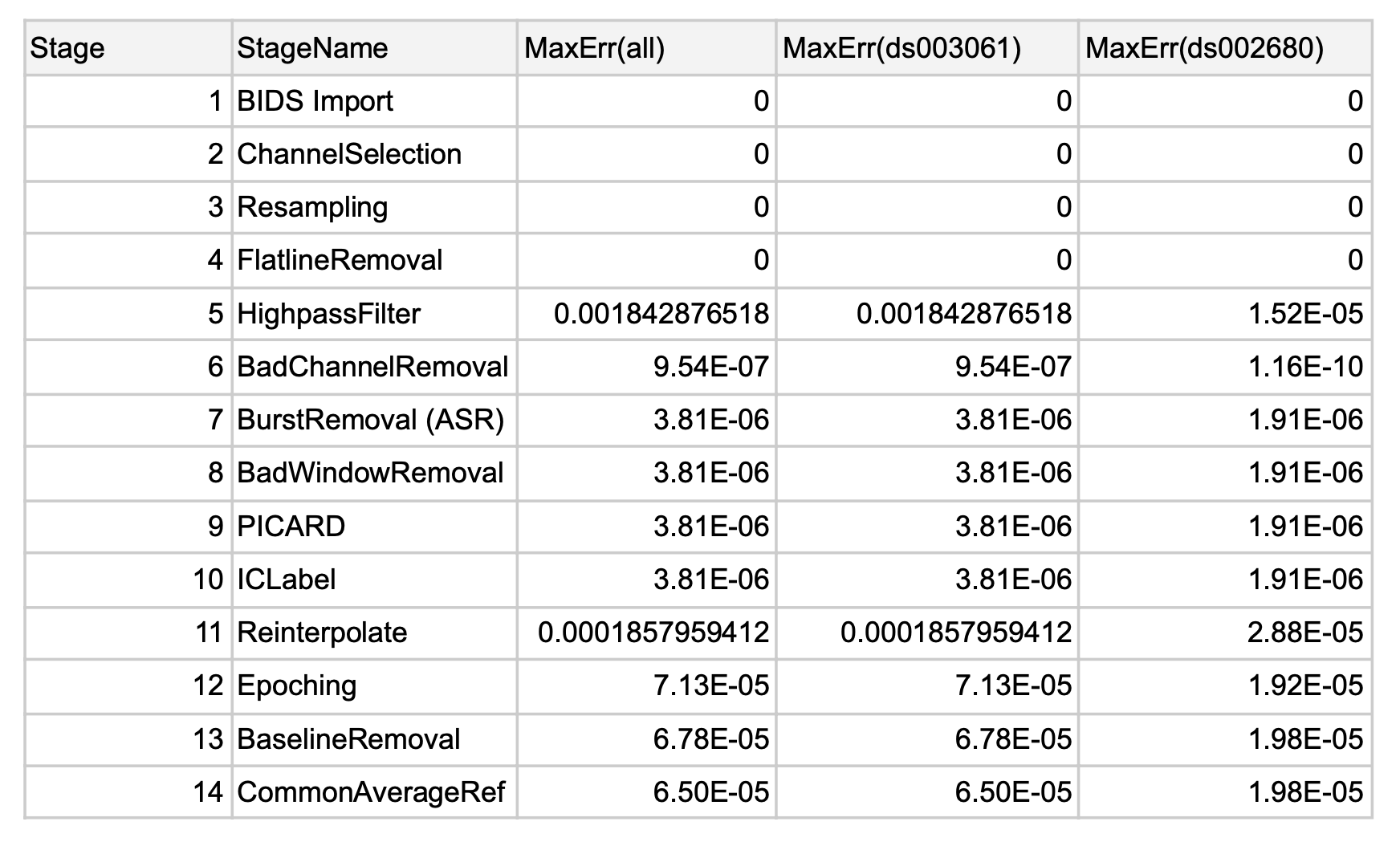
EEGPrep is developed against EEGLAB as a parity oracle. The MATLAB and Python
implementations are tested for close numerical agreement, including default
preprocessing pipeline comparisons that target accuracy down to 1e-5 uV where
the algorithms are deterministic. They have also been compared using the first
two subjects from the BIDS datasets
ds003061 and
ds002680 on NEMAR.
Observed differences were very small, with the largest reported HighpassFilter
difference below 0.002, indicating strong numerical consistency for the tested
workflows.
Development
Run tests from the project root with:
uv run pytest tests
For quick local iteration:
uv run pytest -m "not slow"
The repo uses ruff, ty, and pre-commit.py for linting, formatting, and
type-checking:
./pre-commit.py --changed-from origin/develop
uv run --no-sync ruff check .
uv run --no-sync ruff format --check .
uv run --no-sync ty check
MATLAB parity tests require MATLAB Engine for Python. Install the engine from your MATLAB installation, for example on macOS:
uv pip install /Applications/MATLAB_R2025a.app/extern/engines/python
Check the installation:
import matlab.engine

engine = matlab.engine.start_matlab()
engine.eval("disp('hello world');", nargout=0)
The MATLAB comparison entry point is tests/matlab/main_compare.m.
Cite
If EEGPrep contributes to your research, please cite EEGPrep and the EEGLAB methods it ports. For EEGLAB, cite:
Delorme, A., & Makeig, S. (2004). EEGLAB: an open source toolbox for analysis of single-trial EEG dynamics including independent component analysis. Journal of Neuroscience Methods, 134(1), 9-21.
Core Maintainers
- Arnaud Delorme, UCSD, CA, USA
- Suraj Ranganath, UCSD, CA, USA
- Christian Kothe, Intheon, CA, USA
- Bruno Aristimunha Pinto, Inria, France
Maintainer release notes
Release Process
Releases are published by .github/workflows/release.yml when a v* tag is
pushed. That is the only path to PyPI. Full instructions, including the dry run,
are in docs/source/releasing.rst.
The version lives in src/eegprep/__init__.py (__version__); pyproject.toml
reads it via dynamic = ["version"], so there is nothing to edit there.
# dry run first: everything except publishing
gh workflow run release.yml --ref master -f dry_run=true

# bump __version__, land it on master, then tag to release
git commit -am "release: 0.3.0"
git push origin develop:master
git tag -a v0.3.0 -m "Release version 0.3.0" && git push origin v0.3.0
The workflow lints, type-checks, runs the test suite, builds, verifies the artifacts, publishes to PyPI with Trusted Publishing (no stored token), and creates the GitHub release.
CI does not build Docker images. After the tag is published:
docker login
uv run python scripts/build_docker.py
That builds and pushes arnodelorme/eegprep:<version> and updates the image pin
in tools/hpc/main.pbs; commit the pin.
Verify the published release:
uv pip install eegprep==X.Y.Z
Packaging follows the Python Packaging User Guide: https://packaging.python.org/en/latest/tutorials/packaging-projects/.
Docker notes for SCCN power users
docker build -t eegprep:0.2.9 -f DOCKERFILE .
docker tag eegprep:0.2.9 arnodelorme/eegprep:0.2.9
docker push arnodelorme/eegprep:0.2.9
Check the project on Docker Hub: https://hub.docker.com/.
Mounted folders are available in /usr/src/project.
3 maintainers


Metadata
3 maintainers
Release files for eegprep 0.4.0
For a detailed explanation of source distributions (sdists) and built distributions (wheels), please see the package formats documentation.
Source distribution (sdist)
| File | Size | Uploaded | |
|---|---|---|---|
| eegprep-0.4.0.tar.gz | 16.6 MB | Details |
Built distribution (wheel)
| File | Interpreter | ABI | Platform | Reset |
|---|---|---|---|---|
| eegprep-0.4.0-py3-none-any.whl | Python 3 | none | any | Details |
Total release size: 32.9 MB
Release files / eegprep-0.4.0.tar.gz
| Download URL | eegprep-0.4.0.tar.gz |
|---|---|
| Size | 16.6 MB |
| Tags | Source |
|
SHA-256 checksum How to use checksums |
68842547bb6d2225e9a436f85e05ac1d320e2108b93b6bbdf581f82f4cd4d2d0
|
|
BLAKE2b-256 checksum How to use checksums |
89be1d7931e4f80dae3c14c5529c0307acfe04af9e7260ea08a633a2b076e708
|
| Upload date | |
|
Uploaded using Trusted Publishing? What is trusted publishing? |
Yes |
| Uploaded via |
twine/7.0.0 CPython/3.13.14
|
Provenance
Provenance describes where a file came from. On PyPI, provenance is shared via attestations, which provide a verifiable record of the build or publishing details. View details, limitations and caveats.


PyPI Publish Attestation
PyPI verified that this artifact, at this checksum, originated from the publisher listed below.
Signed by GitHub Actions, verified by PyPI on Sep 23, 2026.
Transparency logRelease files / eegprep-0.4.0-py3-none-any.whl
| Download URL | eegprep-0.4.0-py3-none-any.whl |
|---|---|
| Size | 16.3 MB |
| Tags | Python 3 |
|
SHA-256 checksum How to use checksums |
232dffedad3c0d43bd7473c250d8a3ab776da7c88ac54ca2d3d8f2a2782ee2eb
|
|
BLAKE2b-256 checksum How to use checksums |
c6194703c585f82294fb0d69201d67f480a943bed87c51920f6e484901845268
|
| Upload date | |
|
Uploaded using Trusted Publishing? What is trusted publishing? |
Yes |
| Uploaded via |
twine/7.0.0 CPython/3.13.14
|
Provenance
Provenance describes where a file came from. On PyPI, provenance is shared via attestations, which provide a verifiable record of the build or publishing details. View details, limitations and caveats.
PyPI Publish Attestation
PyPI verified that this artifact, at this checksum, originated from the publisher listed below.
Signed by GitHub Actions, verified by PyPI on Sep 23, 2026.
Transparency log













