
entityxtract


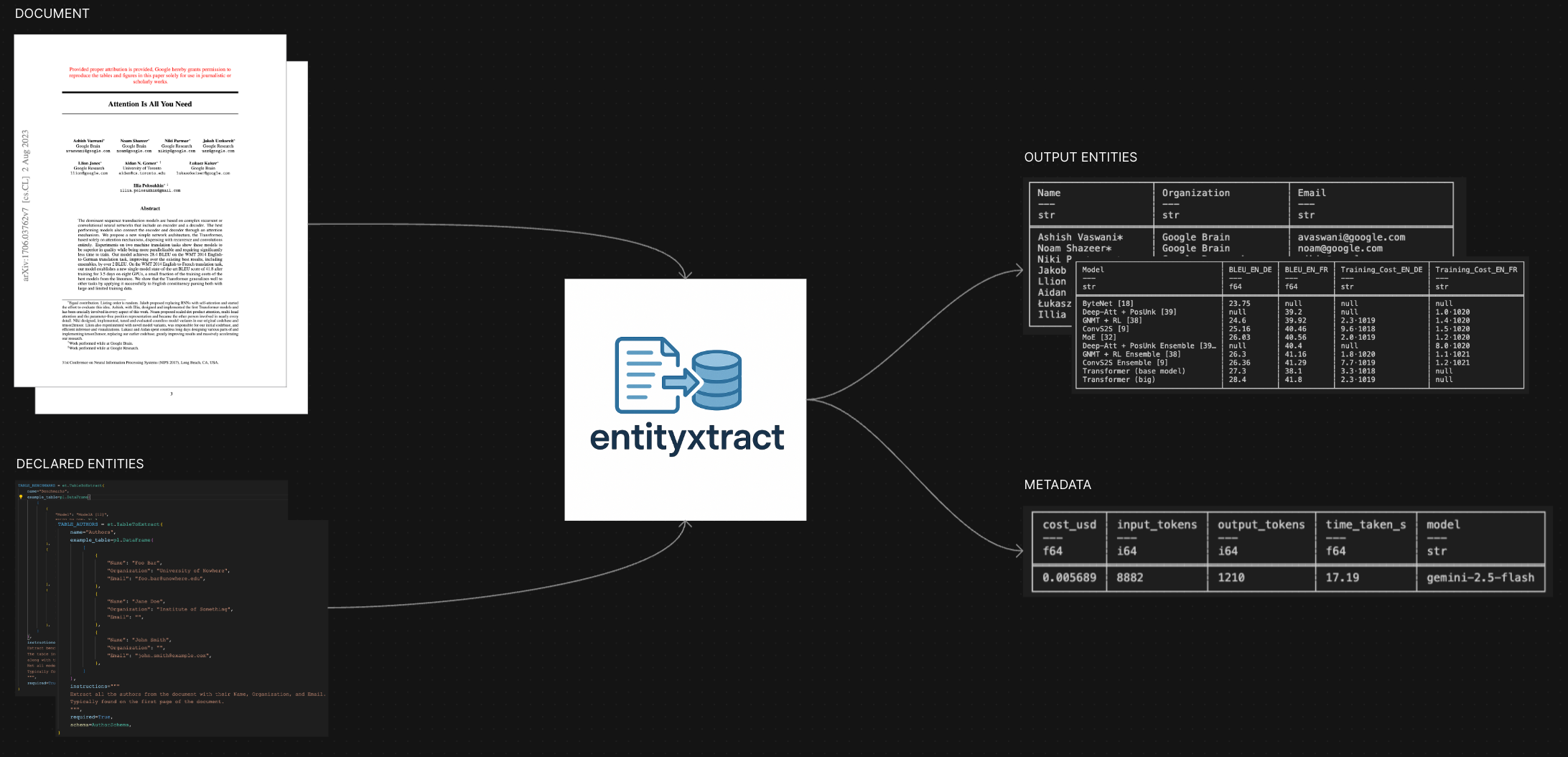
Entity-first, schema-driven extraction of structured data from unstructured documents (PDF, DOCX, TXT, images). Define custom entities with schemas, few-shot examples, and instructions, then extract reliably using any local or SOTA LLM.
Built as an open-source alternative to Google Cloud Document AI, Azure AI Document Intelligence, and Adobe PDF Extract — but provider-agnostic and designed to work with any LLM.
Features
- 🎯 Entity-first extraction — Smart structured data extraction with pre-defined / auto-identified entities.
- 📄 Multiple document formats — Support for PDF, TXT, MD, and images.
- 🔀 Smart input modes — Extract information using text, OCR, or hybrid approaches.
- 🌐 Provider-agnostic design — Works with any LLM via OpenAI-compatible APIs.
- 🔄 Robust execution — Built-in retries, parallel extraction, strictly structured and typed output.
- 📊 Observability — Structured logs, token usage tracking, and optional cost tracking.
- 📦 PyPI Package — Easily install and use entityxtract in your projects.
Coming Soon
- 🌐 FastAPI REST API for remote extraction services.
- 🖥️ Web UI for visual entity/schema management and job monitoring.
- 🔍 Auto-detect mode to automatically identify extractable entities in documents.
- 💰 Cost Optimization using PDF annotation caching, and smart input data pruning.
- 👁️ Deepseek OCR integration for enhanced document processing.
- 🔌 MCP server for agentic applications.
Installation
To use entityxtract, you'll need Python 3.12+ and uv (recommended):
# Install uv if you haven't already
curl -LsSf https://astral.sh/uv/install.sh | sh

# Clone the repository
git clone https://github.com/Prathamesh-Ghatole/entityxtract.git
cd entityxtract

# Install dependencies
uv sync
Getting Started
Extract pre-defined entities:
from pathlib import Path
import polars as pl
from entityxtract.extractor_types import (
    Document, TableToExtract, ObjectsToExtract,
    ExtractionConfig, FileInputMode
)
from entityxtract.extractor import extract_objects

# 1. Load your document
doc = Document(Path("document.pdf"))

# 2. Define what to extract
table = TableToExtract(
    name="Events",
    example_table=pl.DataFrame([
        {"Time": "02:05", "Type": "Operation", "Description": "Example event"},
        {"Time": "03:25", "Type": "Transit", "Description": "Another event"}
    ]),
    instructions="Extract the events table with Time, Type, and Description columns.",
    required=True
)

# 3. Configure extraction
config = ExtractionConfig(
    model_name="google/gemini-2.5-flash",  # Recommended
    temperature=0.0,
    file_input_modes=[FileInputMode.FILE]
)

# 4. Extract!
results = extract_objects(doc, ObjectsToExtract(objects=[table], config=config))

# Use your results
for name, result in results.results.items():
    if result.success:
        df = pl.DataFrame(result.extracted_data)
        print(df)
    else:
        print(f"Failed: {result.message}")
Configuration
Copy the sample environment file .env.sample to .env, or set the following environment variables directly:
# For all OpenAI-compatible endpoints [OpenAI, OpenRouter, Ollama, lm-studio, etc.]
export OPENAI_API_KEY="your-api-key"
export OPENAI_API_BASE="https://openrouter.ai/api/v1"

# Default model
export OPENAI_DEFAULT_MODEL="google/gemini-2.5-flash"
Usage Examples
Complete Example with Multiple Entities
from pathlib import Path
import polars as pl

from entityxtract.extractor_types import (
    Document, ExtractionConfig, FileInputMode,
    TableToExtract, StringToExtract, ObjectsToExtract
)
from entityxtract.extractor import extract_objects

# Load document
doc = Document(Path("reports/quarterly_summary.pdf"))

# Define entities to extract
table = TableToExtract(
    name="Financial Summary",
    example_table=pl.DataFrame([
        {"Quarter": "Q1 2024", "Revenue": "$1.2M", "Expenses": "$800K", "Profit": "$400K"},
        {"Quarter": "Q2 2024", "Revenue": "$1.5M", "Expenses": "$900K", "Profit": "$600K"}
    ]),
    instructions="Extract the quarterly financial summary table with Quarter, Revenue, Expenses, and Profit columns.",
    required=True
)

report_id = StringToExtract(
    name="Report ID",
    example_string="RPT-2024-Q2-001",
    instructions="Extract the report identifier from the document header.",
    required=False
)

# Configure extraction with cost tracking
config = ExtractionConfig(
    model_name="google/gemini-2.5-flash",
    temperature=0.0,
    file_input_modes=[FileInputMode.FILE],
    parallel_requests=4,
    calculate_costs=True
)

# Run extraction
objects = ObjectsToExtract(objects=[table, report_id], config=config)
results = extract_objects(doc, objects)

# Process results
for name, res in results.results.items():
    if res.success:
        print(f"✓ [{name}] extracted successfully")
        print(f"  Tokens: {res.input_tokens} in / {res.output_tokens} out")
        print(f"  Cost: ${res.cost:.4f}")

        # Export table to CSV
        if isinstance(res.extracted_data, list):
            df = pl.DataFrame(res.extracted_data)
            df.write_csv(f"{name}.csv")
            print(f"  Saved to {name}.csv")
    else:
        print(f"✗ [{name}] failed: {res.message}")

print(f"\nTotals: {results.total_input_tokens} tokens in, {results.total_output_tokens} tokens out")
print(f"Total cost: ${results.total_cost:.4f}")
Different Input Modes
# Pass document as file attachment
config = ExtractionConfig(
    model_name="google/gemini-2.5-flash",
    file_input_modes=[FileInputMode.FILE]
)

# Pass document as text content
config = ExtractionConfig(
    model_name="google/gemini-2.5-flash",
    file_input_modes=[FileInputMode.TEXT]
)

# Pass document as images (useful for scanned documents)
config = ExtractionConfig(
    model_name="google/gemini-2.5-flash",
    file_input_modes=[FileInputMode.IMAGE]
)

# Combine multiple input modes
config = ExtractionConfig(
    model_name="google/gemini-2.5-flash",
    file_input_modes=[FileInputMode.FILE, FileInputMode.TEXT]
)
See tests/test.py for more complete examples.
Roadmap
Interfaces
- 🌐 FastAPI REST API for remote extraction services
- 🖥️ Web UI for entity management, job runs, and results review
- 🤖 Auto-detect mode: automatically identify entities in documents
Developer Experience
- 📦 Publish to PyPI for easy
pip install entityxtract - ⚡ ENV-first configuration (deprecate YAML)
- 💾 Document annotation caching to reduce token usage
- 🔧 JSON import/export for entity schemas and results
- 📝 Enhanced CLI with
entityxtractcommand
Providers & Models
- 🏠 Local inference via Ollama
- 🔌 Native adapters for OpenAI, Gemini, Claude, and more
- 🌍 Support for additional LLM providers
Quality & Testing
- ✅ Expanded test coverage
- 📊 Benchmark suite for accuracy and performance
- 📚 Comprehensive documentation site
Comparisons
entityxtract positions itself as a flexible, open-source alternative to both commercial services and closed-source solutions:
Key Differentiators:
- Provider Agnostic: Works with any LLM, not locked to a single provider
- Open Source: Full transparency, customizable, and community-driven
- Schema + Examples: Strong emphasis on structured entity definitions with few-shot learning
- Complete Stack: Python SDK today, REST API and Web UI coming soon
Contributing
We welcome contributions! entityxtract uses modern Python tooling:
# Use uv for environment management
uv sync

# Run tests
uv run pytest tests/

# Code formatting with Ruff
uv run ruff check .
uv run ruff format .
Guidelines:
- Follow strict JSON output conventions
- Include tests for new features
- Update documentation as needed
- Use structured logging patterns
Open an issue or PR with a clear description and we'll be happy to review!
Get Help and Support
- 💬 GitHub Discussions - Ask questions and share ideas
- 🐛 Issues - Report bugs or request features
- 📧 Contact: prathamesh.s.ghatole@gmail.com
License
entityxtract is released under the MIT License. Free for commercial and personal use.
Built with ❤️ by Prathamesh Ghatole
entityxtract was built out of the need for intelligent entity extraction from documents using AI with minimal effort. Define what you need, and let AI handle the rest.
1 maintainer

Metadata
1 maintainer
Release files for entityxtract 0.5.4
For a detailed explanation of source distributions (sdists) and built distributions (wheels), please see the package formats documentation.
Source distribution (sdist)
| File | Size | Uploaded | |
|---|---|---|---|
| entityxtract-0.5.4.tar.gz | 2.7 MB | Details |
Built distribution (wheel)
| File | Interpreter | ABI | Platform | Reset |
|---|---|---|---|---|
| entityxtract-0.5.4-py3-none-any.whl | Python 3 | none | any | Details |
Total release size: 2.7 MB
Release files / entityxtract-0.5.4.tar.gz
| Download URL | entityxtract-0.5.4.tar.gz |
|---|---|
| Size | 2.7 MB |
| Tags | Source |
|
SHA-256 checksum How to use checksums |
395dec4246f07d4eb8b4f307455a0d7278eee1b1b46dfe4506571941c50595a2
|
|
BLAKE2b-256 checksum How to use checksums |
fea64c0daf51961bad856b2459ef3bc4a95f55217054df6380294fcbe934ef4b
|
| Upload date | |
|
Uploaded using Trusted Publishing? What is trusted publishing? |
Yes |
| Uploaded via |
twine/6.1.0 CPython/3.13.12
|
Provenance
Provenance describes where a file came from. On PyPI, provenance is shared via attestations, which provide a verifiable record of the build or publishing details. View details, limitations and caveats.


PyPI Publish Attestation
PyPI verified that this artifact, at this checksum, originated from the publisher listed below.
Signed by GitHub Actions, verified by PyPI on Apr 7, 2026.
Transparency logRelease files / entityxtract-0.5.4-py3-none-any.whl
| Download URL | entityxtract-0.5.4-py3-none-any.whl |
|---|---|
| Size | 21.1 kB |
| Tags | Python 3 |
|
SHA-256 checksum How to use checksums |
3fdab908b6e4745ed87b3a52fa7f846465e53dc2abd61db6d58f0d4d2e37e302
|
|
BLAKE2b-256 checksum How to use checksums |
78e5660a689995a19de4aca5b6ee98e54e7badcd7b3cd07fdbcd102e73dce81f
|
| Upload date | |
|
Uploaded using Trusted Publishing? What is trusted publishing? |
Yes |
| Uploaded via |
twine/6.1.0 CPython/3.13.12
|
Provenance
Provenance describes where a file came from. On PyPI, provenance is shared via attestations, which provide a verifiable record of the build or publishing details. View details, limitations and caveats.
PyPI Publish Attestation
PyPI verified that this artifact, at this checksum, originated from the publisher listed below.
Signed by GitHub Actions, verified by PyPI on Apr 7, 2026.
Transparency log













