
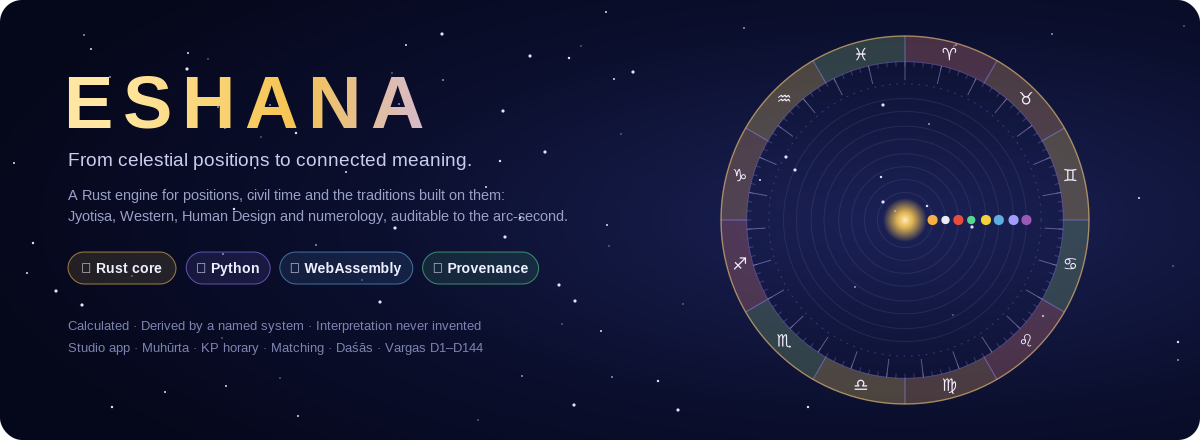
ESHANA
Extensible Spatiotemporal Hypersystem for Astroinformatics, Natural Cycles & Associations
From celestial positions to connected meaning.
A Rust engine for celestial positions, civil time and the traditions built on them (Jyotiṣa, Western astrology, Human Design and numerology), with an offline chart studio, a Python API and a CLI. Every number is computed, every rule is named, and no interpretation is ever invented.







📖 Docs · 🖼️ Gallery · 🪐 Live studio · 📝 Changelog · 🗺️ Roadmap
📚 Contents
- ✨ Why ESHANA?
- 🧭 Three layers, kept apart
- ⚡ Quick start
- 🪐 ESHANA Studio
- 🔭 What it computes
- ⚙️ How it works
- 🧪 One engine, every question
- 🛡️ Guarantees
- 📏 Accuracy, measured
- 🧩 Ways to use it
- 🛠️ Development
- 🗺️ Repository map
- 🤝 Status and honesty
✨ Why ESHANA?
Astrology software usually mixes three very different things on one screen: astronomy you can verify, rules that belong to one school, and readings someone wrote. ESHANA pulls them apart so each can be checked on its own terms.
| 😕 The usual way | 🌟 With ESHANA | |
|---|---|---|
| 🕰️ Birth time | A local time is quietly turned into UTC; a time that the clocks skipped becomes something | IANA zones with historic offsets; a skipped or repeated time is an error with a code, never a guess |
| 📐 Methods | Ayanāṃśa, houses and daśā variants are buried in settings | Every method has an id; an unknown one is refused (ESH-METHOD); the choice travels with the result |
| 🧾 Results | Numbers without a trail | Provenance on every envelope: engine, provider, tz database, rule versions, assumptions and a config_hash |
| 🔮 Meaning | Readings presented as facts | interpretations is always empty; rules are labelled tradition_rule; research scores are labelled experimental |
| 🌍 Surfaces | The web app and the API drift apart | One Engine::execute_json behind the CLI, Python and the studio (compiled to WebAssembly) |
| 🔒 Privacy | Birth data uploaded to a server | Everything runs on your machine; the studio is one offline HTML file |
🧭 Three layers, kept apart
| Layer | Example | Produced by |
|---|---|---|
| 🧮 Calculated | ecliptic longitude, speed, Ascendant, sunrise | verifiable code, tested against JPL DE440s and the Swiss Ephemeris |
| 📜 Derived by a named system | nakshatra and pada, varga sign, daśā period, muhūrta window, Human Design gate, name number | a versioned rule pack with a method id, labelled tradition_rule |
| 🔮 Interpretive | character, meaning, compatibility | never the engine: interpretations is always empty |
ESHANA does not claim that astrology, numerology or Human Design predict anything. It makes their rules computable and auditable.
⚡ Quick start
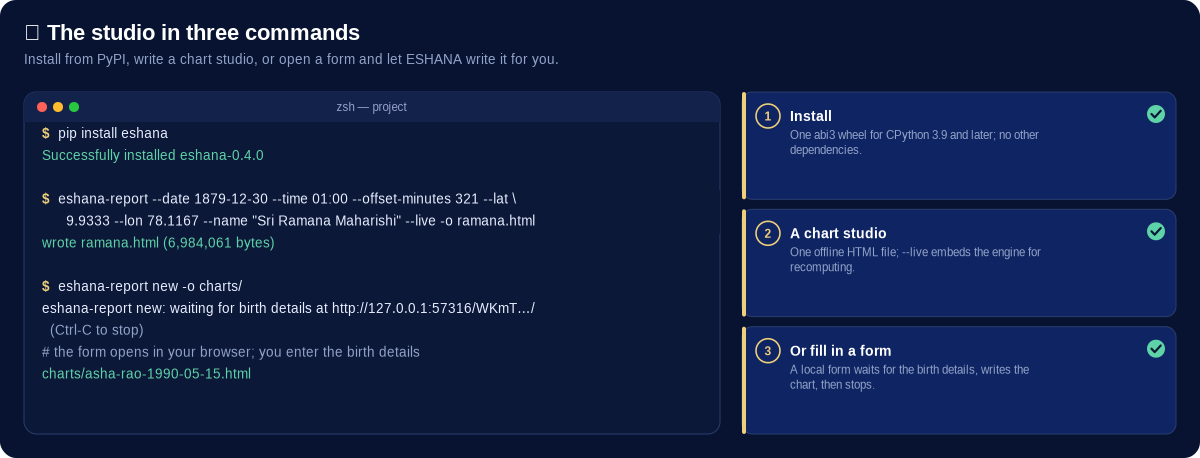
pip install eshana

# 🪐 a full chart studio in one offline HTML file
eshana-report --date 1992-05-28 --time 20:05 --tz Asia/Kolkata --lat 17.385 --lon 78.487 -o chart.html

# 📝 or let a form ask for the details: it opens in your browser, writes the chart, and stops
eshana-report new -o charts/
from eshana import ChartEngine, Context

ctx = Context.from_local_birth(date="1992-05-28", time="20:05:00", timezone="Asia/Kolkata",
                               latitude=17.385, longitude=78.487)
chart = ChartEngine().vedic_chart(ctx, ayanamsha="lahiri", divisions=[1, 9], dasha=True)

chart.position("moon")["sign"]["name"]           # 'Meena'
chart.attribute("vedic.moon.nakshatra")["name"]  # 'Revati'
chart.provenance["assumptions"]                  # everything that was chosen for you
chart.to_html("chart.html")                      # the studio, from Python
🪐 ESHANA Studio
eshana-report writes one self-contained HTML file that works as a multi-page app: no server, no network,
prints cleanly. With --live it carries the engine itself, compiled to WebAssembly, so the compare workspace and the
playground recompute offline with exactly the same rules as Python and the CLI.
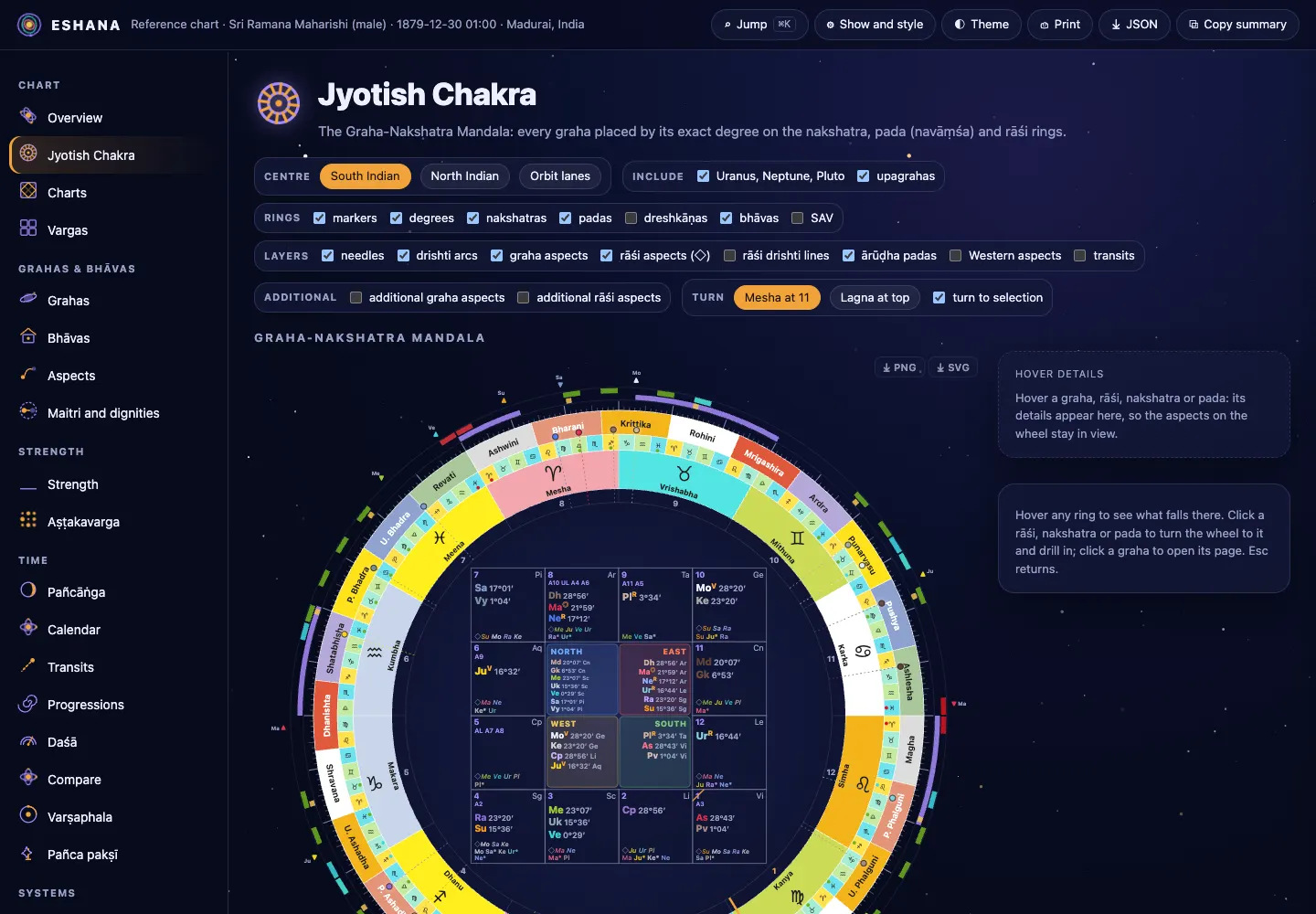 🌀 Jyotish Chakra Every graha by exact degree on the nakshatra, pada and rāśi rings, with the D1 chart and the Nadi directions in the centre. |
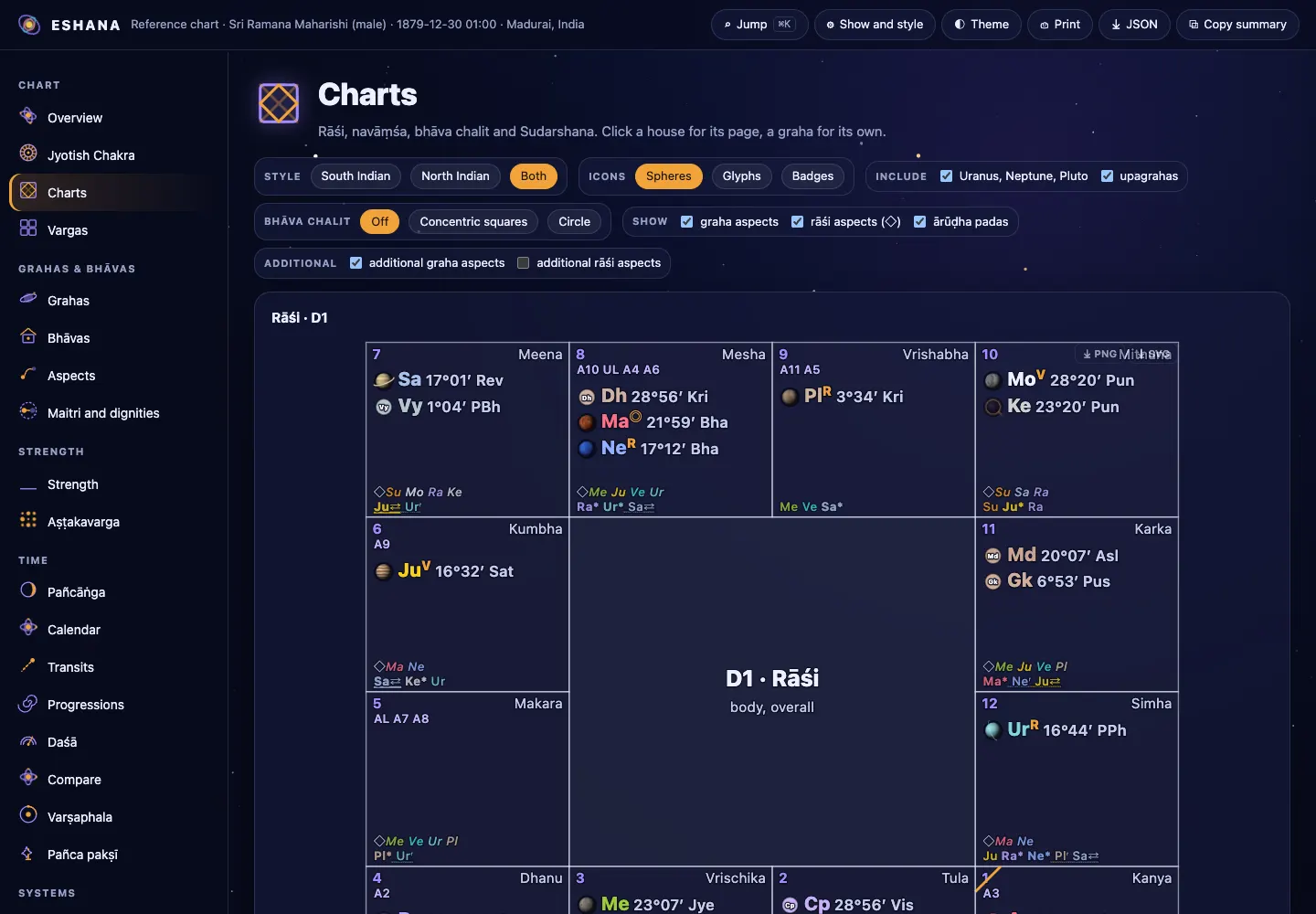 🔲 South and North Indian charts Grahas bold and first; ārūḍha padas and aspect marks smaller; crowded signs reflow. |
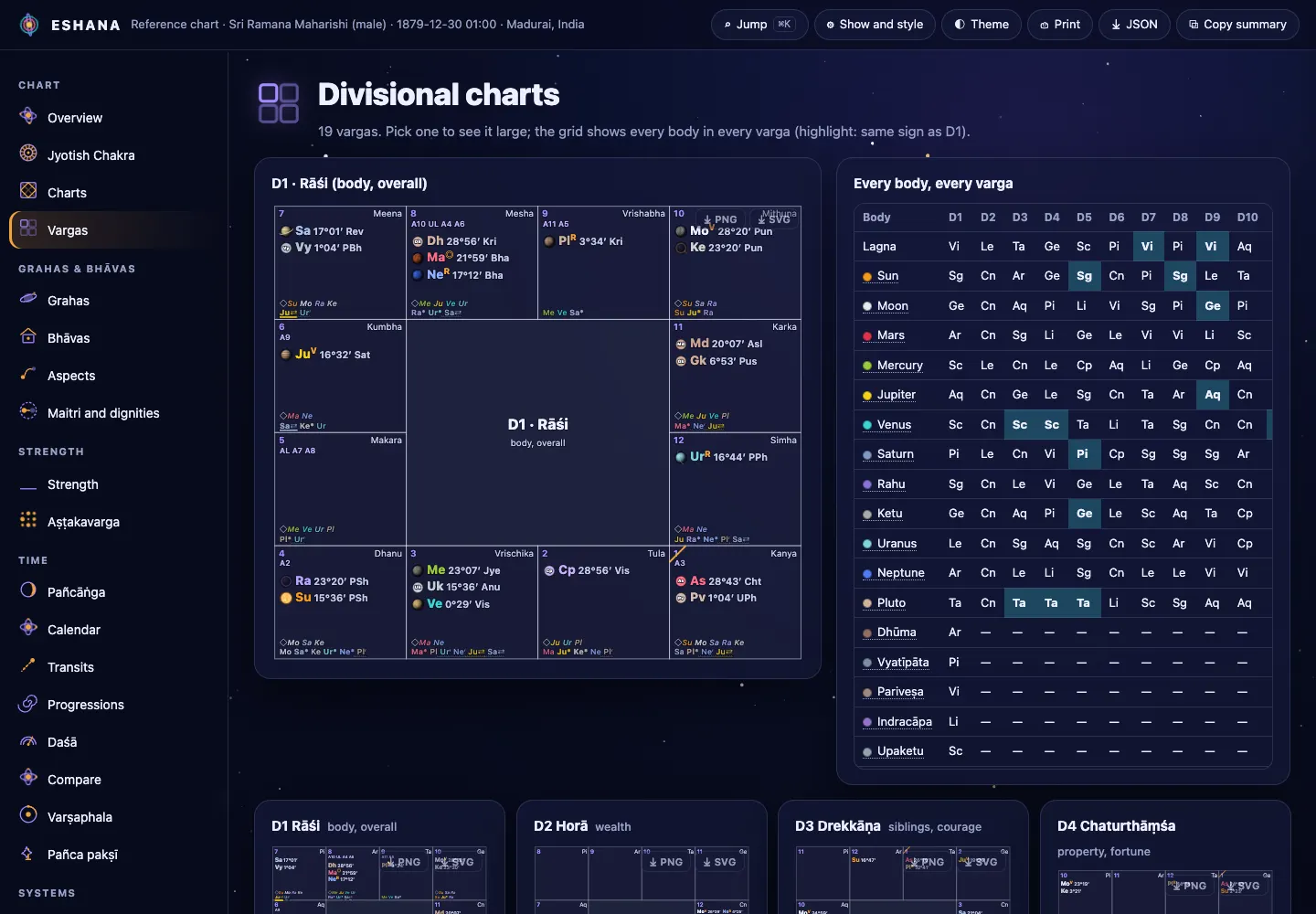 🧩 Vargas D1 to D60, plus parivṛtti D2/D3, D81, D108 and D144 as named methods. |
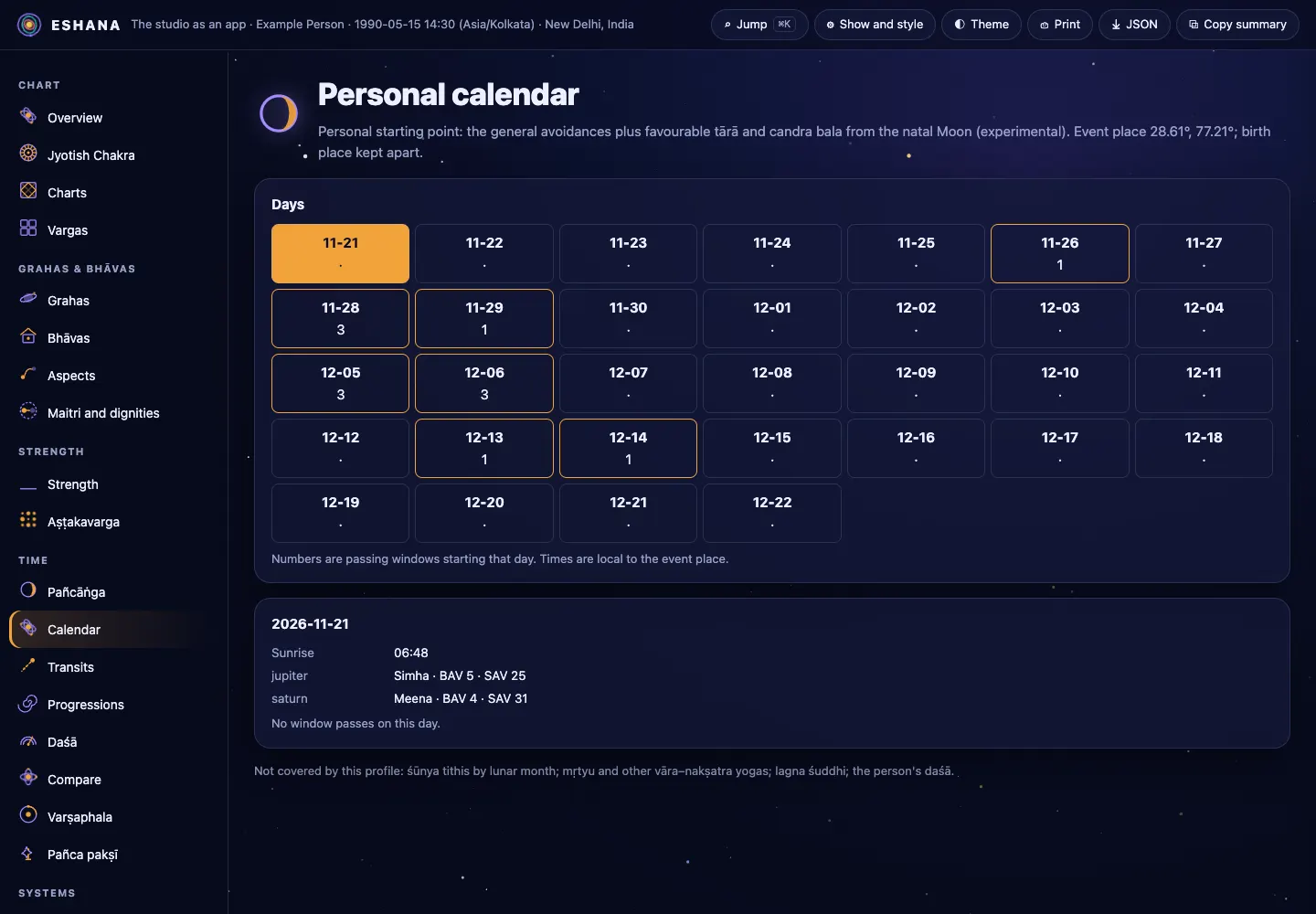 📅 Personal calendar Muhūrta windows with tārā and candra bala; export CSV or ICS. |
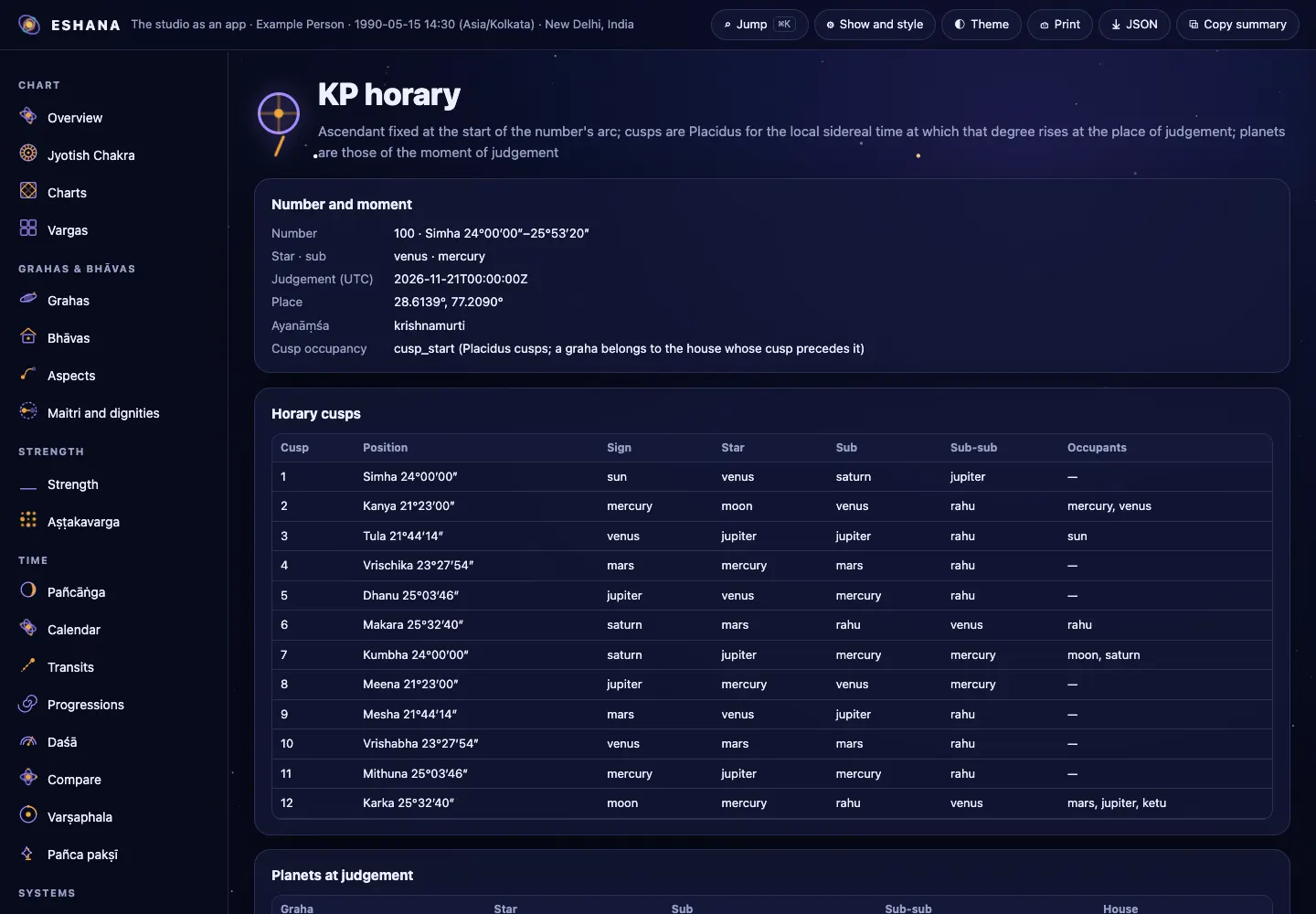 🎯 KP horary Numbers 1–249; cusps within 0.07″ of an independent reference. |
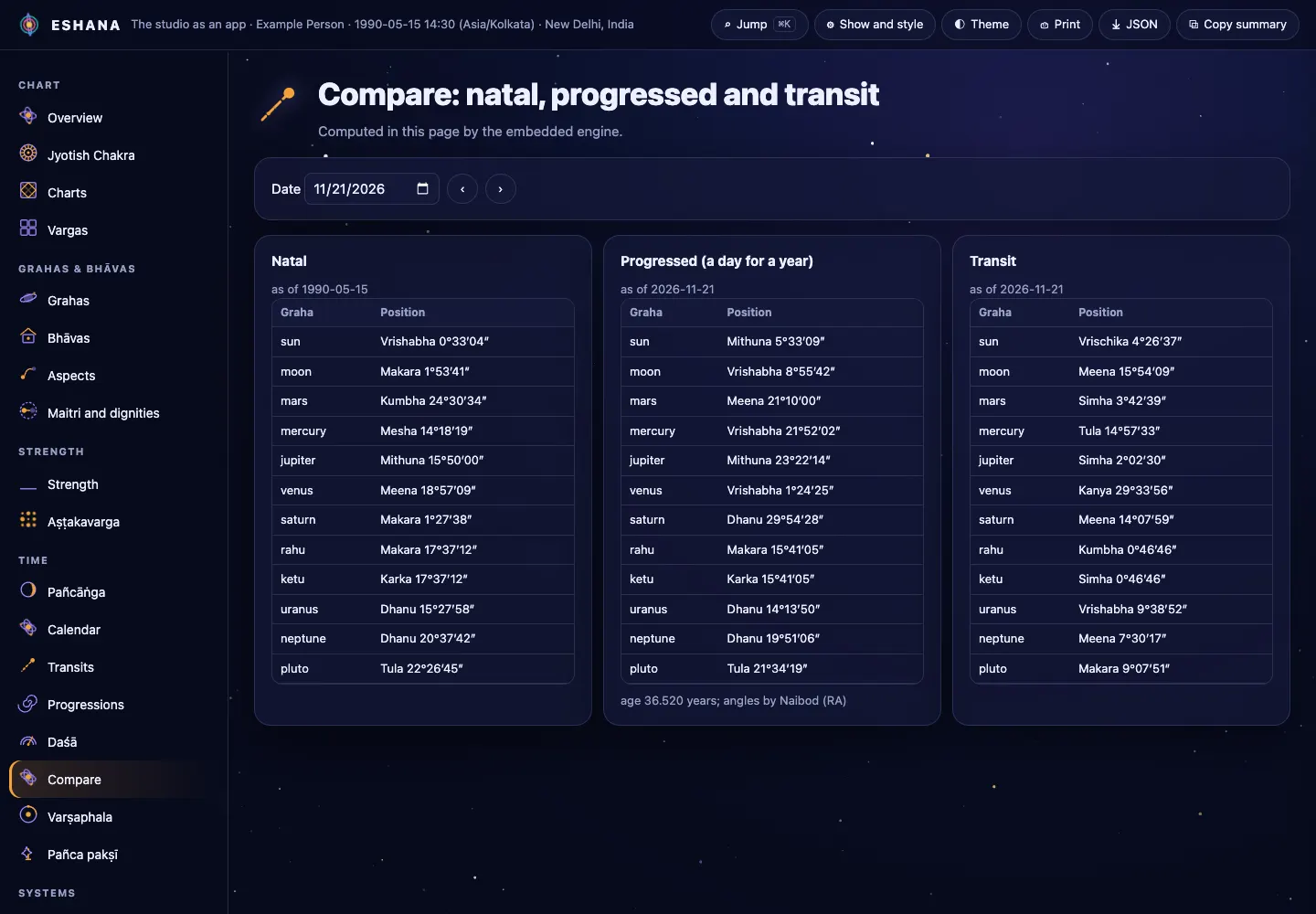 🔁 Compare Natal, progressed and transit side by side, recomputed in the page. |
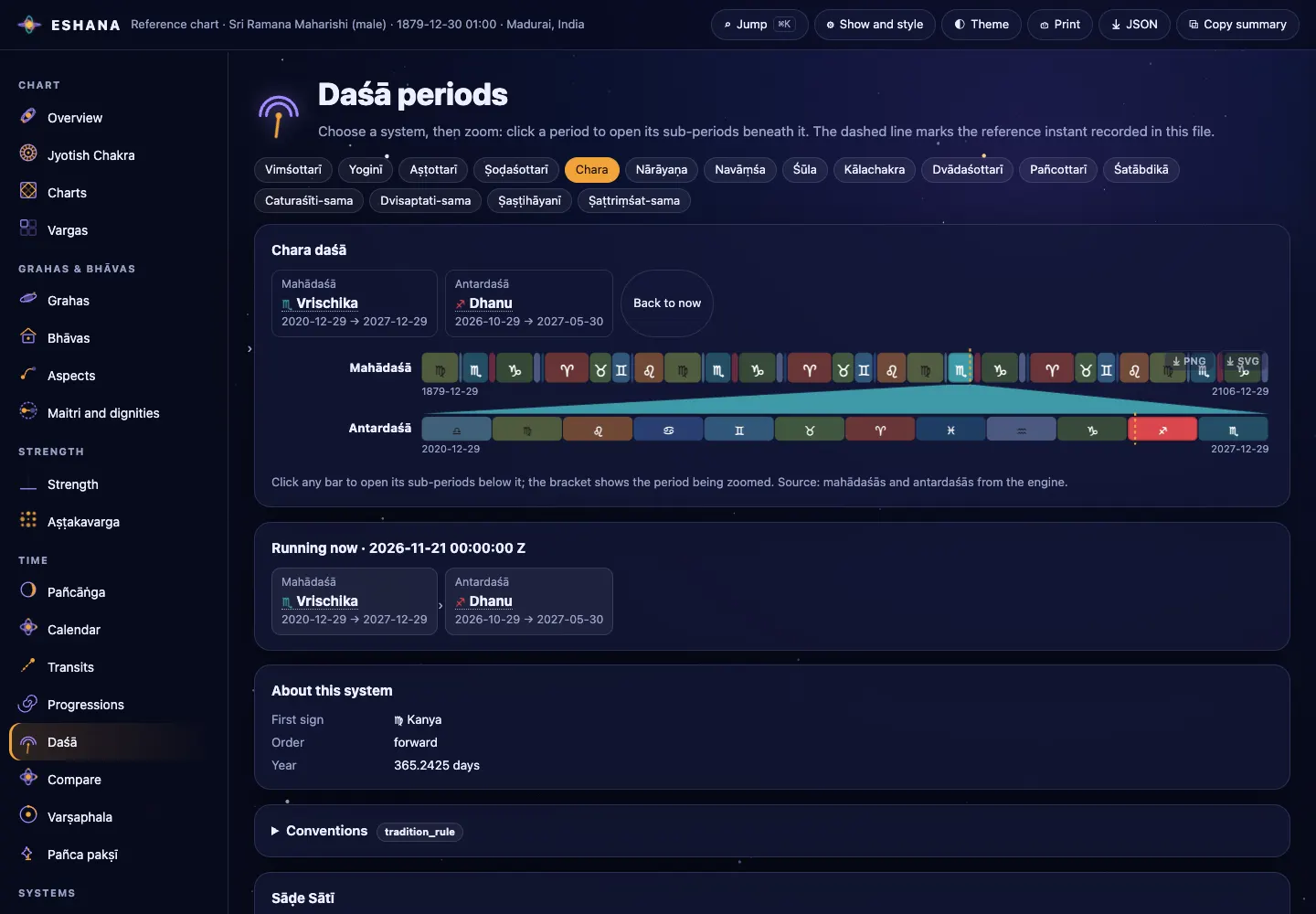 ⏳ Daśās Sixteen systems, including seven conditional daśās that say whether their condition holds. |
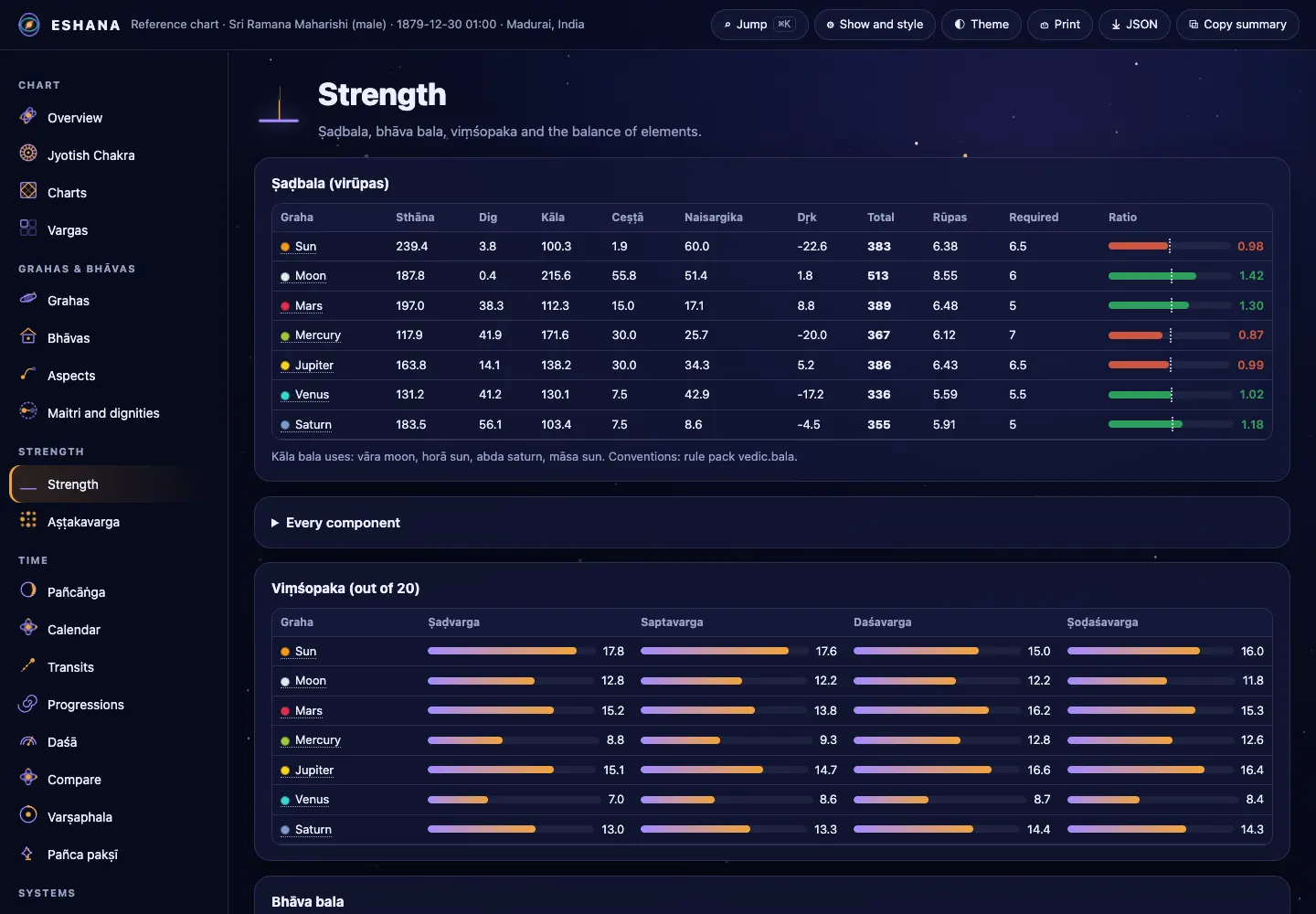 💪 Strength Ṣaḍbala against the required minimum, bhāva bala and viṃśopaka. |
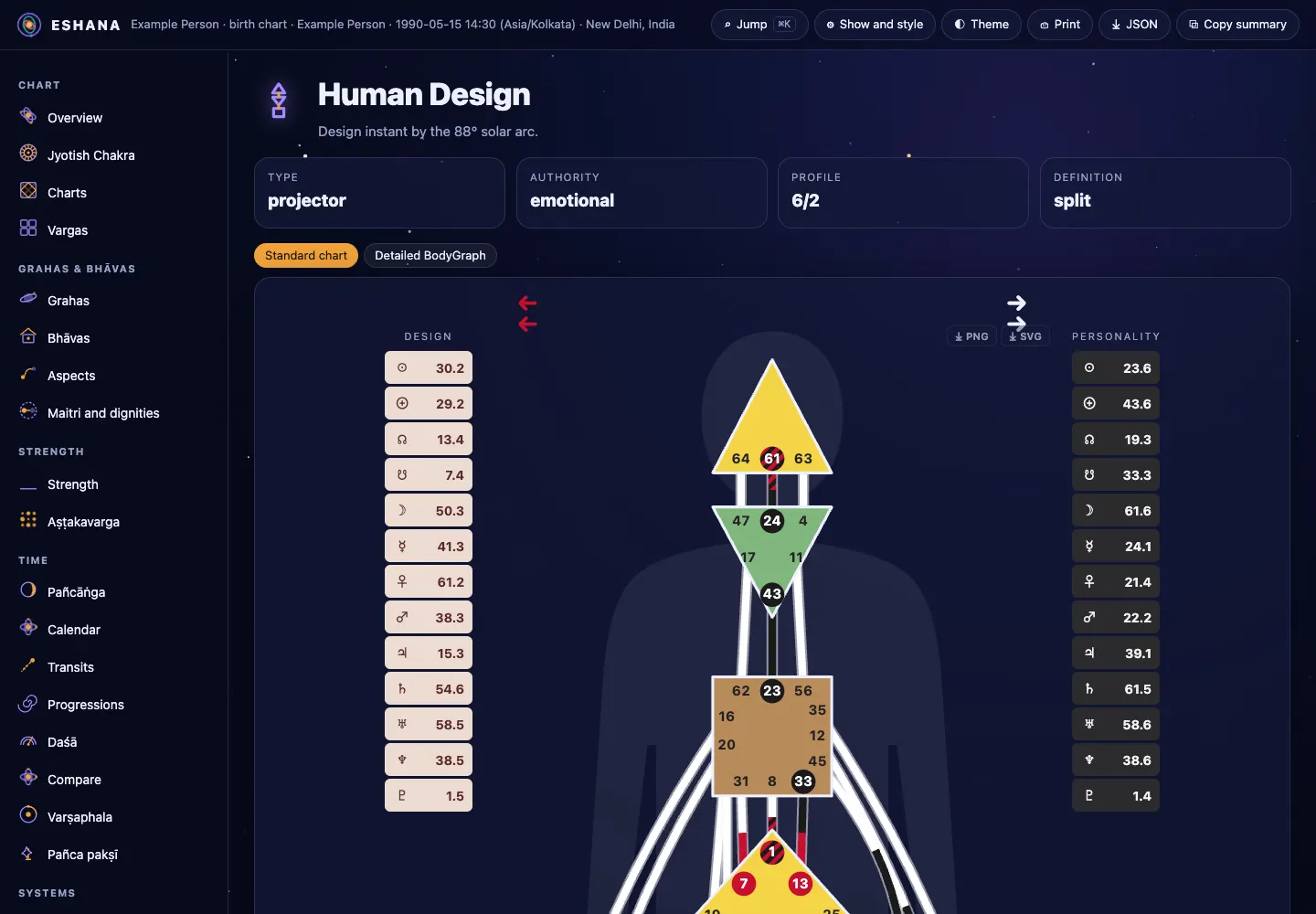 🧬 Human Design The design instant by the 88° solar arc, gates, channels and properties. |
Also in the studio:
- 🖼️ Download any chart as PNG or SVG, exactly as shown: your layers, filters, rotation, theme and language. The PNG is print-sized with a caption, and the SVG opens in any editor.
- 🌐 Interface language as a reader setting: English by default, Hindi included. Labels only, never values.
- ⌨️ Keyboard first: ⌘K palette, a playground driven by the arrow keys with undo, focus rings everywhere.
- 🌗 Light and dark themes, checked for contrast by tests on every page.
👉 See all 23 views in the gallery · Open the live studio · Studio guide
🔭 What it computes
| Area | Highlights |
|---|---|
| 🕰️ Time and positions | IANA zones with historic offsets (war time, double summer time, local mean time); ten bodies plus the nodes, apparent geocentric; an analytic provider with no data files and an spk provider for JPL kernels |
| 🌙 Jyotiṣa | rāśi, nakshatra and pada; vargas D1–D60 plus D81, D108 and D144; ten ayanāṃśas; graha and rāśi drishti; aṣṭakavarga; ṣaḍbala; Jaimini kārakas and ārūḍhas; yogas and doshas; sahams; Sarvatobhadra and Kota chakras; varṣaphala; pañca pakṣī |
| ⏳ Daśās | Vimśottarī to five levels, Yoginī, Chara and more, sixteen systems in all, including seven conditional daśās that report whether their condition holds |
| 🗓️ Timing | stations and retrograde intervals; exact crossings and aspects; dated aṣṭakavarga; pañcāṅga with horā, choghaḍiyā and the kālams |
| 🪔 Muhūrta | windows as exact [start, end) intervals under versioned profiles; an empty result says which rule removed every window; personal and pair calendars (JSON, CSV, ICS) |
| 🎯 KP | sub-lords and significators; horary numbers 1–249 with Placidus cusps; cusp-occupancy methods named, the natal default unchanged |
| 💞 Matching | the 36-point aṣṭakūṭa, unchanged byte for byte; rajju, vedha, mahendra, strī-dīrgha and Maṅgala doṣa with every cancellation listed; cross-chart factors |
| ♈ Western | tropical; whole-sign, equal and Placidus (refused where undefined); aspects with the applying state; secondary progressions with named angle methods |
| 🧬 Human Design | the design instant by solving the 88° solar arc (not "88 days"), gates, lines, channels, centres, type, authority and profile |
| 🔢 Numerology | Pythagorean and Chaldean as separate schemas, Lo Shu and Kua, compound numbers, letter transits |
| 🧪 Research (experimental) | each score is written up first (factors, weights, worked examples); one window-ranking model, labelled experimental |
Every method family and id the engine knows: eshana methods, or docs/reference/methods.md.
⚙️ How it works
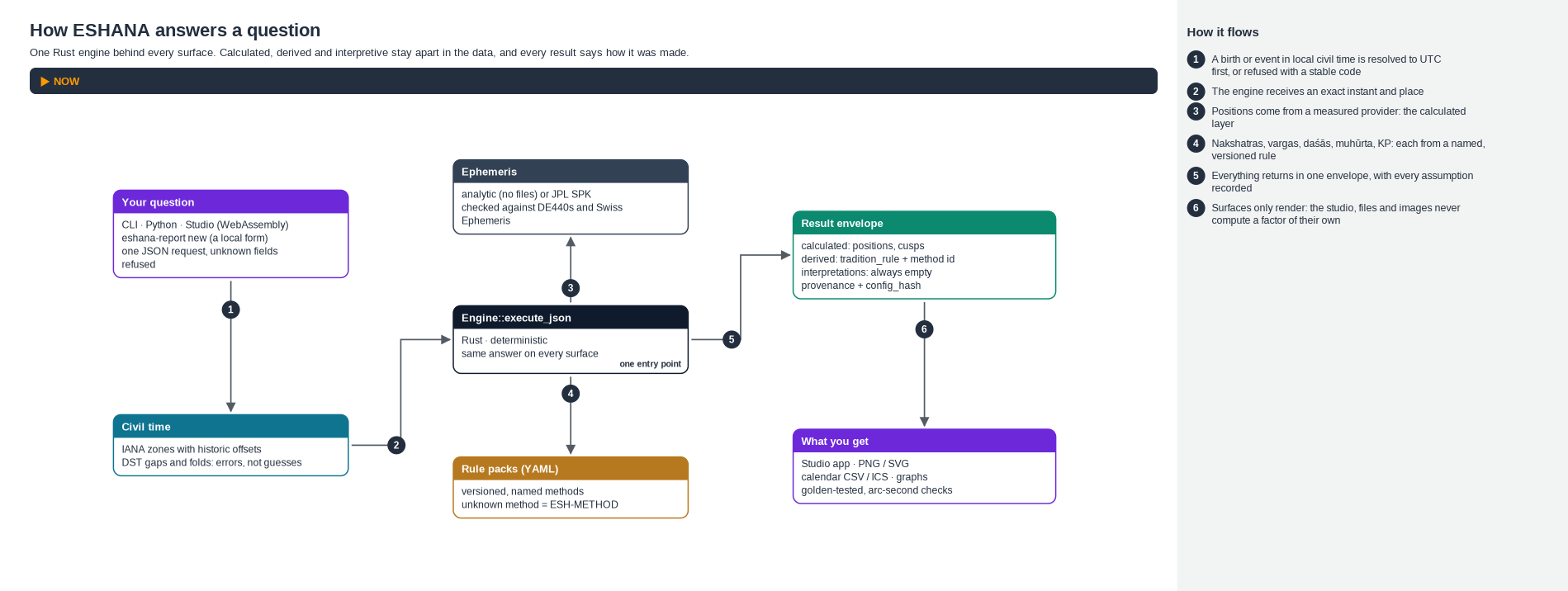
- One entry point.
Engine::execute_jsontakes a JSON request (with anop) and returns a JSON envelope. The CLI, the Python package and the studio's WebAssembly build are thin shells around it. - Rule packs are data. YAML files with versions and method ids, printed by
eshana rulesets. A changed formula is a new rule version, with golden fixtures that show the difference. - Surfaces never compute. The studio renders envelopes; it never works out a factor of its own.
🧪 One engine, every question
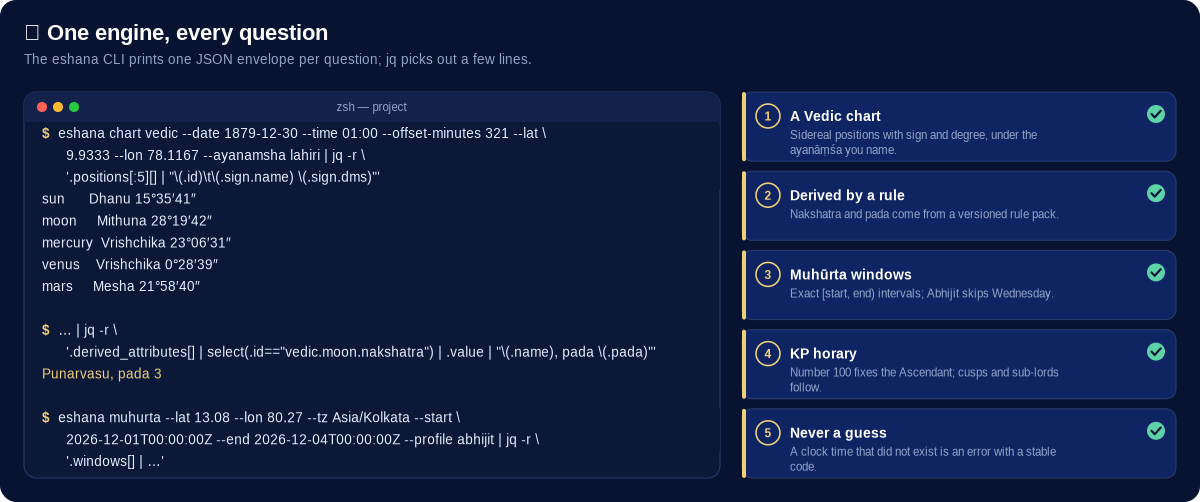
Every line in these walkthroughs is real output from eshana 0.4 (regenerate them from
assets/readme/src/).
🛡️ Guarantees
Each of these is a scenario in the release gate (make acceptance: 122 scenarios, all passing):
- 🚫 Sidereal without an ayanāṃśa is refused, unless you ask for defaults, in which case the default is recorded.
- ⏰ A skipped or repeated local time is refused with its own code; pick
--fold earliest|latestto resolve a repeat. - 🧊 Placidus beyond the polar circle is refused, not approximated.
- ❓ An unknown birth time gets intervals, not noon. The Ascendant and houses are never invented.
- 🔁 The same request returns the same bytes, with a
config_hashnaming the settings. - 🙈 A chart writes nothing to disk and sends nothing anywhere.
- 🧷 Unavailable is not zero. A factor that cannot be computed (a polar sunrise, a node without a table) says so, and says what is missing.
📏 Accuracy, measured
Not promised: measured against independent references and written down.
| What | Against | Result |
|---|---|---|
🌍 Positions, spk provider |
an independent JPL DE440s pipeline | 0.3″ |
🌍 Positions, analytic provider (40 charts) |
Swiss Ephemeris (offline oracle) | Moon 6″ worst, Sun 18″; outer planets arc-minute class |
| 🧭 Ascendant and cusps | Swiss Ephemeris | 3.2″ worst |
| 🎯 KP horary cusps | Swiss Ephemeris houses_armc |
0.07″ |
| 📐 Ten ayanāṃśas, 1800–2100 | Swiss Ephemeris | 0.05″ worst (De Luce) |
| ⏱️ Stations and crossings | Swiss Ephemeris event search | within the stated solver tolerance |
| 📚 Published charts | printed reference values | see the accuracy report |
The Swiss Ephemeris is used only as an offline test oracle: never bundled, never linked. Details: accuracy report · provider accuracy · accuracy guide.
🧩 Ways to use it
| You want… | Use | Example |
|---|---|---|
| 🪐 a chart to read, offline | eshana-report |
eshana-report --date … --tz … --lat … --lon … --live -o chart.html |
| 📝 to type details, not flags | eshana-report new |
a local form on 127.0.0.1 that writes the chart and stops |
| 🐍 numbers in Python | eshana |
eshana.execute({"op": "muhurta_windows", …}) or ChartEngine() |
| 🧰 JSON from a shell | the Rust CLI | eshana chart vedic …, eshana muhurta …, eshana kp-horary … |
| 🗓️ a calendar file | personal_calendar |
format: "ics" for any calendar app |
| 🕸️ the engine in a browser | eshana-wasm |
three C functions, no bindings generator (ADR-013) |
pip install eshana                                    # Python package + eshana-report
cargo build --release -p eshana-cli                   # the Rust CLI, from source
The prebuilt wheel is for macOS on Apple silicon (abi3, CPython 3.9 and later); other platforms build from the sdist, which needs a Rust toolchain. More in ways to use ESHANA.
🛠️ Development
make verify            # fmt, clippy -D warnings, every Rust test, Python tests, tracker freshness, accuracy suite
make acceptance        # the Gherkin release gate (must say PROMOTE)
make studio-journeys   # real Chrome: every studio page, text hierarchy, downloads, contrast, the new-chart form
make preview           # local preview of the studio and the website
Work is tracked in planning/backlog.json, rendered as
planning/TRACKING.md, with exact status words: proposed, implemented, verified
(evidence required) and released. Publishing: docs/guides/publishing.md.
🗺️ Repository map
| Path | What |
|---|---|
crates/ |
eshana-core, -time, -ephemeris, -engine (rules and rule packs), -cli, -python, -wasm |
docs/ |
concepts, guides, reference and ADRs; also the source of the website |
website/ |
the Astro site: landing page, live demos, gallery |
acceptance/ |
Gherkin capability scenarios, the release gate, and the browser journeys |
accuracy/, benchmarks/ |
the birth-chart accuracy suite, golden fixtures and offline oracle data |
examples/ |
example studio reports and the gallery screenshots, all generated by the real engine |
assets/readme/ |
the animated SVGs on this page, with their sources |
planning/ |
the backlog, the tracker and the capability-expansion plan |
🤝 Status and honesty
- 📦 Version 0.4, on PyPI. Open source under Apache-2.0 (ADR-011).
- 🧪 Experimental pieces are labelled. Muhūrta purpose presets and the research window score wait for a practitioner's review. The conditional daśās wait for published worked examples.
- 🔭 Know the provider.
analyticis arc-minute class for Jupiter and Saturn; usespkwith a JPL kernel when that matters. - 🧭 Next steps: docs/next-steps.md · changes: CHANGELOG.md · design record: ESHANA_Project_Vision_and_Master_Plan.md.
Calculated · Derived by a named system · Never interpreted for you 🌌
1 maintainer

Metadata
1 maintainer
Release files for eshana 0.4.1
For a detailed explanation of source distributions (sdists) and built distributions (wheels), please see the package formats documentation.
Source distribution (sdist)
| File | Size | Uploaded | Provenance | Actions |
|---|---|---|---|---|
| eshana-0.4.1.tar.gz | 1.5 MB | Without provenance | Details for eshana-0.4.1.tar.gz |
Built distribution (wheel)
| File | Interpreter | ABI | Platform | Actions Reset |
|---|---|---|---|---|
| eshana-0.4.1-cp39-abi3-macosx_11_0_arm64.whl | CPython 3.9 | abi3 | macOS 11.0+ ARM64 | Details for eshana-0.4.1-cp39-abi3-macosx_11_0_arm64.whl |
Total release size: 4.4 MB
Release files / eshana-0.4.1.tar.gz
| Download URL | eshana-0.4.1.tar.gz |
|---|---|
| Size | 1.5 MB |
| Tags | Source |
|
SHA-256 checksum How to use checksums |
f3254232cc13e87d7622564f297ed3cd20cf17715fb6fd8a7e7ae2a783cfb582
|
|
BLAKE2b-256 checksum How to use checksums |
b0194425cbdb63034dda436d594cee08f311be236d018fed9fa60cd5fadbe744
|
| Upload date | |
|
Uploaded using Trusted Publishing? What is trusted publishing? |
No |
| Uploaded via |
uv/0.8.22
|
Release files / eshana-0.4.1-cp39-abi3-macosx_11_0_arm64.whl
| Download URL | eshana-0.4.1-cp39-abi3-macosx_11_0_arm64.whl |
|---|---|
| Size | 2.9 MB |
| Tags | CPython 3.9 abi3 macOS 11.0+ ARM64 |
|
SHA-256 checksum How to use checksums |
7774688d174456f0b5d1c5c35f4997a667f82daddb07ee03358eb1c10bedc1ee
|
|
BLAKE2b-256 checksum How to use checksums |
6beb4345a075686bcb45b74c27dfe79e1b282847a8967a164b8cd6670b14e44b
|
| Upload date | |
|
Uploaded using Trusted Publishing? What is trusted publishing? |
No |
| Uploaded via |
uv/0.8.22
|
Security for eshana 0.4.1
Provenance
Provenance describes where a file came from. On PyPI, provenance is shared via attestations, which provide a verifiable record of the build or publishing details. View details, limitations and caveats.
No provenance found
None of the files in this release were uploaded with provenance metadata.
A note on package security
PyPI is a repository for distributing packages, not a service for auditing them. While third-party security researchers and our staff do their best to detect and remove malicious packages, PyPI cannot guarantee the quality, security or suitability of any given package.
To learn more about protecting yourself from malicious actors, visit our package security documentation.














