
ESHANA
Extensible Spatiotemporal Hypersystem for Astroinformatics, Natural Cycles & Associations
From celestial positions to connected meaning.
A Rust engine for celestial positions, civil time and the traditions built on them (Jyotiṣa, Western astrology, Human Design and numerology), with an offline chart studio, a Python API and a CLI. Every number is computed, every rule is named, and no interpretation is ever invented.







📖 Docs · 🖼️ Gallery · 🪐 Live studio · 🐍 PyPI · 📝 Changelog · 🗺️ Roadmap
📝 Note
ESHANA makes the rules of astrology, numerology and Human Design computable and auditable. It does not claim they predict anything, and itsinterpretationsfield is always empty. Experimental pieces are labelled as such in every result.
📚 Contents
|
Start here |
What it does |
Trust and internals |
✨ Why ESHANA?
Astrology software usually mixes three very different things on one screen: astronomy you can verify, rules that belong to one school, and readings someone wrote. ESHANA pulls them apart so each can be checked on its own terms.
| 😕 The usual way | 🌟 With ESHANA | |
|---|---|---|
| 🕰️ Birth time | A local time is quietly turned into UTC; a time that the clocks skipped becomes something | IANA zones with historic offsets; a skipped or repeated time is an error with a code, never a guess |
| 📐 Methods | Ayanāṃśa, houses and daśā variants are buried in settings | Every method has an id; an unknown one is refused (ESH-METHOD); the choice travels with the result |
| 🧾 Results | Numbers without a trail | Provenance on every envelope: engine, provider, tz database, rule versions, assumptions and a config_hash |
| 🔮 Meaning | Readings presented as facts | interpretations is always empty; rules are labelled tradition_rule; research scores are labelled experimental |
| 🌍 Surfaces | The web app and the API drift apart | One Engine::execute_json behind the CLI, Python and the studio (compiled to WebAssembly) |
| 🔒 Privacy | Birth data uploaded to a server | Everything runs on your machine; the studio is one offline HTML file |
🧭 Three layers, kept apart
| Layer | Example | Produced by | In the envelope |
|---|---|---|---|
| 🧮 Calculated | ecliptic longitude, speed, Ascendant, sunrise | verifiable code, tested against JPL DE440s and the Swiss Ephemeris | positions, houses with epistemic: calculated |
| 📜 Derived by a named system | nakshatra and pada, varga sign, daśā period, muhūrta window, Human Design gate, name number | a versioned rule pack with a method id | derived_attributes with epistemic: tradition_rule |
| 🔮 Interpretive | character, meaning, compatibility | never the engine | interpretations: [], always |
{
  "kind": "chart", "schema_version": "0.4.0",
  "positions": [{ "id": "moon", "longitude_deg": 88.33, "epistemic": "calculated", "sign": { "name": "Mithuna", "dms": "28°19′42″" } }],
  "derived_attributes": [{ "id": "vedic.moon.nakshatra", "epistemic": "tradition_rule", "value": { "name": "Punarvasu", "pada": 3 } }],
  "interpretations": [],
  "calculation": { "ayanamsha": "lahiri", "house_system": "whole_sign", "config_hash": "fnv1a64:…" },
  "provenance": { "engine_version": "0.4.2", "tzdb_version": "2026f", "assumptions": ["house_system not given; whole_sign used", "…"] }
}
⚡ Quick start
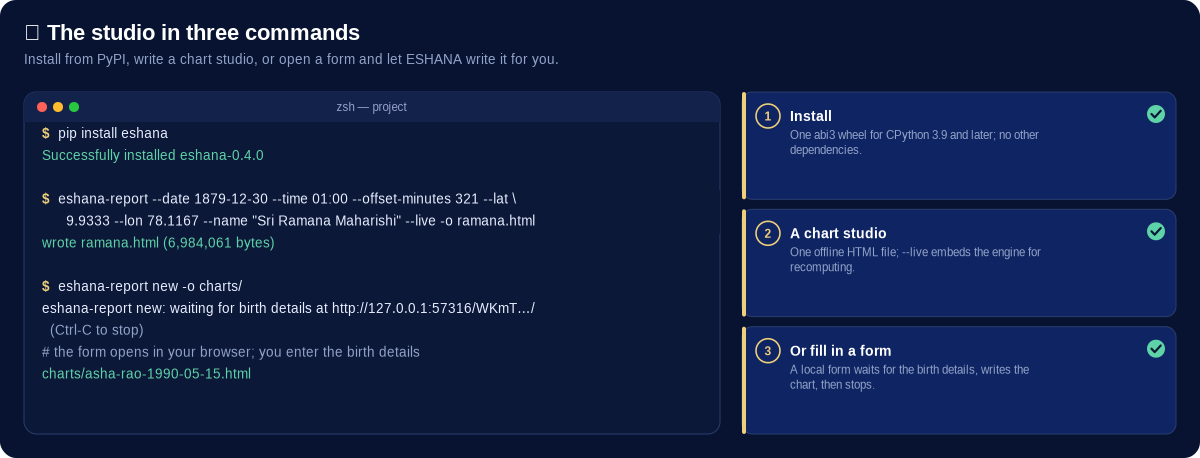
pip install eshana

# 🪐 a full chart studio in one offline HTML file (--live embeds the engine for recomputing in the page)
eshana-report --date 1992-05-28 --time 20:05 --tz Asia/Kolkata --lat 17.385 --lon 78.487 --live -o chart.html

# 📝 or let a form ask for the details: it opens in your browser, writes the chart, and stops
eshana-report new -o charts/
from eshana import ChartEngine, Context

ctx = Context.from_local_birth(date="1992-05-28", time="20:05:00", timezone="Asia/Kolkata",
                               latitude=17.385, longitude=78.487)
chart = ChartEngine().vedic_chart(ctx, ayanamsha="lahiri", divisions=[1, 9], dasha=True)

chart.position("moon")["sign"]["name"]           # 'Meena'
chart.attribute("vedic.moon.nakshatra")["name"]  # 'Revati'
chart.provenance["assumptions"]                  # everything that was chosen for you
chart.to_html("chart.html")                      # the studio, from Python
💡 Tip
Unknown birth time? Leave out--time. Positions and signs that hold all day are kept; the Ascendant, houses and anything else that needs the hour are listed under Not computed, with the engine's reason.
🪐 ESHANA Studio
eshana-report writes one self-contained HTML file that works as a multi-page app: no server, no network,
prints cleanly. With --live it carries the engine itself, compiled to WebAssembly, so the compare workspace and the
playground recompute offline with exactly the same rules as Python and the CLI.
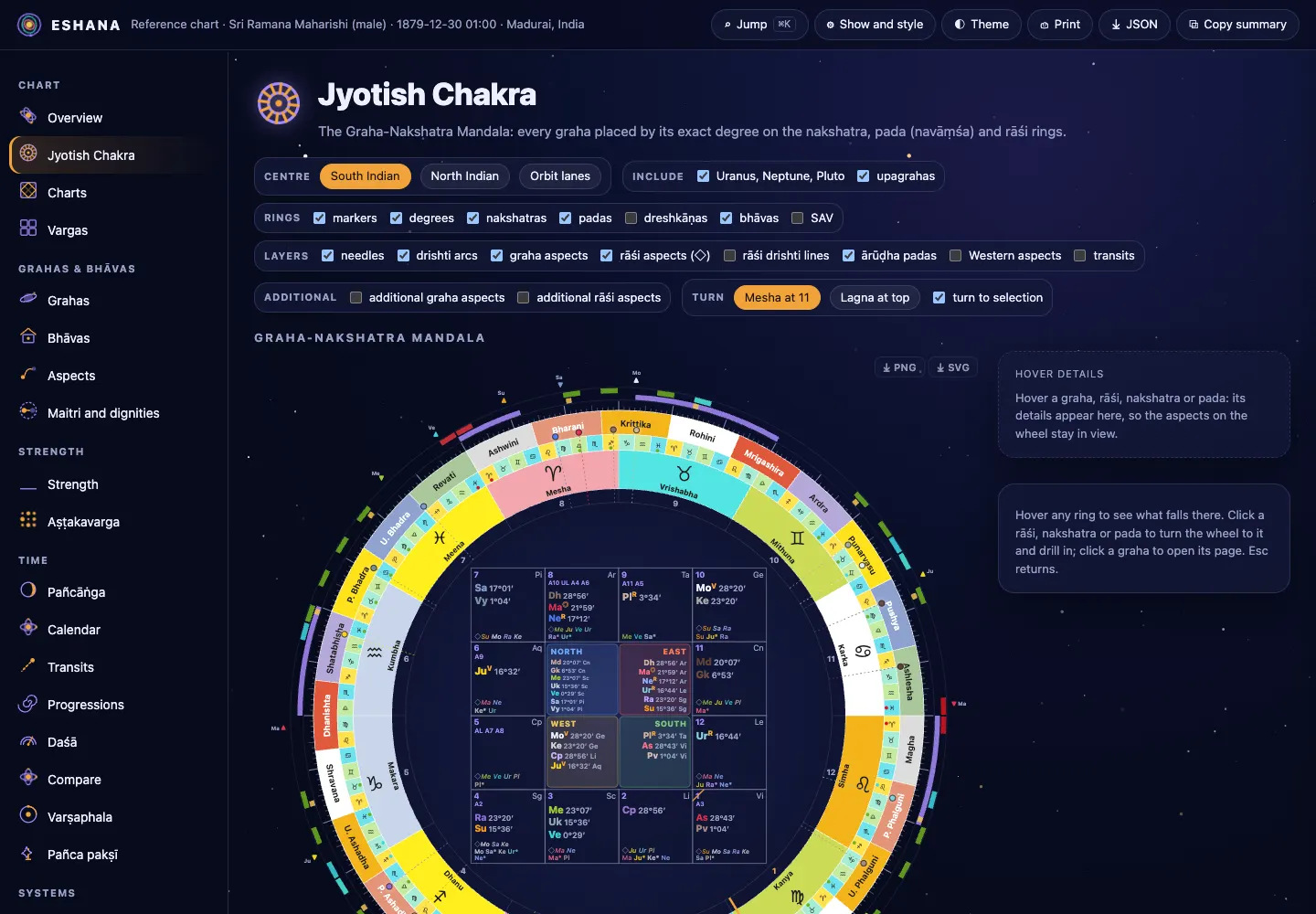 🌀 Jyotish Chakra Every graha by exact degree on the nakshatra, pada and rāśi rings, with the D1 chart and the Nadi directions in the centre. |
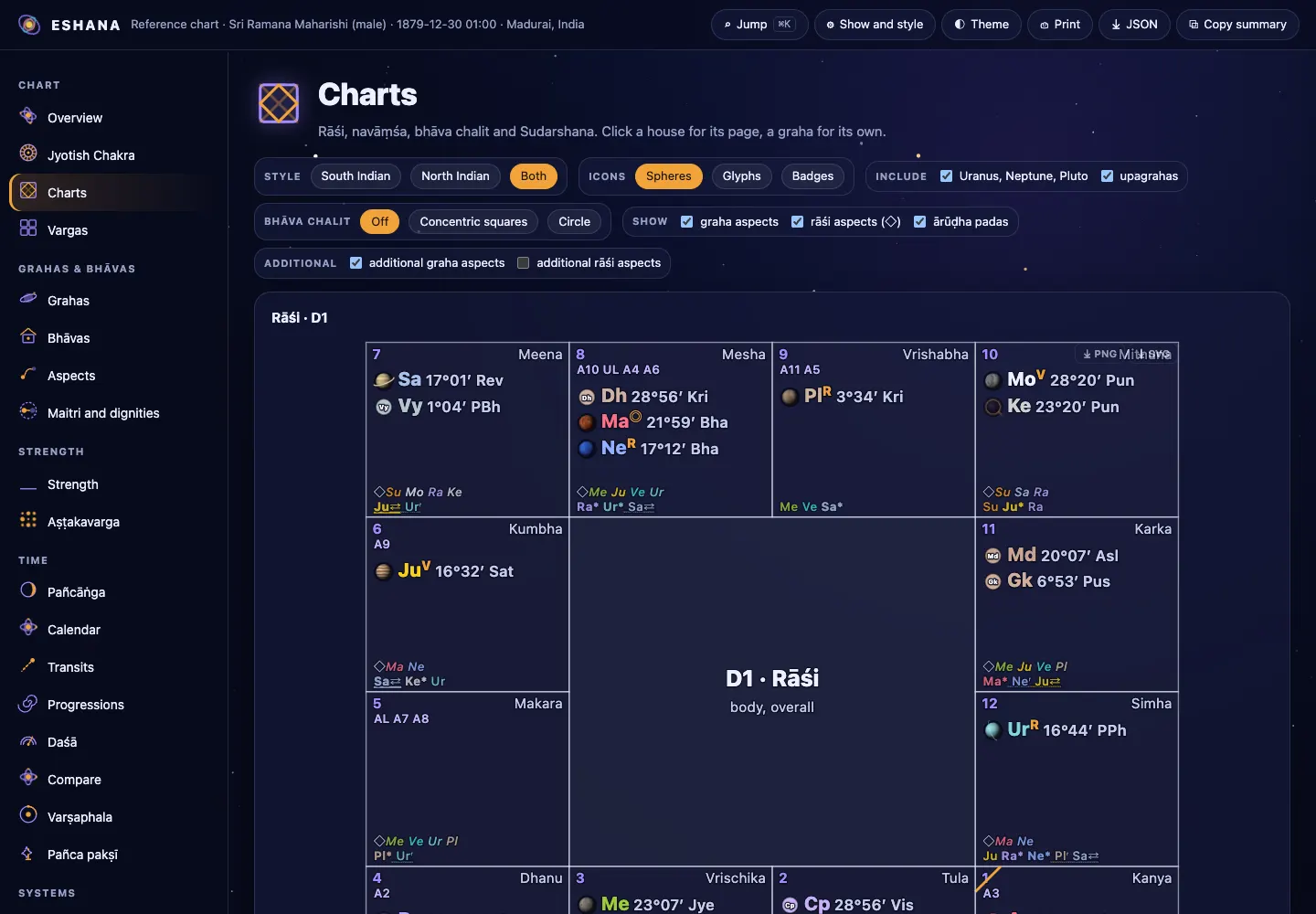 🔲 South and North Indian charts Grahas bold and first; ārūḍha padas and aspect marks smaller; crowded signs reflow. |
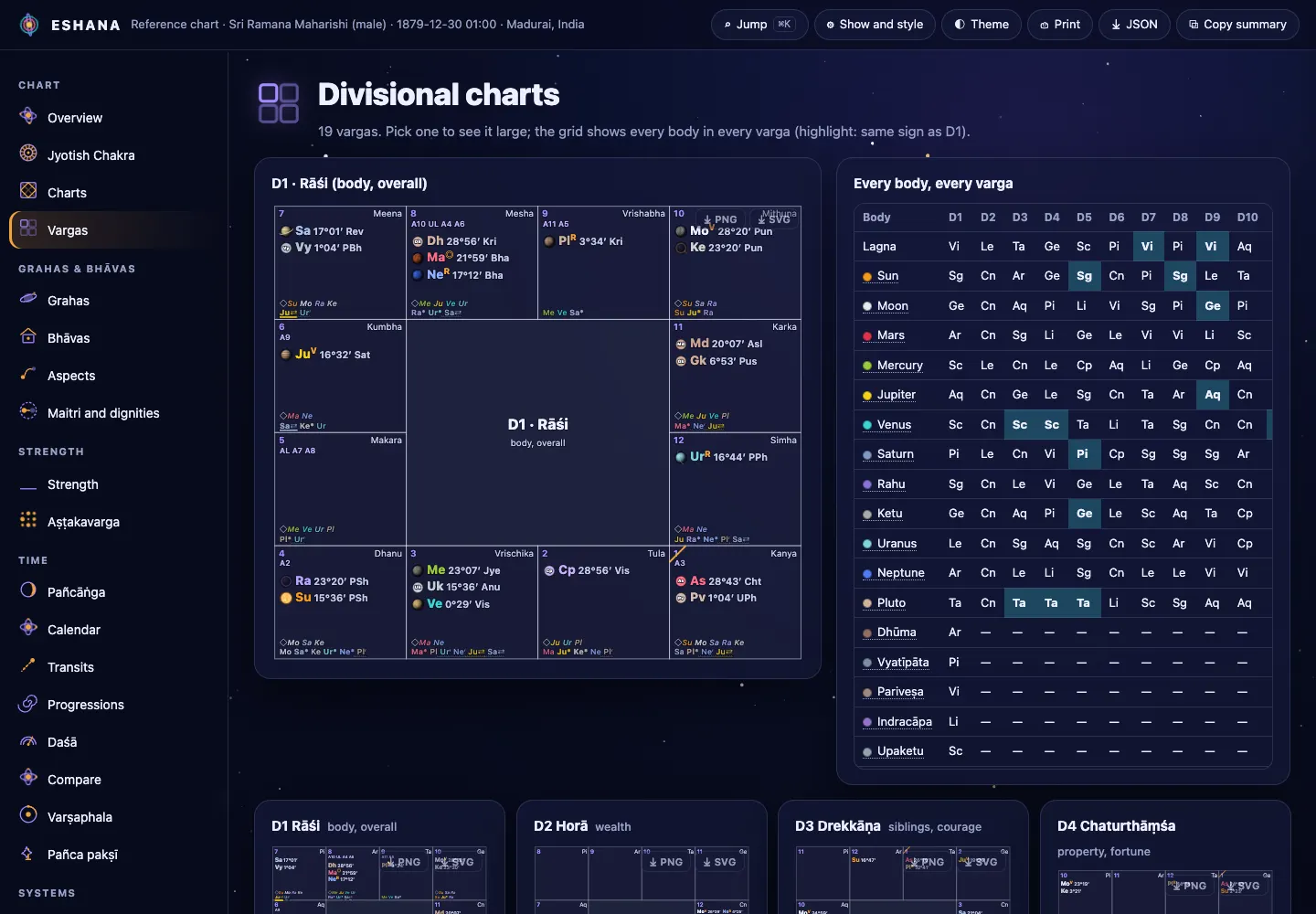 🧩 Vargas D1 to D60, plus parivṛtti D2/D3, D81, D108 and D144 as named methods. |
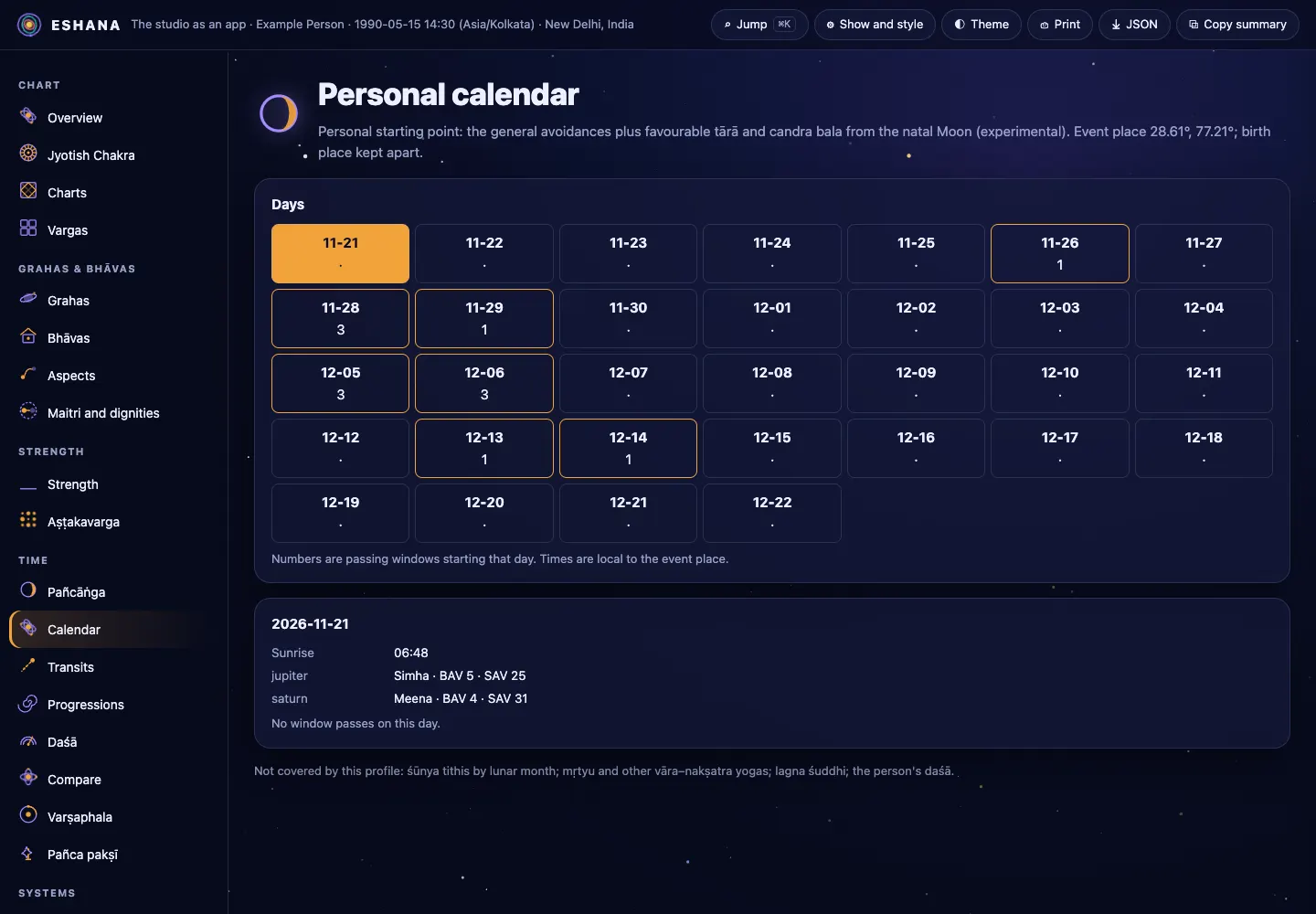 📅 Personal calendar Muhūrta windows with tārā and candra bala; export CSV or ICS. |
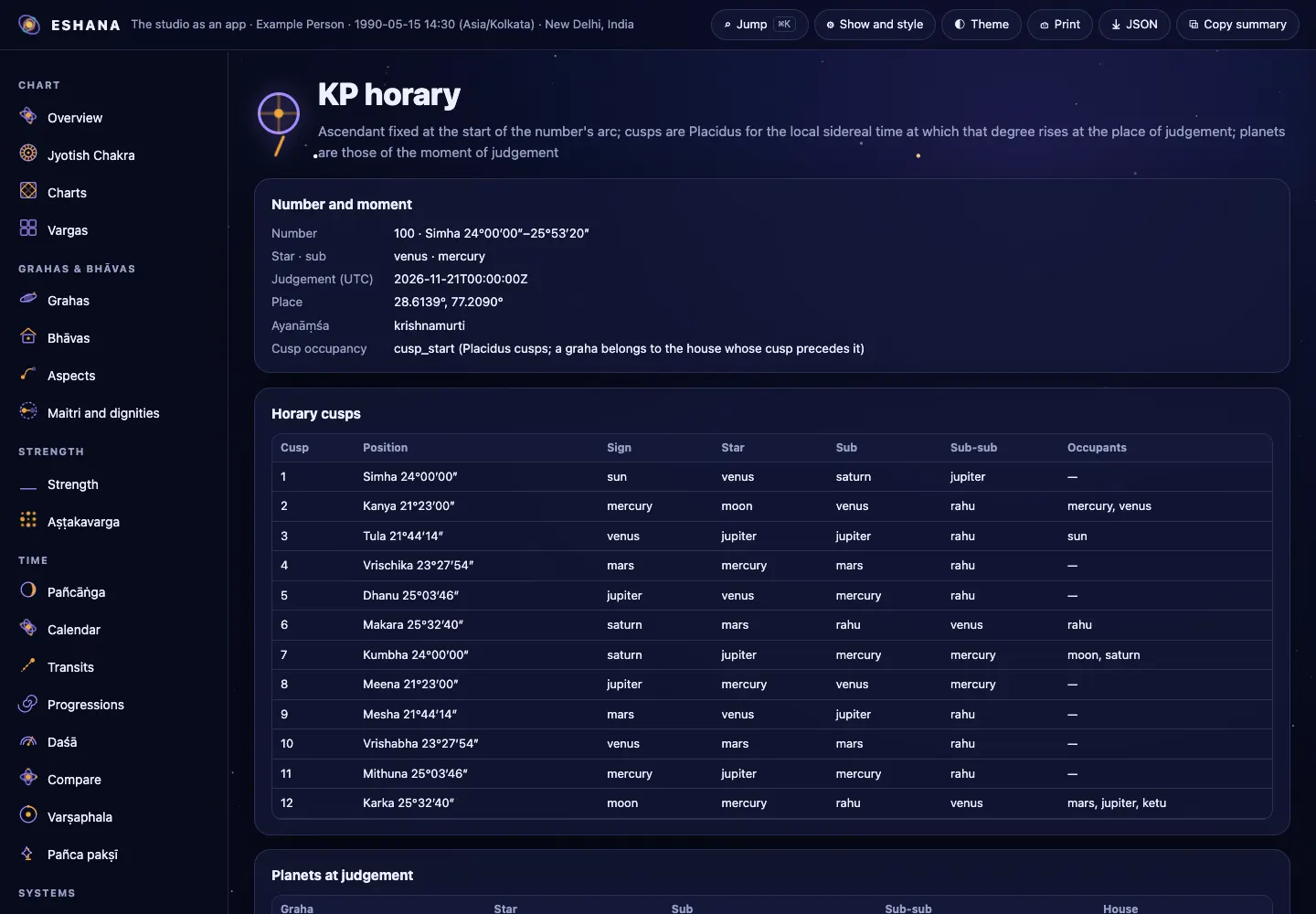 🎯 KP horary Numbers 1–249; cusps within 0.07″ of an independent reference. |
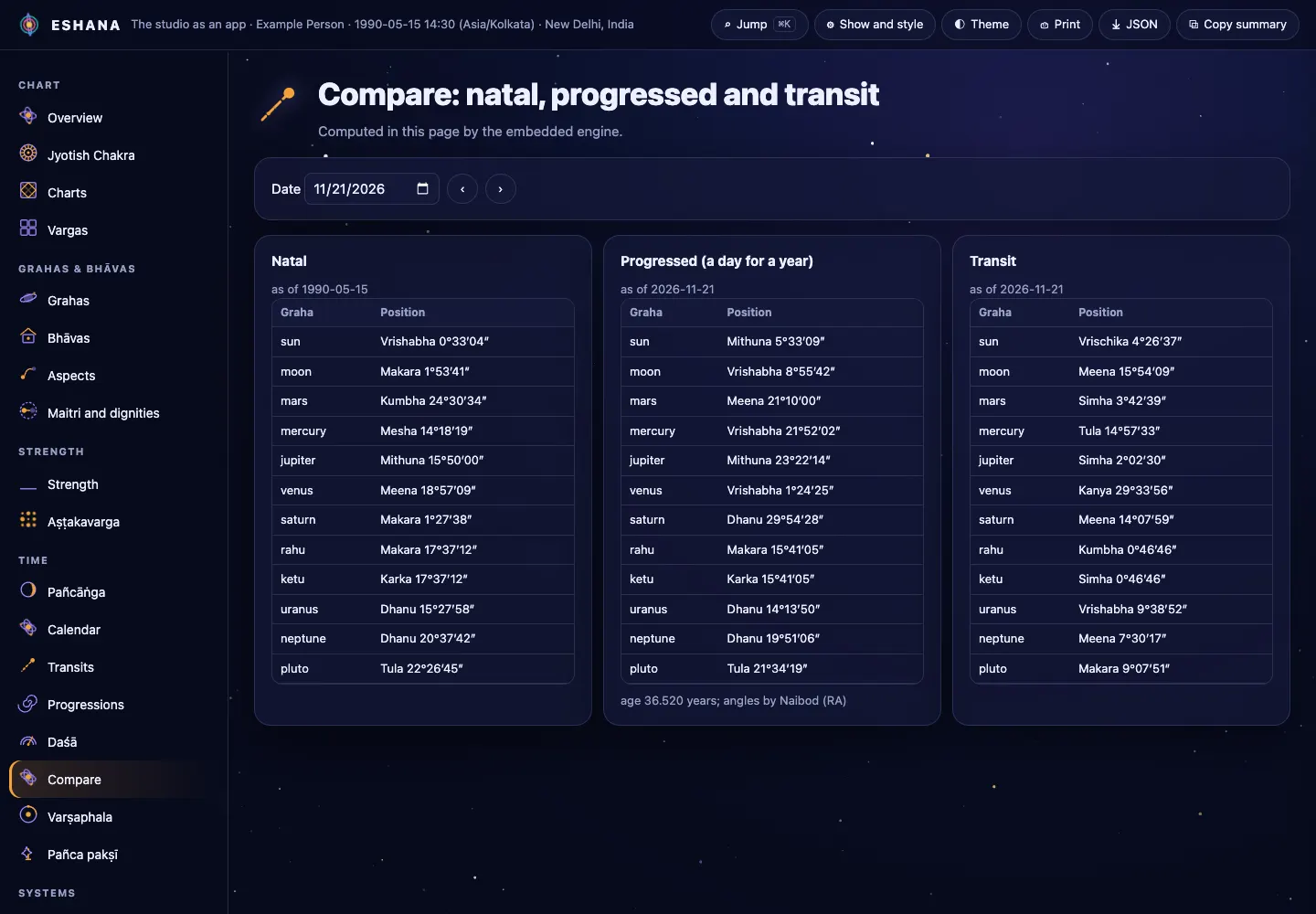 🔁 Compare Natal, progressed and transit side by side, recomputed in the page. |
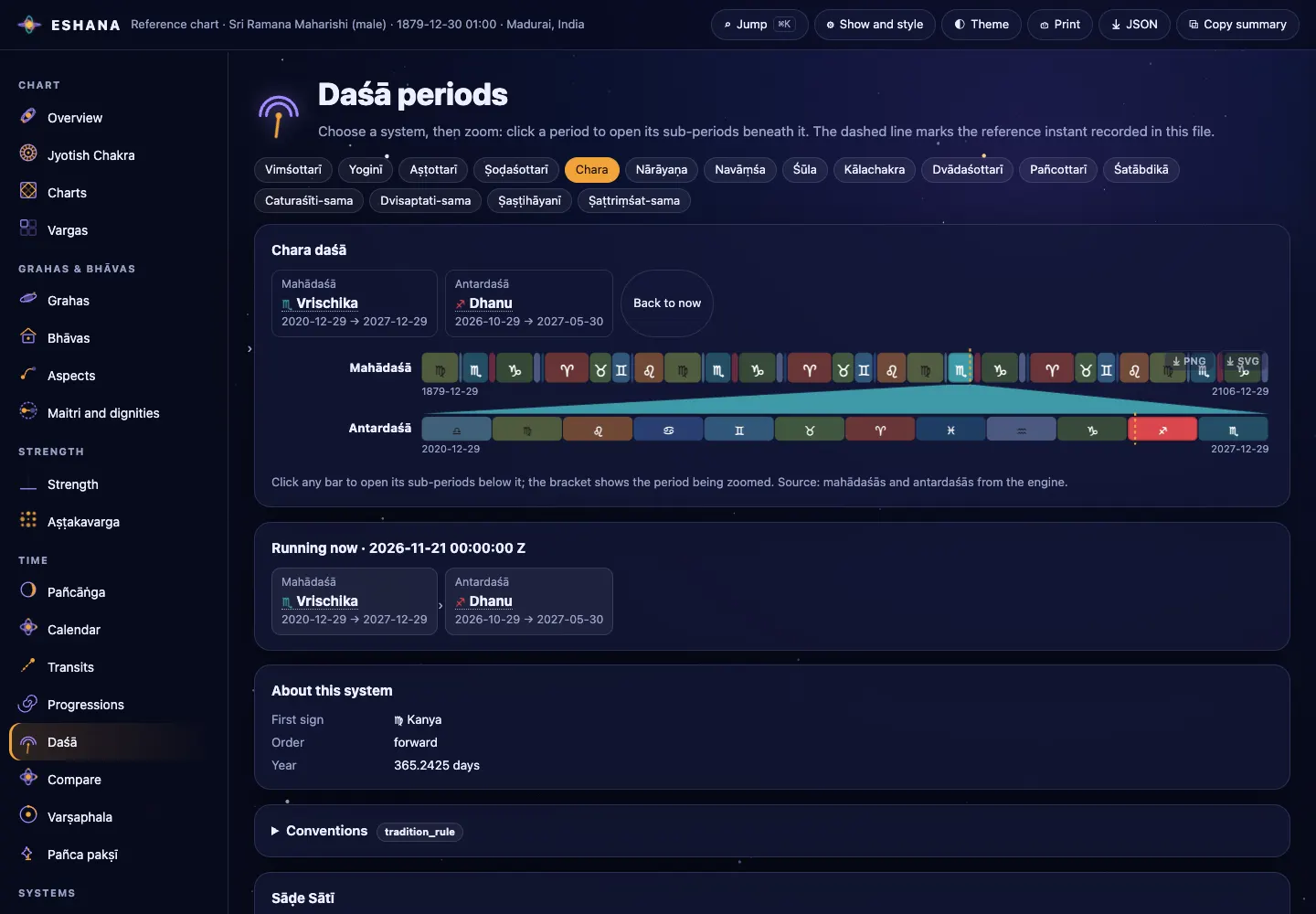 ⏳ Daśās Sixteen systems, including seven conditional daśās that say whether their condition holds. |
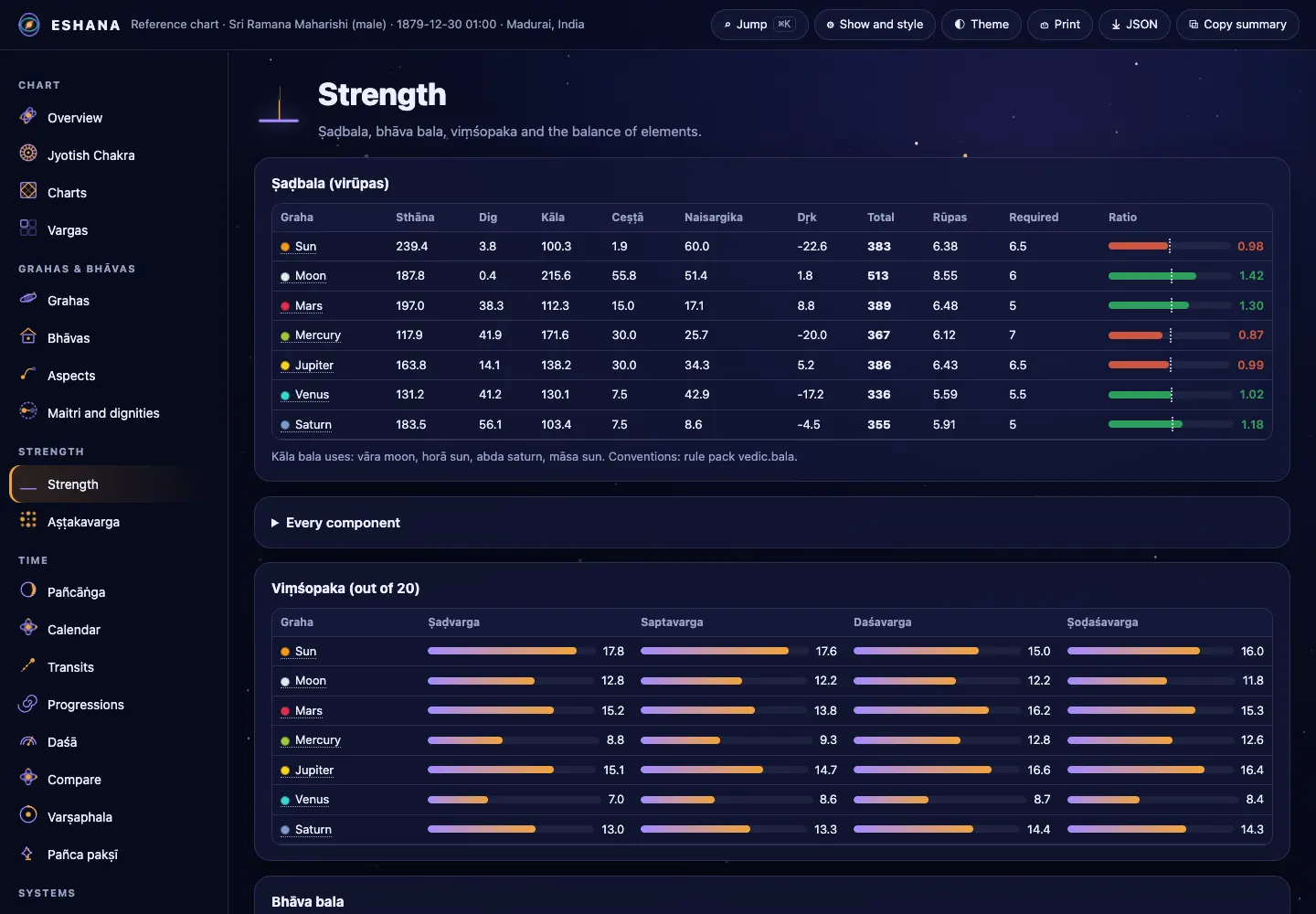 💪 Strength Ṣaḍbala against the required minimum, bhāva bala and viṃśopaka. |
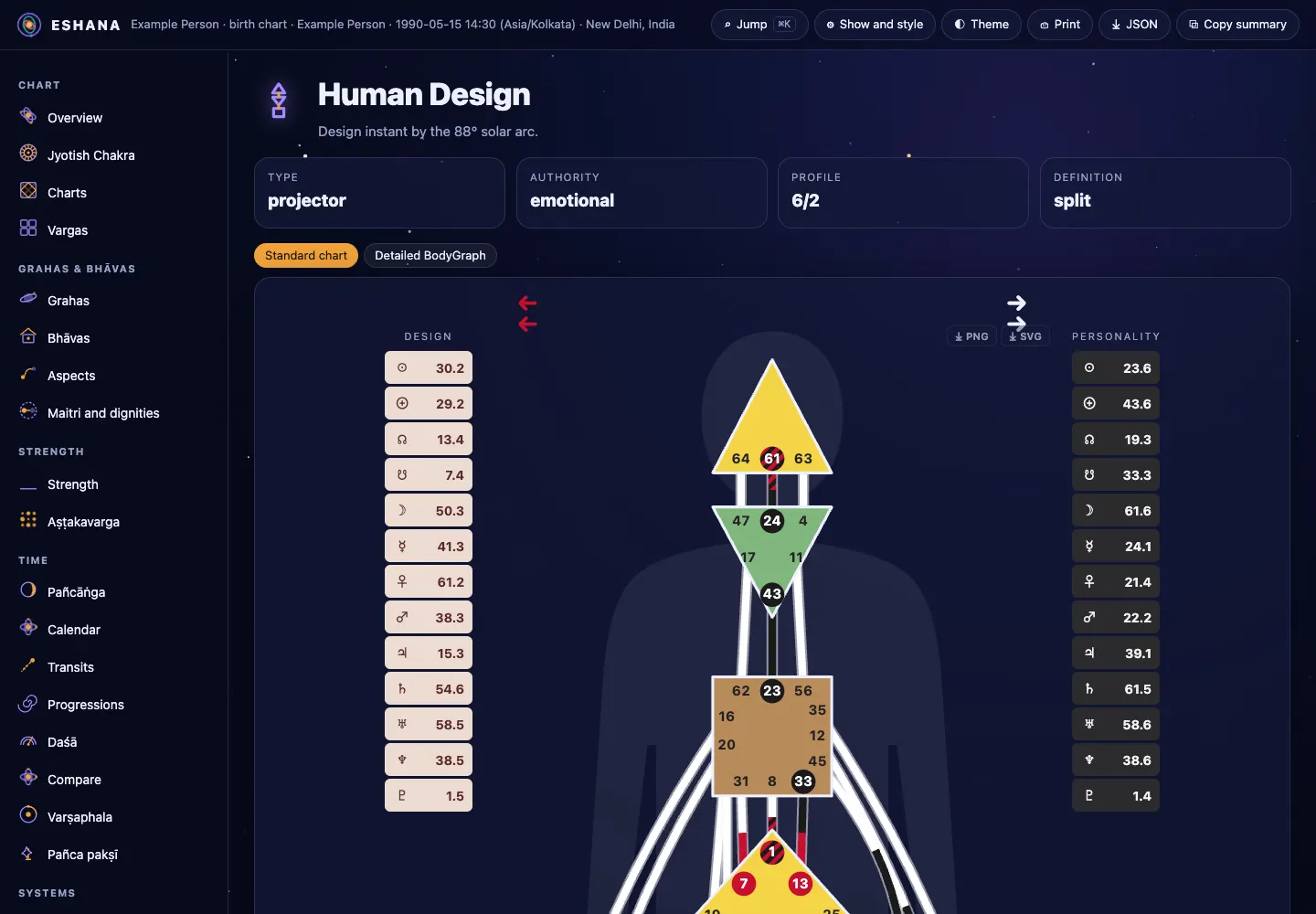 🧬 Human Design The design instant by the 88° solar arc, gates, channels and properties. |
🖼️ All 23 studio views (click to open)
Jyotish Chakra The Graha-Nakshatra Mandala: rāśis, nakshatras, padas and every graha, with the D1 chart in the centre. Hover details sit beside the wheel. | South and North Indian charts Ārūḍha padas at the top of each rāśi, aspect marks at the bottom; crowded North Indian houses fit their shape. | Divisional charts D1 to D60 side by side. | 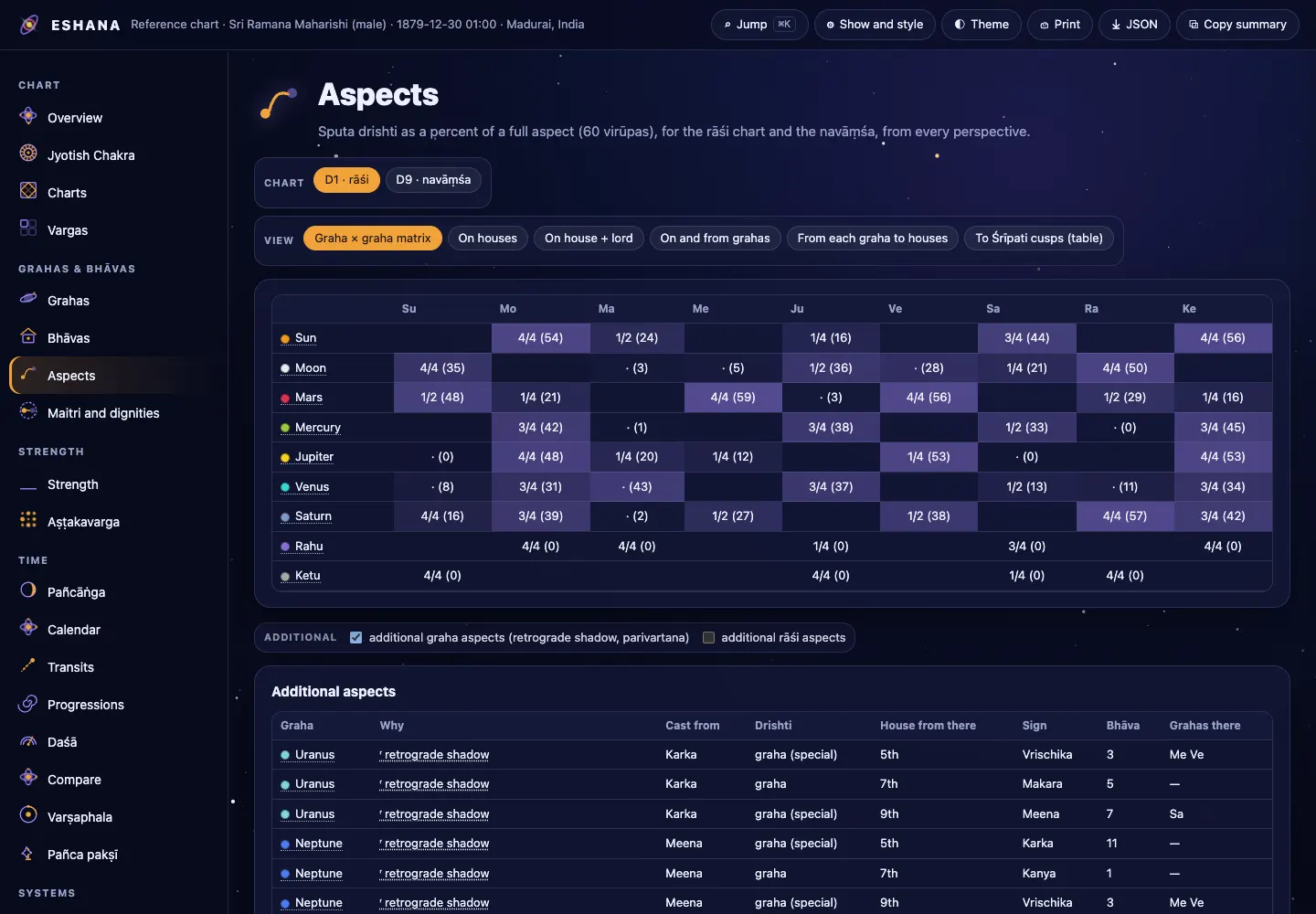 Aspects Graha drishti, rāśi drishti and sputa drishti in virūpas, on grahas, houses and cusps. |
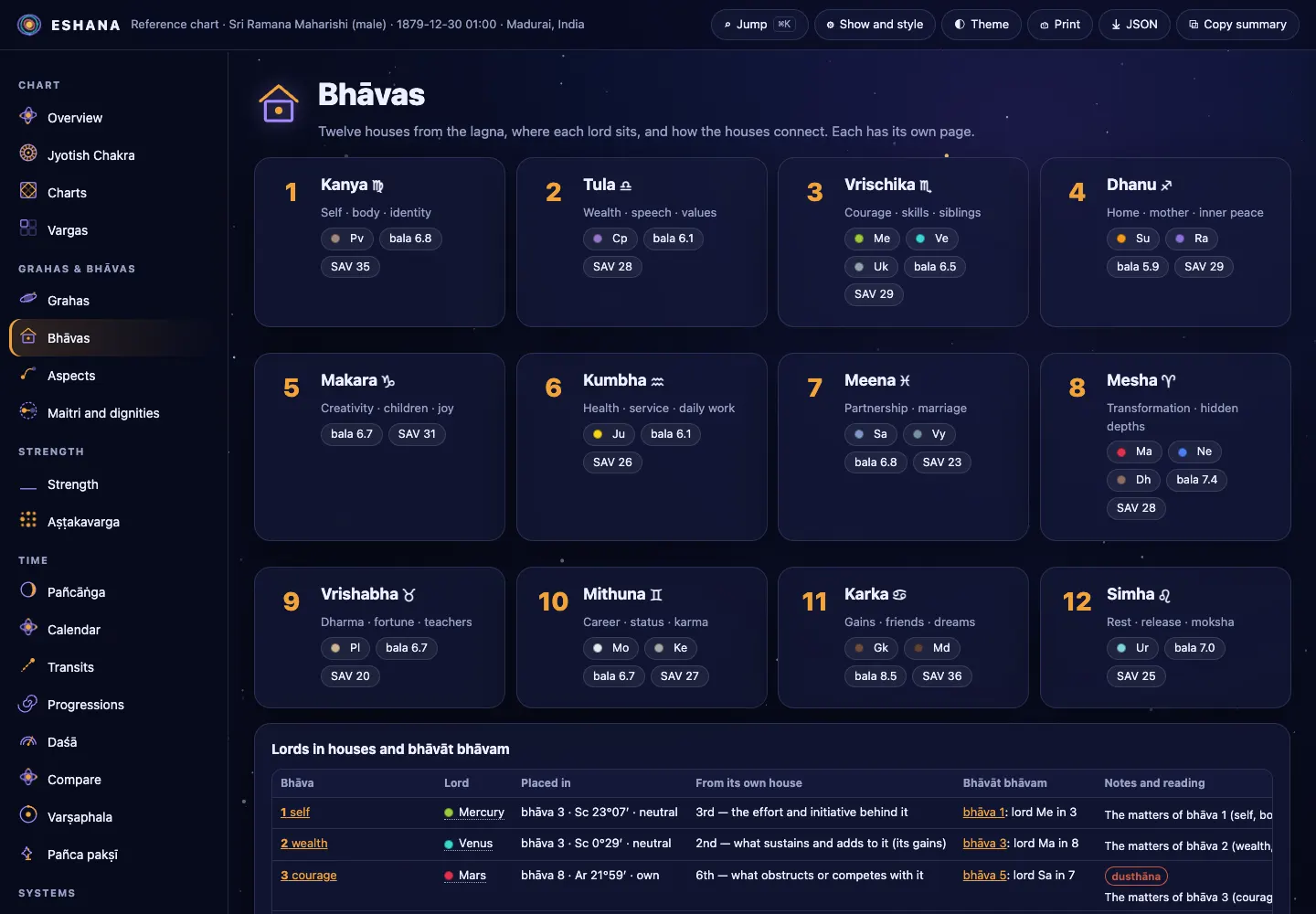 Bhāvas Every house, where its lord sits, and lordships in D1, D9 and D10 with the exchanges between lords. | 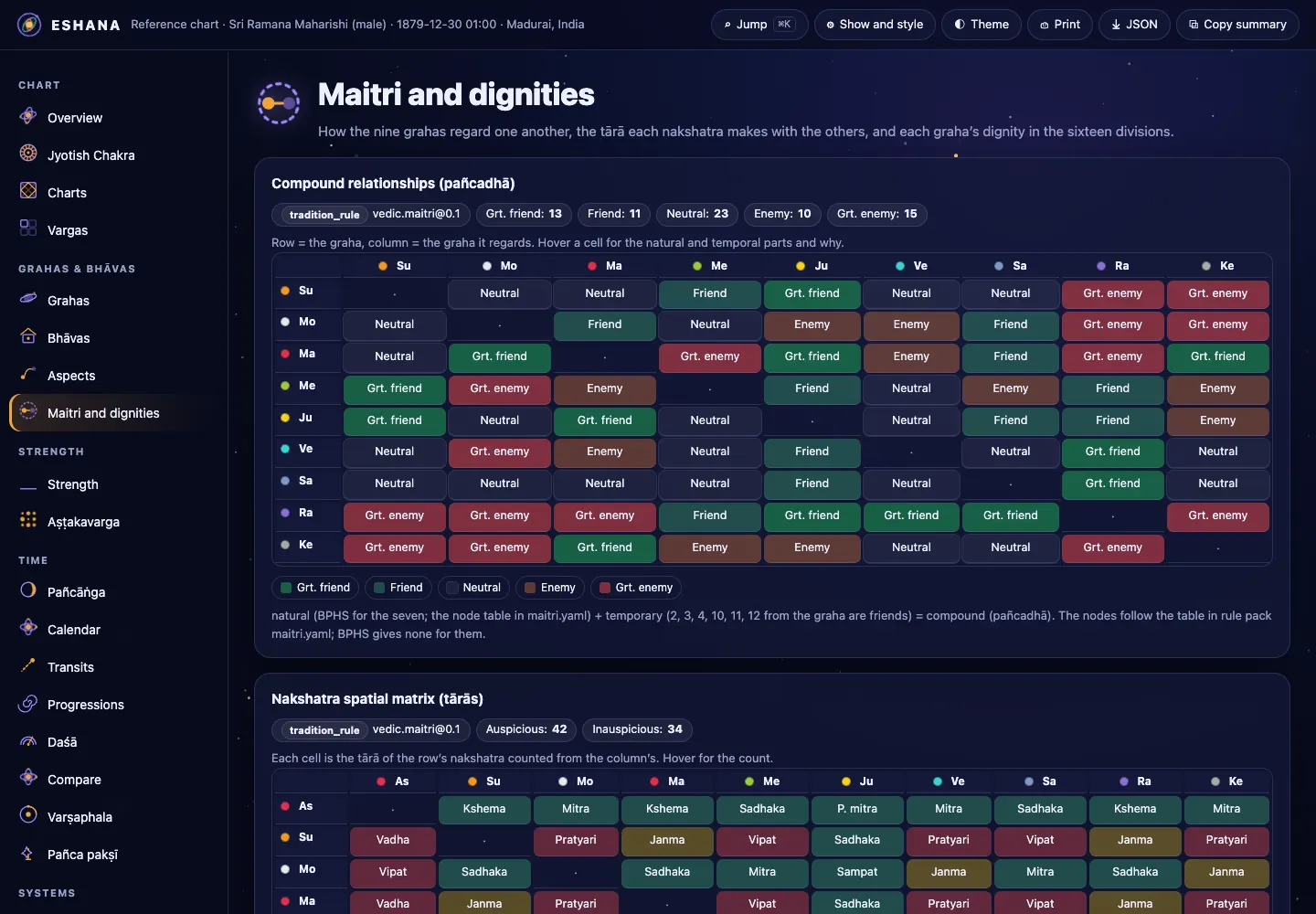 Maitri and dignities Compound relationships of the nine grahas, the nakshatra tārā matrix and dignities in 16 divisions. | Strength Ṣaḍbala with the cut-off at the required minimum, bhāva bala and viṃśopaka. | 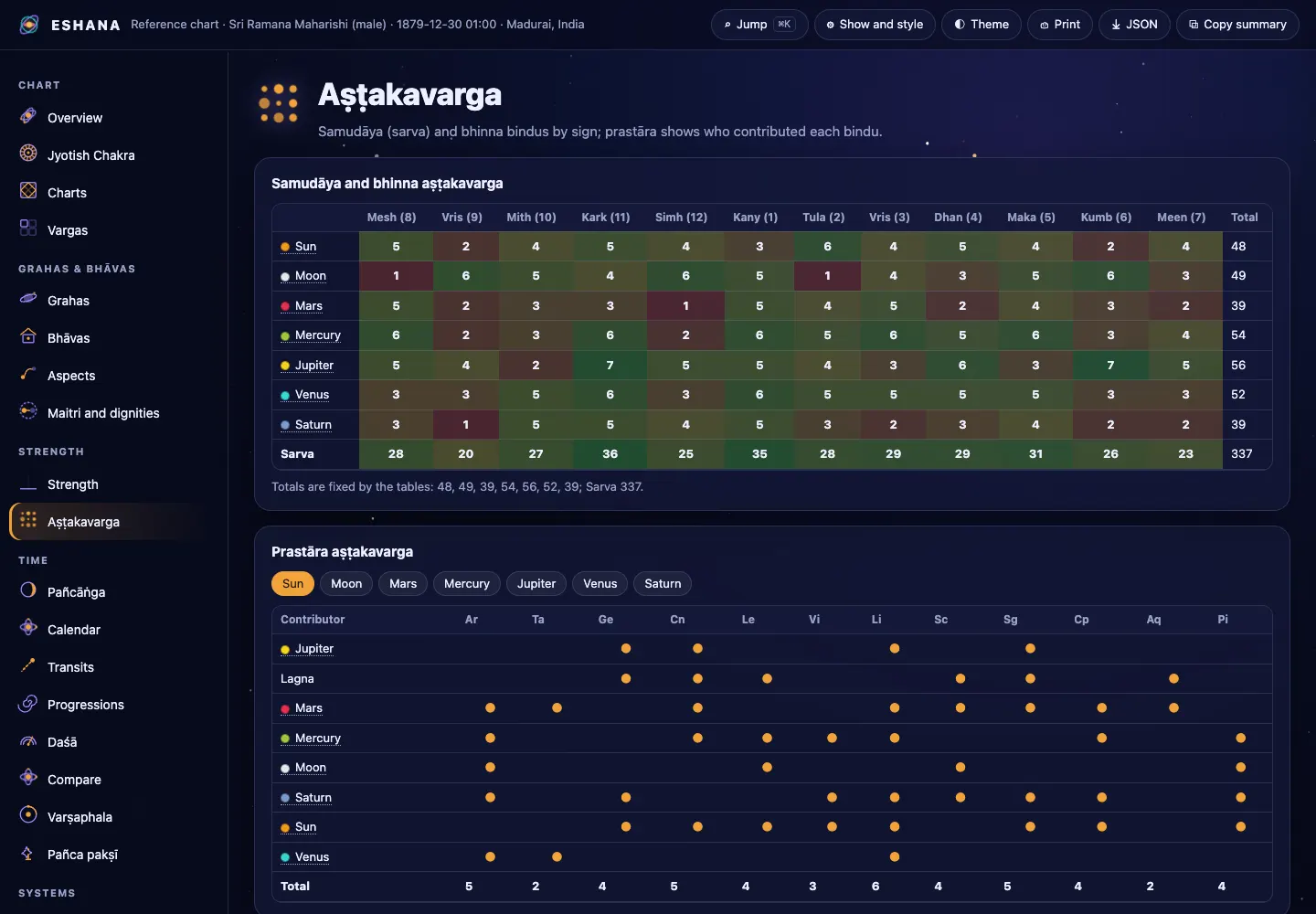 Aṣṭakavarga Bhinna and sarva aṣṭakavarga. |
Daśā Nine daśā systems; the zoom opens five levels deep. Shown: Chara daśā. | 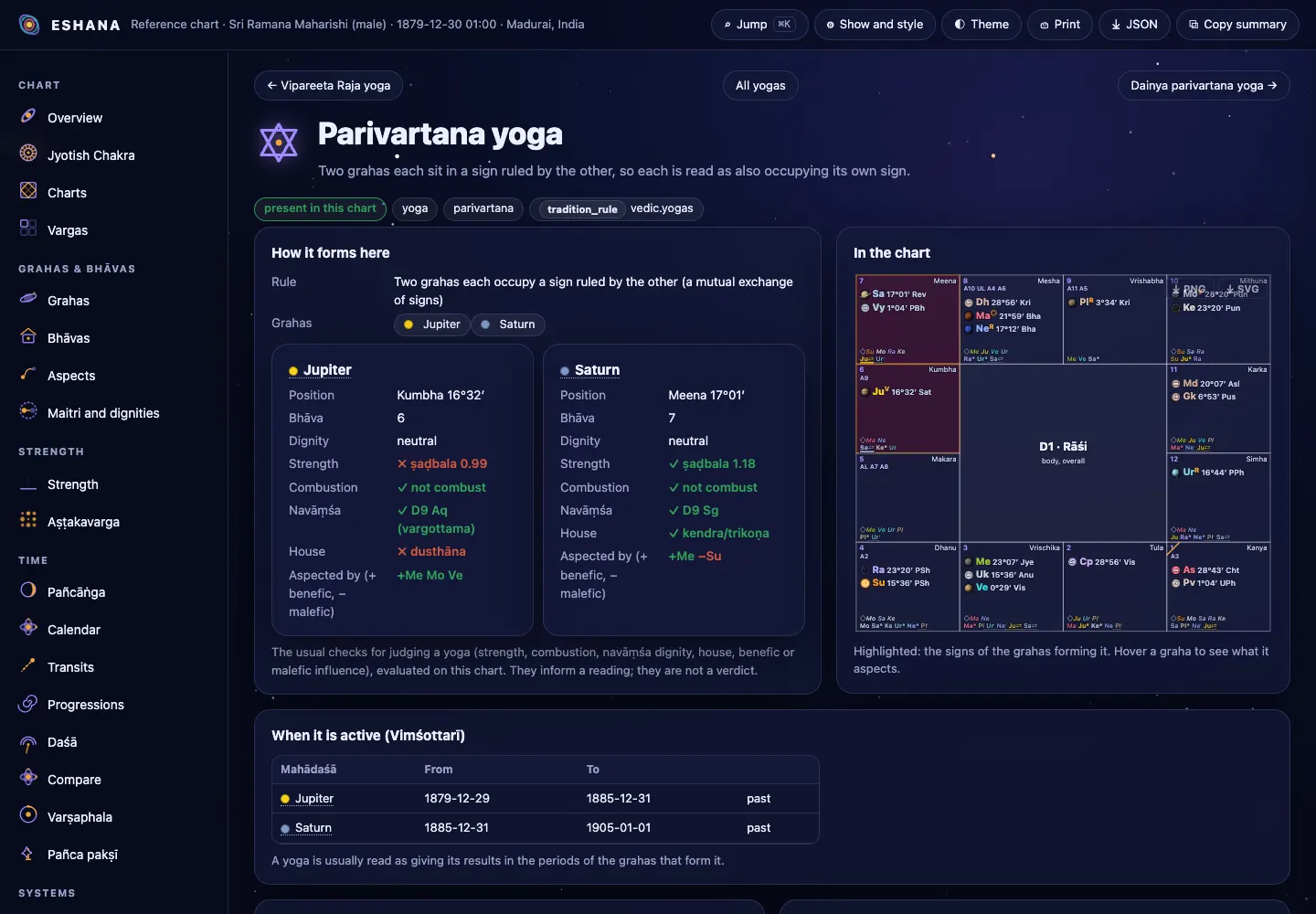 Yogas Each yoga present, with how it forms, strength checks, timing and its reading. Shown: the Jupiter–Saturn parivartana. | 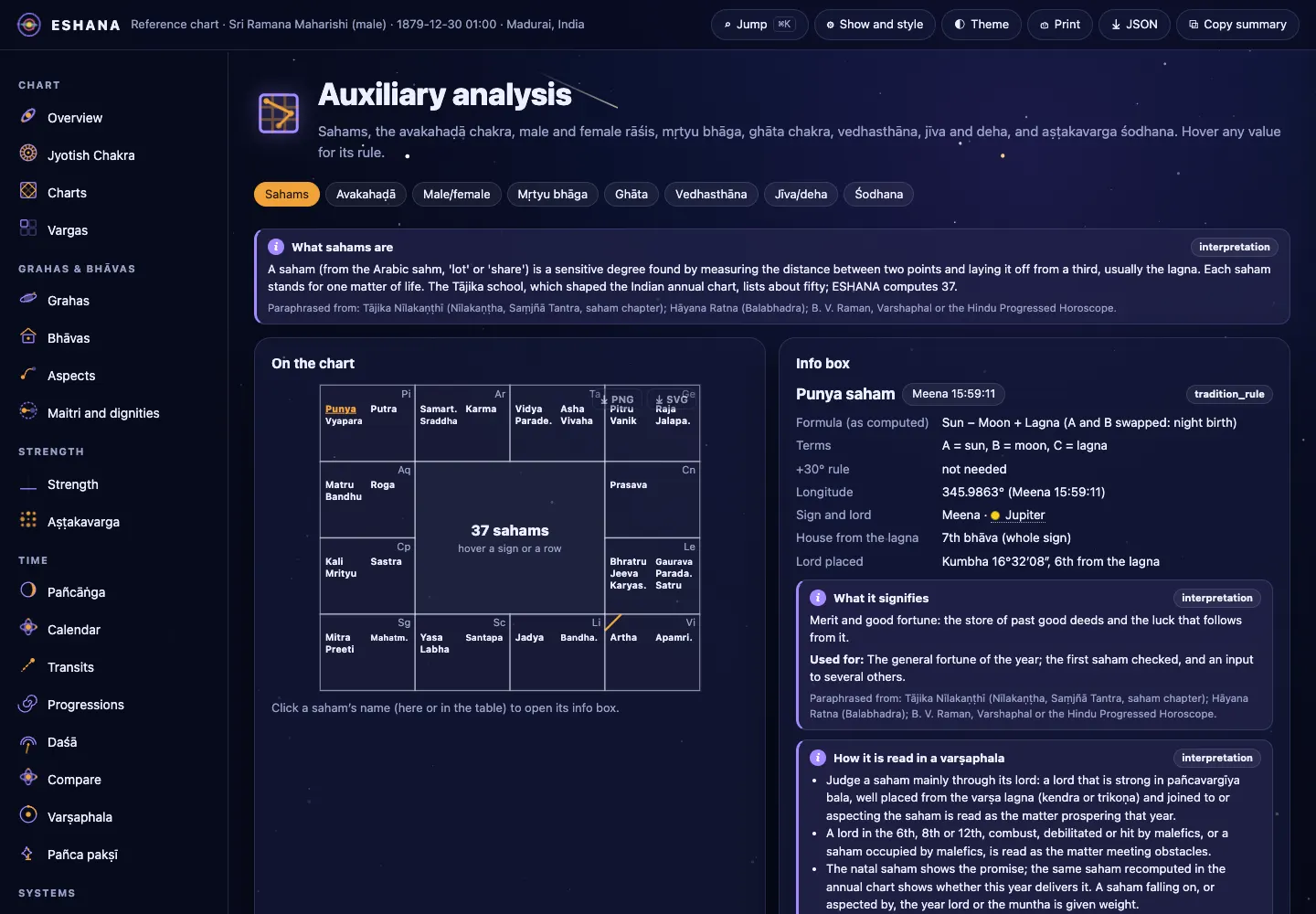 Sahams 37 sahams on the chart, each with an info box: formula as computed, placement and meaning. | 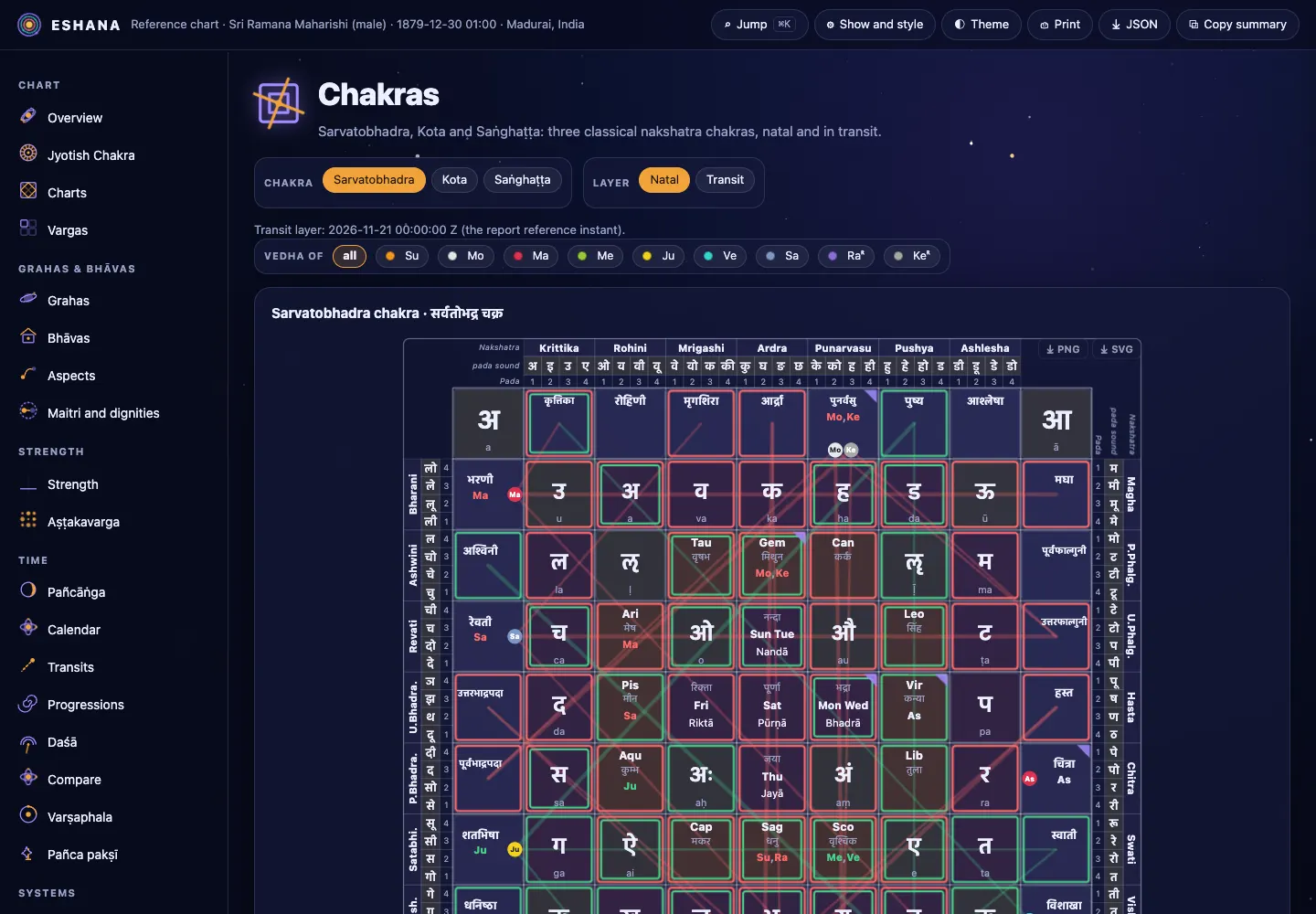 Sarvatobhadra The 9×9 chakra framed by nakshatra, pada-sound and pada bands, with vedha lines and borders. |
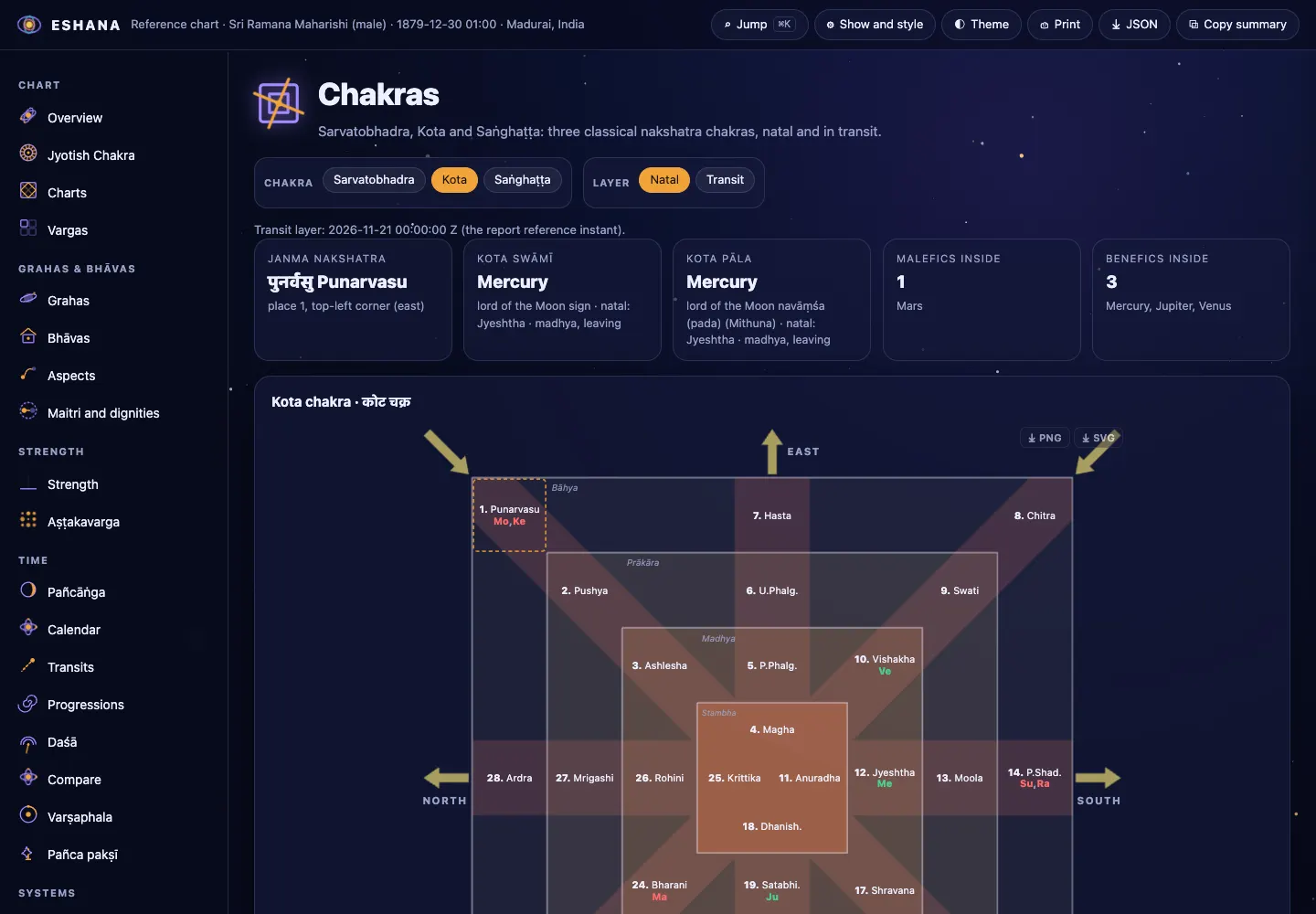 Kota chakra The fort: Bāhya, Prākāra, Madhya and Stambha, with the paths in and out. | 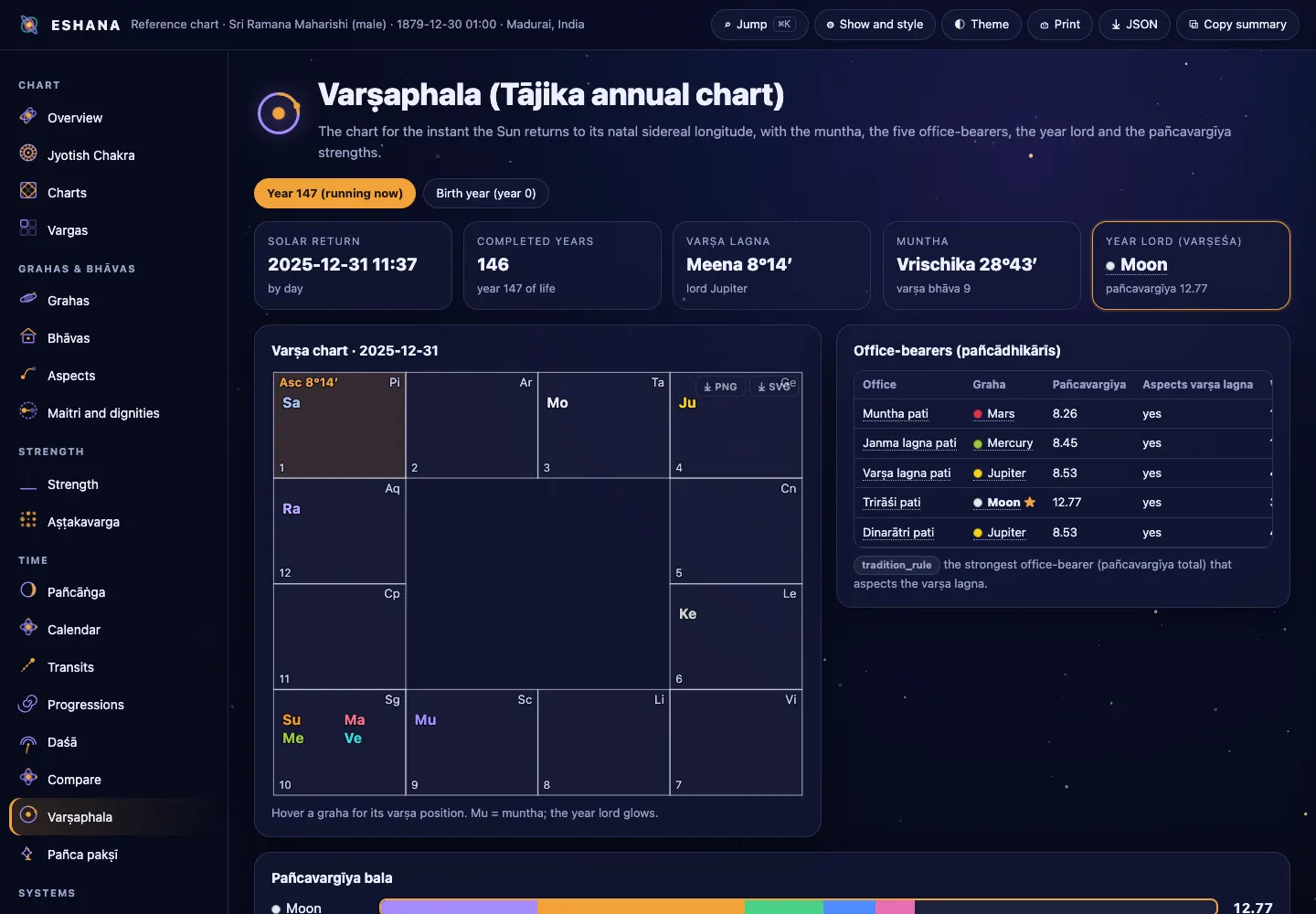 Varṣaphala The annual chart, muntha, office-bearers and the five-fold strengths. | 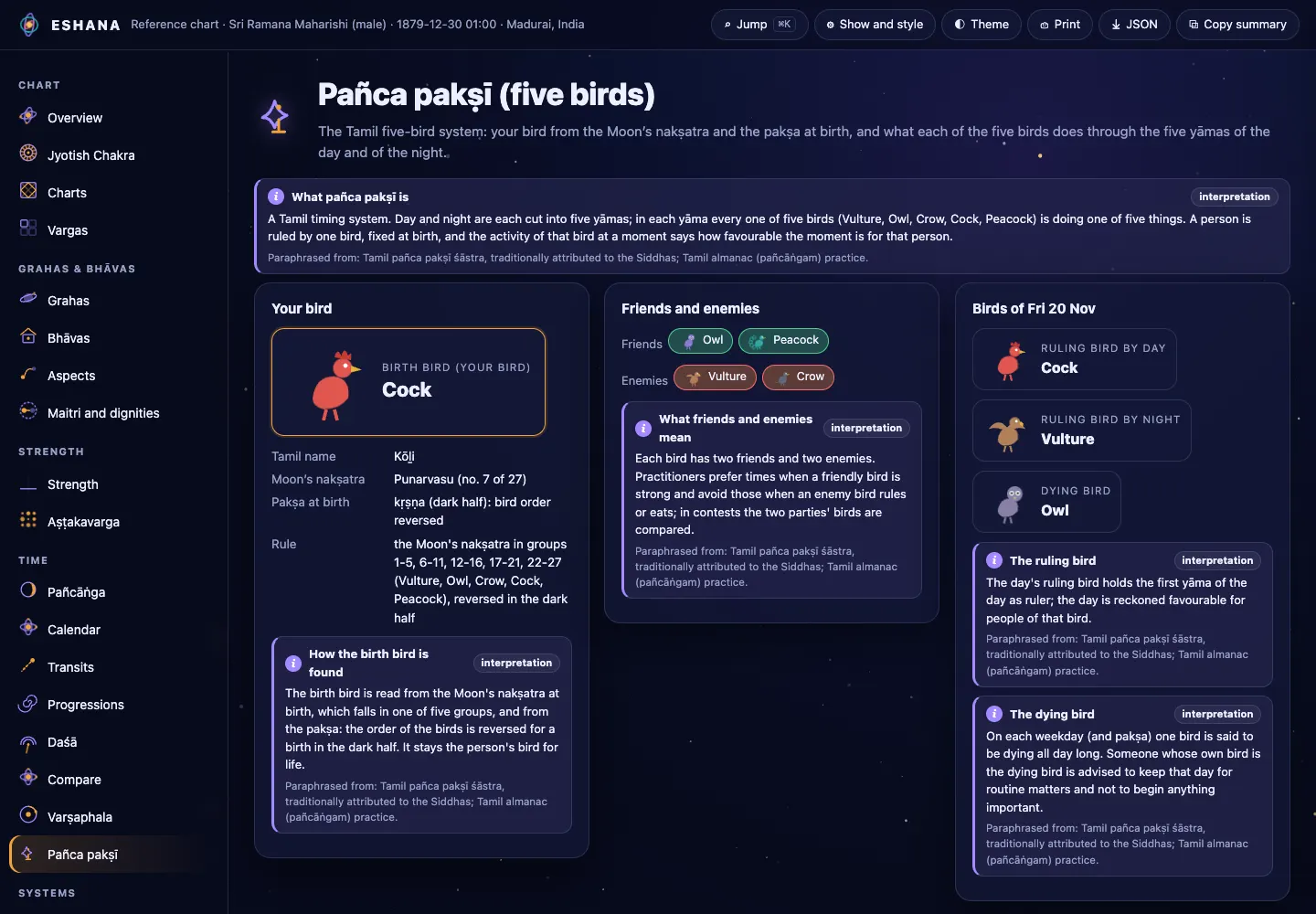 Pañca pakṣī The five birds through the day and the night, the current yāma, and the sub-periods. | 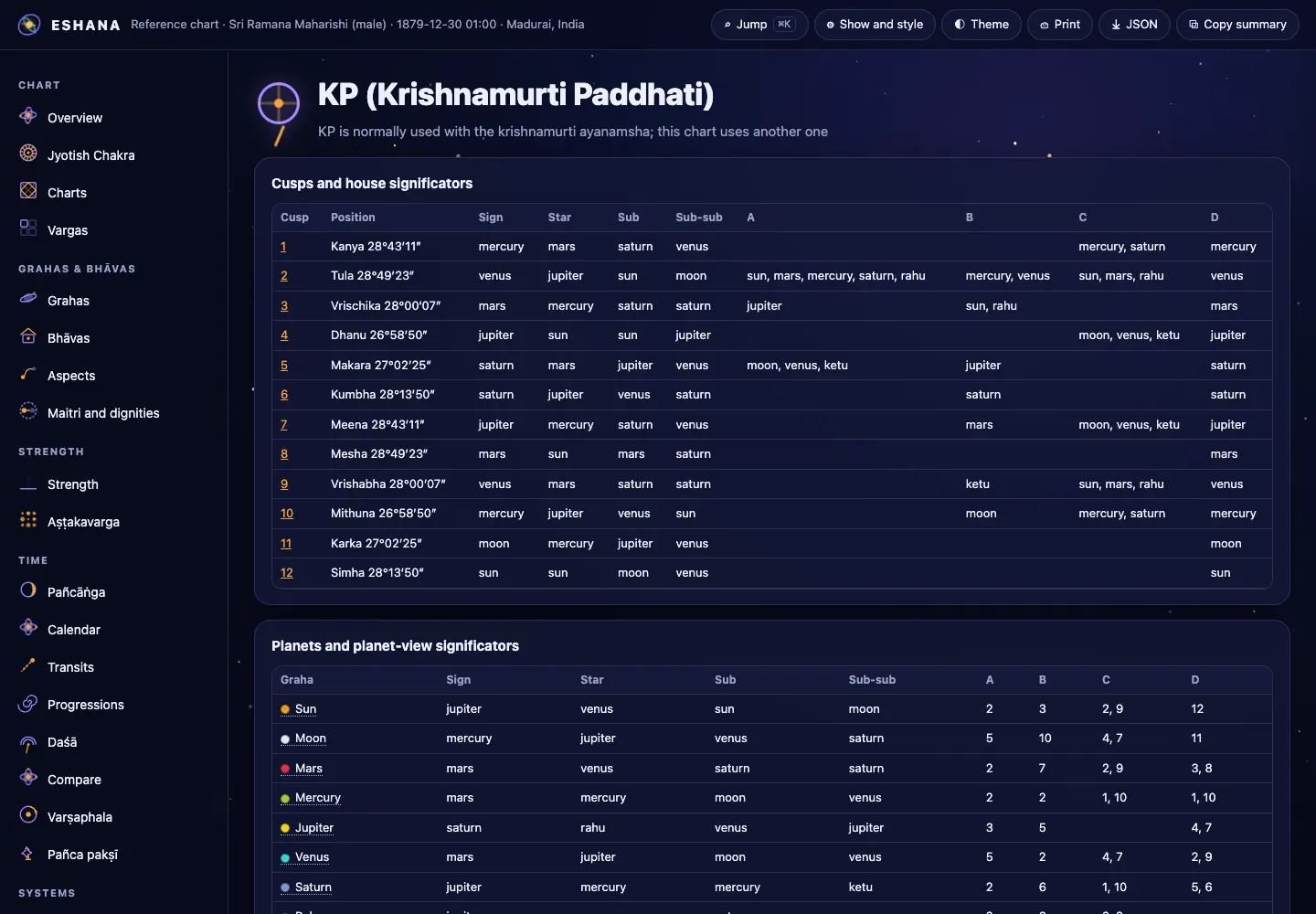 KP Sub-lords, cusps and significator tables by bhāva and by graha. |
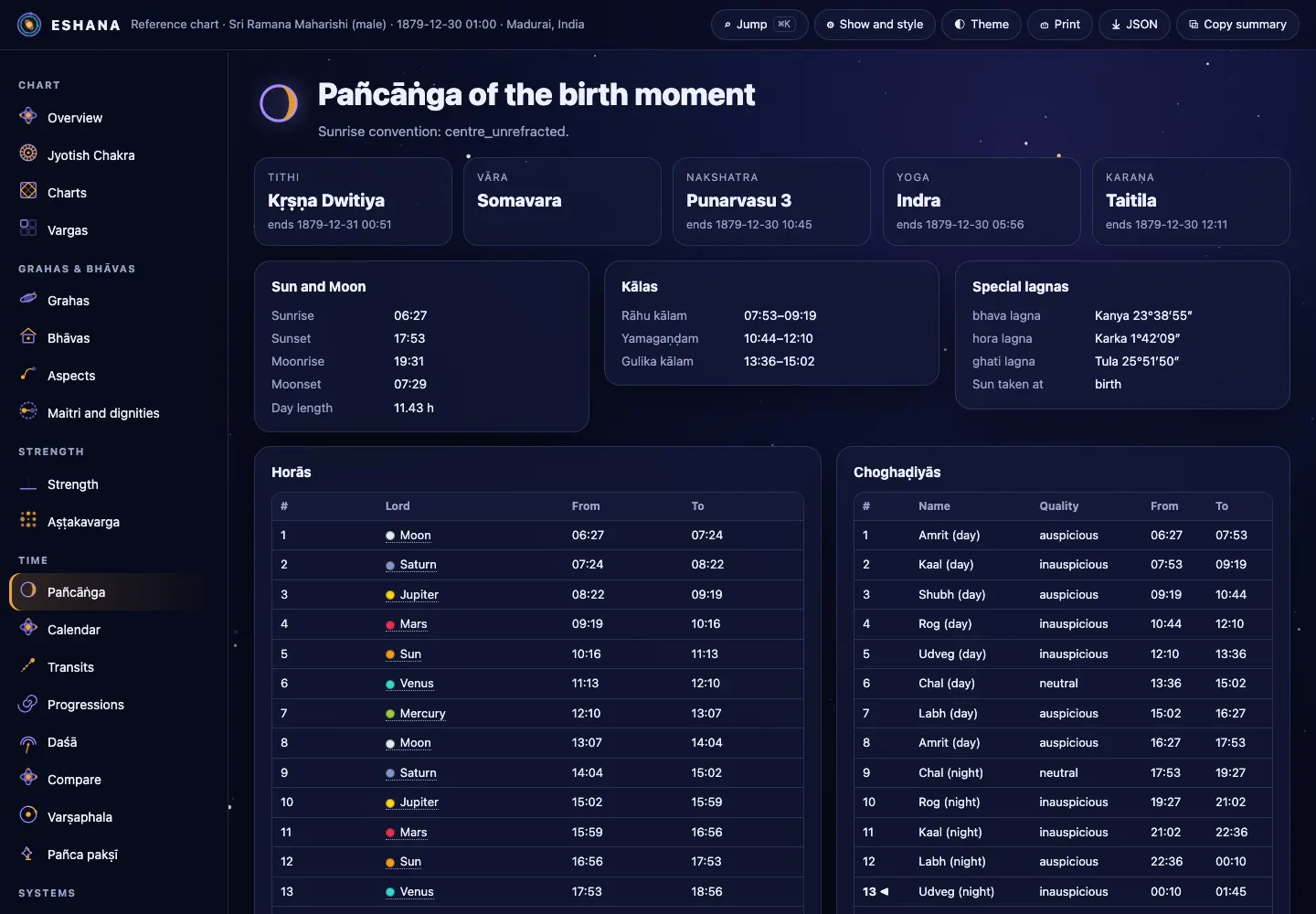 Pañcāṅga Tithi, vāra, nakshatra, yoga and karaṇa at birth. | Human Design The standard BodyGraph with gates, channels and properties. | 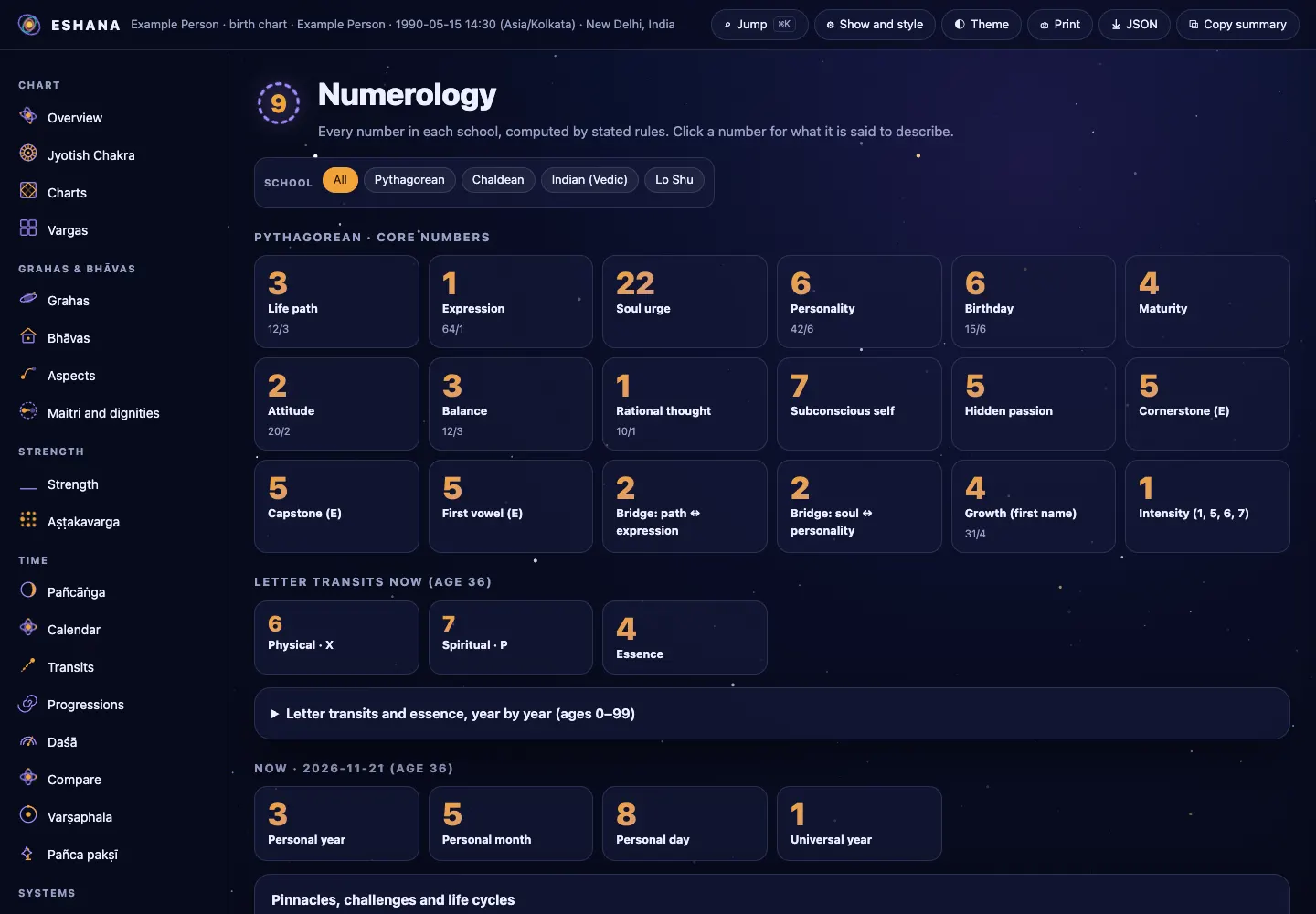 Numerology Every school's numbers, the Lo Shu grid and the Kua number. | Personal calendar Muhūrta windows for 31 days with tārā and candra bala from the birth chart; export as CSV or ICS. |
KP horary Number 100 fixes the Ascendant; Placidus cusps, sub-lords and significators at the moment of judgement. | Compare workspace Natal, progressed and transit positions side by side, recomputed offline by the embedded engine. | 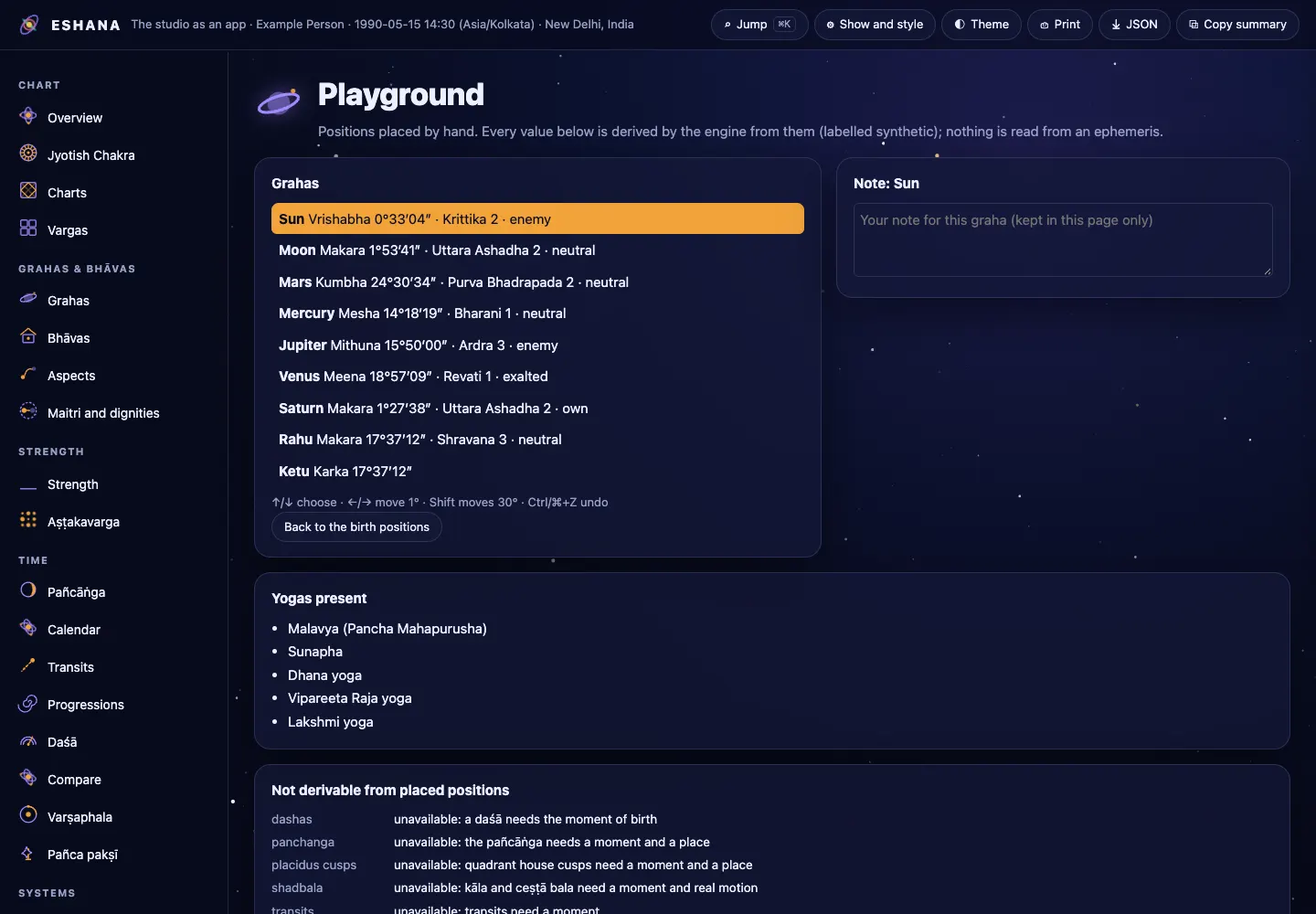 Playground Place grahas by keyboard and see what follows; factors that need a real moment are listed as unavailable. |
Also in the studio:
- 🖼️ Download any chart as PNG or SVG, exactly as shown: your layers, filters, rotation, theme and language. The PNG is print-sized with a caption, and the SVG opens in any editor.
- 🌐 Interface language as a reader setting: English by default, Hindi included. Labels only, never values.
- ⌨️ Keyboard first: ⌘K palette, a playground driven by the arrow keys with undo, focus rings everywhere.
- 🌗 Light and dark themes, every page and every form control checked for contrast in a real browser.
👉 Open the live studio · Studio guide
📝 A new chart from a form
eshana-report new is for people who would rather type the birth details than write options. It starts a one-shot
web form on your machine, waits, and stops as soon as one valid chart is written.
📊 A diagram is here on GitHub: view the README there.
- 🔐 Loopback only, a random token in every URL,
HostandOriginchecked, no external assets. - 🧾 Never overwrites a file (
-2,-3… are added);--librarysaves the birth as a new profile revision. - ⏱️
--timeout(exit 3) and Ctrl-C (exit 130) write nothing. The path is the last line on stdout:open "$(eshana-report new)".
🔭 What it computes
| Area | Highlights |
|---|---|
| 🕰️ Time and positions | IANA zones with historic offsets (war time, double summer time, local mean time); ten bodies plus the nodes, apparent geocentric; an analytic provider with no data files and an spk provider for JPL kernels |
| 🌙 Jyotiṣa | rāśi, nakshatra and pada; vargas D1–D60 plus D81, D108 and D144; ten ayanāṃśas; graha and rāśi drishti; aṣṭakavarga; ṣaḍbala; Jaimini kārakas and ārūḍhas; yogas and doshas; sahams; Sarvatobhadra and Kota chakras; varṣaphala; pañca pakṣī |
| ⏳ Daśās | Vimśottarī to five levels, Yoginī, Chara and more, sixteen systems in all, including seven conditional daśās that report whether their condition holds |
| 🗓️ Timing | stations and retrograde intervals; exact crossings and aspects; dated aṣṭakavarga; pañcāṅga with horā, choghaḍiyā and the kālams |
| 🪔 Muhūrta | windows as exact [start, end) intervals under versioned profiles; an empty result says which rule removed every window; personal and pair calendars (JSON, CSV, ICS) |
| 🎯 KP | sub-lords and significators; horary numbers 1–249 with Placidus cusps; cusp-occupancy methods named, the natal default unchanged |
| 💞 Matching | the 36-point aṣṭakūṭa, unchanged byte for byte; rajju, vedha, mahendra, strī-dīrgha and Maṅgala doṣa with every cancellation listed; cross-chart factors |
| ♈ Western | tropical; whole-sign, equal and Placidus (refused where undefined); aspects with the applying state; secondary progressions with named angle methods |
| 🧬 Human Design | the design instant by solving the 88° solar arc (not "88 days"), gates, lines, channels, centres, type, authority and profile |
| 🔢 Numerology | Pythagorean and Chaldean as separate schemas, Lo Shu and Kua, compound numbers, letter transits |
| 🧪 Research (experimental) | each score is written up first (factors, weights, worked examples); one window-ranking model, labelled experimental |
🌌 The ten ayanāṃśas
| id | id | ||
|---|---|---|---|
lahiri |
Chitrapakṣa, the Indian national standard | jn_bhasin |
J. N. Bhasin |
raman |
B. V. Raman | ushashashi |
Usha–Shashi |
krishnamurti |
KP (the default for KP horary) | sassanian |
Sassanian |
fagan_bradley |
the Western sidereal standard | deluce |
De Luce |
yukteshwar |
Sri Yukteshwar | djwhal_khul |
Djwhal Khul |
Each is defined by its epoch and rate (info → ayanamsha_definitions) and checked against an independent reference
from 1800 to 2100: worst error 0.05″.
🪔 Muhūrta, step by step
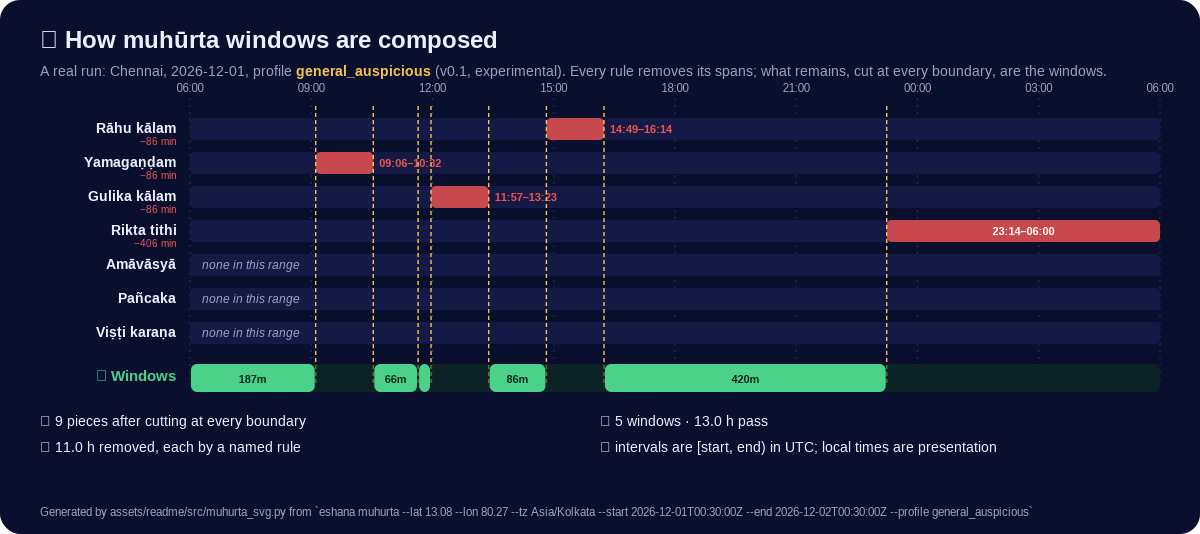
Every factor (the kālams, tithi, nakshatra, karaṇa, horā, choghaḍiyā, tārā and candra bala) is a timeline of exact intervals. A profile is a list of named constraints. The engine cuts the range at every boundary, evaluates each piece and merges equal neighbours, so a window starts and ends exactly where a factor changes. The picture above is drawn from a real run (its generator).
❗ Important
The profiles that combine rules (general_auspicious,personal_general,pair_general,travel) are labelled experimental until a practitioner has reviewed them. Each one lists what it does not cover (śūnya tithis, vāra–nakṣatra yogas, lagna śuddhi), and that list travels with every result.
🧪 One engine, every question
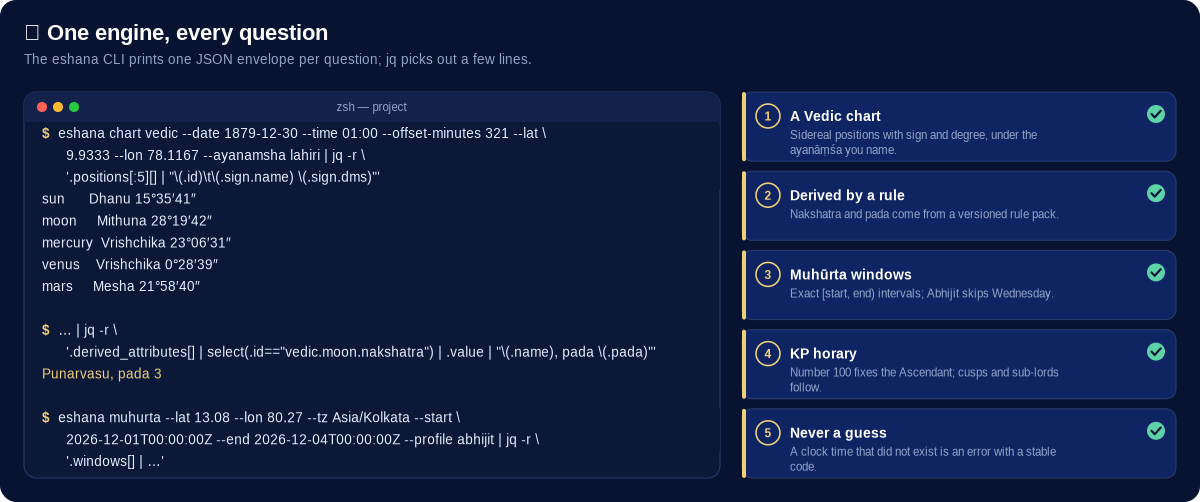
Every line in these walkthroughs is real output from eshana 0.4 (regenerate them from
assets/readme/src/).
🐍 Python cookbook
Every example below was run against eshana 0.4.1; the comments show what it returned.
from eshana import ChartEngine, Context

eng = ChartEngine()
birth = Context.from_local_birth("1990-05-15", "14:30", "Asia/Kolkata", 28.6139, 77.2090)

# 🪔 muhūrta windows for a day in Chennai
mw = eng.muhurta_windows(13.08, 80.27, "2026-12-01T00:30:00Z", "2026-12-02T00:30:00Z",
                         timezone="Asia/Kolkata", profile="general_auspicious")
len(mw["windows"]), mw["windows"][0]["start_local"]       # (5, '2026-12-01T06:00:00+05:30')
mw["removed_minutes"]["no_rahu_kalam"]                    # 85.6…, and which rule removed what

# 📅 a personal calendar as an ICS file for any calendar app
cal = eng.personal_calendar(birth, 28.6139, 77.2090, "2026-12-01T00:00:00Z", "2026-12-08T00:00:00Z",
                            timezone="Asia/Kolkata", format="ics")
cal["media_type"]                                         # 'text/calendar'
open("muhurta.ics", "w").write(cal["content"])

# 🎯 KP horary: number 100, judged now in Chennai
kp = eng.kp_horary(100, Context.from_utc("2026-11-24T06:00:00Z", 13.08, 80.27))
kp["ascendant"]["sign"]["name"], kp["ascendant"]["sign"]["dms"]   # ('Simha', '24°00′00″')

# 🔄 Mercury's stations and retrograde intervals in 2026
st = eng.stations("mercury", "2026-01-01T00:00:00Z", "2027-01-01T00:00:00Z")
st["stations"][0]["station"], st["stations"][0]["utc"]   # ('retrograde', '2026-02-26T06:50:13.770Z')
round(st["retrograde_intervals"][0]["days"], 1)           # 22.5

# 📈 secondary progressions with a named angle method
pr = eng.progressions(birth, "2026-11-24T00:00:00Z", angle_method="naibod_ra")
round(pr["calculation"]["age_years"], 3)                  # 36.528

# 📋 every method family and id the engine knows
[f["family"] for f in eng.methods()["families"]][:4]      # ['ayanamsha', 'house_system', 'node_model', 'divisional_chart']
Anything else is one raw request away: eshana.execute({"op": "…", …}) returns the envelope or raises
EshanaError with a stable ESH-* code. The request format: docs/reference/request.md.
📐 Formulas, written down
Rules are data, and the ones people ask about most are short enough to read here.
Vimśottarī balance at birth. With f the fraction of the birth nakshatra the Moon has already crossed and
Y_lord the years of that nakshatra's lord, the first daśā has
\text{balance} = (1 - f)\, Y_{\text{lord}}, \qquad \sum_{\text{lords}} Y = 120 \text{ years}
Experimental window score (research.window_score@0.1). Each available factor gives s_i \in [0, 1] with weight
w_i; missing factors are left out and their weight is spread over the rest, so the score never pretends to know more
than it does:
S = 100 \sum_{i \in A} \frac{w_i}{\sum_{j \in A} w_j}\, s_i, \qquad \text{coverage} = \sum_{i \in A} w_i \;\;(\text{no score below } 0.5)
The specification, with hand-worked examples that are also the unit tests: docs/design/research-models.md.
⚙️ How it works
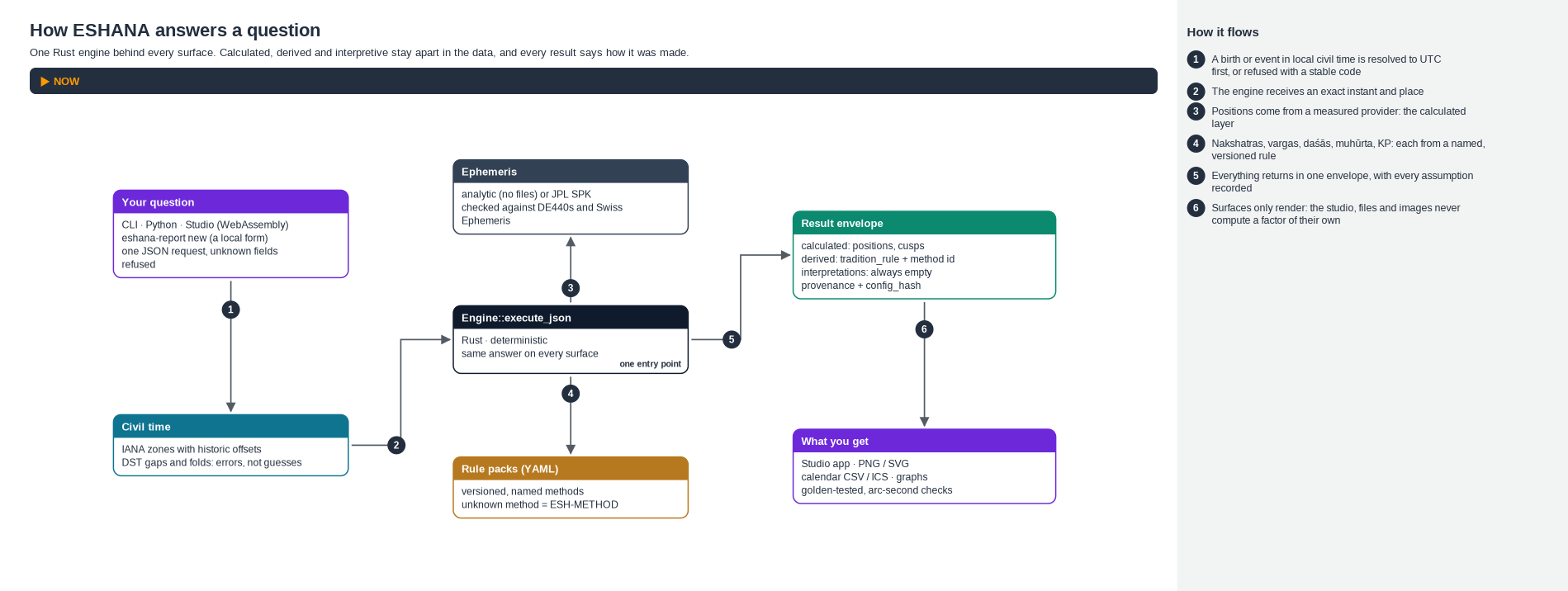
📊 A diagram is here on GitHub: view the README there.
- One entry point.
Engine::execute_jsontakes a JSON request (with anop) and returns a JSON envelope. The CLI, the Python package (pyo3) and the WebAssembly build (three C functions, no bindings generator) are thin shells. - Rule packs are data. YAML files with versions and method ids, printed by
eshana rulesets. A changed formula is a new rule version, with golden fixtures that show the difference. - Surfaces never compute. The studio renders envelopes; it never works out a factor of its own.
🛡️ Guarantees
Each of these is a scenario in the release gate (make acceptance: 122 scenarios, all passing):
| Guarantee | Error code | |
|---|---|---|
| 🚫 | Sidereal without an ayanāṃśa is refused, unless you ask for defaults, in which case the default is recorded | ESH-CONFIG |
| ⏰ | A local time that the clocks skipped is refused | ESH-TIME-NONEXISTENT |
| 🔁 | A local time that happened twice is refused until you pick earliest or latest |
ESH-TIME-AMBIGUOUS |
| 🧊 | Placidus beyond the polar circle is refused, not approximated | ESH-LATITUDE |
| ❓ | An unknown birth time gets intervals, not noon; the Ascendant and houses are never invented | ESH-TIME-UNCERTAIN |
| 🧩 | An unknown method id is refused, never swapped for a default | ESH-METHOD |
| 📏 | A search past its documented limit is refused or marked truncated |
ESH-LIMIT |
| 🔂 | The same request returns the same bytes, with a config_hash naming the settings |
|
| 🙈 | A chart writes nothing to disk and sends nothing anywhere | |
| 🧷 | Unavailable is not zero: a factor that cannot be computed says so, and says what is missing |
📏 Accuracy, measured
Not promised: measured against independent references and written down.
| What | Against | Result |
|---|---|---|
🌍 Positions, spk provider |
an independent JPL DE440s pipeline | 0.3″ |
🌍 Positions, analytic provider (40 charts) |
Swiss Ephemeris (offline oracle) | Moon 6″ worst, Sun 18″; outer planets arc-minute class |
| 🧭 Ascendant and cusps | Swiss Ephemeris | 3.2″ worst |
| 🎯 KP horary cusps | Swiss Ephemeris houses_armc |
0.07″ |
| 📐 Ten ayanāṃśas, 1800–2100 | Swiss Ephemeris | 0.05″ worst (De Luce) |
| ⏱️ Stations and crossings | Swiss Ephemeris event search | within the stated solver tolerance |
| 📚 Published charts | printed reference values | see the accuracy report |
⚠️ Warning
Theanalyticprovider is arc-minute class for Jupiter and Saturn. When that matters, use thespkprovider with a JPL kernel (--provider spk --spk de440s.bsp).
The Swiss Ephemeris is used only as an offline test oracle: never bundled, never linked. Details: accuracy report · provider accuracy · accuracy guide.
📖 Reference
⚙️ All 24 operations (the op of a request)
op |
What it answers | |
|---|---|---|
| 🌍 | positions |
apparent geocentric positions only |
| 🪐 | chart |
a Vedic (sidereal) or Western (tropical) chart, with the requested features |
| 🧬 | human_design |
design instant by the 88° solar arc, gates, lines, channels, type, authority, profile |
| 🔢 | numerology |
name and birth-date numerology under a named school |
| 🔁 | compare |
the same input under two configurations, with a diff of what changed |
| 🕸️ | graph |
a symbolic graph of a chart: JSON, Mermaid or GraphML, no causal edges |
| 🌅 | panchanga |
tithi, vāra, nakshatra, yoga, karaṇa, sunrise, horā, choghaḍiyā and the kālams |
| 💞 | matching |
aṣṭakūṭa matching plus the supplementary rules, each cancellation listed |
| 📈 | ephemeris |
longitudes at regular steps (transit animation, progressions) |
| 🚪 | ingresses |
sign ingresses of one body between two instants |
| 🔄 | stations |
stations and retrograde intervals, clipped flags at the range ends |
| 🎯 | crossings |
when a body reaches a point or an aspect to it, with touches reported apart |
| 📜 | rulesets |
the built-in YAML rule packs |
| 📐 | methods |
every method family and id the engine implements |
| 🗓️ | ashtakavarga_transits |
dated aṣṭakavarga: the natal bindus each graha reads, between ingresses |
| 🪔 | muhurta_windows |
muhūrta windows composed from factor timelines under a profile |
| 📅 | personal_calendar |
windows with tārā and candra bala from a birth; JSON, CSV or ICS |
| 👫 | pair_calendar |
windows that suit two people and the event, each explained |
| 📆 | progressions |
secondary progressions with fractional age and named angle methods |
| 🔢 | kp_table |
the KP 1–249 horary number table |
| 🎯 | kp_horary |
a KP horary chart: the number fixes the Ascendant |
| 🧪 | synthetic_chart |
positions you place by hand, labelled synthetic (the playground) |
| 📊 | research_window_score |
the experimental window score, with coverage and sensitivity |
| ℹ️ | info |
versions, operations, method families and ayanāṃśa definitions |
Fields of each: docs/reference/request.md.
🧰 All 25 CLI commands
| Command | What it does |
|---|---|
eshana positions |
Apparent geocentric positions only |
eshana chart |
A Vedic (sidereal) or Western (tropical) chart |
eshana human-design |
Human Design: design instant, gates, lines, channels, type, authority, profile |
eshana numerology |
Name and birth-date numerology |
eshana compare |
Same input under two configurations, with a diff of what changed |
eshana graph |
Symbolic graph of a chart: json, mermaid or graphml |
eshana panchanga |
Panchanga and day divisions (sunrise, tithi, nakshatra, yoga, karana, hora, choghadiya, rahu kalam) |
eshana ashtakavarga-transits |
Transit Ashtakavarga: the natal BAV/SAV cells each graha reads, as segments between ingresses |
eshana muhurta |
Muhurta windows: factor timelines over a range composed under a profile and constraints |
eshana calendar |
Personal calendar: muhurta windows with tara and chandra bala from a birth, day summaries; json, csv or ics |
eshana pair-calendar |
Pair calendar: windows that suit both people and the event; each window explained by both and the event |
eshana progress |
Secondary progressions: a day for a year, fractional age, angles under a named method |
eshana kp-table |
The KP 1-249 horary number table |
eshana kp-horary |
KP horary chart: the number fixes the Ascendant; the moment and place are those of judgement |
eshana matching |
Ashtakoota compatibility of two births: a = the role classical tables give the groom, b = the bride |
eshana ephemeris |
Longitudes at regular steps (transit animation, progressions) |
eshana ingresses |
Sign ingresses of one body between two instants |
eshana stations |
Stations and retrograde intervals of one body between two instants |
eshana crossings |
When a body reaches a longitude, or an aspect to it, between two instants |
eshana rulesets |
Print the built-in YAML rule packs |
eshana methods |
List every method family and method id the engine implements |
eshana request |
Send a raw JSON request from a file, or - for stdin |
eshana doctor |
Show the environment, providers, rule packs and error codes |
eshana explain |
Explain a stable error code, e.g. ESH-LATITUDE |
eshana schema |
Print the JSON Schema of the result envelope |
Every command prints one JSON envelope; --compact for one line. Errors print an error envelope and exit 2.
📐 All 13 method families (eshana methods)
| Family | Method ids |
|---|---|
ayanamsha |
lahiri, raman, krishnamurti, fagan_bradley, yukteshwar, jn_bhasin, ushashashi, sassanian, deluce, djwhal_khul |
house_system |
whole_sign, equal, placidus |
node_model |
mean, true |
divisional_chart |
d1, d2, d3, d4, d5, d6, d7, d8, d9, d10, d12, d16, d20, d24, d27, d30, d40, d45, d60 |
year_convention |
julian, gregorian, savana, sidereal |
sunrise |
upper_limb_refracted, centre_refracted, centre_unrefracted |
event_search |
ingresses, stations, crossings |
numerology_school |
pythagorean, chaldean |
kp_cusp_occupancy |
cusp_start, cusp_midpoint |
muhurta_profile |
daily_avoidances, general_auspicious, abhijit, brahma_muhurta, personal_general, pair_general, travel |
varga_method |
d2_parivritti, d3_parivritti, d81_navanavamsha, d108_ashtottaramsha_cyclic, d144_dvadasha_dvadashamsha |
progression_angles |
solar_arc_longitude, naibod_ra, quotidian |
research_model |
research.window_score@0.1 |
An id that is not listed is refused with ESH-METHOD, never replaced by a default.
🚨 All 14 error codes (eshana explain CODE)
| Code | Meaning |
|---|---|
ESH-INPUT |
Malformed or out-of-range input |
ESH-CONFIG |
Conflicting or incomplete configuration |
ESH-TZ-UNKNOWN |
Unknown IANA time zone |
ESH-TIME-AMBIGUOUS |
Local time occurs twice; give a fold policy |
ESH-TIME-NONEXISTENT |
Local time was skipped by a DST change |
ESH-TIME-UNCERTAIN |
Result needs a more precise birth time |
ESH-RANGE |
Instant outside the provider's range |
ESH-BODY |
Provider cannot supply this body |
ESH-LATITUDE |
Houses undefined at this latitude |
ESH-PROVIDER |
Ephemeris provider failure |
ESH-RULES |
Rule-pack or numerology policy problem |
ESH-METHOD |
Method id not implemented; list them with the methods operation |
ESH-RANGE-INVALID |
Range end is not after its start |
ESH-LIMIT |
Request exceeds a documented work limit |
Codes are stable across versions: docs/reference/errors.md.
🧩 Ways to use it
| You want… | Use | Example |
|---|---|---|
| 🪐 a chart to read, offline | eshana-report |
eshana-report --date … --tz … --lat … --lon … --live -o chart.html |
| 📝 to type details, not flags | eshana-report new |
a local form on 127.0.0.1 that writes the chart and stops |
| 🐍 numbers in Python | eshana |
eshana.execute({"op": "muhurta_windows", …}) or ChartEngine() |
| 🧰 JSON from a shell | the Rust CLI | eshana chart vedic …, eshana muhurta …, eshana kp-horary … |
| 🗓️ a calendar file | personal_calendar |
format: "ics" for any calendar app |
| 🕸️ the engine in a browser | eshana-wasm |
three C functions, no bindings generator (ADR-013) |
pip install eshana                                    # Python package + eshana-report
cargo build --release -p eshana-cli                   # the Rust CLI, from source
The prebuilt wheel is for macOS on Apple silicon (abi3, CPython 3.9 and later); other platforms build from the sdist, which needs a Rust toolchain. More in ways to use ESHANA.
🛠️ Development and releases
make verify            # fmt, clippy -D warnings, every Rust test, Python tests, tracker freshness, accuracy suite
make acceptance        # the Gherkin release gate (must say PROMOTE)
make studio-journeys   # real Chrome: every studio page, text hierarchy, downloads, contrast, the new-chart form
make docs-check        # docs, links, ADR index, and that the PyPI README matches this one
make preview           # local preview of the studio and the website
📊 A diagram is here on GitHub: view the README there.
Work is tracked in planning/backlog.json, rendered as
planning/TRACKING.md, with exact status words: proposed, implemented, verified
(evidence required) and released. Releasing: docs/guides/publishing.md.
🗺️ Repository map
| Path | What |
|---|---|
crates/ |
eshana-core, -time, -ephemeris, -engine (rules and rule packs), -cli, -python, -wasm |
docs/ |
concepts, guides, reference and ADRs; also the source of the website |
website/ |
the Astro site: landing page, live demos, gallery |
acceptance/ |
Gherkin capability scenarios, the release gate, and the browser journeys |
accuracy/, benchmarks/ |
the birth-chart accuracy suite, golden fixtures and offline oracle data |
examples/ |
example studio reports and the gallery screenshots, all generated by the real engine |
assets/readme/ |
the animated SVGs on this page, with their sources and generators |
planning/ |
the backlog, the tracker and the capability-expansion plan |
scripts/ |
report, gallery, capability, tracker and PyPI-README generators and checks |
❓ FAQ
Does ESHANA tell me what my chart means?
No. It computes positions and applies named rules, and it labels each. interpretations is always empty. The studio
shows reading notes only where they are attributed to a source, kept apart from the engine's output.
Why was my birth time refused?
Because it did not exist, or happened twice. On a spring-forward night the clock jumps from 02:00 to 03:00, so 02:30
never happened (ESH-TIME-NONEXISTENT). On a fall-back night 01:30 happens twice (ESH-TIME-AMBIGUOUS); say which
with --fold earliest or --fold latest. Old records may need a fixed offset: --offset-minutes 321 for local mean
time in Madurai in 1879.
Which ayanāṃśa, houses and nodes should I use?
ESHANA does not choose for you. Sidereal charts need an ayanāṃśa (lahiri is the common one). Houses default to
whole-sign for Vedic charts and nodes to mean, and both defaults are written into provenance.assumptions. KP horary
defaults to krishnamurti and Placidus, as KP defines it.
Does anything leave my machine?
No. The engine has no network code, a chart writes nothing to disk unless you ask it to, the studio is an offline file,
and eshana-report new listens on 127.0.0.1 only. Tests check that the studio file loads nothing from the network,
and release-gate scenarios check that a chart writes nothing to your project or home folder and that birth data is not
echoed to the terminal.
How do I cite a result?
Keep the envelope: schema_version, provenance (engine, provider, tz database and rule versions) and
calculation.config_hash identify exactly how it was computed. The same request returns the same bytes.
Can I use it from JavaScript?
Yes, through eshana-wasm: eshana_alloc, eshana_execute and eshana_free take and return the same JSON as
everywhere else. The studio's --live mode is that module, embedded. See ADR-013.
🤝 Status and honesty
- 📦 Version 0.4, on PyPI. Open source under Apache-2.0 (ADR-011).
- 🧪 Experimental pieces are labelled. Muhūrta purpose presets and the research window score wait for a practitioner's review. The conditional daśās wait for published worked examples.
- 🔭 Know the provider.
analyticis arc-minute class for Jupiter and Saturn; usespkwith a JPL kernel when that matters. - 🧭 Next steps: docs/next-steps.md · changes: CHANGELOG.md · design record: ESHANA_Project_Vision_and_Master_Plan.md.
Calculated · Derived by a named system · Never interpreted for you 🌌
1 maintainer

Metadata
1 maintainer
Release files for eshana 0.4.2
For a detailed explanation of source distributions (sdists) and built distributions (wheels), please see the package formats documentation.
Source distribution (sdist)
| File | Size | Uploaded | Provenance | Actions |
|---|---|---|---|---|
| eshana-0.4.2.tar.gz | 1.5 MB | Without provenance | Details for eshana-0.4.2.tar.gz |
Built distribution (wheel)
| File | Interpreter | ABI | Platform | Actions Reset |
|---|---|---|---|---|
| eshana-0.4.2-cp39-abi3-macosx_11_0_arm64.whl | CPython 3.9 | abi3 | macOS 11.0+ ARM64 | Details for eshana-0.4.2-cp39-abi3-macosx_11_0_arm64.whl |
Total release size: 4.4 MB
Release files / eshana-0.4.2.tar.gz
| Download URL | eshana-0.4.2.tar.gz |
|---|---|
| Size | 1.5 MB |
| Tags | Source |
|
SHA-256 checksum How to use checksums |
026e67b83a26a007196ccdadbdaebaf0e76f8dc0ffdeb10c2f3fcdc1c523a158
|
|
BLAKE2b-256 checksum How to use checksums |
edfe8c84ec87f43f115b06ea0d67c6d31aac513f448f4a36c2e690893796fdaa
|
| Upload date | |
|
Uploaded using Trusted Publishing? What is trusted publishing? |
No |
| Uploaded via |
uv/0.8.22
|
Release files / eshana-0.4.2-cp39-abi3-macosx_11_0_arm64.whl
| Download URL | eshana-0.4.2-cp39-abi3-macosx_11_0_arm64.whl |
|---|---|
| Size | 2.9 MB |
| Tags | CPython 3.9 abi3 macOS 11.0+ ARM64 |
|
SHA-256 checksum How to use checksums |
76ec6881d07ce016f6638ba1e65b7615658a16317b9326ad8fe1f163d15bf965
|
|
BLAKE2b-256 checksum How to use checksums |
1cccbc28dff2d88d152d34d3e43e73e292d4a798751e92c798aae4e9f6975598
|
| Upload date | |
|
Uploaded using Trusted Publishing? What is trusted publishing? |
No |
| Uploaded via |
uv/0.8.22
|
Security for eshana 0.4.2
Provenance
Provenance describes where a file came from. On PyPI, provenance is shared via attestations, which provide a verifiable record of the build or publishing details. View details, limitations and caveats.
No provenance found
None of the files in this release were uploaded with provenance metadata.
A note on package security
PyPI is a repository for distributing packages, not a service for auditing them. While third-party security researchers and our staff do their best to detect and remove malicious packages, PyPI cannot guarantee the quality, security or suitability of any given package.
To learn more about protecting yourself from malicious actors, visit our package security documentation.














