
fast_trimul
A drop-in, hardware-agnostic library for Fused Triangle Multiplicative Updates across AlphaFold3-family models, powered by CUTLASS CuTe kernels. A drop-in, hardware-agnostic library for Fused Triangle Multiplicative Updates across AlphaFold3-family models, powered by CUTLASS CuTe kernels





Works with OpenFold-3, Chai, and Protenix (Others coming!!).
At a glance
*This runs the real OpenFold-3 code with fast_trimul patched in — the exact
one-line swap from the Quickstart,
with a ready-to-run quickstart_lightning example included.
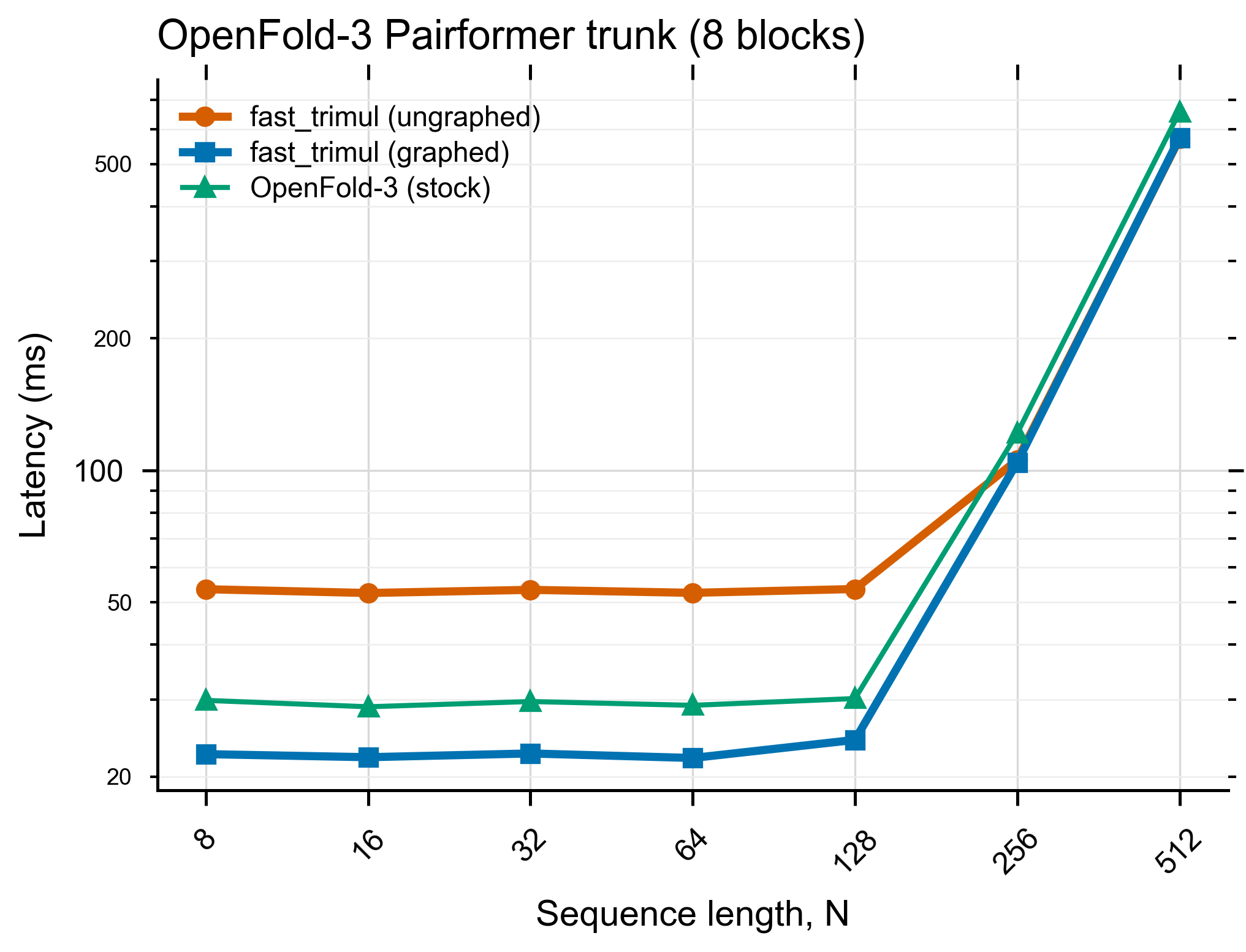
Speed — the graphed fast kernel beats the stock (native) trunk at every N:
| N | 8 | 16 | 32 | 64 | 128 | 256 | 512 |
|---|---|---|---|---|---|---|---|
| graphed vs native — faster by | 33% | 30% | 31% | 32% | 24% | 17% | 15% |
Memory — but graphed's peak VRAM is higher:
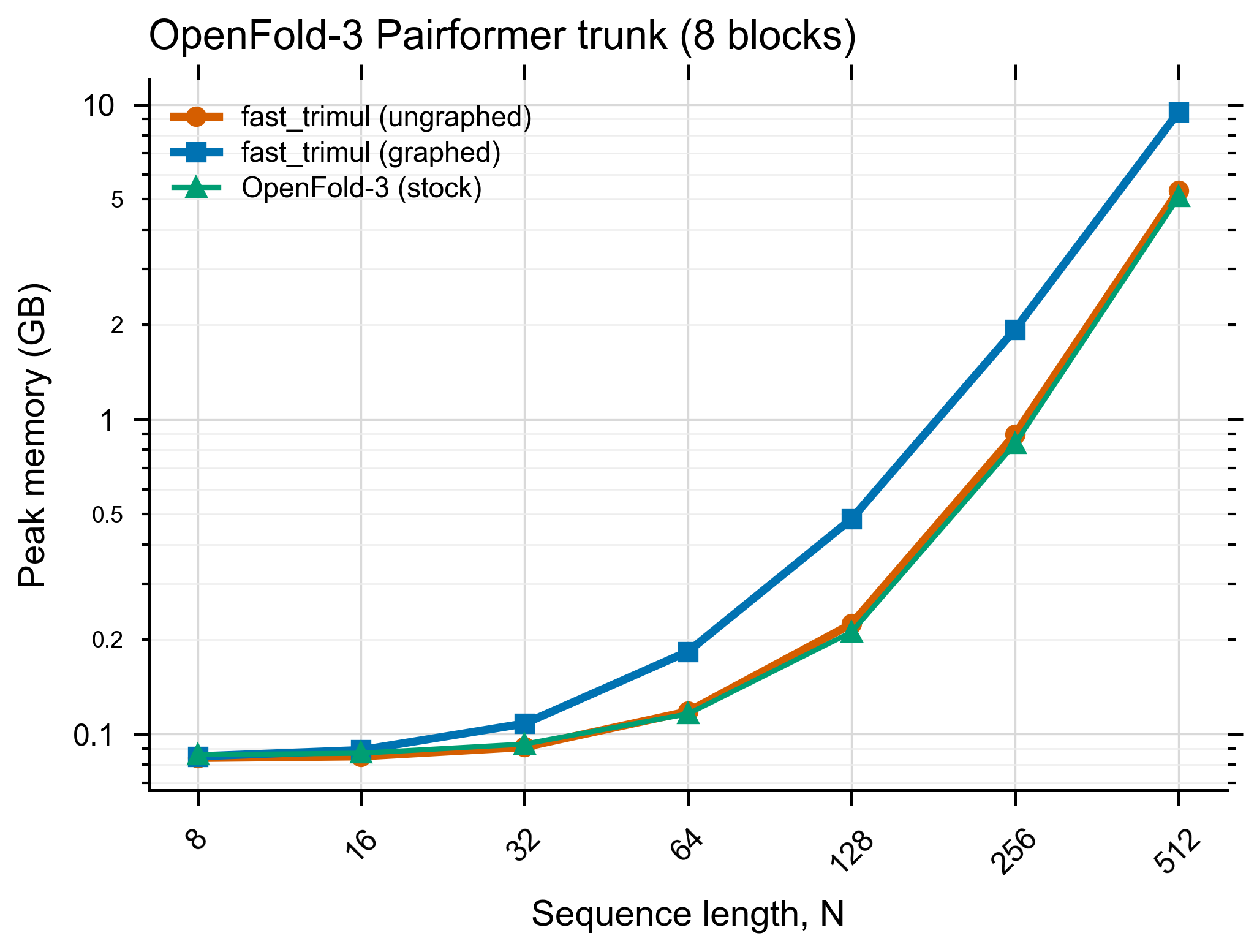
Why more memory? Each CUDA graph reserves its own buffers (not reused across layers), so activation memory reads 0 GB but resurfaces as higher peak VRAM — the speed-for-memory trade-off.
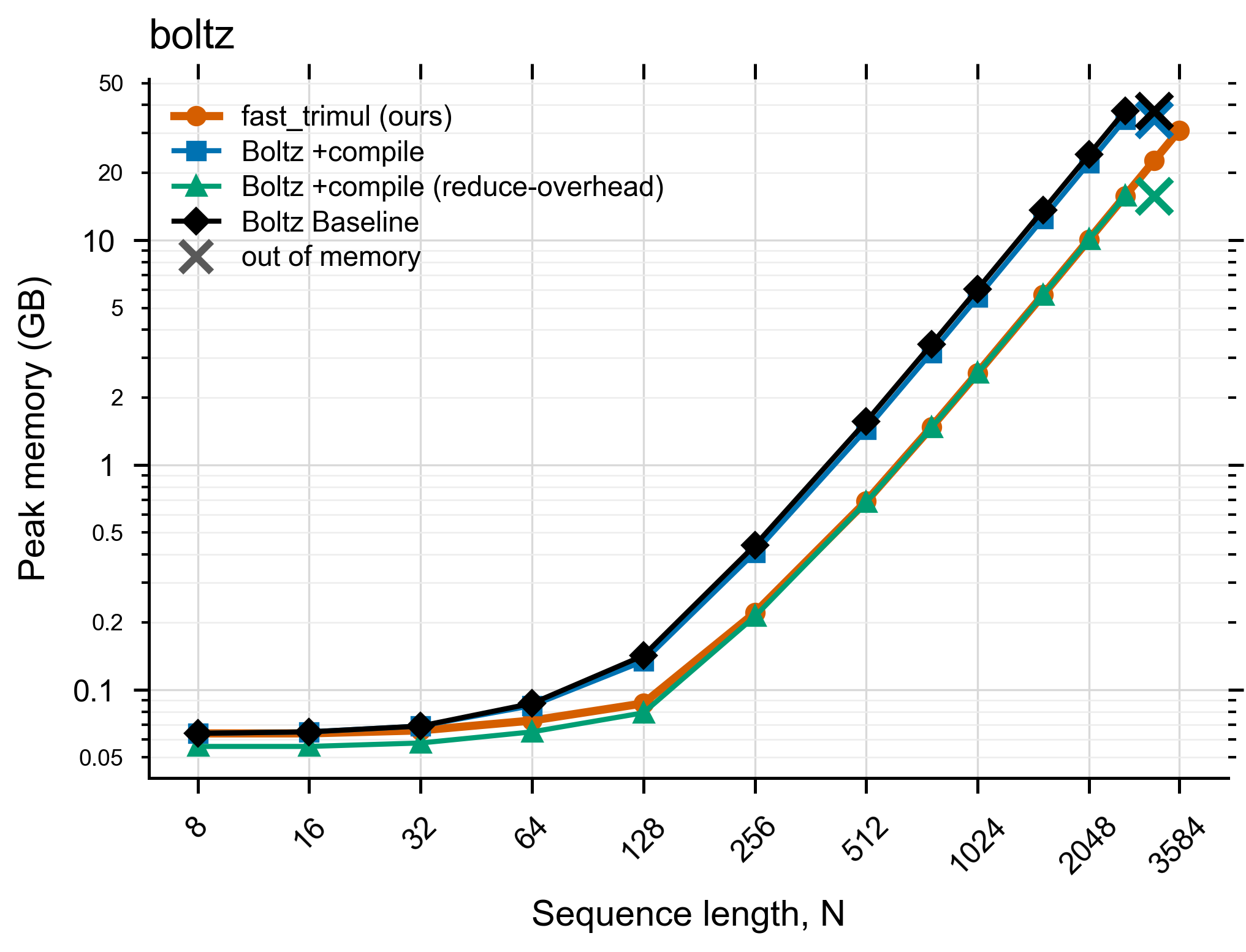
Big memory win, per op: the kernel itself keeps near-zero scratch memory and uses ~2.2–2.4× less peak VRAM than the plain layer (10.1 vs 22–24 GB at N=2048), letting it fold ~1.4× longer sequences before running out — the higher VRAM above is only from graphing all 8 trunk layers at once (memory figures ↓).
Small, hackable kernels: written in Python-level CuTe DSL (not thousands of lines of C++/CUDA), so tuning a tile or porting to a new GPU is a quick edit, not a rewrite.
Quickstart: accelerate OpenFold-3 in one line
One line — patch_openfold3() — swaps OpenFold-3's TriMul for the fast kernel
before you build the model. This exact script is verified on an NVIDIA A100 —
both Lightning AI and Google Colab:
uv pip install --system openfold3 fast_trimul "cuda-python<13"
import fast_trimul
fast_trimul.patch_openfold3()          # <-- That is it!! OpenFold-3 now runs on the fast kernel.

# build and run OpenFold-3 exactly as you always would:
import torch
from openfold3.core.model.latent.pairformer import PairFormerStack

model = PairFormerStack(c_s=384, c_z=128, no_blocks=8, c_hidden_pair_bias=32, no_heads_pair_bias=4,
                        c_hidden_mul=128, c_hidden_pair_att=32, no_heads_pair=4,
                        transition_type="swiglu", transition_n=4, pair_dropout=0.25,
                        fuse_projection_weights=False, blocks_per_ckpt=None, inf=1e9).cuda().eval()

N = 64
s = torch.randn(1, N, 384, device="cuda")
z = torch.randn(1, N, N, 128, device="cuda")
with torch.no_grad():
    _, out_z = model(s, z, torch.ones(1, N, device="cuda"), torch.ones(1, N, N, device="cuda"))
print("OpenFold-3 running on fast_trimul ->", tuple(out_z.shape))    # (1, 256, 256, 128)
Same one-liner for the other stacks: patch_openfold(), patch_boltz(),
patch_protenix(). Ready-to-run copies are in quickstart/ — one for
Lightning AI (the snippet above) and one for Google Colab (adds a tiny
fake-scipy shim so OpenFold-3 imports without Colab's numpy quirk; the
patch_openfold3() integration is identical).
Prefer no global patch?
Use the module directly (FastTriangleMultiplication, see
Quick start), and use @accelerate / with accelerated("cuda"): to pin which
backend runs your own code (they control cuda-vs-torch selection, not the swap).
Run the shipped benchmark on your own GPU for numbers — see Benchmark below, and
read Limitations for where torch.compile is the better choice.
Why fast_trimul?
Output matches the standard module within tiny rounding (about $6 \times 10^{-6}$ in half-precision). Verified by loading trained weights and comparing outputs across OpenFold, OpenFold-3, Boltz-1, Protenix, and an AF3/Chai-style reference (with detailed evaluations in reports/results/ and figures below.
Uses roughly half the GPU memory with almost zero scratch data at any sequence length $N$, cutting memory usage by 2.2–2.4× at $N=2048$ and fitting ~1.4× longer sequences before running out of memory while reaching up to 39 TFLOP/s.Fastest on short sequences, running 4.5–6.8× quicker than the plain layer at $N=8$ and remaining the fastest up to $N=128$. At small sizes, most execution time goes to launching tiny GPU steps; recording them into a single CUDA graph eliminates this overhead. This directly benefits real-world workloads like large-scale screening, peptides, and repeated refinement passes.
Runs anywhere without crashing by using a fast CUTLASS kernel when supported and gracefully falling back to a plain PyTorch version for unusual shapes or data types. Supporting new hardware like TPUs or Intel GPUs requires only a small add-on rather than a rewrite. Works at any sequence length as a direct drop-in replacement with no whole-model compilation step needed.
Benchmark results
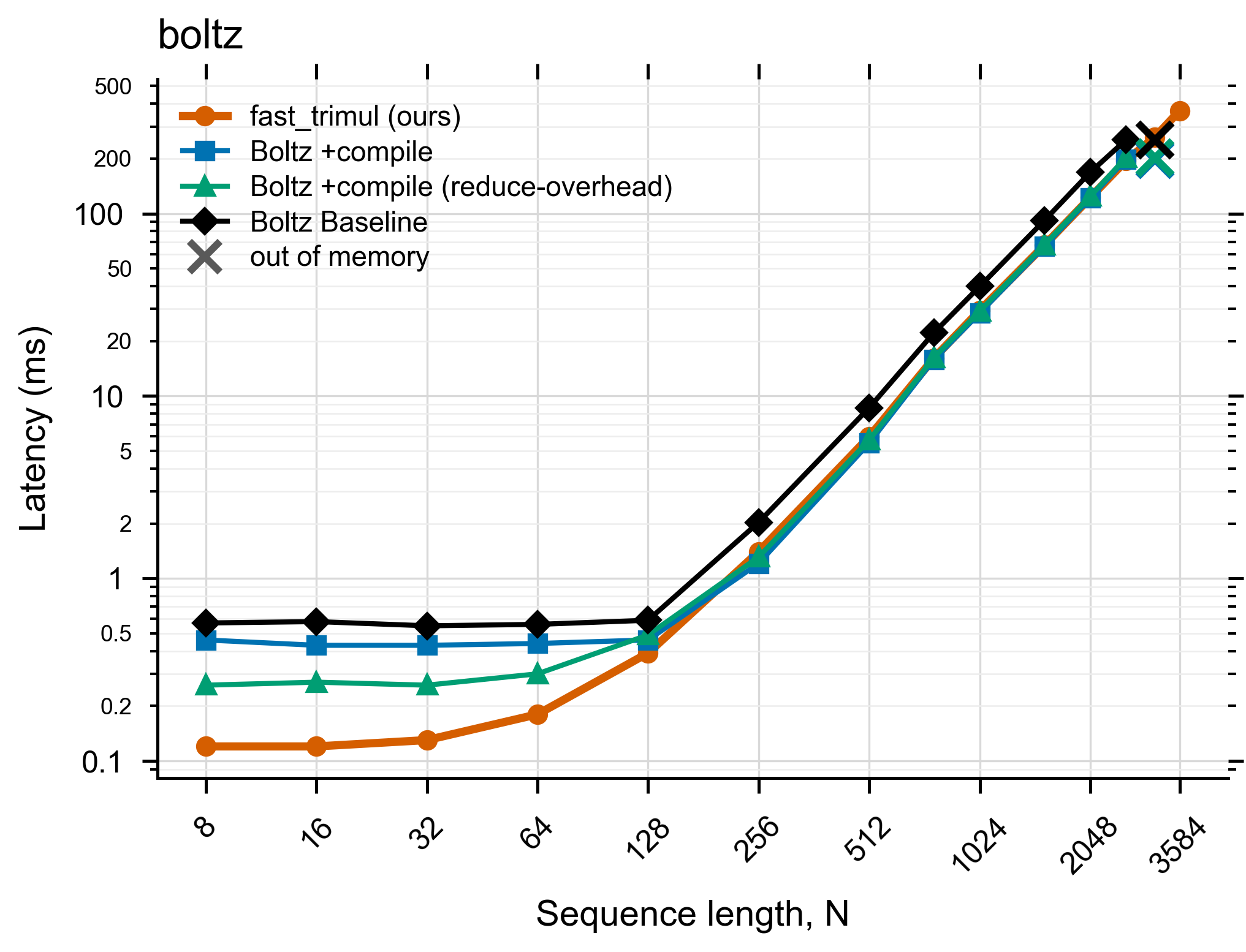
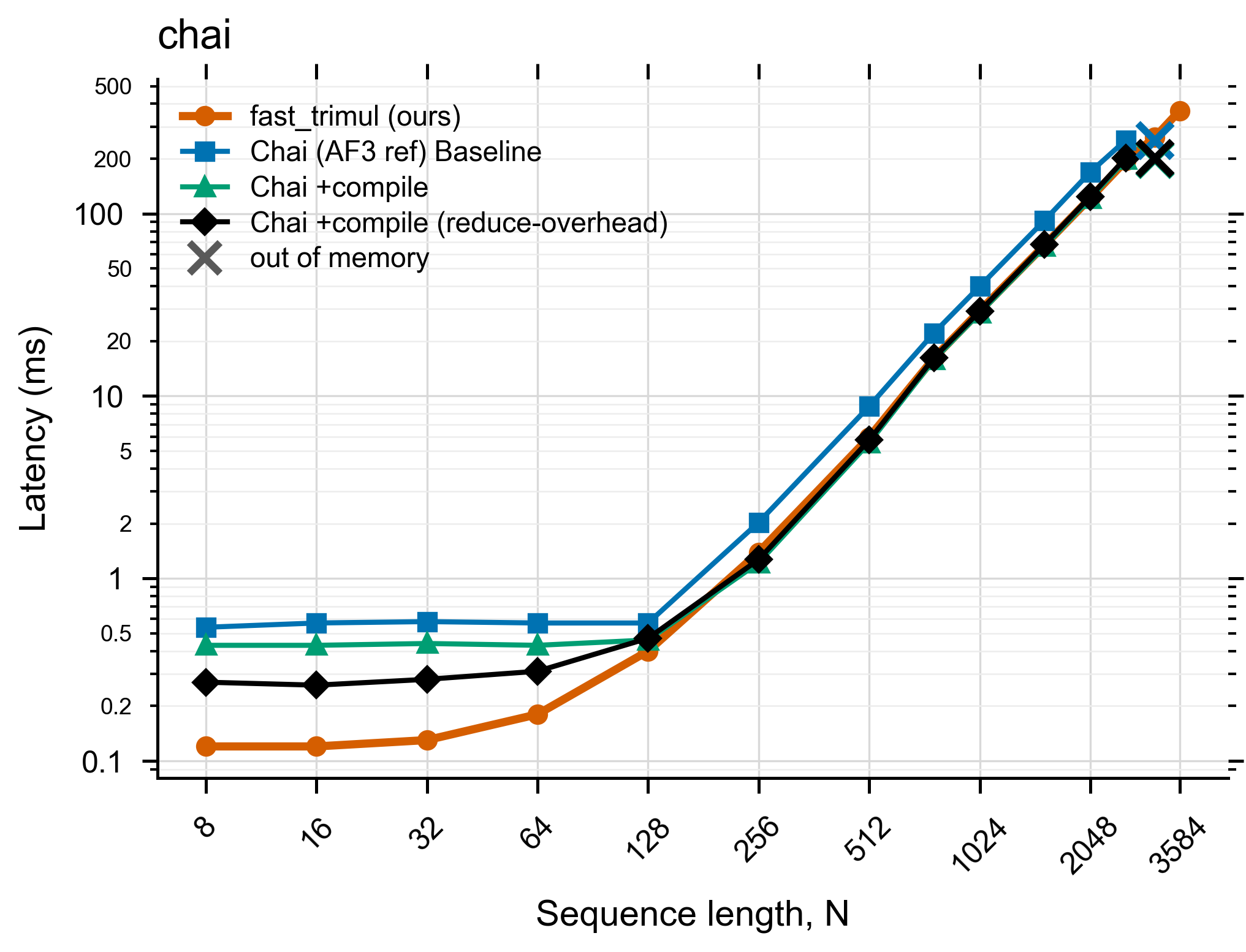
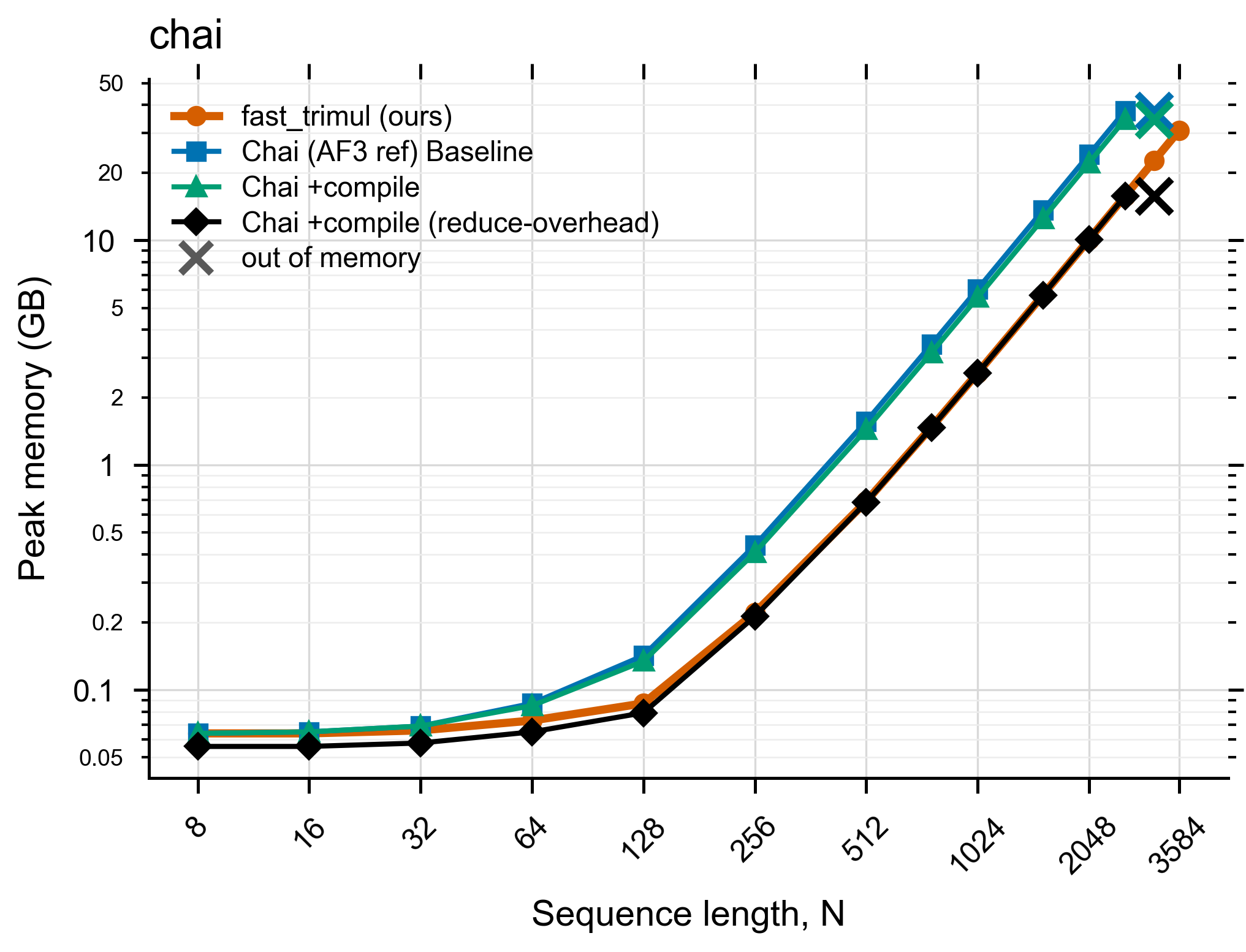
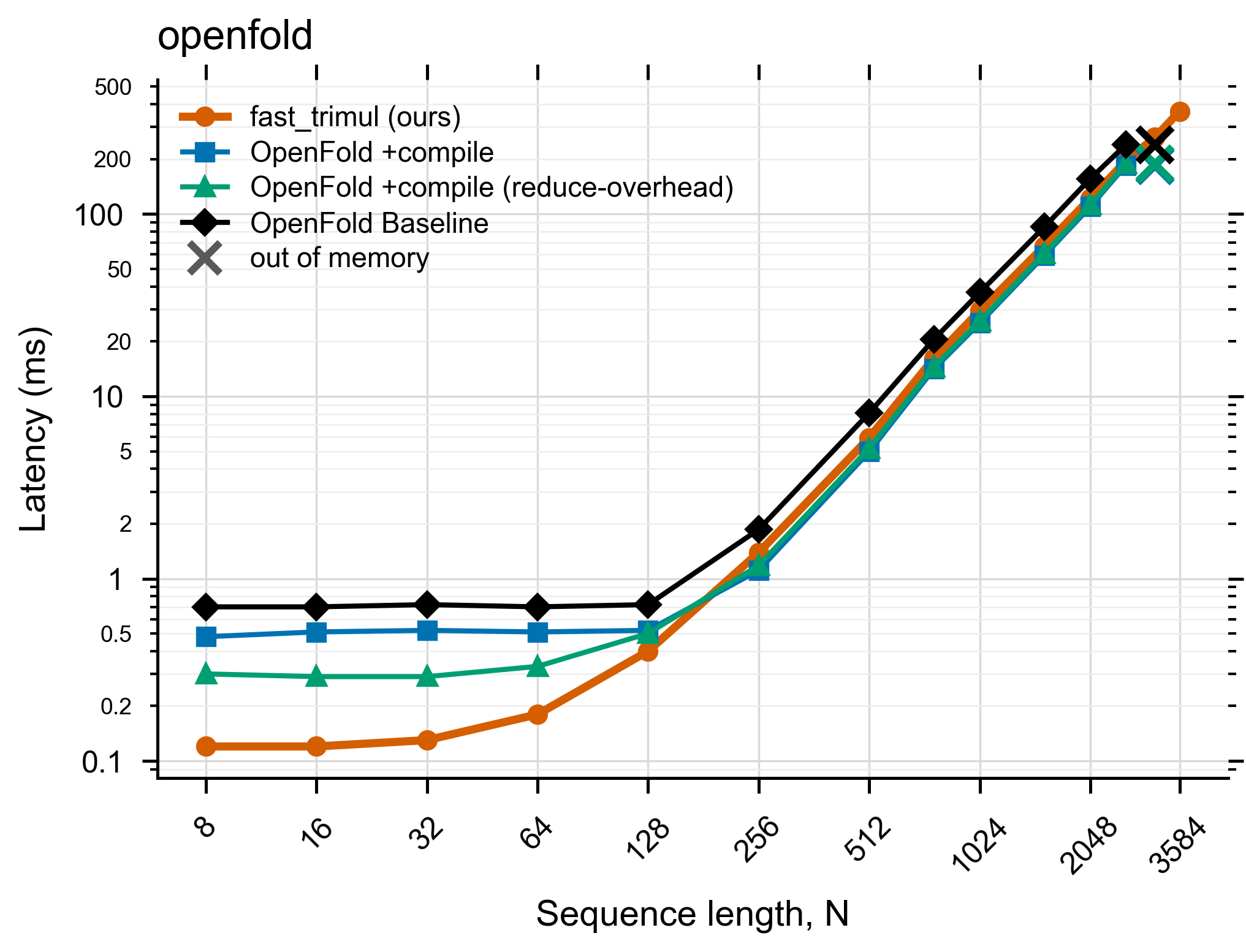
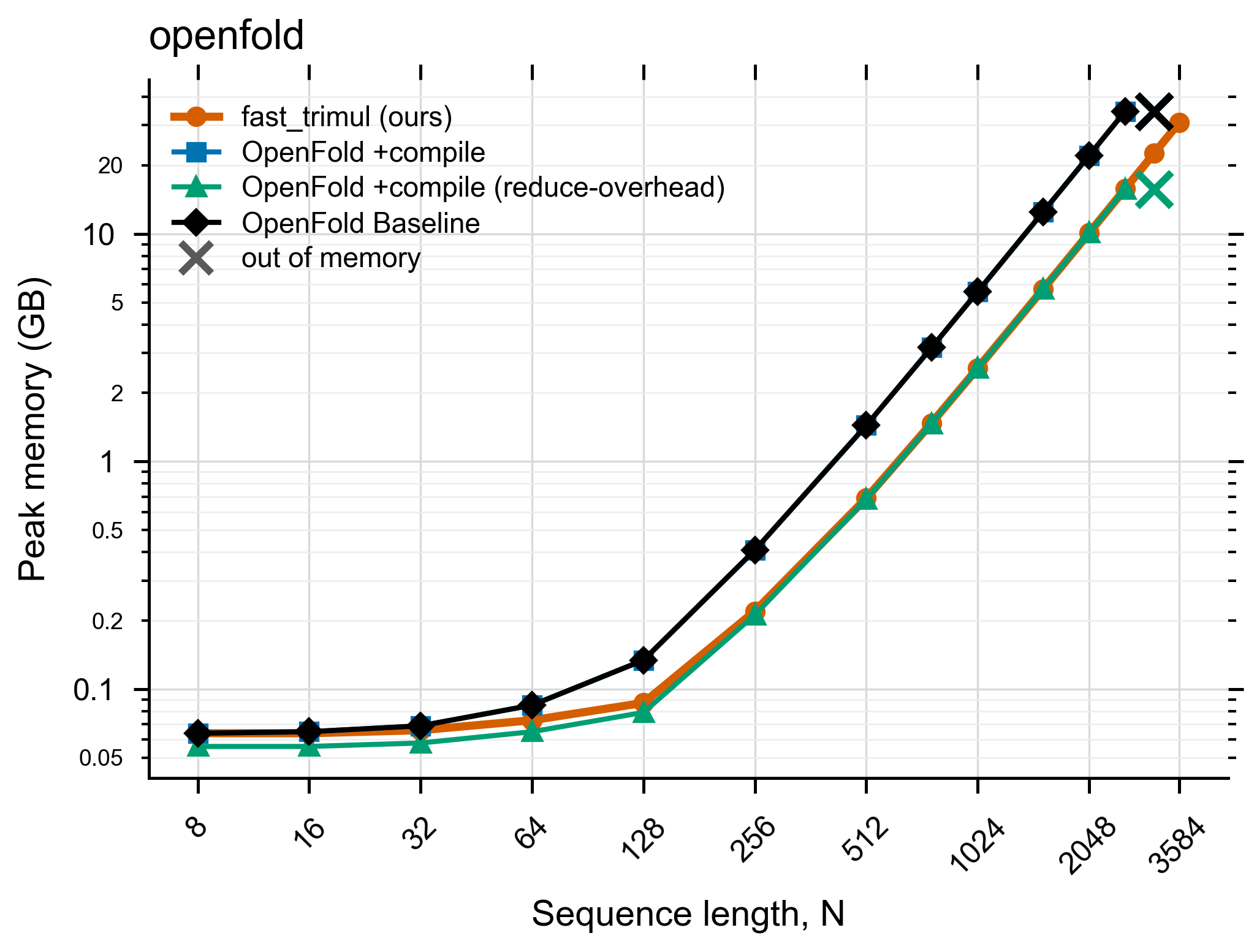
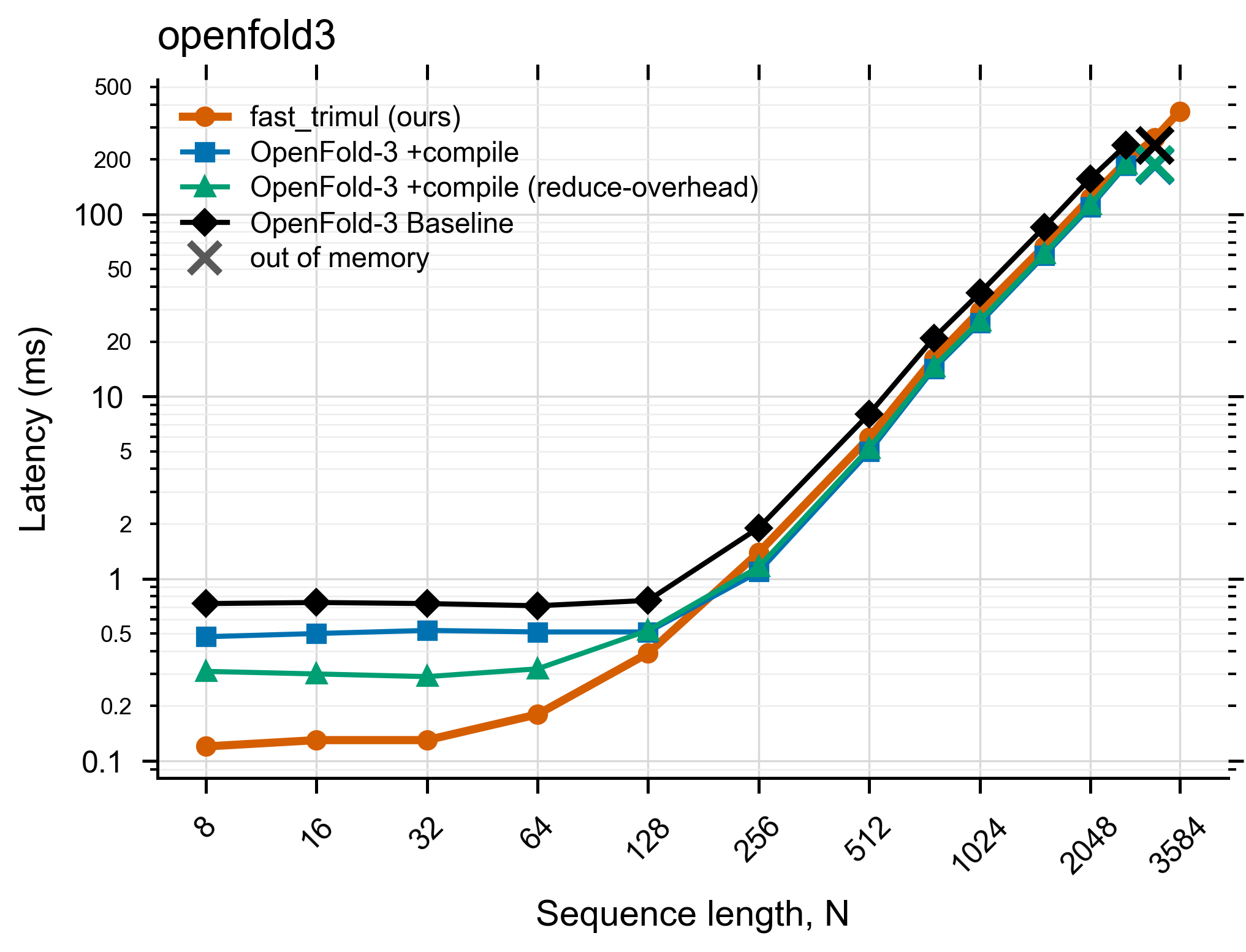
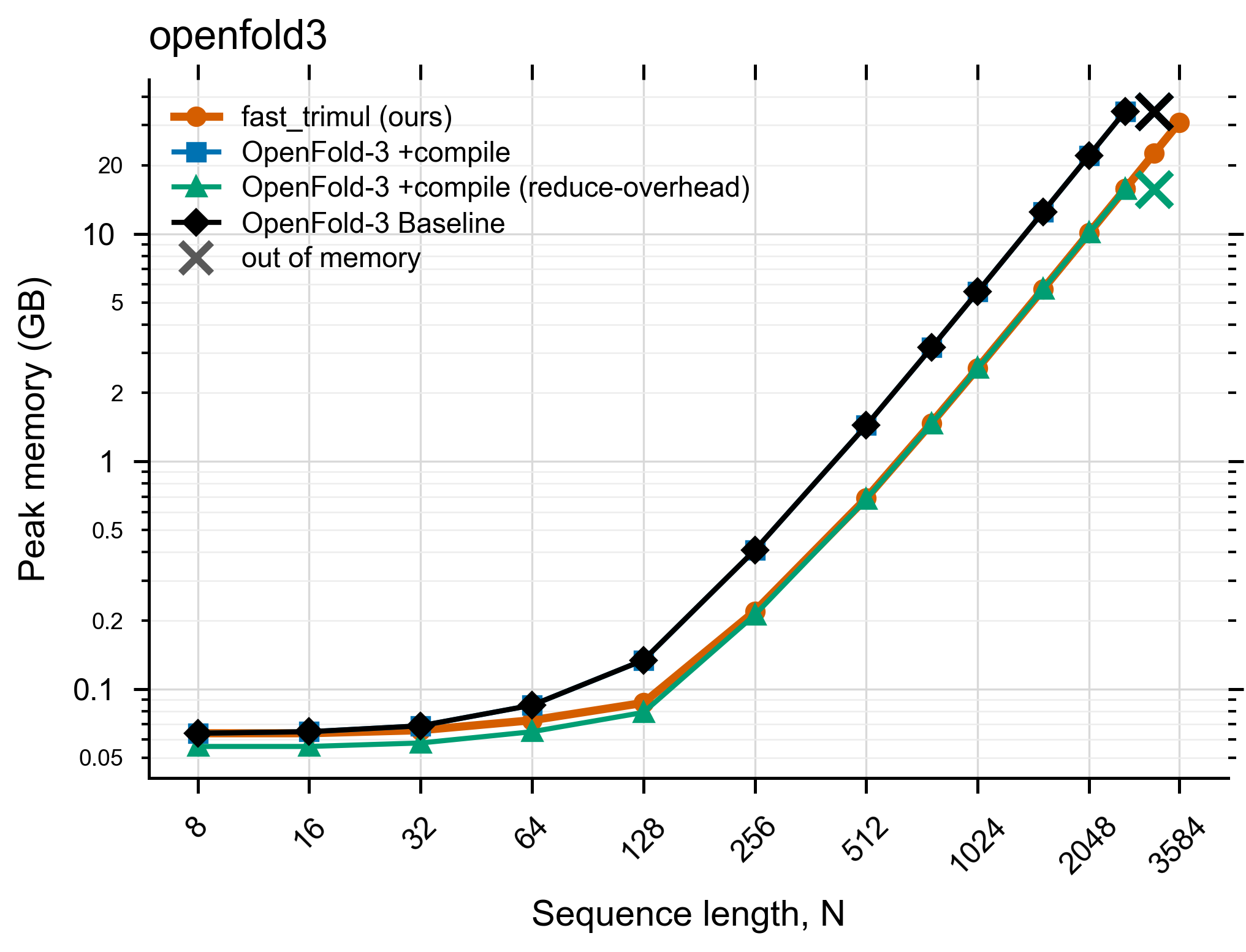
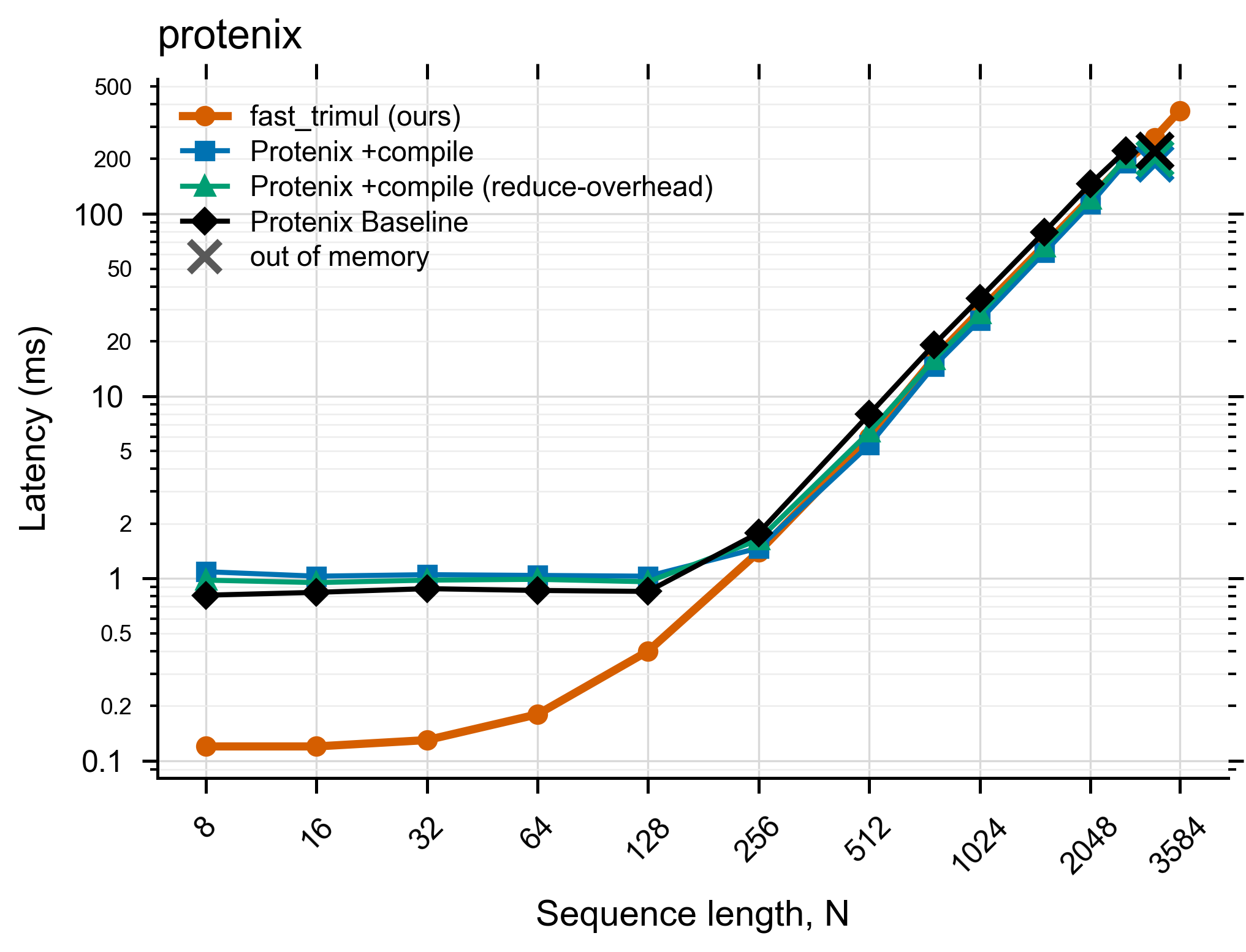
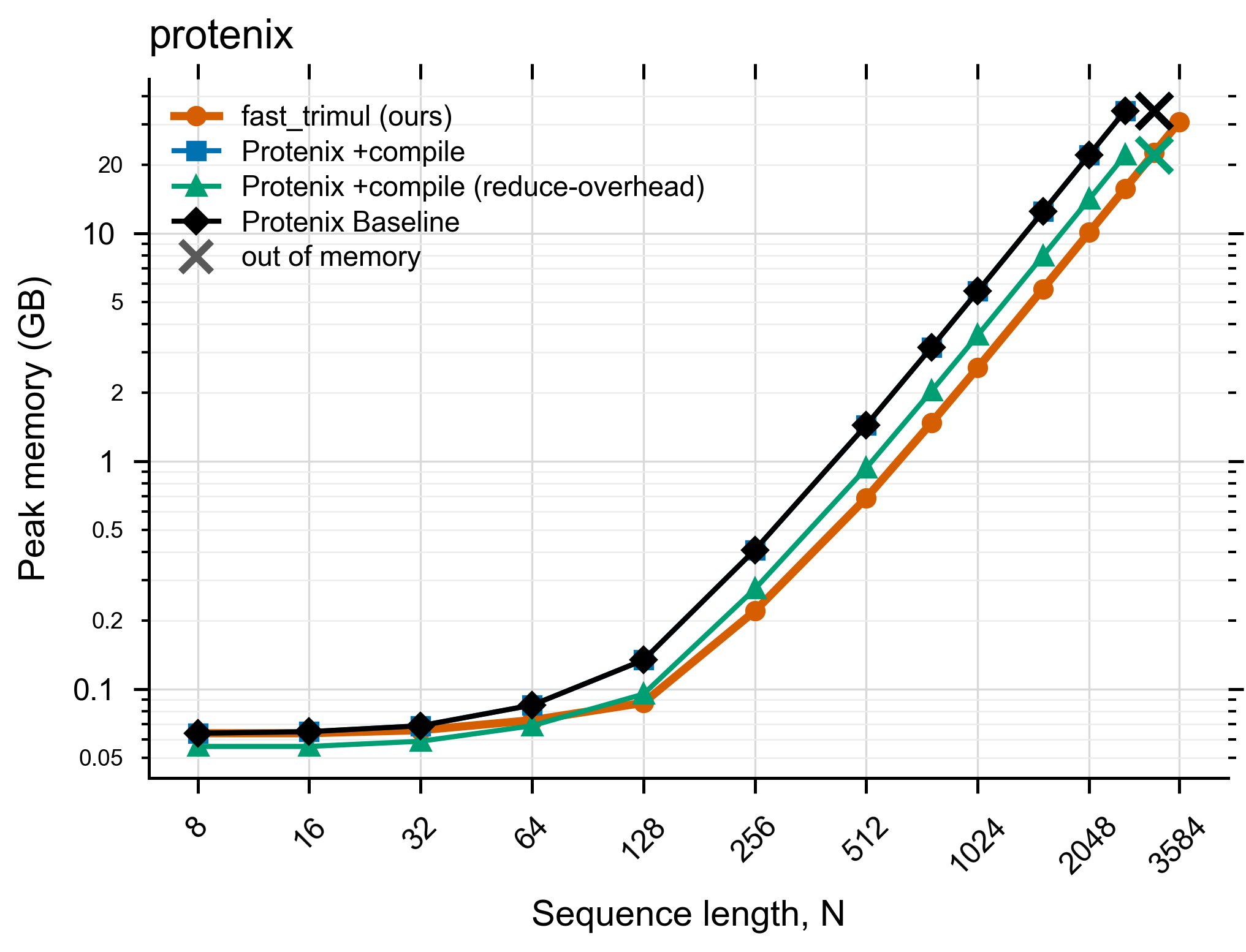
Speed (latency) and peak-memory scaling for a single Triangle-Multiplicative
Update across five stacks, plus the OpenFold-3 Pairformer whole-trunk (8
blocks). fast_trimul is the vermilion line; an ✕ marks where a baseline ran
out of memory. Single-op runs on a single NVIDIA A100-SXM4-80GB (PyTorch 2.13 / CUDA
13.0, B=1, d_z=d_c=128, TF32 on so the fp32 baselines are fair, medians of 30 timed / 5 warmup
runs); the whole-trunk on a single NVIDIA A100 40GB, 100 passes.
Full tables live in reports/results/, one-click reproduction
notebooks in reports/colab_reproduce/, and the figures
are regenerated by reports/plot_results.py.
Boltz-1
 |
 |
Chai / AF3
 |
 |
OpenFold (AF2)
 |
 |
OpenFold-3
 |
 |
Protenix
 |
 |
Whole-trunk — OpenFold-3 Pairformer (8 blocks)
fast_trimul (ungraphed) = the fused kernel un-graphed; fast_trimul (graphed) = with a captured CUDA graph; OpenFold-3 (stock) = the unmodified trunk.
|
|
Why the baselines OOM: their temporary activations grow quadratically-to-cubically with N, so by N=3072 they no longer fit the 80 GB card (fragmentation also blocks a contiguous alloc);
torch.compileshrinks but doesn't remove those buffers. fast_trimul keeps activations on-chip (SRAM), so its extra activation memory stays 0 GB and it still fits at N=3584.
Table of Contents
- Quickstart: accelerate OpenFold-3 in one line
- Why fast_trimul?
- Benchmark results
- Install
- Quick start
- Swap into a real model (whole-trunk example)
- Gradients (training)
- Benchmark
- Architecture
- API
- Limitations
- Roadmap
- Contributing
- Related Resources
- Built With
- Contact
- Citation
- License
Install
pip install fast_trimul # or: uv pip install fast_trimul
Or install the latest straight from GitHub (no PyPI release needed — pure-Python package, so there's no compile step):
pip install git+https://github.com/tiagomonteiro0715/fast_trimul
Requires a CUDA GPU, torch, nvidia-cutlass-dsl, and cuda-python.
Kernels JIT-compile on first use (one-time cost, then cached in-process).
| Hardware / precision / shape | |
|---|---|
| Fast path (CUTLASS kernel) | NVIDIA Ampere (A100, RTX 3090/4090), fp16, N divisible by 8 |
| Pure-torch fallback (always correct) | everything else — Hopper/Blackwell, non-Ampere GPUs, CPU, TPU, bf16/fp32, or N not divisible by 8 |
Driver note: cuda-python must match your CUDA driver (it can be newer than the runtime, never older). If nvidia-smi
shows CUDA 12.x (e.g. driver 570), pin the CUDA-12 line — otherwise you get
cudaErrorInsufficientDriver (35):
pip install "cuda-python<13"
fast_trimul pins cuda-python<13 by default (most drivers are still CUDA 12.x);
override it if your driver is CUDA 13+.
Troubleshooting the first run (kernels JIT-compile then):
- JIT/build errors (missing
nvccor CUDA headers): setCUDA_HOMEto your CUDA toolkit so the compiler and headers are found. - Slow or failing first-shape autotune: set
FAST_TRIMUL_AUTOTUNE=0to skip GEMM autotuning (uses a safe default config).
Quick start
On Google Colab (Runtime → Change runtime type → GPU), install first:
!pip install -q uv
!uv pip install fast_trimul
Then use it:
import torch
from fast_trimul import FastTriangleMultiplication

module = FastTriangleMultiplication(d_z=128, d_c=128, mode="outgoing").cuda()
z = torch.randn(1, 256, 256, 128, device="cuda")          # (B, N, N, d_z)
mask = torch.ones(1, 256, 256, device="cuda")             # optional (B, N, N)
out = module(z, mask=mask)                                 # same dtype as z
For fastest inference at a fixed shape, capture a CUDA graph once — this removes the per-launch overhead of the internal kernels, which dominates the runtime at small N:
module.graphed(z, mask)      # capture once at this shape (inference only)
out = module(z, mask=mask)   # subsequent calls replay the graph
Low-level functional API (FlashAttention style):
from fast_trimul import functional
out = functional.triangle_multiplication(z, module._impl, mask=mask)
Load pretrained weights from a target library — one call, pick the source
(names are remapped, and fused a/b projections are split, for you):
module.load_weights(ref.state_dict(), source="openfold") # or: openfold3 / protenix / boltz / chai
The five named helpers (load_openfold_state_dict, …) still work as thin aliases.
These target modules apply their residual (+ z) outside the triangle block,
so build with residual=False when matching their output exactly:
module = FastTriangleMultiplication(d_z=128, d_c=128, mode="outgoing", residual=False).cuda()
Pick or force a backend (default is "auto" — fastest available, then torch):
from fast_trimul import list_backends
list_backends()                                            # e.g. ['torch', 'cuda']
FastTriangleMultiplication(d_z=128, backend="cuda")        # force the fast path (still falls back)
FastTriangleMultiplication(d_z=128, backend="torch")       # force the portable reference
Opt in explicitly, without any global monkeypatching (safe under strict
runtime policies) — @accelerate on a function, or the scoped accelerated():
from fast_trimul import accelerate, accelerated

@accelerate                    # runs this function with the accelerated backend
def infer(z): ...

with accelerated("cuda"):      # scoped: reverts on exit, never leaks
    out = model(z)
One-line correctness check — build your library's TriMul, then:
import fast_trimul
fast_trimul.verify("openfold", my_openfold_trimul)         # -> True if outputs match (fp16 tol)
verify stays a one-liner even when a library changes its API, because you pass
the reference module and only the (registered) name-remap is library-specific.
Swap into a real model (whole-trunk example)
Drop fast_trimul into a library's trunk by replacing its TriMul class with a
thin adapter, then capturing a CUDA graph per layer. Verified end-to-end on the
OpenFold-3 Pairformer trunk (A100).
import torch
import openfold3.core.model.latent.base_blocks as blocks
from openfold3.core.model.latent.pairformer import PairFormerStack
from fast_trimul import FastTriangleMultiplication

# 1) a thin adapter: match the library's constructor, swallow its extra forward kwargs,
#    and use residual=False (the block adds the residual itself).
class FastTriMul(FastTriangleMultiplication):
    def __init__(self, c_z, c_hidden=None, *args, **kw):
        super().__init__(d_z=c_z, d_c=c_hidden or c_z, mode="outgoing", residual=False)
    def forward(self, z, mask=None, **kw):
        return super().forward(z, mask=mask)

# 2) patch the library's TriMul classes BEFORE building the model
blocks.TriangleMultiplicationOutgoing = FastTriMul
blocks.TriangleMultiplicationIncoming = FastTriMul
blocks.FusedTriangleMultiplicationOutgoing = FastTriMul
blocks.FusedTriangleMultiplicationIncoming = FastTriMul

model = PairFormerStack(c_s=384, c_z=128, no_blocks=8, ...).cuda().eval()

# 3) capture a CUDA graph for each swapped-in layer (fixed shape, inference only)
dummy_z = torch.randn(1, N, N, 128, device="cuda")
dummy_mask = torch.ones(1, N, N, device="cuda")
for m in model.modules():
    if isinstance(m, FastTriangleMultiplication):
        m.graphed(dummy_z, dummy_mask)

# ... now run model(s, z, single_mask, pair_mask) as usual ...
Install for this example (note the CUDA-12 driver pin — see Install):
uv pip install --system openfold3 fast_trimul "cuda-python<13"
Whole-trunk results (OpenFold-3 Pairformer, 8 blocks)
Full forward of the Pairformer trunk, random weights + inputs, 100 timed passes. Measured on NVIDIA A100-SXM4-40GB (Lightning AI). Latency in ms (lower is better), peak VRAM in GB; bold = fastest at that N.
| N | native | eager | graphed | native VRAM | eager VRAM | graphed VRAM |
|---|---|---|---|---|---|---|
| 8 | 29.86 | 53.55 | 22.51 | 0.086 | 0.084 | 0.085 |
| 16 | 28.87 | 52.49 | 22.15 | 0.087 | 0.085 | 0.089 |
| 32 | 29.68 | 53.37 | 22.59 | 0.093 | 0.091 | 0.108 |
| 64 | 29.09 | 52.54 | 22.06 | 0.116 | 0.118 | 0.183 |
| 128 | 30.15 | 53.60 | 24.26 | 0.211 | 0.224 | 0.483 |
| 256 | 121.56 | 105.61 | 104.29 | 0.837 | 0.897 | 1.933 |
| 512 | 657.51 | 571.46 | 573.98 | 5.092 | 5.340 | 9.481 |
Reading it honestly — when to use each:
- graphed is fastest at every N (1.15–1.35× over native) with near-deterministic latency, but reserves memory — one CUDA graph per layer, so peak VRAM grows to ~1.9× native at N=512. Use it when you're latency-bound and have VRAM headroom.
- eager matches native's memory (~equal), and is faster than native only at larger N (256+); at small N it's slower than native, because the un-graphed fused kernel is launch-bound across the trunk's ~16 TriMul layers.
- So: graphed for latency, eager for large-N at native-level memory. The whole-trunk win here is speed (graphed), not memory — the per-op memory advantage doesn't stack across many graphed layers.
Gradients (training)
The forward runs the fused fp16 kernel; the backward is a correct torch recompute
(correct, not yet fast), so gradients flow and you can train / fine-tune with it. Do
not call .graphed() for training — graphs are inference only. Verified on A100:
import torch
from fast_trimul import FastTriangleMultiplication

trimul = FastTriangleMultiplication(d_z=128, d_c=128, mode="outgoing").cuda()
z = torch.randn(1, 64, 64, 128, device="cuda", requires_grad=True)   # N a multiple of 8
out = trimul(z, mask=torch.ones(1, 64, 64, device="cuda"))
out.sum().backward()                                                 # gradients recomputed through the kernel
assert z.grad is not None and torch.isfinite(z.grad).all()           # input grads flow
assert all(p.grad is not None for p in trimul.parameters())          # parameter grads flow
Benchmark
The package ships a benchmark that measures machine ceilings (memory bandwidth,
fp16 tensor-core peak, launch floor), a per-iteration median timer, achieved
TFLOP/s, peak memory, and a size sweep. It reports fast_trimul both un-graphed
and graphed, next to torch.compile and an eager reference, so you can compare
on your own hardware:
!pip install -q uv
!uv pip install fast_trimul
from fast_trimul.benchmark import run_benchmark
run_benchmark()              # or: run_benchmark(head_size=384, sweep=(128, 256, 512))
Or from a shell:
python -m fast_trimul.benchmark
It reports these variants:
fast no-graph— the kernel, fp16, un-graphed (shows the launch-overhead cost),fast +graph— the same kernel with a captured CUDA graph (.graphed()),compile—torch.compile(mode="reduce-overhead")and default mode,torch eager— the eager reference.
Mode by N (the trade-off): use +graph for small-N latency; at large N prefer eager (no-graph) — it matches native memory and skips the CUDA-graph VRAM reservation, which only pays off when you're latency-bound with VRAM headroom.
Use CUDA events + synchronize() (as the shipped benchmark does) so timing
reflects when the GPU finishes the work, not when the launch is queued. Warm up
(or call .graphed()) before timing to exclude the one-time JIT/autotune cost.
Architecture
The library is a small stable front-end over a registry of interchangeable backends. CUDA is one backend; a pure-torch backend is the universal fallback. Adding new hardware or a new library is a plug-in (one decorated class/function), not a core edit.
The kernels are written in Python-level CuTe DSL, not thousands of lines of C++/CUDA — so the whole kernel codebase stays small and readable, and tuning a tile size, adding a fused epilogue, or porting to a new GPU is a quick edit instead of a rewrite.
  front-end   @accelerate  accelerated()  verify()          # stable, tiny
      │
  guard        contiguous · dtype · align · int64 strides   # NormalizedInput
      │
  dispatch     pick backend, then FALL BACK: cuda -> torch  # never crashes on a bad shape
      │
  backends     cuda_cute (CUTLASS)   torch_ref (portable)   # + future: xla/tpu, xpu/intel
| Module | Role |
|---|---|
core/registry.py |
@backend / @weights_for decorators + O(1) lookup tables |
core/context.py |
the input guard → NormalizedInput (contiguous, dtype, alignment, int64 strides) |
core/dispatch.py |
picks a backend and walks the fallback chain (cuda → torch) |
core/decorators.py |
@accelerate + accelerated() — explicit, scoped, no global patching |
backends/torch_ref.py |
universal pure-torch backend (any device torch supports) |
backends/cuda_cute.py |
thin wrapper over the existing CUTLASS kernels (unchanged) |
ops/triangle.py |
FastTriangleMultiplication (dispatch + graph capture + load_weights) |
integrations/loaders.py |
the five per-library weight maps (@weights_for) |
integrations/checks.py |
verify() |
Everything the architecture adds — registries, guard, dispatch, decorators — is
O(1) overhead; only the op itself scales with N. The CUDA kernels
(_kernels.py) are untouched.
Adding a new backend
from fast_trimul.core.registry import backend

@backend("mybackend", dtypes={torch.float16}, min_align=8)
class MyBackend:
    def __init__(self, caps): self.caps = caps
    def execute(self, inp, params): ...   # inp.tensor is guarded (contiguous, right dtype)
That one file makes backend="mybackend" selectable and slots it into the
fallback chain — no changes to the dispatcher or the module.
API
fast_trimul.FastTriangleMultiplication(d_z, d_c=None, mode="outgoing", residual=True, backend="auto")— the module.forward(z, mask=None),.graphed(z, mask=None),.load_weights(state_dict, source=...)(plus the named aliases.load_openfold_state_dict/.load_openfold3_state_dict/.load_protenix_state_dict/.load_boltz_state_dict).fast_trimul.accelerate/fast_trimul.accelerated(backend="auto")— explicit opt-in decorator / scoped context manager.fast_trimul.verify(source, reference, ...)— one-line correctness check against a reference module.fast_trimul.list_backends()— backends registered on this machine.fast_trimul.functional.triangle_multiplication(z, params, mask=None)— low-level functional call.fast_trimul.core.registry.{backend, weights_for}— decorators to register a new backend or library weight-map.
Limitations (read before relying on it)
torch.compile(mode="reduce-overhead")is competitive and often faster above small N. On an A100 it is frequently faster per call in the mid-range and, on several stacks, uses similar peak memory. These kernels are not yet epilogue-fused (future work), so the reasons to prefer this are drop-in-ness and robustness, not raw latency:reduce-overheadneeds static shapes and recompiles for every new sequence length — and in protein modelingNchanges with almost every input, so you pay repeated recompiles and latency spikes (and sometimes memory blow-ups) throughout a run — and it can break on some models, whereas this is a plainnn.Modulethat works on any shape with no compilation step. Benchmark both on your workload.- Don't wrap a patched model in
torch.compile. Afterpatch_openfold3()the TriMul runs a JIT-compiled CUTLASS kernel thattorch.compilecan't trace through — use one or the other. For launch-overhead reduction, use.graphed()instead. - First call is slow: JIT compile + GEMM autotune. On the first forward at a
new shape, the GEMM configs are auto-tuned (one-time, cached). Disable with the
env var
FAST_TRIMUL_AUTOTUNE=0. Warm up (or call.graphed()) before timing. - fp16 only. bf16/fp32 inputs are cast to fp16 and back; keep the module in
fp16 (do not call
.float()/.bfloat16()on it). - Pretrained weights need name remapping. Each library names its
projections/norms differently, so a strict checkpoint load will not line up.
Automated for the common stacks via
load_weights(sd, source=...):openfold(OpenFold/AF2),openfold3(separate or fused variant),protenix,boltz, andchai(Boltz/Chai/AF3 fuse the a/b projections). Other stacks: supply a@weights_forremap. - Mask semantics are approximate. The mask is applied to the pair tensor in and out; validate against each library's exact masking before production use.
- Backward is correct but not fast (torch recompute), so it helps inference more than training throughput.
- The CUDA kernel is Ampere (sm80) tested; fp16 only. On other hardware, or for
bf16/fp32, or non-multiple-of-8
N, the dispatcher falls back to the pure-torch backend (correct, slower). Hopper/Blackwell + fp8 are future work. - Building a module needs a CUDA GPU + CUTLASS (the fused kernel weights live in
a CUTLASS module).
import fast_trimulitself is lazy and does not require CUTLASS until you constructFastTriangleMultiplication.
Roadmap
- Epilogue fusion / megakernel: fuse post-GEMM norms + activations.
- Multi-arc support: H100/H200 (FP8/FP16 paths), B200 (NVFP4/FP4, Gen 2 Transformer Engine).
- Fused backward kernel (transposed operands) to remove autograd memory overhead.
- Per-stack quickstart code examples in the README (e.g. Boltz-1) — once the CI/CD pipeline validates the installs end to end.
Star History

Contributing
Contributions, bug reports, and benchmark numbers from your own hardware are welcome!
- Found a bug, a shape that falls back unexpectedly, or a stack whose weights don't remap? Open an issue, or reach out at monteiro.t@northeastern.edu.
- Added a new backend or a
@weights_formap for another library? Send a pull request — a new backend or weight-map is one decorated class/function and needs no changes to the core (see Architecture → Adding a new backend). - Enjoyed it? Star the repository — it helps others find the project.
Related Resources
- The Math Behind Artificial Intelligence — a guide to AI's mathematical foundations from an engineering perspective.
- My FreeCodeCamp Articles — tutorials and deep dives on AI and programming.
- Signal Processing Guide — companion resource on signal processing.
New to the GPU terms used here? Modal's GPU Glossary explains them well — CUDA graph, CUTLASS, Tensor Core, shared memory (SRAM), kernel, warp, and Streaming Multiprocessor.
Built With
- Python — the front-end, dispatcher, backends, and integrations.
- NVIDIA CUTLASS CuTe DSL — the fused GEMM / kernel core, written in Python-level CuTe DSL so the kernels stay clean, editable, and easy to re-tune for new GPU generations.
- PyTorch — tensors, autograd, and CUDA-graph capture.
- cuda-python — the driver bindings the kernels launch through.
- uv — fast Python package installer used throughout the docs.
Contact
Tiago Monteiro
- Email: monteiro.t@northeastern.edu
- GitHub: @tiagomonteiro0715
- FreeCodeCamp: Author Profile
Citation
If you use fast_trimul in research, please cite it:
@software{monteiro_fast_trimul,
  author = {Monteiro, Tiago},
  title  = {fast_trimul: Fused Triangle Multiplicative Update on CUTLASS CuTe DSL kernels},
  year   = {2026},
  url    = {https://github.com/tiagomonteiro0715/fast_trimul}
}
License
Apache License 2.0 (this project) — see LICENSE. The GEMM core is
derived from NVIDIA CUTLASS — specifically the CuTe DSL Ampere dense-GEMM example
tensorop_gemm.py
— and is licensed under BSD 3-Clause — see NOTICE.
If you find fast_trimul useful, please consider starring the repository!
Your support helps others discover this project.
1 maintainer

Download files
Download the file for your platform. If you're not sure which to choose, learn more about installing packages.
Source Distribution
Built Distribution
Filter files by name, interpreter, ABI, and platform.
If you're not sure about the file name format, learn more about wheel file names.
Copy a direct link to the current filters
File details
Details for the file fast_trimul-2.4.30.tar.gz.
File metadata
- Download URL: fast_trimul-2.4.30.tar.gz
- Upload date:
- Size: 2.5 MB
- Tags: Source
- Uploaded using Trusted Publishing? No
- Uploaded via:
uv/0.9.18 {"installer":{"name":"uv","version":"0.9.18","subcommand":["publish"]},"python":null,"implementation":{"name":null,"version":null},"distro":null,"system":{"name":null,"release":null},"cpu":null,"openssl_version":null,"setuptools_version":null,"rustc_version":null,"ci":null}
File hashes
| Algorithm | Hash digest | |
|---|---|---|
| SHA256 |
987d28a9d7db17d3de9ccd18b3ae4618111326f6679da99db0f53b397b346416
|
|
| MD5 |
98de862be55a17f5b7a9d6d524621546
|
|
| BLAKE2b-256 |
337e9d1eabf3f80588d0226e9dbd871ac9264f73e8da13258e8aef725a7feb6a
|
File details
Details for the file fast_trimul-2.4.30-py3-none-any.whl.
File metadata
- Download URL: fast_trimul-2.4.30-py3-none-any.whl
- Upload date:
- Size: 57.2 kB
- Tags: Python 3
- Uploaded using Trusted Publishing? No
- Uploaded via:
uv/0.9.18 {"installer":{"name":"uv","version":"0.9.18","subcommand":["publish"]},"python":null,"implementation":{"name":null,"version":null},"distro":null,"system":{"name":null,"release":null},"cpu":null,"openssl_version":null,"setuptools_version":null,"rustc_version":null,"ci":null}
File hashes
| Algorithm | Hash digest | |
|---|---|---|
| SHA256 |
f623806d2e157cd0f4e4fa96cbdb76343e3722fefdf2d706859e6ed7c3d2259c
|
|
| MD5 |
d3a9900156eda14a0c0a045a9b27078c
|
|
| BLAKE2b-256 |
6ad86de778f8ca9aa6775ef054b0af738949c2e50c780e6f0981920a66f12165
|







