
FastHydroMap



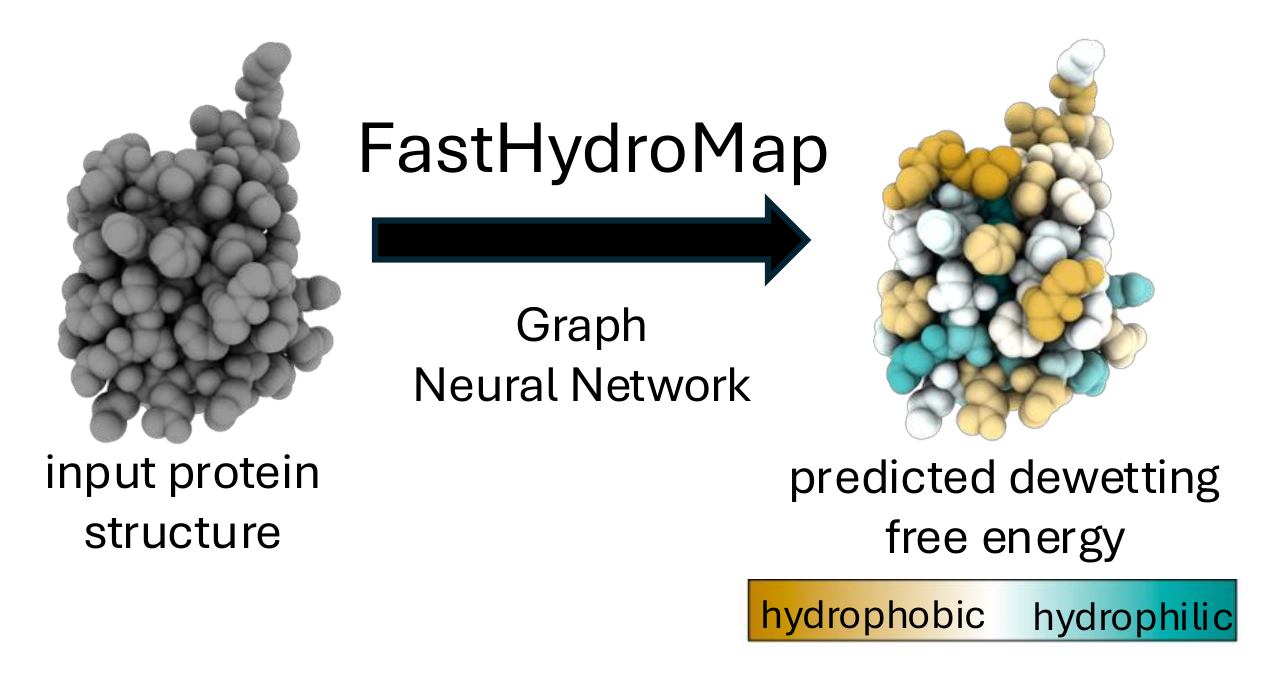
FastHydroMap predicts per-residue dewetting free energies (Fdewet) from protein structures and trajectories.
It can also predict water structuring (PC1, PC2, PC3 of the water triplet angle distribution).
It is available as a ChimeraX bundle from the
UCSF ChimeraX Toolshed.
Quick Start
Use a fresh Python environment. Python 3.11 to 3.14 are supported.
pip install fasthydromap
fasthydromap install-torch
fasthydromap predict your_structure.pdb -o outputs/your_structure_fdewet
fasthydromap install-torch defaults to the CPU build, which is usually the right choice for current FastHydroMap workloads because SASA preprocessing dominates runtime.
Advanced installation options, Docker usage, GPU Torch variants, and release workflows are documented in INSTALL.md and PYPI_RELEASE.md.
ChimeraX implementation
FastHydroMap is available directly from the UCSF ChimeraX Toolshed for ChimeraX 1.12 and newer. In ChimeraX, choose Tools > More Tools..., search for FastHydroMap, and click Install. The command-line equivalent is:
toolshed install FastHydroMap
Then perform the one-time installation of FastHydroMap and PyTorch in the bundle-managed environment:
fasthydromap install
Open a protein and make a residue-level Fdewet map:
open 1a1u
fasthydromap #1
Here, #1 refers to the first loaded model. Water-structure maps and custom
ranges are available through command options:
fasthydromap #1 quantity pc1
fasthydromap #1 quantity pc2 range -2,8
Run help fasthydromap inside ChimeraX for examples and interpretation, or see
the complete
FastHydroMap ChimeraX tutorial.
Inputs
FastHydroMap supports:
- Single protein structures in
PDBformat - Protein trajectories in
DCDorXTCformat together with a matching topologyPDB
Typical usage:
# Single structure
fasthydromap predict examples/1A1U.pdb -o outputs/1A1U_fdewet
fasthydromap predict examples/1A1U.pdb --quantity pc1 -o outputs/1A1U_pc1

# Trajectory
fasthydromap predict-trajectory examples/proteinG.pdb examples/proteinG_short.dcd -o outputs/proteinG_fdewet
The default --quantity fdewet predicts dewetting free energy. Use --quantity pc1, --quantity pc2, or --quantity pc3 to predict water-structure principal-component maps instead.
Outputs
For a single structure, FastHydroMap writes:
*.csv: one row per residue with the requested quantity; with--parts, intrinsic and context columns are included*.pdb: a copy of the input structure with the requested quantity written to B-factors
For a trajectory, FastHydroMap writes wide CSV files containing one row per frame and one column per residue.
Use --parts to also write intrinsic, context, and per-frame summary CSVs.
Model Scope
FastHydroMap was trained on structured single-chain proteins and the 20 canonical amino-acid chemistries. Predictions for PTMs and other non-canonical chemistries should be treated cautiously; consider using or adapting HydroMap for those systems.
Visualization
FastHydroMap writes predicted values to the B-factor column of output PDBs, so you can color structures directly in molecular viewers.
ChimeraX:
color bfactor range 4,6.5 palette ^lipophilicity
Example PC map coloring in ChimeraX:
color bfactor range -8,8 palette red-white-blue # example range and palette for PC1: redder = more tetrahedral angles
color bfactor range -2,8 palette cyanmaroon # for PC2: maroon = more 90 deg angles (unstructured)
color bfactor range -2,2 palette ^lipophilicity # for PC3: yellower = fewer 50 deg angles (i.e. fewer highly coordinated waters)
PyMOL:
spectrum b, red_white_blue, minimum=4, maximum=6.5
For dynamic hydrophobicity visualization in a MD trajectory, see the teaching-oriented example script
scripts/chimerax_fdewet_trajectory_example.py with a ChimeraX implementation you can adjust.
Citation
If you use FastHydroMap in your research, please cite the HydroMap and FastHydroMap paper:
Lobo, S.; Najafi, S.; Shea, J.-E.; Shell, M. S. Context-Aware Hydrophobicity Modeling: HydroMap and FastHydroMap. bioRxiv (2026). https://doi.org/10.64898/2026.06.07.730647
Acknowledgements
Shell Lab and Shea Group
1 maintainer

Metadata
1 maintainer
Release files for fasthydromap 0.1.4
For a detailed explanation of source distributions (sdists) and built distributions (wheels), please see the package formats documentation.
Source distribution (sdist)
| File | Size | Uploaded | Provenance | Actions |
|---|---|---|---|---|
| fasthydromap-0.1.4.tar.gz | 740.6 kB | Without provenance | Details for fasthydromap-0.1.4.tar.gz |
Built distribution (wheel)
| File | Interpreter | ABI | Platform | Actions Reset |
|---|---|---|---|---|
| fasthydromap-0.1.4-py3-none-any.whl | Python 3 | none | any | Details for fasthydromap-0.1.4-py3-none-any.whl |
Total release size: 1.5 MB
Release files / fasthydromap-0.1.4.tar.gz
| Download URL | fasthydromap-0.1.4.tar.gz |
|---|---|
| Size | 740.6 kB |
| Tags | Source |
|
SHA-256 checksum How to use checksums |
acece1035759a050f42b33f86ce6bf89fe6a872a15c3ccb28898a9b79226be65
|
|
BLAKE2b-256 checksum How to use checksums |
ab2167cb9ee5c09fd6ec4763453823d026c5be226497b432208dbef6b0822334
|
| Upload date | |
|
Uploaded using Trusted Publishing? What is trusted publishing? |
No |
| Uploaded via |
twine/7.0.0 CPython/3.11.0
|
Release files / fasthydromap-0.1.4-py3-none-any.whl
| Download URL | fasthydromap-0.1.4-py3-none-any.whl |
|---|---|
| Size | 735.2 kB |
| Tags | Python 3 |
|
SHA-256 checksum How to use checksums |
bd1d5ecbf402f35efdb7f20a15b7c65b0829c28fb336c444bf45ea512a4b525a
|
|
BLAKE2b-256 checksum How to use checksums |
7f9c63fd31f65da83e624b222963604f97fd0c213786360262286e9f913da43f
|
| Upload date | |
|
Uploaded using Trusted Publishing? What is trusted publishing? |
No |
| Uploaded via |
twine/7.0.0 CPython/3.11.0
|
Security for fasthydromap 0.1.4
Provenance
Provenance describes where a file came from. On PyPI, provenance is shared via attestations, which provide a verifiable record of the build or publishing details. View details, limitations and caveats.
No provenance found
None of the files in this release were uploaded with provenance metadata.
A note on package security
PyPI is a repository for distributing packages, not a service for auditing them. While third-party security researchers and our staff do their best to detect and remove malicious packages, PyPI cannot guarantee the quality, security or suitability of any given package.
To learn more about protecting yourself from malicious actors, visit our package security documentation.














