
FastHydroMap
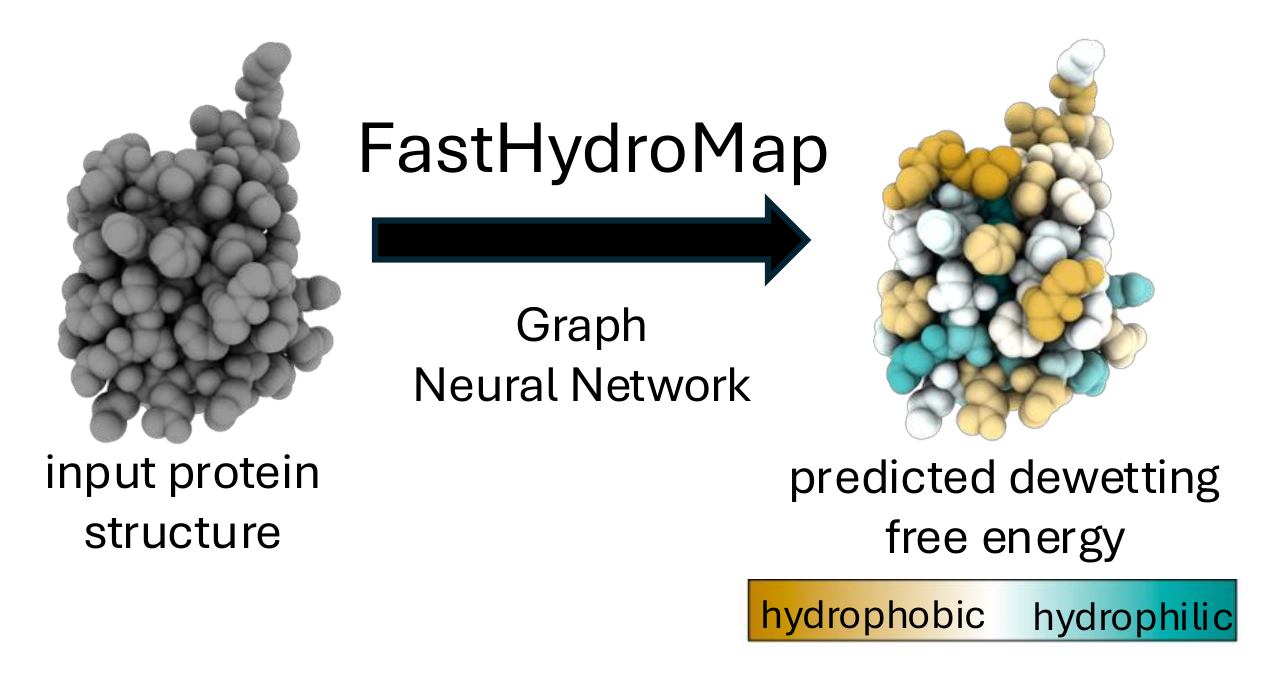
FastHydroMap predicts residue-level hydrophobicity (Fdewet) and water-structure
maps (PC1, PC2, PC3) from protein structures. It runs on a
CPU without explicit-water simulations. Lower Fdewet indicates a more hydrophobic
local surface.
Quick start
In a fresh Python 3.12 environment:
python -m pip install fasthydromap
fasthydromap install-torch
fasthydromap predict protein.pdb -o results/protein
This writes one CSV with all four scores, four PDBs with the scores in their B-factor columns, and an NPZ file of residue embeddings for downstream analysis.
For missing heavy atoms, add --prepare and inspect the saved prepared structure.
ChimeraX
The updated bundle is awaiting Toolshed publication. The instructions below describe the published installation workflow.
In ChimeraX, open Tools → More Tools…, find FastHydroMap in the
Toolshed, and click Install.
Run fasthydromap install once to set up its Python dependencies, then predict
and color a structure:
fasthydromap #1
fasthydromap #1 quantity pc1
See the ChimeraX tutorial for installation, coloring output PDBs, and interpreting the maps.
Trajectories
fasthydromap predict-trajectory protein.pdb trajectory.dcd -o results/trajectory
DCD and XTC trajectory files are supported. This writes trajectory.npz with all four scores
per frame and residue, plus residue IDs and frame/time information.
Add --csv for a wide _total.csv, or --embeddings to include per-frame
embeddings in the NPZ.
Make sure you have a complete topology with matching atom order, and make molecules whole
before prediction.
See how to load the results.
Inputs and scope
Use standard protein heavy atoms. Ordinary HIS defaults to neutral HIE;
HID/HIE/HIP names or --histidine-states states.csv specify an assignment.
FastHydroMap does not estimate pKa. See input details.
Training used restrained, single-chain protein simulations. Buried residues, termini, assemblies, and unsupported chemistry need caution.
Documentation and citation
Lobo, S.; Najafi, S.; Shea, J.-E.; Shell, M. S. Context-Aware Hydrophobicity Modeling: HydroMap and FastHydroMap. bioRxiv (2026). doi:10.64898/2026.06.07.730647.
1 maintainer

Metadata
1 maintainer
Release files for fasthydromap 2.0.0
For a detailed explanation of source distributions (sdists) and built distributions (wheels), please see the package formats documentation.
Source distribution (sdist)
| File | Size | Uploaded | Provenance | Actions |
|---|---|---|---|---|
| fasthydromap-2.0.0.tar.gz | 10.3 MB | Without provenance | Details for fasthydromap-2.0.0.tar.gz |
Built distribution (wheel)
| File | Interpreter | ABI | Platform | Actions Reset |
|---|---|---|---|---|
| fasthydromap-2.0.0-py3-none-any.whl | Python 3 | none | any | Details for fasthydromap-2.0.0-py3-none-any.whl |
Total release size: 11.2 MB
Release files / fasthydromap-2.0.0.tar.gz
| Download URL | fasthydromap-2.0.0.tar.gz |
|---|---|
| Size | 10.3 MB |
| Tags | Source |
|
SHA-256 checksum How to use checksums |
3bb5d8b81981cfc04272ffc1e447659760bf06a441805be53e42117b2f5384f0
|
|
BLAKE2b-256 checksum How to use checksums |
ea1a360e230513d814c048be396c0471b716167c832317f6fe65534cd6e4020f
|
| Upload date | |
|
Uploaded using Trusted Publishing? What is trusted publishing? |
No |
| Uploaded via |
twine/6.2.0 CPython/3.12.2
|
Release files / fasthydromap-2.0.0-py3-none-any.whl
| Download URL | fasthydromap-2.0.0-py3-none-any.whl |
|---|---|
| Size | 914.5 kB |
| Tags | Python 3 |
|
SHA-256 checksum How to use checksums |
b8620b99e14c149dc8f4b1aca7f0699b072704b5385c2f3548ae81c63cf5b784
|
|
BLAKE2b-256 checksum How to use checksums |
5c5d91b3eb3967736ebfdb10c056e5fdc0e4254f81e7ddea07da64eeff503f1f
|
| Upload date | |
|
Uploaded using Trusted Publishing? What is trusted publishing? |
No |
| Uploaded via |
twine/6.2.0 CPython/3.12.2
|
Security for fasthydromap 2.0.0
Provenance
Provenance describes where a file came from. On PyPI, provenance is shared via attestations, which provide a verifiable record of the build or publishing details. View details, limitations and caveats.
No provenance found
None of the files in this release were uploaded with provenance metadata.
A note on package security
PyPI is a repository for distributing packages, not a service for auditing them. While third-party security researchers and our staff do their best to detect and remove malicious packages, PyPI cannot guarantee the quality, security or suitability of any given package.
To learn more about protecting yourself from malicious actors, visit our package security documentation.














