
fetch-sitemap
Retrieves all URLs of a given sitemap.xml URL and fetches each page one by one. Useful for (load) testing the entire site for error responses.
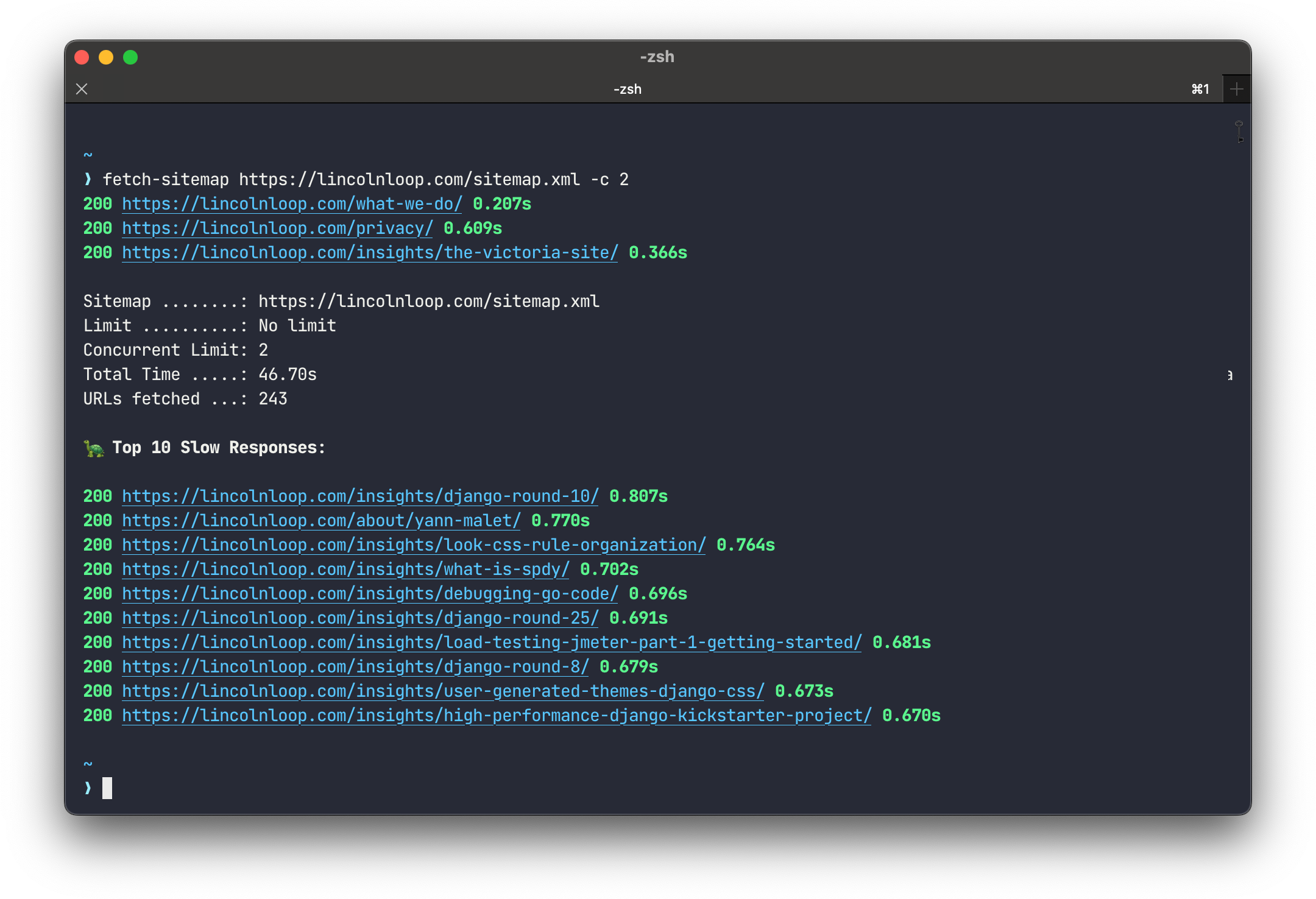
Installation
$ pip install fetch-sitemap
Usage
$ fetch-sitemap --help

 Usage: fetch-sitemap [OPTIONS] SITEMAP_URL

 Fetch a given sitemap and retrieve all URLs in it.

╭─ Options ──────────────────────────────────────────────────────────────────────────────────────────────────────────────────────────────────────────────────────╮
│ --basic-auth                -a  TEXT              Basic auth information. Format: 'username:password'                                                          │
│ --limit                     -l  INT [>=1]         Maximum number of URLs to fetch from the given sitemap.xml.                                                  │
│ --recursive/--no-recursive                        Recursively fetch all sitemap documents from the given sitemap.xml. [default: recursive]                     │
│ --concurrency-limit         -c  INT [>=1]         Max number of concurrent requests. [default: 5; >=1]                                                         │
│ --request-timeout           -t  INT [>=1]         Timeout for fetching a URL in seconds. [default: 30; >=1]                                                    │
│ --random                    -r                    Append a random string like ?12334232343 to each URL to bypass frontend cache.                               │
│ --random-length                 INT [1 to 100]    Length of the --random hash. [default: 15; 1 to 100]                                                         │
│ --report-path               -p  FILE              Store results in a CSV file. Example: ./report.csv                                                           │
│ --output-dir                -o  DIRECTORY         Store all fetched sitemap documents in this folder. Example: /tmp/my.domain.com/                             │
│ --slow-threshold                FLOAT [>=0.0]     Responses slower than this (in seconds) are considered 'slow'. [default: 5.0; >=0.0]                         │
│ --slow-num                      INTEGER OR "ALL"  How many 'slow' responses to show. [default: 10]                                                             │
│ --user-agent                    TEXT              User-Agent string set in the HTTP header. [default: Mozilla/5.0 (compatible; fetch-sitemap/23)]              │
│ --version                                         Show the version and exit.                                                                                   │
│ --help                                            Show this message and exit.                                                                                  │
╰────────────────────────────────────────────────────────────────────────────────────────────────────────────────────────────────────────────────────────────────╯
🤺 Local Development
poetry install
poetry run fetch-sitemap -h
poetry run ./tests.sh
1 maintainer

Metadata
1 maintainer
Release files for fetch-sitemap 27
For a detailed explanation of source distributions (sdists) and built distributions (wheels), please see the package formats documentation.
Source distribution (sdist)
| File | Size | Uploaded | Provenance | Actions |
|---|---|---|---|---|
| fetch_sitemap-27.tar.gz | 9.2 kB | Without provenance | Details for fetch_sitemap-27.tar.gz |
Built distribution (wheel)
| File | Interpreter | ABI | Platform | Actions Reset |
|---|---|---|---|---|
| fetch_sitemap-27-py3-none-any.whl | Python 3 | none | any | Details for fetch_sitemap-27-py3-none-any.whl |
Total release size: 19.2 kB
Release files / fetch_sitemap-27.tar.gz
| Download URL | fetch_sitemap-27.tar.gz |
|---|---|
| Size | 9.2 kB |
| Tags | Source |
|
SHA-256 checksum How to use checksums |
ff888992d0e3eee82075b42f5d441784ad3d20816ebc3f480cd2a0750a504052
|
|
BLAKE2b-256 checksum How to use checksums |
5ff7a438aafe4b8c25943177c300dc6067523d2df642393682b9587ccc8a2d44
|
| Upload date | |
|
Uploaded using Trusted Publishing? What is trusted publishing? |
No |
| Uploaded via |
poetry/1.8.4 CPython/3.12.7 Darwin/24.0.0
|
Release files / fetch_sitemap-27-py3-none-any.whl
| Download URL | fetch_sitemap-27-py3-none-any.whl |
|---|---|
| Size | 9.9 kB |
| Tags | Python 3 |
|
SHA-256 checksum How to use checksums |
4f9f4606303c416a46be20ff82450b87391ece12fef33bd810da1514b1519ad4
|
|
BLAKE2b-256 checksum How to use checksums |
09a38e87dab6872b12ee477adc5005e30c3c01a5ef6cbe95b6fa0315bacb569e
|
| Upload date | |
|
Uploaded using Trusted Publishing? What is trusted publishing? |
No |
| Uploaded via |
poetry/1.8.4 CPython/3.12.7 Darwin/24.0.0
|
Security for fetch-sitemap 27
Provenance
Provenance describes where a file came from. On PyPI, provenance is shared via attestations, which provide a verifiable record of the build or publishing details. View details, limitations and caveats.
No provenance found
None of the files in this release were uploaded with provenance metadata.
A note on package security
PyPI is a repository for distributing packages, not a service for auditing them. While third-party security researchers and our staff do their best to detect and remove malicious packages, PyPI cannot guarantee the quality, security or suitability of any given package.
To learn more about protecting yourself from malicious actors, visit our package security documentation.














