
figure-gate
A style sheet says what to do. figure-gate says whether it happened.
Two validators and a matplotlib style sheet that check a built figure — its own artists, at the size it actually prints — for colorblind-safe color, composition, and legible type. Plus an Agent Skill wrapper so Claude Code applies the same method.
The premise: a figure can be correct, legible and colorblind-safe and still be bad, but it can't be good while failing any of those. Those three are checkable, so check them instead of squinting.
python check_palette.py "#E69F00,#56B4E9,#009E73" --pairs all
python check_figure.py              # self-test on a broken figure
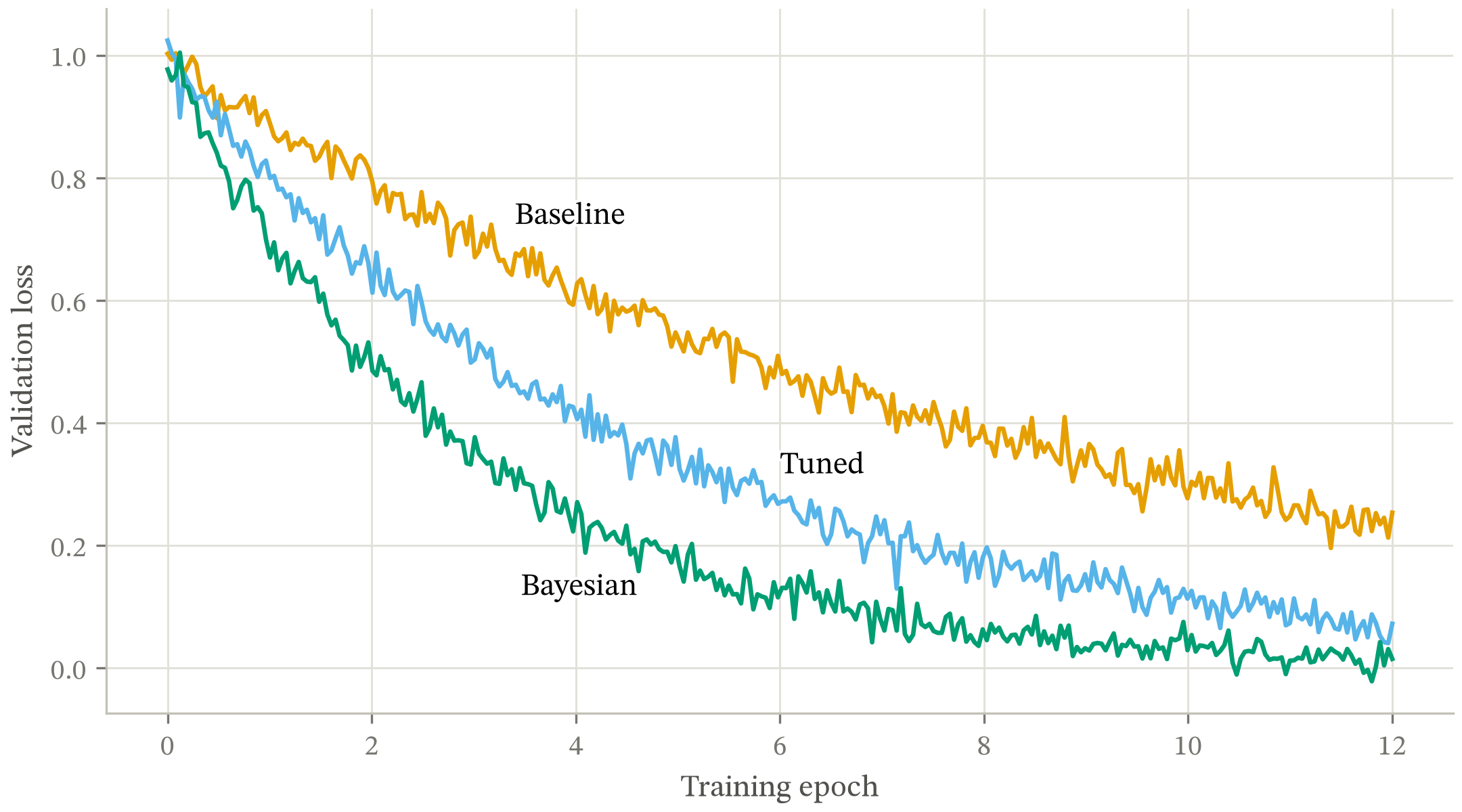
python examples/demo.py — the whole method in 40 lines. python examples/gallery.py is the harder half: a shared-axis grid, a filled field with
a colorbar, an axis-free schematic, three statistical forms, a log-log
convergence plot with a slope triangle, and a dense attractor. Writing those
found five defects in the checks themselves.
Why this exists
A figure on matplotlib's default tab10 cycle, with a twinx second axis,
passed every composition check clean — while check_palette.py rated that
cycle's orange and green at ΔE 1.4 under protanopia. One hue, to that reader.
The two scripts had no way to speak to each other.
They do now. check_series_color reads the hues off the figure's own artists
and puts them through the palette gates, working out from the marks whether the
figure needs adjacent separation (lines, bars) or all pairs (scatter).
What it catches
check_palette.py — standard library only, takes hex strings, so it works
from any language or toolchain.
| Gate | Fails when |
|---|---|
| Lightness band | a hue is too light or too dark to read as a mark |
| Chroma floor | a "color" is effectively gray |
| CVD separation | two hues collapse under protanopia or deuteranopia |
| Normal-vision floor | two hues are hard to tell apart even in full color |
| Contrast vs surface | a hue is under 3:1 on the page (advisory) |
| Ordinal ramp | an ordered ramp is non-monotone, unevenly stepped, or ends too light |
check_figure.py — reads a built matplotlib figure's own artists.
| Gate | Fails when |
|---|---|
| Clipping | text runs past the canvas |
| Text collision | two labels overlap |
| Text readability | data ink crosses a label's glyphs, or text misses WCAG on the backdrop it actually got |
| Contrast stack | nothing is opaque, or transparency has too many levels |
| Mark ratio | one mark is so large it reads as ornament |
| Overplotting | a scatter is dense enough that the marks merge into a blob |
| Axis redundancy | panels on a shared scale repeat their axis furniture |
| Type size | a string lands under 7.5pt on the printed page |
| Line weight | a stroke lands under 1pt on the printed page (SIAM's floor) |
| Ink coverage | a panel is empty or saturated (advisory) |
| Series color | the hues actually drawn collapse under color blindness |
| Dual axis | a second y scale carries data of its own |
| Form | pie, 3D, or bars on a truncated baseline |
| Identity channel | series are told apart by hue alone (advisory) |
| Label attribution | a direct label sits nearer some other series than the one it names |
| Style sheet | figure.mplstyle is not the one in effect (advisory) |
| Contour dash | a signed contour spends dashing on its negative levels |
| Fonts | PDF/PS export is Type 3, or no named typeface is installed (advisory) |
| Alt text | the figure carries no description for a reader who cannot see it (advisory) |
Thresholds cite a standard where one exists — SIAM's "one point or thicker",
WCAG 4.5:1 for text, Nature/Science/PNAS type floors — and the rest were
measured. references/style-guide.md names the real failure beside each rule.
The one people are surprised by
A figure authored at 14 inches and placed on a 750pt slide shrinks to 0.74×, so a 9pt label arrives at 6.7pt — fine on your monitor, unreadable from the back of a lecture hall. The type gate derives the scale per figure and measures what actually renders, so sizes set through rcParams or by a helper are caught too.
Placing at a fraction of the content width? Say so — audit(fig, placed_frac=0.48) mirrors \includegraphics[width=0.48\textwidth], and without
it a half-width figure is certified at twice the type size it ships at. If your
document is a venue the table knows, skip the measuring: audit(fig, venue="neurips"), and python check_figure.py --venues lists all twelve.
Install
Copy three files into your project. check_palette.py is standard library only;
check_figure.py needs matplotlib. scipy is optional and only a speed-up.
git clone https://github.com/narenp12/figure-gate
cp figure-gate/skill/assets/figure.mplstyle       your-project/diagrams/
cp figure-gate/skill/scripts/check_palette.py     your-project/diagrams/
cp figure-gate/skill/scripts/check_figure.py      your-project/diagrams/
Or pin a version instead of vendoring a file. Same two checkers, installed as
check-palette and check-figure:
uv add figure-gate # or: uv tool install figure-gate
Copying stays the default: a vendored checker is one you can read and edit beside the figures it gates.
Then set two things and nothing else:
font.serifinfigure.mplstyle→ your document's body typeface.CONTENT_WIDTH_PTat the top ofcheck_figure.py→ the usable width, in points, of the page the figure lands in. Leave itNoneif you author each figure at the width it's placed at, which makes the scale 1.0 and the whole calculation disappear — or skip it and passvenue=instead.
As a Claude Code skill
cp -r figure-gate/skill ~/.claude/skills/research-figures
Claude then applies the method when you ask for a figure for a paper or deck.
skill/SKILL.md is the workflow; skill/references/style-guide.md is the
reasoning behind every threshold.
Use it
from pathlib import Path
import matplotlib.pyplot as plt
from matplotlib import colormaps

plt.style.use(str(Path(__file__).parent / "figure.mplstyle"))

okabe = colormaps["okabe_ito"]          # matplotlib >= 3.11
fig, ax = plt.subplots(figsize=(7, 4), constrained_layout=True)
ax.plot(x, y, color=okabe(1), label="Baseline")  # widths from the sheet

from check_figure import report
report(fig, "my-figure")
Resolve the style sheet relative to the file, not the working directory —
plt.style.use("figure.mplstyle") breaks the moment a test runner or build
script invokes it from elsewhere.
Wire it into your build so a broken figure fails CI:
@pytest.mark.parametrize("name", sorted(FIGURES))
def test_figure_is_composed(name):
    ok, rows = audit(build(name))
    assert ok, "\n".join(f"{k}: {d}" for k, s, d in rows if not s)
Where this sits
Prescriptive style sheets already exist and are good: SciencePlots and LovelyPlots for journal looks, tueplots and mpl_sizes for exact conference sizing. Accessibility tooling exists too: matplotalt generates alt text, Chart4Blind converts a chart image into an accessible one, contrast reporters check colors in isolation.
None of them verifies a built figure. That is the gap this fills, and it makes the two complementary: use a style sheet, then gate it.
What it doesn't do
It won't tell you the figure is worth making. Every check here is an elimination gate — each forbids one enumerated failure, and none of them ever looks at the figure as a whole. A figure that passes has been judged not-bad in exactly the ways someone thought to write down, which is not the same as good. Render a PNG and look at it. The checker can't see that an arrow points at the wrong thing, that reading order runs backwards, or that a label is true of the concept and false of the curve beside it.
It also isn't for interactive web charts. Dashboards have different constraints (hover, responsive reflow, dark mode) and most of the rules here don't transfer.
Design notes
Use what matplotlib ships. viridis for sequential, RdBu for diverging,
okabe_ito for categorical, style sheets for defaults, constrained_layout for
layout. Earlier versions of this hand-rolled all four and every one was worse.
RdBu's poles clear every gate in check_palette.py unmodified; a windowed
custom ramp threw away 35% of viridis for no benefit.
WARN is not FAIL. A sub-3:1 hue is legal if it carries a direct label; a heatmap panel legitimately measures 0.98 ink coverage. Failing those would train everyone to ignore the row, and a gate people learn to skip is worse than no gate.
Gates get tested for their ability to fail. tests/ asserts that each check
catches a figure with exactly that one defect, and that the style sheet's colors
actually apply. That last one exists because # starts a comment in matplotlib's
style format, so grid.color: #e1e0d9 silently parses as empty and matplotlib
keeps its defaults — with every other test still green.
The full reasoning, including the measurements behind each threshold and the
rules that were tried and reverted, is in
skill/references/style-guide.md.
Which form the data wants — the decision the styling rules cannot rescue — is
in skill/references/choosing-a-form.md.
It is built on Cleveland & McGill's ordering of the elementary perceptual tasks,
and only its mechanical subset is gated: a script can rule out a pie or a cut bar
baseline, but it cannot tell you a box plot is hiding an n of 8.
Requirements
check_palette.py— Python 3.8+, standard library only. Tested on 3.8–3.13. Copied, it runs on 3.8; installed from PyPI it does not, because the package carriescheck_figure.pytoo and that needs 3.9.check_figure.py— Python 3.9+, matplotlib 3.8+.colormaps["okabe_ito"]needs matplotlib 3.11+. On older versions the palette is eight hex strings; they're listed in the style guide.
CI runs the palette checker with no pip install at all, on 3.8, 3.9, 3.11 and
3.13, because "standard library only" is a load-bearing claim.
Contributing
New gates are welcome, and the bar is the one the project holds itself to: a gate ships with a test proving it fails on a figure with that defect, a test proving it doesn't over-fire on the nearest legitimate case, and a note naming the real failure that motivated it. See CONTRIBUTING.md.
License
MIT — see LICENSE.
1 maintainer

Download files
Download the file for your platform. If you're not sure which to choose, learn more about installing packages.
Source Distribution
Built Distribution
Filter files by name, interpreter, ABI, and platform.
If you're not sure about the file name format, learn more about wheel file names.
Copy a direct link to the current filters
File details
Details for the file figure_gate-0.1.1.tar.gz.
File metadata
- Download URL: figure_gate-0.1.1.tar.gz
- Upload date:
- Size: 1.4 MB
- Tags: Source
- Uploaded using Trusted Publishing? Yes
- Uploaded via:
twine/6.1.0 CPython/3.13.14
File hashes
| Algorithm | Hash digest | |
|---|---|---|
| SHA256 |
20fa18f20dc68d9564d4b7ad3c9cf22d5fabe70e0bb88a2422aade28aa44d4b1
|
|
| MD5 |
586542e941a766f0e8bf0cba049c3ba5
|
|
| BLAKE2b-256 |
2e76c5d738f936e22ef280c99633573188986ada808151d938a0c74f54bd2245
|
Provenance
The following attestation bundles were made for figure_gate-0.1.1.tar.gz:
Publisher:
release.yml on narenp12/figure-gate
-
Statement:
-
Statement type:
https://in-toto.io/Statement/v1 -
Predicate type:
https://docs.pypi.org/attestations/publish/v1 -
Subject name:
figure_gate-0.1.1.tar.gz -
Subject digest:
20fa18f20dc68d9564d4b7ad3c9cf22d5fabe70e0bb88a2422aade28aa44d4b1 - Sigstore transparency entry: 2266158817
- Sigstore integration time:
-
Permalink:
narenp12/figure-gate@37d7e54858e9ca9ff19184a4ec1d4b31440ac15b -
Branch / Tag:
refs/tags/v0.1.1 - Owner: https://github.com/narenp12
-
Access:
public
-
Token Issuer:
https://token.actions.githubusercontent.com -
Runner Environment:
github-hosted -
Publication workflow:
release.yml@37d7e54858e9ca9ff19184a4ec1d4b31440ac15b -
Trigger Event:
push
-
Statement type:
File details
Details for the file figure_gate-0.1.1-py3-none-any.whl.
File metadata
- Download URL: figure_gate-0.1.1-py3-none-any.whl
- Upload date:
- Size: 39.0 kB
- Tags: Python 3
- Uploaded using Trusted Publishing? Yes
- Uploaded via:
twine/6.1.0 CPython/3.13.14
File hashes
| Algorithm | Hash digest | |
|---|---|---|
| SHA256 |
df7ec5799d6109f6e3baec6a0b1204549490ab326e9a35cdfb7569564fc6b5c4
|
|
| MD5 |
bcec64319f6ee88a2f0ebca00c0d7d7d
|
|
| BLAKE2b-256 |
6f56f10a381bfabbf5a3f58ad7727b557c6700c1f486f970e29657f6114c971a
|
Provenance
The following attestation bundles were made for figure_gate-0.1.1-py3-none-any.whl:
Publisher:
release.yml on narenp12/figure-gate
-
Statement:
-
Statement type:
https://in-toto.io/Statement/v1 -
Predicate type:
https://docs.pypi.org/attestations/publish/v1 -
Subject name:
figure_gate-0.1.1-py3-none-any.whl -
Subject digest:
df7ec5799d6109f6e3baec6a0b1204549490ab326e9a35cdfb7569564fc6b5c4 - Sigstore transparency entry: 2266158940
- Sigstore integration time:
-
Permalink:
narenp12/figure-gate@37d7e54858e9ca9ff19184a4ec1d4b31440ac15b -
Branch / Tag:
refs/tags/v0.1.1 - Owner: https://github.com/narenp12
-
Access:
public
-
Token Issuer:
https://token.actions.githubusercontent.com -
Runner Environment:
github-hosted -
Publication workflow:
release.yml@37d7e54858e9ca9ff19184a4ec1d4b31440ac15b -
Trigger Event:
push
-
Statement type:














