
findllm - Detect AI-generated text by analyzing token prediction patterns using GPT-2.
https://github.com/user-attachments/assets/89d03001-7cef-4b9e-878d-c991bd520f18
Installation
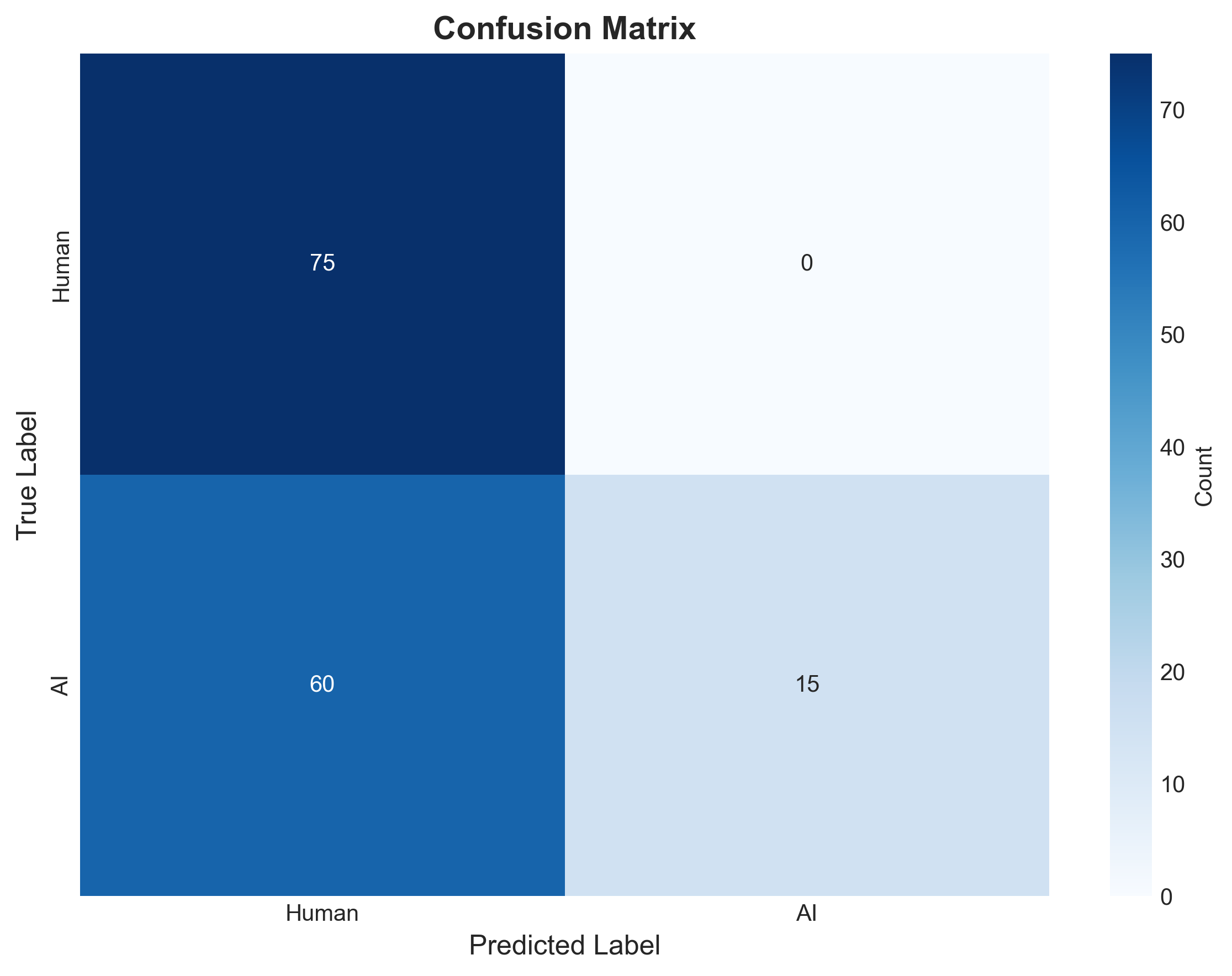
[!IMPORTANT] This project was 99% vibe coded using gemini 3 Pro, sonnet 4.5 and opus 4.5. The model tends to identify AI text as human text more often than the reverse. The metrics can't be fully trusted though, so use everything with caution!
# Run directly with uv
uvx findllm document.md

# With document conversion support (PDF, DOCX, PPTX, etc.)
uvx 'findllm[markitdown]' document.pdf

# Or install into your environment
pip install findllm

# With document conversion support
pip install 'findllm[markitdown]'
Usage
# Analyze a text file (sentence mode by default)
findllm document.md

# Analyze documents (PDF, DOCX, PPTX, XLSX, etc.) - requires markitdown extra
findllm paper.pdf
findllm presentation.pptx
findllm report.docx

# Use token-level analysis
findllm document.md --mode token

# Chunk sentences into smaller batches (e.g., 10 tokens per chunk)
findllm document.md --max-sentence-tokens 10

# Skip short sentences (e.g., less than 5 tokens, default is 3)
findllm document.md --min-sentence-tokens 5

# Use different aggregation methods (mean, max, l2, rmse, median, default is l2)
findllm document.md --aggregation max

# JSON output for programmatic use
findllm document.md --json
Document Support
With the markitdown extra installed, findllm can analyze various document formats:
- PDF (.pdf)
- Microsoft Office (.docx, .pptx, .xlsx)
- HTML (.html, .htm)
- Rich Text (.rtf)
- And more - see markitdown for full format support
Documents are automatically converted to markdown in-memory before analysis.
How It Works
The tool analyzes how predictable each token in the text is according to GPT-2:
- Green = Low probability (unpredictable, human-like)
- Yellow = Moderate probability
- Orange = Higher probability
- Red = High probability (predictable, AI-like)
AI-generated text tends to follow predictable patterns that language models can easily anticipate. Human writing is more variable and surprising.
Metrics
- Perplexity: How "surprised" the model is overall (lower = more predictable)
- Burstiness: Variation in complexity (humans tend to write with more variation)
- Color Distribution: Percentage of green/yellow/orange/red tokens
Evaluation
Evaluation on 150 samples from https://www.kaggle.com/datasets/shanegerami/ai-vs-human-text
Metadata
Release files for findllm 0.1.2
For a detailed explanation of source distributions (sdists) and built distributions (wheels), please see the package formats documentation.
Source distribution (sdist)
| File | Size | Uploaded | Provenance | |
|---|---|---|---|---|
| findllm-0.1.2.tar.gz | 10.5 kB | Without provenance | Details |
Built distribution (wheel)
| File | Interpreter | ABI | Platform | Reset |
|---|---|---|---|---|
| findllm-0.1.2-py3-none-any.whl | Python 3 | none | any | Details |
Total release size: 22.0 kB
Release files / findllm-0.1.2.tar.gz
| Download URL | findllm-0.1.2.tar.gz |
|---|---|
| Size | 10.5 kB |
| Tags | Source |
|
SHA-256 checksum How to use checksums |
9e5ca9a2ae5d850758fa0ff549a1d9679c8082020c4c63252199bc9d3537eebb
|
|
BLAKE2b-256 checksum How to use checksums |
eb09f0aee982ada7586cce6f2c1cb3a63817c3a0bb7c938cce09e5ecf9606aa7
|
| Upload date | |
|
Uploaded using Trusted Publishing? What is trusted publishing? |
No |
| Uploaded via |
uv/0.9.2
|
Release files / findllm-0.1.2-py3-none-any.whl
| Download URL | findllm-0.1.2-py3-none-any.whl |
|---|---|
| Size | 11.4 kB |
| Tags | Python 3 |
|
SHA-256 checksum How to use checksums |
a67d68512ec714a1ce24b7e27331050a89c5d8c472a056b510759eb2a2630dea
|
|
BLAKE2b-256 checksum How to use checksums |
7293554fcc3ac8fd32081807f5d217b639968fac6b8c672db721b8fc423226a7
|
| Upload date | |
|
Uploaded using Trusted Publishing? What is trusted publishing? |
No |
| Uploaded via |
uv/0.9.2
|
Security for findllm 0.1.2
Provenance
Provenance describes where a file came from. On PyPI, provenance is shared via attestations, which provide a verifiable record of the build or publishing details. View details, limitations and caveats.
No provenance found
None of the files in this release were uploaded with provenance metadata.
A note on package security
PyPI is a repository for distributing packages, not a service for auditing them. While third-party security researchers and our staff do their best to detect and remove malicious packages, PyPI cannot guarantee the quality, security or suitability of any given package.
To learn more about protecting yourself from malicious actors, visit our package security documentation.














