
⚡Flash-ANSR:
Fast Amortized Neural Symbolic Regression





Flash-ANSR is a library for amortized neural symbolic regression: load a pretrained model, call fit(X, y), and recover a symbolic expression for your tabular data, or train your own model. It is built for fast, ready-to-use inference.
Publications
- Saegert & Köthe 2026, Breaking the Simplification Bottleneck in Amortized Neural Symbolic Regression (ICML 2026) https://arxiv.org/abs/2602.08885
Usage
Requires Python >= 3.12.
pip install flash-ansr
flash_ansr install psaegert/flash-ansr-v25.0-T8-20M   # the reference checkpoint (see "Models")
import numpy as np
import torch
from flash_ansr import FlashANSR, SoftmaxSamplingConfig, get_path

device = "cuda" if torch.cuda.is_available() else "cpu"

# The estimator's policy is fixed at construction: the sampler, the refiner, the ranking, the compute.
model = FlashANSR.load(
  directory=get_path("models", "psaegert/flash-ansr-v25.0-T8-20M"),
  generation_config=SoftmaxSamplingConfig(draws=1024),  # the search budget: expressions drawn per problem
  ranking="mdl",                                        # log10(FVU) + 1e-2 per bit of description length (default)
  compute={"device": device},
)

# Define data: a small synthetic example, y = 2 * x + sin(3 * x)
X = np.linspace(-5, 5, 100).reshape(-1, 1)
y = 2 * X[:, 0] + np.sin(3 * X[:, 0])

# One call: draw candidates, fit their constants, rank them
result = model.fit(X, y)

print(result.best.expression_infix)   # the answer
print(model.get_expression())         # the same, read back from the estimator
y_pred = model.predict(X)             # evaluate the answer on new data
The result. fit returns a FitResult and keeps it as model.result_: the score-sorted refined candidates (each a Candidate with its expression, constants, fvu, score, mdl, log_prob, ...), the full ledger (every draw, classified FIT_OK / FIT_FAILED / INVALID), the ranking that ordered them and the generation / refinement times. Everything else is a view of it:
result.predict(X, rank=3)                                   # evaluate the candidate at rank 3
result.get_expression(rank=3, precision=3)                  # render it, constants rounded for display
result.to_dataframe()                                       # one row per refined candidate
result.rerank("weighted", weights={"n_nodes": 0.05})        # a NEW result under another ranking, no refit
result.save("result.pkl")                                   # plain data: no model objects inside
FitResult.load("result.pkl", engine=model.simplipy_engine)  # ... and back, evaluable again
The call. Everything that changes with the problem is an argument of fit: draws= overrides the budget for this call, seed= makes the draw and the refinement reproducible, complexity= hints the target complexity, on_empty="raise" raises ConvergenceError instead of returning an empty result when nothing fitted, variable_names= names the columns. Everything else is policy and lives on the estimator.
Explore more in the Demo Notebook.
Train your own: see the training guide.
Models
The v25.0-T8 series: one recipe and one data prior at three sizes. Pick by the hardware you have; every one of them runs the examples above unchanged.
| Checkpoint | Parameters | Training | Notes |
|---|---|---|---|
psaegert/flash-ansr-v25.0-T8-3M |
3.5M | 1.5M steps, batch 128, configs/v25.0-T8-3M |
the smallest; comfortable on a CPU |
psaegert/flash-ansr-v25.0-T8-20M |
23.7M | 1.5M steps, batch 128, configs/v25.0-T8-20M |
the reference checkpoint for this release |
psaegert/flash-ansr-v25.0-T8-120M |
123.6M | 1.5M steps, batch 128, configs/v25.0-T8-120M |
the largest; a GPU is advisable |
flash_ansr install psaegert/flash-ansr-v25.0-T8-20M
Every catalog that srbf evaluates on is held out of the training data by canonical form (6,660 expressions across 29 catalogs).
Inference speed
Several inference-speed features are enabled by default and designed to be quality-neutral, so the quickstart above already runs in the fast regime. The speed-relevant settings are the compute group of the generation config:
| Setting | Default | What it does |
|---|---|---|
use_cache |
True |
KV-cache decoding |
batch_size |
'auto' |
budget-adaptive batching (pass an int to override) |
static_decode |
None |
static decoding, auto-enabled for capable models (set True/False to force) |
from flash_ansr import SoftmaxSamplingConfig

config = SoftmaxSamplingConfig(
  draws=1024,          # number of candidate expressions to draw per problem (fit(draws=) overrides it)
  use_cache=True,      # KV cache (default)
  batch_size='auto',   # budget-adaptive chunking (default)
  static_decode=None,  # auto for capable models (default)
)
Constant refinement runs in parallel; control it via compute={"workers": N, "persistent_pool": True} on FlashANSR.load. By default (workers=None) the pool uses every available CPU core, which oversubscribes shared machines; pass an explicit integer to cap it (0 disables multiprocessing).
To opt out of these defaults:
SoftmaxSamplingConfig(draws=1024, use_cache=False, batch_size=128, static_decode=False)
Candidate ranking. Three modes, one sort:
ranking="mdl"(default;log10(FVU)plusmdl_strengthdecades per bit of the refined expression's description length),{"mode": "weighted", "weights": {...}}(weights overn_nodes,n_constants,n_constant_placeholders,n_typed_literals,mdl,neg_log_prob) and{"mode": "pareto", "metrics": [...], "tie_break": ...}(the non-dominated front over the metrics). Each knob belongs to one mode and raises under another. A fitted result can be re-ordered under any ranking without refitting:result.rerank(...).
Overview
SRSD/FastSRB Results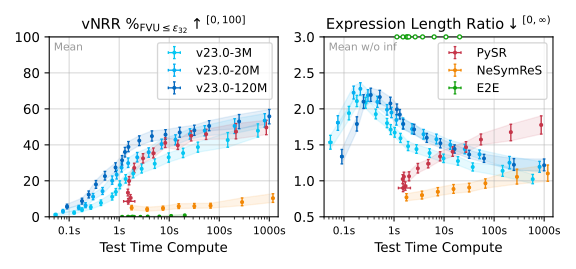
Results on the SRSD/FastSRB benchmark [Matsubara et al. 2022], [Martinek 2025] Left: Validation Numeric Recovery Rate (vNRR) as a function of inference time (log scale). FLASH-ANSR models (shades of blue) scale monotonically with compute, with the 120M model partially surpassing the PySR baseline (red). Baselines NeSymReS [Biggio et al. 2021] and E2E [Kamienny et al. 2022] fail to generalize to the benchmark. Right: Expression Length Ratio (predicted vs ground truth) versus compute. We observe a parsimony inversion: while PySR [Cranmer 2023] increases complexity to minimize error over time, FLASH-ANSR converges toward simpler, more canonical expressions as the sampling budget increases. Shaded regions denote 95% confidence intervals. |
Training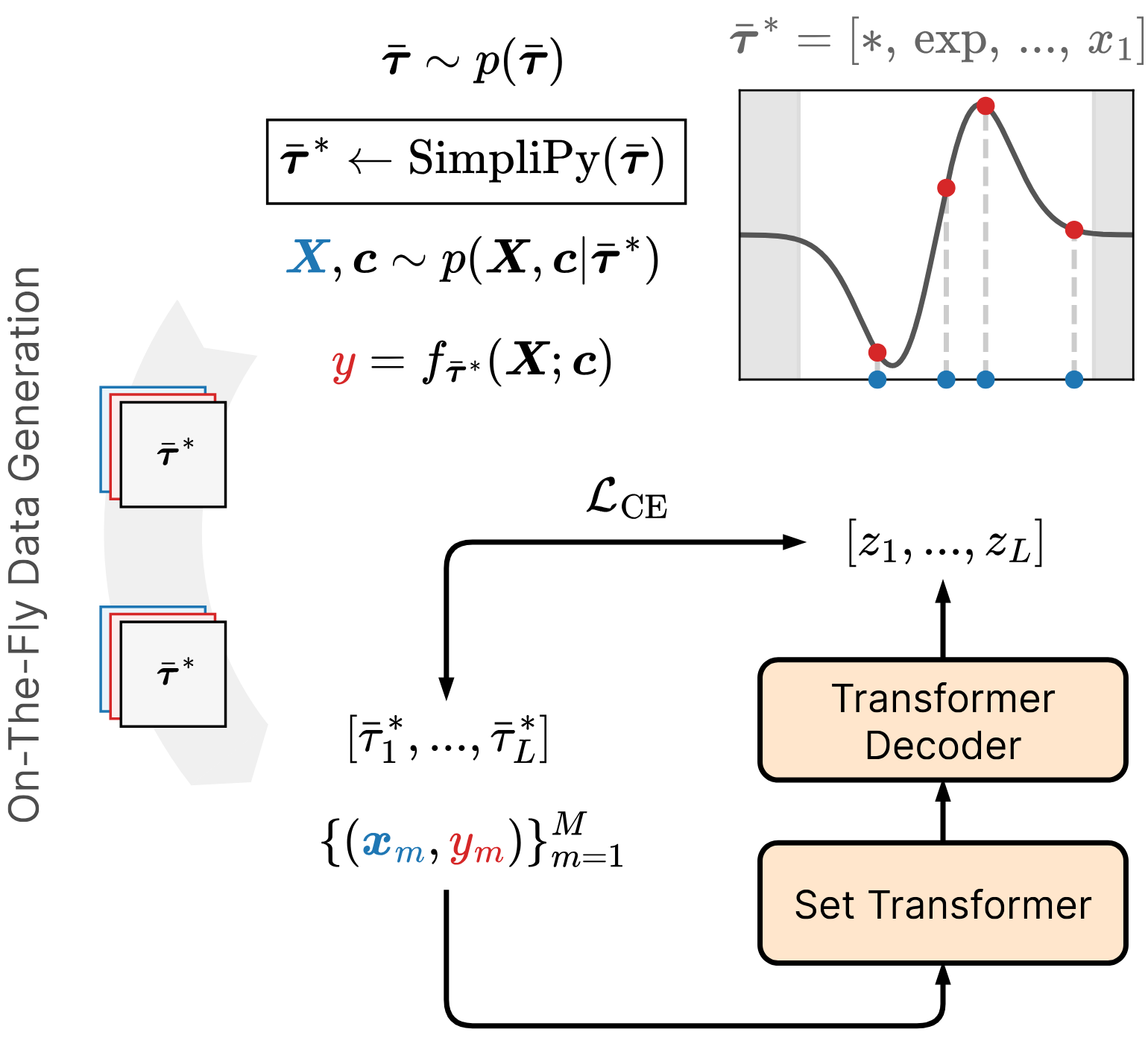
The Flash-ANSR training pipeline. Following the established standard encoder-decoder paradigm, our framework integrates SimpliPy (top center) into the loop for synchronous simplification of on-the-fly generated training expressions. |
Architecture
Flash-ANSR model architecture. The Set Transformer [Lee et al. 2019] encoder ingests a variable-sized set of input-output pairs and produces a fixed-size latent representation via Induced Set Attention Blocks (ISAB) and Set Attention Blocks (SAB). The Transformer decoder [Vaswani et al. 2017], [Xiong et al. 2020] autoregressively generates a symbolic expression token-by-token, attending to the encoded dataset at each step. |
Related projects
- SimpliPy: the expression simplification engine integrated into the Flash-ANSR training loop.
- symbolic-data: the model-agnostic symbolic-regression data layer (catalogs,
ProblemSource, holdouts) that feeds Flash-ANSR training. It is an unconditional runtime dependency and the backbone of the training loop. - srbf: the companion symbolic-regression evaluation and benchmarking framework (engine, model adapters, benchmarks, metrics), developed alongside Flash-ANSR.
Citation
@inproceedings{saegert2026breakingsimplificationbottleneckamortized,
  title   = {Breaking the Simplification Bottleneck in Amortized Neural Symbolic Regression},
  author  = {Paul Saegert and Ullrich Köthe},
  booktitle = {Proceedings of the 43rd International Conference on Machine Learning (ICML)},
  year    = {2026},
  eprint  = {2602.08885},
  archivePrefix =  {arXiv},
  primaryClass  = {cs.LG},
  url     = {https://arxiv.org/abs/2602.08885},
}

% Optionally
@mastersthesis{flash-ansr2024-thesis,
  author  = {Paul Saegert},
  title   = {Flash Amortized Neural Symbolic Regression},
  school  = {Heidelberg University},
  year    = {2025},
  url     = {https://github.com/psaegert/flash-ansr-thesis}
}
@software{flash-ansr2024,
  author  = {Paul Saegert},
  title   = {Flash Amortized Neural Symbolic Regression},
  year    = {2024},
  publisher   = {GitHub},
  version = {0.14.0},
  url     = {https://github.com/psaegert/flash-ansr}
}
1 maintainer

Download files
Download the file for your platform. If you're not sure which to choose, learn more about installing packages.
Source Distribution
Built Distribution
Filter files by name, interpreter, ABI, and platform.
If you're not sure about the file name format, learn more about wheel file names.
Copy a direct link to the current filters
File details
Details for the file flash_ansr-0.17.0.tar.gz.
File metadata
- Download URL: flash_ansr-0.17.0.tar.gz
- Upload date:
- Size: 361.4 kB
- Tags: Source
- Uploaded using Trusted Publishing? Yes
- Uploaded via:
twine/7.0.0 CPython/3.13.14
File hashes
| Algorithm | Hash digest | |
|---|---|---|
| SHA256 |
b6b2f8f66a9bf77d7512872a8c17e098f1e1a0b8e595f629cd589a84074b4636
|
|
| MD5 |
47625d6a9f8557ac84c83ec65ad76acd
|
|
| BLAKE2b-256 |
2252f2ec83c065a076c04c09e1217859495e6f446aee204af242882d8f0e7ee8
|
Provenance
The following attestation bundles were made for flash_ansr-0.17.0.tar.gz:
Publisher:
publish.yaml on psaegert/flash-ansr
-
Statement:
-
Statement type:
https://in-toto.io/Statement/v1 -
Predicate type:
https://docs.pypi.org/attestations/publish/v1 -
Subject name:
flash_ansr-0.17.0.tar.gz -
Subject digest:
b6b2f8f66a9bf77d7512872a8c17e098f1e1a0b8e595f629cd589a84074b4636 - Sigstore transparency entry: 2831508834
- Sigstore integration time:
-
Permalink:
psaegert/flash-ansr@51557db3bb3bb27d5c7e1cb05efd1b582f84d523 -
Branch / Tag:
refs/tags/v0.17.0 - Owner: https://github.com/psaegert
-
Access:
public
-
Token Issuer:
https://token.actions.githubusercontent.com -
Runner Environment:
github-hosted -
Publication workflow:
publish.yaml@51557db3bb3bb27d5c7e1cb05efd1b582f84d523 -
Trigger Event:
release
-
Statement type:
File details
Details for the file flash_ansr-0.17.0-py3-none-any.whl.
File metadata
- Download URL: flash_ansr-0.17.0-py3-none-any.whl
- Upload date:
- Size: 270.7 kB
- Tags: Python 3
- Uploaded using Trusted Publishing? Yes
- Uploaded via:
twine/7.0.0 CPython/3.13.14
File hashes
| Algorithm | Hash digest | |
|---|---|---|
| SHA256 |
46eef63752187c28650775563d5d88f46bff3944de90cded71cd0174302cee75
|
|
| MD5 |
04ce27501944df4bb81a49a39e3be75e
|
|
| BLAKE2b-256 |
0ac62cd91ec8edd27bd45e39ad36327ae05ad6d57d7d5e3b42904bc43af04321
|
Provenance
The following attestation bundles were made for flash_ansr-0.17.0-py3-none-any.whl:
Publisher:
publish.yaml on psaegert/flash-ansr
-
Statement:
-
Statement type:
https://in-toto.io/Statement/v1 -
Predicate type:
https://docs.pypi.org/attestations/publish/v1 -
Subject name:
flash_ansr-0.17.0-py3-none-any.whl -
Subject digest:
46eef63752187c28650775563d5d88f46bff3944de90cded71cd0174302cee75 - Sigstore transparency entry: 2831508874
- Sigstore integration time:
-
Permalink:
psaegert/flash-ansr@51557db3bb3bb27d5c7e1cb05efd1b582f84d523 -
Branch / Tag:
refs/tags/v0.17.0 - Owner: https://github.com/psaegert
-
Access:
public
-
Token Issuer:
https://token.actions.githubusercontent.com -
Runner Environment:
github-hosted -
Publication workflow:
publish.yaml@51557db3bb3bb27d5c7e1cb05efd1b582f84d523 -
Trigger Event:
release
-
Statement type:














