
Flask extension designed to effortlessly validate requests with Pydantic based on standard Python type hints.

Project description






About
flask_typed_routes is a Flask extension designed to effortlessly validate requests with Pydantic based on standard Python type hints.
Documentation: https://rmoralespp.github.io/flask_typed_routes/
Features
- Easy: Easy to use and integrate with Flask applications.
- Standard-based: Based on OpenAPI Specification
- Data validation: Fast data verification based on Pydantic
Requirements
- Python 3.10+
- Pydantic 2.0+
- Flask
Installation
To install flask_typed_routes using pip, run the following command:
pip install flask_typed_routes
Getting Started
This tool allows you to validate request parameters in Flask, similar to how FastAPI handles validation. It supports Path, Query, Header, Cookie, and Body validation.
Example
Create a file items.py with:
# -*- coding: utf-8 -*-

import flask
import flask_typed_routes as ftr

app = flask.Flask(__name__)
ftr.FlaskTypedRoutes(app=app)


@app.get("/")
def read_root():
    return flask.jsonify({"Hello": "World"})


@app.get("/items/<user>/")
def read_items(user: str, skip: int = 0, limit: int = 10):
    return flask.jsonify({"user": user, "skip": skip, "limit": limit})
Run the server with:
flask --app items run --debug
Open your browser and go to http://127.0.0.1:5000/items/myuser/?skip=20
You will see the JSON response as:
{
  "limit": 10,
  "skip": 20,
  "user": "myuser"
}
Validation: Open your browser and go to http://127.0.0.1:5000/items/myuser/?skip=abc
You will see the JSON response with the error details because the skip parameter is not an integer:
{
  "errors": [
    {
      "input": "abc",
      "loc": [
        "query",
        "skip"
      ],
      "msg": "Input should be a valid integer, unable to parse string as an integer",
      "type": "int_parsing",
      "url": "https://errors.pydantic.dev/2.9/v/int_parsing"
    }
  ]
}
Example Body Validation
You can also use Pydantic models to validate the request body.
Now let's update the items.py file with:
# -*- coding: utf-8 -*-

import flask
import flask_typed_routes as ftr
import pydantic


app = flask.Flask(__name__)
ftr.FlaskTypedRoutes(app=app)


class Item(pydantic.BaseModel):
    name: str
    price: float
    description: str = None


@app.get("/")
def read_root():
    return flask.jsonify({"Hello": "World"})


@app.get("/items/<user>/")
def read_items(user: str, skip: int = 0, limit: int = 10):
    return flask.jsonify({"user": user, "skip": skip, "limit": limit})


@app.post('/items/')
def create_item(item: Item):
    return flask.jsonify(item.model_dump())


@app.put('/items/<item_id>/')
def update_item(item_id: int, item: Item):
    return flask.jsonify({'item_id': item_id, **item.model_dump()})
Example Flask Blueprints
Now let's update the items.py file with:
# -*- coding: utf-8 -*-

import flask
import flask_typed_routes as ftr

app = flask.Flask(__name__)
ftr.FlaskTypedRoutes(app=app)
orders = flask.Blueprint('orders', __name__)


@orders.get("/orders/<user>/")
def read_orders(user: str, skip: int = 0, limit: int = 10):
    return flask.jsonify({"user": user, "skip": skip, "limit": limit})


app.register_blueprint(orders)
Example Flask Class-Based Views
Now let's update the items.py file with:
# -*- coding: utf-8 -*-

import flask
import flask.views
import flask_typed_routes as ftr

app = flask.Flask(__name__)
ftr.FlaskTypedRoutes(app=app)


class UserProducts(flask.views.View):

    def dispatch_request(self, user: str, skip: int = 0, limit: int = 10):
        data = {'user': user, 'skip': skip, 'limit': limit}
        return flask.jsonify(data)


class UserOrders(flask.views.MethodView):

    def get(self, user: str, skip: int = 0, limit: int = 10):
        data = {'user': user, 'skip': skip, 'limit': limit}
        return flask.jsonify(data)


app.add_url_rule('/products/<user>/', view_func=UserProducts.as_view('user_products'))
app.add_url_rule('/orders/<user>/', view_func=UserOrders.as_view('user_orders'))
Interactive API docs
You can generate interactive API docs for your Flask application using OpenAPI schema generated by flask_typed_routes
with any OpenAPI UI library. For example, you can use swagger-ui-py to generate the API docs.
pip install swagger-ui-py # ignore if already installed
# -*- coding: utf-8 -*-

import flask
import flask_typed_routes as ftr
import pydantic
import swagger_ui

app = flask.Flask(__name__)
app_ftr = ftr.FlaskTypedRoutes(app=app)


class Item(pydantic.BaseModel):
    name: str
    price: float
    description: str = None


@app.get('/items/<user>/')
def read_items(user: str, skip: int = 0, limit: int = 10):
    data = {'user': user, 'skip': skip, 'limit': limit}
    return flask.jsonify(data)


@app.post('/items/')
def create_item(item: Item):
    return flask.jsonify(item.model_dump())


@app.put('/items/<item_id>/')
def update_item(item_id: int, item: Item):
    return flask.jsonify({'item_id': item_id, **item.model_dump()})


@app.delete('/items/<item_id>/')
def remove_item(item_id: int):
    return flask.jsonify({'item_id': item_id})


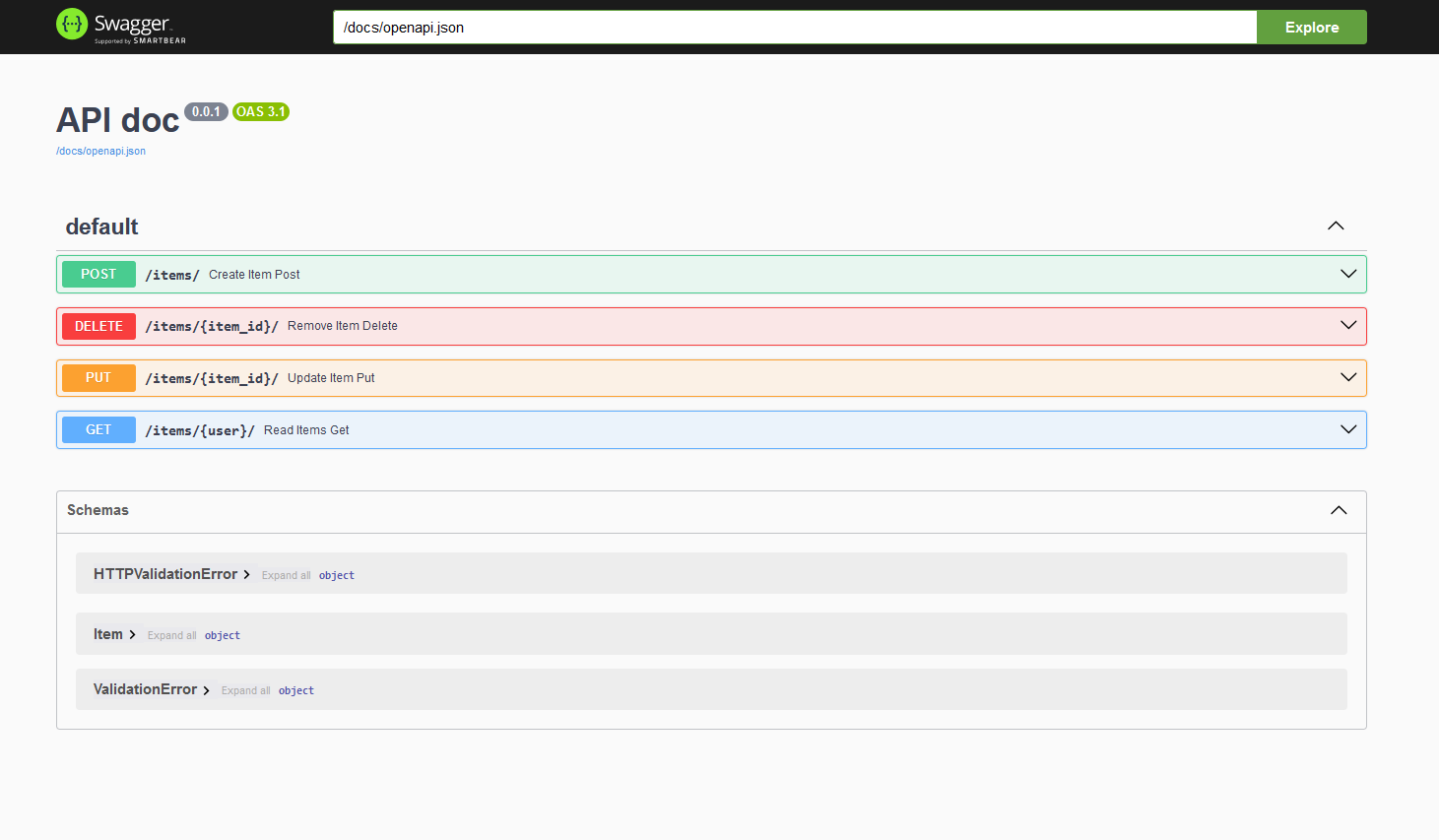
swagger_ui.api_doc(app, config=app_ftr.get_openapi_schema(), url_prefix='/docs')
Open your browser and go to http://127.0.0.1:5000/docs/
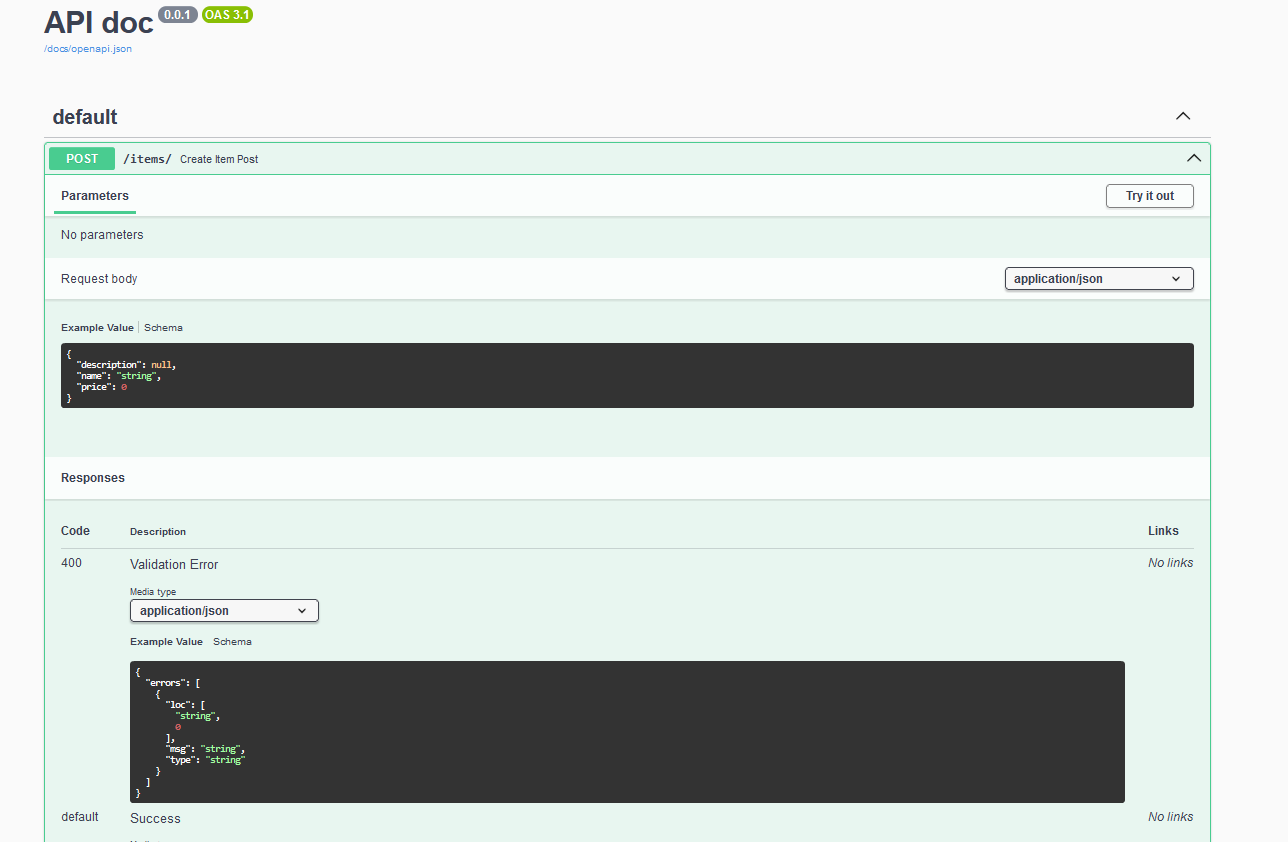
Create item endpoint:
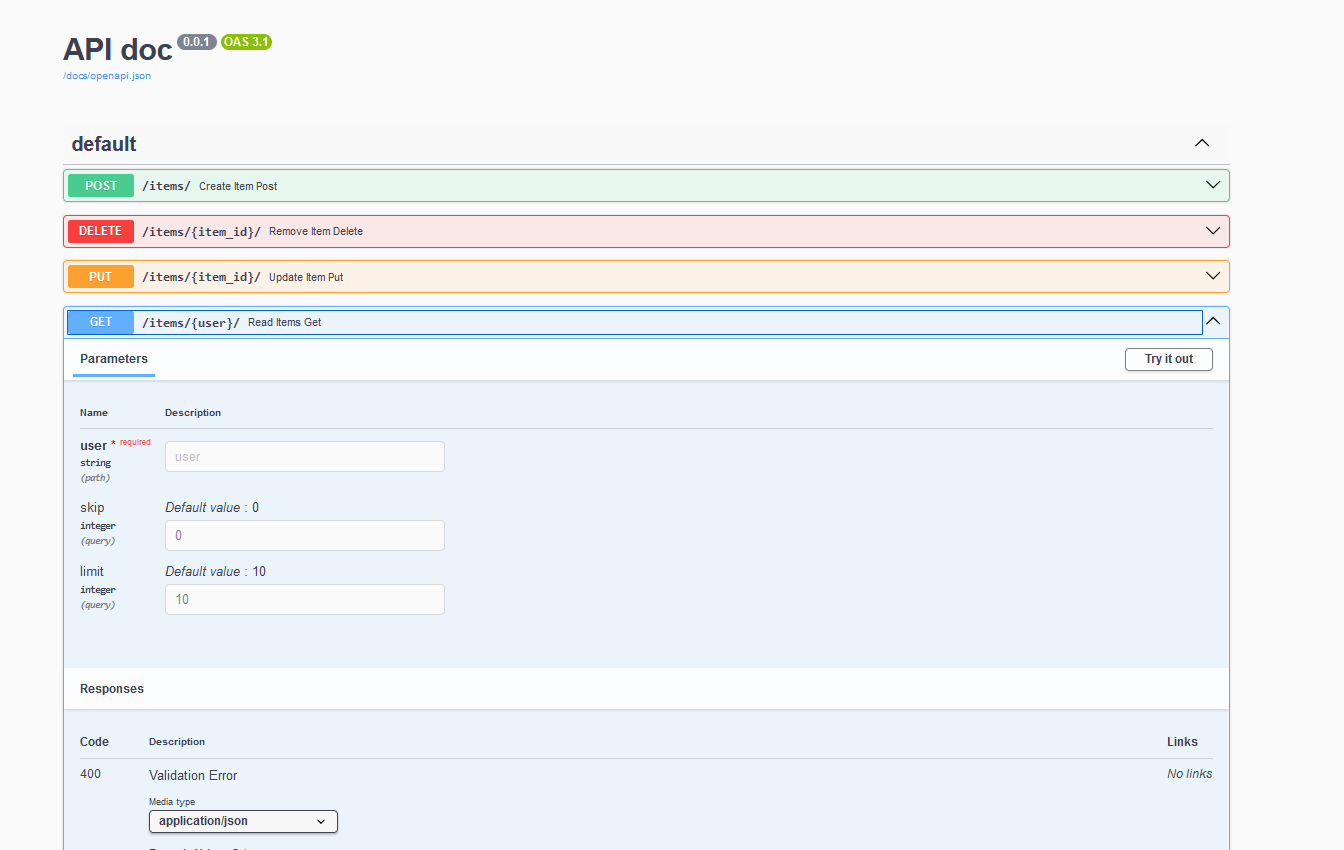
Read Items endpoint:
Documentation
For more detailed information and usage examples, refer to the project documentation
Development
To contribute to the project, you can run the following commands for testing and documentation:
Setting up the Development Environment
Ensure you have PIP updated:
python -m pip install --upgrade pip
Running Unit Tests
Install the test dependencies and run the tests:
pip install --group=test --upgrade  # Skip if already installed
python -m pytest tests/
python -m pytest --cov  # With coverage report
Running the Linter
To run the linter, use the following commands:
pip install --group=lint --upgrade  # Skip if already installed
ruff check .
Building the Documentation
To build the documentation locally, use the following commands:
pip install --group=doc --upgrade  # Skip if already installed
mkdocs serve  # Start live-reloading docs server
mkdocs build  # Build the documentation site
License
This project is licensed under the MIT license.
Release history Release notifications | RSS feed


Download files
Download the file for your platform. If you're not sure which to choose, learn more about installing packages.
Source Distribution
Built Distribution
Filter files by name, interpreter, ABI, and platform.
If you're not sure about the file name format, learn more about wheel file names.
Copy a direct link to the current filters
File details
Details for the file flask_typed_routes-0.2.8.tar.gz.
File metadata
- Download URL: flask_typed_routes-0.2.8.tar.gz
- Upload date:
- Size: 20.1 kB
- Tags: Source
- Uploaded using Trusted Publishing? No
- Uploaded via: twine/6.1.0 CPython/3.13.7
File hashes
| Algorithm | Hash digest | |
|---|---|---|
| SHA256 |
d8296c4a0939e12ede29c56ade945910c8a292d9cda919d86760365f9c6e2cc7
|
|
| MD5 |
4ad40080863f29862e06d216112871b6
|
|
| BLAKE2b-256 |
e12992b3f0030d7ebac7e49f2725f9675c7d379c6dc36726db3267ee4bbacc51
|
File details
Details for the file flask_typed_routes-0.2.8-py3-none-any.whl.
File metadata
- Download URL: flask_typed_routes-0.2.8-py3-none-any.whl
- Upload date:
- Size: 19.6 kB
- Tags: Python 3
- Uploaded using Trusted Publishing? No
- Uploaded via: twine/6.1.0 CPython/3.13.7
File hashes
| Algorithm | Hash digest | |
|---|---|---|
| SHA256 |
b19bc4998a08073fb59b1776f2194d71a5afd43c0cb9915beee85b935ca420bd
|
|
| MD5 |
6707c2a6a417781399747993e2adf6cf
|
|
| BLAKE2b-256 |
c6c012181747247d103c96aa66eda00116efba852794fadc1a332dcf269e991f
|






