
Flow Gym is a toolkit for research and deployment in flow quantification inspired by OpenAI Gym and Stable-Baselines3.

Project description
🌊 Flow Gym : A Research Toolkit for Fluid Flow Estimation





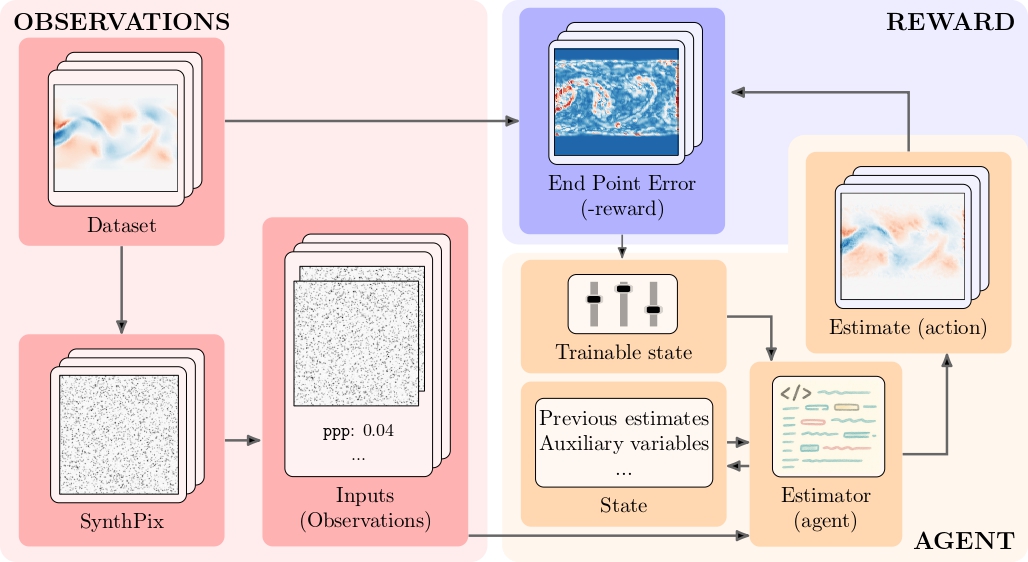
Flow Gym is a toolkit for research and deployment in flow quantification, inspired by OpenAI Gym and Stable-Baselines3. It leverages SynthPix for synthetic image generation and provides a unified interface for testing, training, and deploying learning-based algorithms that estimate fluid flow from sequences of tracer-particle images. The framework also includes a growing collection of integrated algorithms and stable JAX re-implementations of state-of-the-art methods.
✨ Features
-
Stable and reproducible environments Flow Gym provides FluidEnv, a unified environment for both supervised and reinforcement learning. It abstracts away infrastructure details and ensures consistent training and evaluation across experiments.
-
Unified estimator framework The Estimator API makes it easy to integrate, compare, and benchmark different flow estimation algorithms. It also supports extensions beyond velocity estimation — for example, pressure or tracer density — enabling ablation studies and cross-domain applications in fluid dynamics and control.
-
Ready for real-world deployment Flow Gym includes efficient JAX implementations of state-of-the-art flow estimation methods, optimized for real-time performance and suitable for closed-loop control or other fluid-sensing applications.
Getting Started 🚀
# Basic installation
uv add flow-gym-suite # or pip install flow-gym-suite

# With CUDA12 support
uv add "flow-gym-suite[cuda12]"
If you also want to use Flow Gym for training an evaluation, please clone the repository and install the development dependencies as outlined in the CONTRIBUTING.md page. There you can also find help if you have any issues installing Flow Gym.
Basic usage / Deployment 🧭
from flowgym.make import make_estimator
# Define the config (or load from YAML)
model_config = {
    "estimator": "dis_jax",
    "estimate_type": "flow",
    "config": {"jit": True, ..., },
}

# Create the estimator and associated functions
trained_state, create_state_fn, compute_estimate_fn, model = make_estimator(
    model_config=model_config,
    image_shape=image_shape
)

# Compute an estimate for an image pair
est_state = create_state_fn(prev)
new_est_state, metrics = compute_estimate_fn(curr, est_state)
Training a model 🧠
from flowgym.environment.fluid_env import FluidEnv

# Create the environment
env, env_state = FluidEnv.make(env_config)

for episode in range(num_episodes):
    obs, env_state, done = env.reset(env_state)
    est_state = create_state_fn(obs)
    train_step_fn = model.create_train_step()

    while not done.any():
        # Estimator forward pass
        est_state, metrics = compute_estimate_fn(obs, est_state, train_state)

        # Extract the action (the last estimate)
        action = estimation_state["estimates"][:, -1]
        # Environment step
        obs, env_state, reward, done = env.step(env_state, action)

        # Optimization step
        loss, train_state, _ = train_step_fn(
            est_state, train_state, reward
        )
Implementing a custom estimator 🧩
from flowgym.base import Estimator
class MyEstimator(Estimator):
    def init(self, rng, observation_space, action_space):
        # Initialize model parameters and state
        pass

    def _estimate(self, images, state, trainable_state, extras):
        # Define the forward pass of the model
        return new_state, extras, metrics

    def create_trainable_state(self, dummy_input, key):
        # Create the trainable state if needed (e.g., network structure, optimizer, etc.)
        pass

    def create_train_step(self):
        def train_step(self, estimation_state, trainable_state, rewards):
            # Define the training step (loss computation and optimization)
            return loss, new_trainable_state, metrics
Custom Preprocessing 🧼
# flowgym/common/preprocess.py
def custom_preprocess_validate_params(params: Dict[str, Any]) -> None:
    # Validate custom pre-processing parameters
    pass

def custom_preprocess(
    images: jnp.ndarray,
    params: Dict[str, Any]
) -> jnp.ndarray:
    # Implement custom pre-processing logic
    return processed_images

__all__ = [
    "custom_preprocess_validate_params",
    "custom_preprocess",
]
Custom Postprocessing 🎨
# flowgym/flow/postprocess/__init__.py
def custom_flow_postprocess_validate_params(params: Dict[str, Any]) -> None:
    # Validate custom post-processing parameters
    pass

def custom_flow_postprocess(
    estimates: jnp.ndarray,
    params: Dict[str, Any]
) -> jnp.ndarray:
    # Implement custom flow post-processing logic
    return processed_estimates

__all__ = [
    "custom_flow_postprocess_validate_params",
    "custom_flow_postprocess",
]
Examples 📚
For more examples, please check our training and evaluation scripts.
Contributing 🤗
Contributions are more than welcome! 🙏 Please check out our how to contribute page, and feel free to open an issue for problems and feature requests⚠️.
If you have developed a new method integrating with Flow Gym, please do open a PR! New methods should come with reproducible experiments showcasing the features. We collect these experiments in the folder experiments/your-method.
Citation 📈
If you use this code in your research, please cite our paper:
   @article{banelli2025flowgym,
      title={Flow Gym},
      author={Banelli, Francesco and Terpin, Antonio and Bonomi, Alan and D'Andrea, Raffaello},
      year={2025}
   }
License 📝
This project is licensed under the MIT License - see the LICENSE file for details.
Release history Release notifications | RSS feed

Download files
Download the file for your platform. If you're not sure which to choose, learn more about installing packages.
Source Distribution
Built Distribution
Filter files by name, interpreter, ABI, and platform.
If you're not sure about the file name format, learn more about wheel file names.
Copy a direct link to the current filters
File details
Details for the file flow_gym_suite-0.1.0.tar.gz.
File metadata
- Download URL: flow_gym_suite-0.1.0.tar.gz
- Upload date:
- Size: 120.7 kB
- Tags: Source
- Uploaded using Trusted Publishing? No
- Uploaded via: twine/6.2.0 CPython/3.13.5
File hashes
| Algorithm | Hash digest | |
|---|---|---|
| SHA256 |
d4866aee513bb8b0442583267e585d849607cda4a9ae7156b652a80250ee02e6
|
|
| MD5 |
2bebcc6e664cb51248c2885c4f79e04c
|
|
| BLAKE2b-256 |
e6f4ff4caf58245ade3cc00d23c31e935e91d6a0ed1ae3911fb375cbc4d67767
|
File details
Details for the file flow_gym_suite-0.1.0-py3-none-any.whl.
File metadata
- Download URL: flow_gym_suite-0.1.0-py3-none-any.whl
- Upload date:
- Size: 118.4 kB
- Tags: Python 3
- Uploaded using Trusted Publishing? No
- Uploaded via: twine/6.2.0 CPython/3.13.5
File hashes
| Algorithm | Hash digest | |
|---|---|---|
| SHA256 |
00f8e34b874354c1606e1956d49bbabb6d5f51485e1accd44a2f573196ec9089
|
|
| MD5 |
b4068a428a2d841e9ff54b5a719a2a7b
|
|
| BLAKE2b-256 |
7c337b70aad6f700b62a9fa3334e77655da3d302e7d68f27cdac77aaa9fc4e3c
|






