
FlowSurgeon — framework-agnostic profiling middleware for Python (WSGI & ASGI).
Verified details
These details have been verified by PyPIProject links
GitHub Statistics
Maintainers

Project description

FlowSurgeon
Framework-agnostic profiling middleware for Python — drop-in debug UI for Flask and FastAPI.



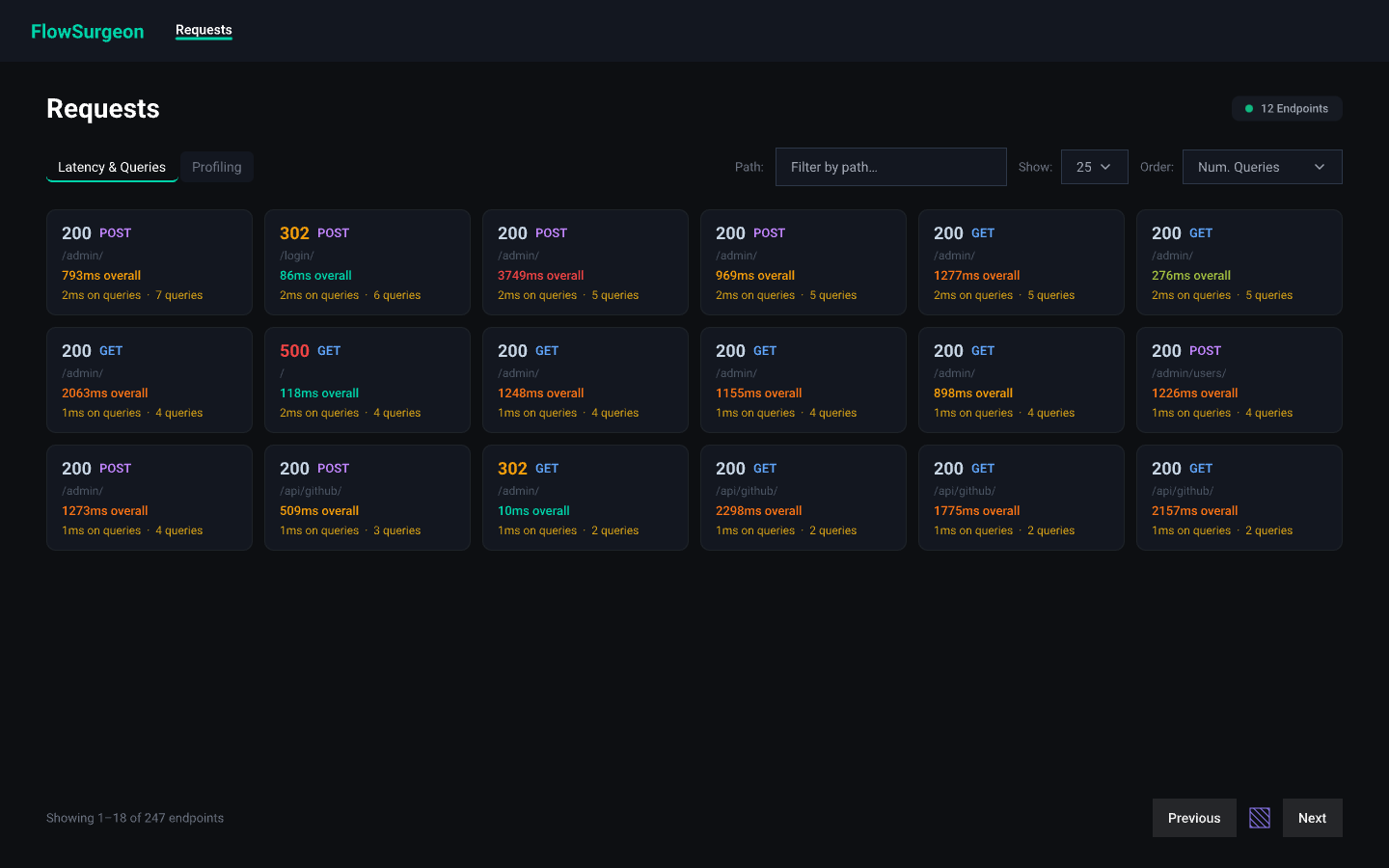
FlowSurgeon wraps your existing WSGI or ASGI app with a single line. It injects a collapsible debug panel into every HTML response and stores a full request history — timing, headers, SQL queries, response bodies — in a local SQLite database, with a built-in dark-themed UI at /flowsurgeon.
Features
- Zero application changes — wraps any WSGI or ASGI callable
- Auto-detect WSGI vs ASGI via the
FlowSurgeon()factory - Inline debug panel injected before
</body>in every HTML response - Built-in history UI at
/flowsurgeon— no extra server needed - Request grid view — browse captured requests sorted by query count, duration, or path
- SQL query tracking via SQLAlchemy and DB-API 2.0 (sqlite3, psycopg2, …)
- Call-stack profiling —
cProfile-based per-request profiling with a sortable stats table and callers drilldown (opt-in viaenable_profiling=True) - Route auto-discovery from Flask (
url_map) and FastAPI/Starlette (app.routes) - Response body capture — stores up to 128 KB for text/JSON/XML responses
- SQLite persistence with auto-pruning (configurable max records)
- Sensitive header redaction —
Authorization,Cookie,Set-Cookiestripped by default FLOWSURGEON_ENABLEDenv var — safe to ship in codebase; disabled by default
Installation
# Recommended
uv add flowsurgeon

# pip
pip install flowsurgeon
Requires Python 3.12+. The only runtime dependency is jinja2.
[!WARNING] FlowSurgeon is a development tool. Do not enable in production. See Security for details.
Quick start
FastAPI / Starlette (ASGI)
from fastapi import FastAPI
from flowsurgeon import FlowSurgeon, Config

_app = FastAPI()

app = FlowSurgeon(
    _app,
    config=Config(enabled=True),
)

@_app.get("/books")
async def books():
    return {"books": ["Clean Code", "Refactoring"]}
uvicorn myapp:app --reload
# Debug UI → http://127.0.0.1:8000/flowsurgeon
Flask (WSGI)
from flask import Flask
from flowsurgeon import FlowSurgeon, Config

app = Flask(__name__)

app.wsgi_app = FlowSurgeon(
    app.wsgi_app,
    config=Config(enabled=True),
)
flask run
# Debug UI → http://127.0.0.1:5000/flowsurgeon
Security
FlowSurgeon is designed for local development — these settings keep it safe and contained.
Kill Switch
The middleware is a no-op unless explicitly enabled, so it is safe to ship in your codebase. Enable it per-environment via an env var or your settings layer.
# Enable without modifying code
FLOWSURGEON_ENABLED=1 uvicorn myapp:app
from flowsurgeon import Config

# Or enable in code
Config(enabled=True)
Allowed Hosts
Only requests from listed IPs can access the debug panel. By default this is restricted to localhost addresses.
from flowsurgeon import Config

Config(
    # Defaults — loopback only
    allowed_hosts=["127.0.0.1", "::1", "localhost"],
)
To allow an additional machine on your local network:
from flowsurgeon import Config

Config(
    allowed_hosts=["127.0.0.1", "::1", "localhost", "192.168.1.50"],
)
Header Redaction
Sensitive header values are replaced with [redacted] before being stored in the database. The default list covers the most common credential-bearing headers.
from flowsurgeon import Config

Config(
    # Defaults — authorization, session cookies redacted
    strip_sensitive_headers=["authorization", "cookie", "set-cookie"],
)
To redact an additional header:
from flowsurgeon import Config

Config(
    strip_sensitive_headers=["authorization", "cookie", "set-cookie", "x-api-key"],
)
Database File
FlowSurgeon writes request data to a local SQLite file (flowsurgeon.db by default). Add it to your project's .gitignore so it is never committed.
# .gitignore
flowsurgeon.db
To store the database elsewhere:
from flowsurgeon import Config

Config(db_path="/tmp/flowsurgeon.db")
SQL query tracking
SQLAlchemy
from sqlalchemy import create_engine
from flowsurgeon import FlowSurgeon, Config
from flowsurgeon.trackers.sqlalchemy import SQLAlchemyTracker

engine = create_engine("sqlite:///mydb.db")
tracker = SQLAlchemyTracker(engine, capture_stacktrace=False)

app = FlowSurgeon(
    asgi_app,
    config=Config(enabled=True),
    trackers=[tracker],
)
DB-API 2.0 (sqlite3, psycopg2, …)
import sqlite3
from flowsurgeon import FlowSurgeon, Config
from flowsurgeon.trackers import DBAPITracker

raw_conn = sqlite3.connect("mydb.db")
tracker = DBAPITracker(raw_conn)
conn = tracker.connection  # use this instead of raw_conn everywhere

app = FlowSurgeon(
    wsgi_app,
    config=Config(enabled=True),
    trackers=[tracker],
)
DBAPITracker works via a transparent proxy — replace your connection object with tracker.connection and every cursor().execute() call is automatically timed and recorded.
Configuration
from flowsurgeon import Config

Config(
    # Master switch — default False. Also controlled by FLOWSURGEON_ENABLED env var.
    enabled=True,

    # Only serve the debug panel to requests from these hosts.
    allowed_hosts=["127.0.0.1", "::1", "localhost"],

    # SQLite file for request history storage.
    db_path="flowsurgeon.db",

    # Prune oldest records when this limit is exceeded.
    max_stored_requests=1000,

    # URL prefix for the built-in debug UI.
    debug_route="/flowsurgeon",

    # Headers replaced with "[redacted]" before storage.
    strip_sensitive_headers=["authorization", "cookie", "set-cookie"],

    # SQL query tracking options.
    track_queries=True,
    slow_query_threshold_ms=100.0,
    capture_query_stacktrace=False,

    # Call-stack profiling (cProfile). Off by default; adds ~1-10% overhead.
    # Also controlled by FLOWSURGEON_PROFILING env var.
    enable_profiling=False,
    profile_top_n=50,              # keep top N functions by cumulative time
    profile_user_code_only=True,   # filter out stdlib + third-party frames

    # Manually register routes shown in the UI before any traffic.
    # Flask and FastAPI routes are auto-discovered; use this for other cases.
    known_routes=[("GET", "/health"), ("POST", "/webhooks/stripe")],
)
Debug UI
| URL | Description |
|---|---|
/flowsurgeon |
Requests grid — all captured requests with latency and query info |
/flowsurgeon?view=profiling |
Profiling tab — list of profiled requests with top hotspot function |
/flowsurgeon?q=/books |
Filter requests by path |
/flowsurgeon?order=duration |
Sort by duration (also: queries, path) |
/flowsurgeon/{request_id} |
Request detail: headers, response body, SQL, tracebacks, profile |
Requests view
Displays all captured requests as a card grid, sorted by number of queries by default. Each card shows: status code, HTTP method, path, total duration, query time and count. Supports filtering by path and ordering by query count, duration, or path.
Request detail — four tabs
- Details — stat cards (status, duration, SQL count, SQL time); request headers; response headers and body (up to 128 KB for text/JSON content types)
- SQL — every captured query with timing,
slowbadge (exceeds threshold),dupbadge (same SQL run more than once), and bound params - Traceback — Python stack trace per query (requires
capture_query_stacktrace=True) - Profile —
cProfilecall-stack stats: function name, file:line, calls, own time, total time, visual time bar, and a native<details>callers drilldown per function (requiresenable_profiling=True)
Call-stack profiling
app = FlowSurgeon(
    _app,
    config=Config(
        enabled=True,
        enable_profiling=True,         # enable cProfile per request
        profile_top_n=50,              # keep top 50 functions by cumulative time
        profile_user_code_only=True,   # hide stdlib + third-party frames
    ),
)
Or via environment variable (no code changes needed):
FLOWSURGEON_ENABLED=1 FLOWSURGEON_PROFILING=1 uvicorn myapp:app
ASGI note: cProfile measures CPU time while the coroutine is on-thread. I/O-wait time (e.g. awaiting a DB call) appears as event-loop time rather than in the awaited coroutine's frame. CPU-bound hotspots are captured accurately.
Running the examples
# FastAPI + SQLAlchemy
uv run --group examples uvicorn examples.fastapi.demo_fastapi:app --reload

# Flask + DB-API (sqlite3)
uv run --group examples python examples/flask/demo_flask.py
Debug UI:
- FastAPI → http://127.0.0.1:8000/flowsurgeon
- Flask → http://127.0.0.1:5000/flowsurgeon
Both demos expose these routes:
| Route | What it demonstrates |
|---|---|
GET /books |
Normal query — 1 SQL |
GET /books/{id} |
Parametrised query |
GET /books/duplicates |
Same query twice → dup badge |
GET /books/slow |
Query exceeds threshold → slow badge |
GET /slow |
Slow endpoint, no SQL |
GET /boom |
500 error |
Environment variable
See Security for the FLOWSURGEON_ENABLED kill switch and other security settings.
License
Project details
Verified details
These details have been verified by PyPIProject links
GitHub Statistics
Maintainers


Download files
Download the file for your platform. If you're not sure which to choose, learn more about installing packages.
Source Distribution
Built Distribution
Filter files by name, interpreter, ABI, and platform.
If you're not sure about the file name format, learn more about wheel file names.
Copy a direct link to the current filters
File details
Details for the file flowsurgeon-0.5.1.tar.gz.
File metadata
- Download URL: flowsurgeon-0.5.1.tar.gz
- Upload date:
- Size: 105.3 kB
- Tags: Source
- Uploaded using Trusted Publishing? Yes
- Uploaded via: uv/0.10.10 {"installer":{"name":"uv","version":"0.10.10","subcommand":["publish"]},"python":null,"implementation":{"name":null,"version":null},"distro":{"name":"Ubuntu","version":"24.04","id":"noble","libc":null},"system":{"name":null,"release":null},"cpu":null,"openssl_version":null,"setuptools_version":null,"rustc_version":null,"ci":true}
File hashes
| Algorithm | Hash digest | |
|---|---|---|
| SHA256 |
63233e44a5a4270ef6c556021d8b5ff6e2fa4e126113f86f45692c08c12da5fc
|
|
| MD5 |
7ce32e9bb39710d960a9abf350decc37
|
|
| BLAKE2b-256 |
75fb05bdb09d38a8b11beabd139ad6f22841cef5fd196eb562dd5f87864b4051
|
File details
Details for the file flowsurgeon-0.5.1-py3-none-any.whl.
File metadata
- Download URL: flowsurgeon-0.5.1-py3-none-any.whl
- Upload date:
- Size: 116.8 kB
- Tags: Python 3
- Uploaded using Trusted Publishing? Yes
- Uploaded via: uv/0.10.10 {"installer":{"name":"uv","version":"0.10.10","subcommand":["publish"]},"python":null,"implementation":{"name":null,"version":null},"distro":{"name":"Ubuntu","version":"24.04","id":"noble","libc":null},"system":{"name":null,"release":null},"cpu":null,"openssl_version":null,"setuptools_version":null,"rustc_version":null,"ci":true}
File hashes
| Algorithm | Hash digest | |
|---|---|---|
| SHA256 |
2355fd39a0b00d7ec11ac1288da7f7c516e73ef2f909bcee3ef2ed2b07febe83
|
|
| MD5 |
e78cae07d009282f6e20444ca82fee28
|
|
| BLAKE2b-256 |
bb2d925e678b1d03a8dc4f94a1c5ad26ce4501f6e6c81a4fd7bbd3257c1979b8
|






