
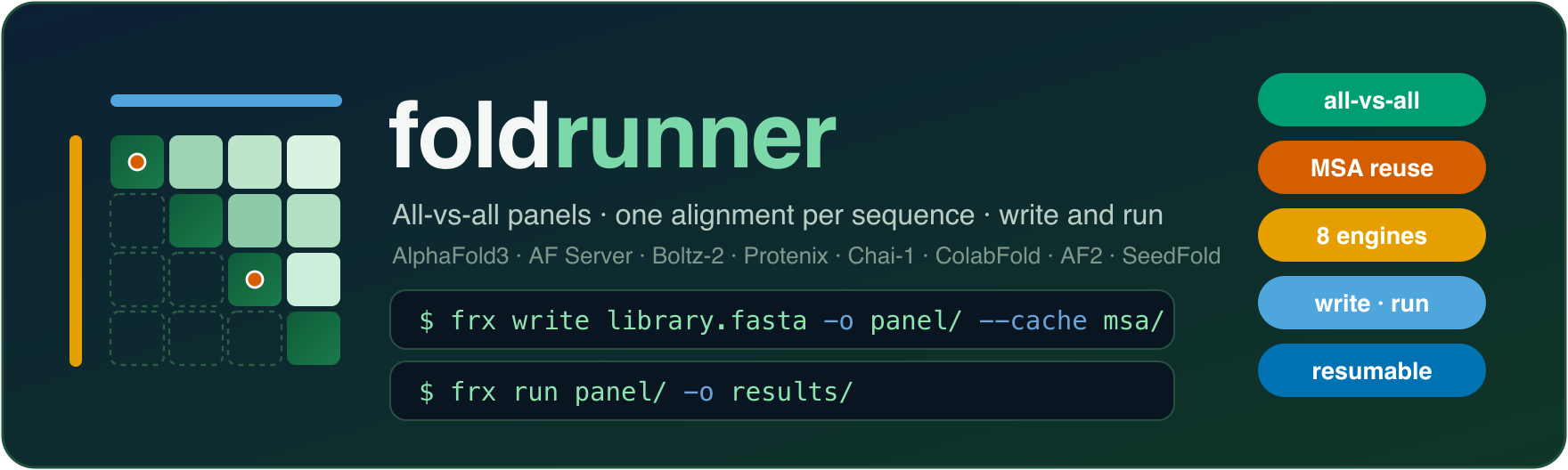
foldrunner: all-vs-all prediction panels with one alignment per sequence
| Testing |  |
|---|---|
| Package |    |
| Meta |   |
🧬 What is it?
foldrunner takes a protein library and produces the input files for a complete
all-vs-all prediction panel across AlphaFold 3, AlphaFold Server, Boltz-2,
Protenix, Chai-1, ColabFold, AlphaFold2-Multimer and SeedFold — computing each
multiple sequence alignment once and handing the same one to every engine.
A panel of N sequences contains N(N+1)/2 complexes but only N distinct sequences. The engines cannot see that: left to itself AlphaFold 3 runs its data pipeline once per job, so a 100-sequence panel searches the same sequence up to 100 times. That difference is the point of the package.
library.fasta ──► enumerate ──► N(N+1)/2 complexes
                      │
                      └──► N alignments  (searched once, addressed by sequence hash)
                                │
      ┌───────────┬─────────────┼──────────────┬────────────┐
  AlphaFold3   Boltz-2      Protenix        Chai-1     ColabFold  …
      └───────────┴─────────────┼──────────────┴────────────┘
                          manifest.tsv ──► foldmetrics
Scores from the resulting predictions are read by foldmetrics, which computes ipSAE, pDockQ2, LIS and DockQ over the same panel. It reads each engine's output tree untouched, so no file has to be renamed or moved first:
pip install "foldrunner[metrics]"     # pulls in foldmetrics >= 0.1.7
fmx score results/ --by-target summary.tsv
Checked against the untouched output of all six engines this package can run: foldmetrics 0.1.7 resolves each one to the same six targets, and counts the models each engine actually produced rather than the files it wrote.
| engine | targets | models | what could go wrong |
|---|---|---|---|
| AlphaFold 3 | 6 | 60 | the top-level copy of the best sample counted twice |
| Protenix | 6 | 60 | seed_N/predictions/ swallowing the job name |
| Chai-1 | 6 | 30 | |
| AlphaFold2-Multimer | 6 | 30 | .pdb and .cif of one model counted as two |
| Boltz-2 | 6 | 12 | two seed directories read as two targets |
| ColabFold | 6 | 6 | a flat directory collapsing the whole panel into one |
Older releases do collapse a panel into a single row on some of these layouts, so the floor is not cosmetic.
📦 Installation
pip install foldrunner
With Chai-1 alignment support (writes .aligned.pqt parquet files):
pip install "foldrunner[chai]"
Development install:
git clone https://github.com/ChiaChunL/foldrunner.git
cd foldrunner
pip install -e ".[dev]"
⚡ Quickstart
CLI (foldrunner, short alias frx):
# what would this panel cost, before anything is submitted?
frx plan library.fasta --mode all

# compute the alignments: once per unique sequence, not once per pair
frx search library.fasta --cache msa/ --contact you@example.org

# ... or adopt alignments an earlier run already produced
frx import old_msa_tree/ --cache msa/ --backend protenix-api --link

# write the inputs
frx write library.fasta -o panel/ --cache msa/ --engines af3,boltz2,protenix,chai1
plan reports the arithmetic that makes the rest worthwhile:
library        87 unique sequences
mode           all
complexes      3828
MSA searches   87   (one per unique sequence, not per complex)
               searching per complex instead would cost 3828
engine files   15312
Python — the CLI is a thin layer over this:
import foldrunner as fr

jobs = fr.panel("library.fasta", "all", seeds=(2066,))

fr.cost(jobs, engines=["af3", "boltz2"])
# PanelCost(complexes=3828, sequences=87, engines=2)
#   .searches_saved -> 3741      .files -> 7656

fr.search(jobs, cache="./msa", backend=backend)     # one search per sequence
written = fr.write(jobs, "./panel", engines=["af3", "boltz2"],
                   cache="./msa", recipe=backend.recipe)
fr.run_plan(written, "./results", scripts="./panel/scripts")
🛠️ Command-line reference
| Command | Purpose |
|---|---|
plan |
report complex and alignment counts without writing anything |
search |
compute the alignments a panel needs, web service or local databases |
import |
re-address alignments from an earlier run into the cache |
write |
generate the input files, plus manifest.tsv |
| Option | Commands | Meaning |
|---|---|---|
--mode {all,hetero,monomer,bipartite} |
plan, search, write | which complexes to enumerate (default all) |
--preys FILE |
plan, search, write | second library, for bipartite |
--cache DIR |
search, import, write | alignment cache directory |
--engines LIST |
plan, write | comma-separated engines; default is all eight |
--seeds LIST |
write | comma-separated integer seeds |
-o, --out DIR |
write | output directory |
--no-batch |
write | one file per complex even for the batch engines |
--contact EMAIL |
search | the web services require callers to identify themselves |
--host / --fallback |
search | primary and standby alignment services |
--batch-size N |
search | sequences per request (default 20) |
--pairing-strategy {greedy,complete} |
search | how strictly taxa must be shared |
--unpaired-only |
search | skip the pairing search |
--link |
import | hard link instead of copying, for large trees |
--dry-run / --limit N |
import | scan without writing / stop early |
--backend / --databases / --tool-version |
import, write | which recipe the alignments belong to |
frx <command> --help prints the complete option list.
🔗 Supported engines
| Engine | Input | Copies expressed as | Keeps chain names | External alignment |
|---|---|---|---|---|
| AlphaFold 3 | JSON per complex | id list |
yes | unpairedMsaPath / pairedMsaPath |
| AlphaFold Server | JSON batches | count |
no (forces A/B) | unpairedMsa, embedded |
| Boltz-2 | YAML per complex | id list |
yes | msa: path |
| Protenix | one JSON panel | count |
no (forces A/B) | unpairedMsaPath / pairedMsaPath |
| Chai-1 | FASTA per complex | repeated records | — | <sha256>.aligned.pqt directory |
| ColabFold | FASTA or CSV | a3m header cardinality | — | concatenated a3m, or CSV a3mpath |
| AlphaFold2-Multimer | FASTA per complex | repeated records | no (starts at B) | --use-precomputed-msas, partial at best |
| SeedFold | JSON, single or batch | copies |
— | not supported |
Every format was checked against upstream source rather than documentation prose;
docs/engine-formats.md records each one with the
inconsistencies that are real and must not be "tidied up" — AlphaFold Server's
separate dialect and nineteen-code ligand allow-list, ColabFold joining chains
with : where AlphaFold2-Multimer uses separate records, and Boltz-2 refusing a
directory that mixes entries with and without an affinity property.
Every format was additionally checked by feeding the generated files to each
engine's own parser — folding_input.Input.from_json, boltz.main.check_inputs,
SampleDictToFeatures, read_inputs, get_queries, parse_fasta — rather than
only to this package's tests.
Two engines cannot fully reuse an alignment, which any comparison has to say
out loud. SeedFold accepts neither a precomputed alignment nor a seed, so it
always searches for itself and its sampling is not reproducible.
AlphaFold2-Multimer can at most reuse bfd_uniref_hits.a3m, the one file in its
precomputed set that is already a3m; the three Stockholm files it also looks for,
including the uniprot_hits.sto that drives pairing, are left for it to search,
because converting into them risks changing the alignment rather than reusing it.
The manifest records this as msa_partial. Whether even that much is reused
depends on the entry point: run_alphafold.py decides per file, but a site
wrapper may refuse to start unless the whole set is present, in which case
AlphaFold2 searches everything itself.
🧮 Enumeration
| Mode | Complexes | Use |
|---|---|---|
all |
N(N+1)/2 | every unordered pair, self-pairs included |
hetero |
N(N-1)/2 | pairs only |
monomer |
N | one job per sequence, as controls |
bipartite |
baits × preys | screening candidates against known partners |
A self-pair is a homodimer: one entity with count=2, not two components
that happen to share a sequence. Six of the eight engines express that directly;
Chai-1 and AlphaFold2-Multimer expand it into repeated records.
Sequences are deduplicated by content on load, so the same protein under two labels is searched once and produces one job rather than two.
🧠 Alignments
Cache entries are keyed by sha256(sequence.upper()) — the same address Chai-1
uses for <hash>.aligned.pqt, so a cache directory doubles as its
msa_directory with no conversion step. Addressing by content rather than by
position is what lets a cache survive a reordered library, a renamed directory,
or reuse by the next panel entirely.
msa/
└── protenix-api-6b0f3f937902/          ← recipe: backend + databases + version
    └── 3dd8c3f8…fcfaaa/                ← sha256 of the sequence
        ├── unpaired.a3m
        ├── paired.a3m
        └── meta.json
The recipe layer is not decoration. Alignments from different backends or database releases have different depths, depth moves ipTM, and a panel that silently mixes two sources produces differences that cannot be attributed afterwards.
Paired and unpaired
The two are fetched and stored separately because they come from different
places. Pairing needs a taxonomy-labelled source — hits arrive as
UniRef100_<accession>_<taxid>/ — while the metagenomic databases that give
unpaired alignments their depth carry no taxon at all.
Pairing follows AlphaFold2-Multimer: group by taxon, drop taxa present in only one chain, rank within a taxon by similarity to that chain's own query.
This matters for any panel spanning more than one species. Two human proteins
share orthologues in mouse, zebrafish and yeast, so their paired alignment runs
to hundreds of rows. A human protein and a viral one share no organism at all, so
theirs is nearly empty and the model has only its priors to work with. Their
interface scores are therefore not on the same footing, and sorting a mixed panel
by ipTM ranks pairing depth as much as it ranks interaction. manifest.tsv
carries n_paired per job so the two can be read apart —
docs/msa-pairing.md works through it.
Where alignments come from
| Backend | When |
|---|---|
| Protenix / ColabFold services | up to a few dozen unique sequences; either can stand in for the other |
| a local MMseqs2 search you run yourself | anything larger — the public services are shared academic resources sized for a few thousand alignments a day across all users. Run colabfold_search and adopt the result with foldrunner import; --local-db is groundwork and refuses to run |
frx import |
alignments an earlier run already produced |
plan and search warn before a panel crosses into territory the public
services are not meant to absorb.
🚀 Running
foldrunner write produces inputs; foldrunner run turns them into commands.
The engine modules know the shape of each invocation, and a config file says
where the engines are installed — so moving a panel to another machine changes
the config, not the package.
# ./foldrunner.toml, ~/.config/foldrunner/foldrunner.toml, or $FOLDRUNNER_CONFIG

[defaults]
# A non-interactive shell is not a login shell: conda is not on PATH, and
# `conda activate` is not even defined until this is sourced.
conda_sh = "/opt/conda/etc/profile.d/conda.sh"

[engines.boltz2]
conda_env = "boltz2"
extra_args = "--cache /opt/boltz-2"

[engines.protenix]
conda_env = "protenix"
env = { PROTENIX_ROOT_DIR = "/opt/Protenix_data" }

[engines.chai1]
conda_env = "chai1"
# Chai-1 fetches its ESM-2 embeddings from Hugging Face even though its own
# weights come from elsewhere; this is where that download is redirected.
env = { HF_ENDPOINT = "https://hf-mirror.com" }

[engines.af3]
container = "docker"
image = "alphafold3"
gpus = "all"
# Alignment paths inside an AlphaFold 3 job are absolute, so the input has to be
# visible at the same path inside the container as outside it.
mounts = ["{input_dir}:{input_dir}", "/opt/af3_models:/models"]
extra_args = "--model_dir=/models --norun_data_pipeline"

[engines.af2_multimer]
executable = "/opt/af2/run_af2.sh"
# The multimer preset is not the default anywhere; the monomer pipeline rejects
# the multi-record FASTA this engine writes, after the job has started.
extra_args = "--model-preset multimer"
foldrunner env                 # what can this machine run?
foldrunner run panel -o results               # writes panel/scripts/run_all.sh
foldrunner run panel -o results --runner local
A worked configuration is in examples/foldrunner.toml.
How much one invocation covers differs by engine and is not a detail: Boltz-2 and ColabFold read a whole directory, so they run once for the panel rather than once per complex; Protenix takes the panel and every seed in one file; AlphaFold 3, Chai-1 and AlphaFold2-Multimer run per complex.
Chai-1 is driven through a generated Python script rather than chai-lab fold,
because the command line writes only the ranking summary and the full PAE exists
solely on the object the Python API returns — a CLI run loses it permanently.
AlphaFold Server and SeedFold have no command at all. They are web forms, and are
listed in scripts/MANUAL.md with the file to upload rather than given an
invented command line.
Failures keep their whole output under panel/logs/, script included. Re-running
a GPU job to read a message it already printed is an expensive way to learn
nothing new.
🧪 Examples
examples/ ships a three-sequence library — barnase, barstar and ubiquitin — so every command above runs as-is after a clone. It holds one known binder, two known non-binders and three homodimers, which is enough to tell a working run from a broken one before committing a real library to it.
📋 Manifest
write produces manifest.tsv alongside the inputs:
job         engine    component  entity   chain  count  n_chains  n_residues  msa_used  n_paired
A__A        boltz2    0          A        A      2      2         1334        1         1681
A__A        boltz2    0          A        B      2      2         1334        1         1681
A__B        protenix  0          A        A      1      2         1090        1         1444
Three engines discard the chain names they are given — Protenix and AlphaFold Server relabel everything to A/B/C, AlphaFold2-Multimer starts at B — so results coming back from different engines cannot be lined up against the same entities without this table. It also carries the paired depth per job, and lets a run resume where it stopped.
📁 Outputs and paths
write -o DIR→ one subdirectory per engine, plusmanifest.tsv.- Batch engines write differently by design: Protenix gets one
panel.json, AlphaFold Server and SeedFold getbatch_000.json,batch_001.json, … sized to a day's upload quota.--no-batchforces one file per complex. - ColabFold additionally gets
queries.csvwith ana3mpathcolumn, which is how it takes precomputed alignments. - Boltz-2 jobs carrying an affinity property go to
boltz2/affinity/. Boltz-2 runs the affinity stage over every entry in a directory, so an entry without the property fails there; keeping them apart is the only way both run. - Job names are
<A>__<B>, order-independent and sanitized to[A-Za-z0-9._-]. The same name is used by every engine so results can be matched back.
💡 Conventions worth knowing
- Entities, not chains. The intermediate representation models an entity and a copy count. Chain identifiers are assigned by each writer and recorded, never carried in the job, because for three engines any name chosen up front is fiction.
- Never let an engine build its own alignment. It is not only slower; the alignment then differs between engines, and the comparison stops being one.
- Alignments are referenced by path, not embedded, everywhere except AlphaFold Server, which has no filesystem to point at. A protein's alignment runs to tens of megabytes and a panel repeats it across every complex the sequence appears in.
- Throttling looks like a corrupt download. The services answer a throttled request with an HTML page under a normal status code; unpacking it raises a gzip error far from its cause. foldrunner checks the archive magic first and reports it as throttling, which is worth waiting out.
- Ligands add PAE tokens. One per heavy atom, so a residue-count-based alignment of a PAE matrix will be wrong for any complex containing one.
✅ What has actually been run
Formats were checked against each engine's own parser, but a parser accepting an input does not mean the engine can run it — every defect this package has had passed format validation and failed after the job started. So this table separates what has produced a structure from what has only been exercised against a stand-in.
| status | |
|---|---|
| AlphaFold 3, Protenix, Boltz-2, Chai-1, ColabFold, AlphaFold2-Multimer | run end to end on GPU; 6-complex panel, 2 seeds, structures scored by foldmetrics |
| AlphaFold Server, SeedFold | inputs match the published schema and official examples; never submitted — they are web forms with no API |
| Alignments from the web services | real calls against both endpoints |
foldrunner import |
22,804 real entries, hard-linked, no duplicated bytes |
--local-db (built-in local search) |
not available — written but never run against real databases, so it refuses rather than pretending. Run colabfold_search yourself and use foldrunner import |
To run a panel on another machine, install foldrunner there and copy the panel across — the snapshot records relative paths, so it works from wherever it lands. There is no remote-execution mode, because driving an engine over ssh needs the panel visible at the same path on both machines and that assumption does not hold often enough to be worth the failure modes.
📚 References
- Abramson J et al. Accurate structure prediction of biomolecular interactions with AlphaFold 3. Nature 630, 493–500 (2024).
- Evans R et al. Protein complex prediction with AlphaFold-Multimer. bioRxiv (2021). — the species-pairing scheme this package follows
- Mirdita M et al. ColabFold: making protein folding accessible to all. Nat Methods 19, 679–682 (2022). — the MMseqs2 alignment service and its a3m conventions
- Steinegger M, Söding J. MMseqs2 enables sensitive protein sequence searching for the analysis of massive data sets. Nat Biotechnol 35, 1026–1028 (2017).
- Wohlwend J et al. Boltz-1: democratizing biomolecular interaction modeling. bioRxiv (2024).
- Chai Discovery. Chai-1: decoding the molecular interactions of life. bioRxiv (2024).
- Chen X et al. Protenix: advancing structure prediction through a comprehensive AlphaFold3 reproduction. bioRxiv (2025).
- ByteDance Seed. SeedFold: scaling biomolecular structure prediction. arXiv (2025).
📄 License
1 maintainer

Metadata
1 maintainer
Release files for foldrunner 0.1.0
For a detailed explanation of source distributions (sdists) and built distributions (wheels), please see the package formats documentation.
Source distribution (sdist)
| File | Size | Uploaded | Provenance | |
|---|---|---|---|---|
| foldrunner-0.1.0.tar.gz | 226.4 kB | With provenance | Details |
Built distribution (wheel)
| File | Interpreter | ABI | Platform | Reset |
|---|---|---|---|---|
| foldrunner-0.1.0-py3-none-any.whl | Python 3 | none | any | Details |
Total release size: 302.2 kB
Release files / foldrunner-0.1.0.tar.gz
| Download URL | foldrunner-0.1.0.tar.gz |
|---|---|
| Size | 226.4 kB |
| Tags | Source |
|
SHA-256 checksum How to use checksums |
bfc75ba89c063c4d67772f59d291d828ceb50413b92c9183d3deebea3da15a03
|
|
BLAKE2b-256 checksum How to use checksums |
87b598bb629bdee4aec907c70b5fd3dde8255bc01211875e5951a99a430c6802
|
| Upload date | |
|
Uploaded using Trusted Publishing? What is trusted publishing? |
Yes |
| Uploaded via |
twine/7.0.0 CPython/3.13.14
|
Provenance
Provenance describes where a file came from. On PyPI, provenance is shared via attestations, which provide a verifiable record of the build or publishing details. View details, limitations and caveats.


PyPI Publish Attestation
PyPI verified that this artifact, at this checksum, originated from the publisher listed below.
Signed by GitHub Actions, verified by PyPI on Aug 19, 2026.
Transparency logRelease files / foldrunner-0.1.0-py3-none-any.whl
| Download URL | foldrunner-0.1.0-py3-none-any.whl |
|---|---|
| Size | 75.8 kB |
| Tags | Python 3 |
|
SHA-256 checksum How to use checksums |
0eaddfffc4f6a3bb36341cc7a68fca4ac14b0b980ed9ca0dc49f99d99d34b58b
|
|
BLAKE2b-256 checksum How to use checksums |
802eb8387ad305a5bc3d3a619a2315ee4808fb38d5587d94e6e8796202502c0b
|
| Upload date | |
|
Uploaded using Trusted Publishing? What is trusted publishing? |
Yes |
| Uploaded via |
twine/7.0.0 CPython/3.13.14
|
Provenance
Provenance describes where a file came from. On PyPI, provenance is shared via attestations, which provide a verifiable record of the build or publishing details. View details, limitations and caveats.
PyPI Publish Attestation
PyPI verified that this artifact, at this checksum, originated from the publisher listed below.
Signed by GitHub Actions, verified by PyPI on Aug 19, 2026.
Transparency logSecurity for foldrunner 0.1.0
Provenance
Provenance describes where a file came from. On PyPI, provenance is shared via attestations, which provide a verifiable record of the build or publishing details. View details, limitations and caveats.
Full provenance
All 2 files in this release have been uploaded with provenance metadata.
Attestation for foldrunner-0.1.0.tar.gz
PyPI Publish Attestation
PyPI verified that this artifact, at this checksum, originated from the publisher listed below.
Signed by GitHub Actions, verified by PyPI on Aug 19, 2026.
Transparency logA note on package security
PyPI is a repository for distributing packages, not a service for auditing them. While third-party security researchers and our staff do their best to detect and remove malicious packages, PyPI cannot guarantee the quality, security or suitability of any given package.
To learn more about protecting yourself from malicious actors, visit our package security documentation.













