

FPF Agentic Thinking Map
A small, deterministic Python runtime for agents that may reason freely but must move through a workflow lawfully.
It keeps operational state, evidence freshness, transition legality, authorization boundaries, and waiting conditions outside the model's prose context. The model can inspect the map and choose; the runtime decides whether the move is valid.







pip install fpf-thinking-map
python -m fpf_thinking_map.verify
Important links
- ARCHITECTURE.md
- VERSION_TRACKER.md
- TRIPLE_TAX_CALCULUS.md
- REFLECTIONS.md
- CONTRIBUTING.md
- ADVISORIES.md
dev_mcp/
The dev_mcp development and compliance harness is genuinely tested against
the package and updated whenever runtime behavior, compliance checks, or
integration requirements change.
The problem
An agent can explain a workflow rule and still lose track of it during a long run. Prose instructions compete with task content, earlier decisions, tool output, and context compression.
FPF Agentic Thinking Map moves the parts that should not depend on narration into ordinary code:
- current context and state;
- evidence presence and TTL freshness;
- gates, guards, and lawful transitions;
- cross-context bridges;
- human authorization;
- external dependencies and wake conditions;
- concrete move identity and trace lineage.
This is not another reasoning prompt. It is a compact control surface around reasoning.
The contract
The division of responsibility is deliberate:
| Agent or application | Thinking map runtime |
|---|---|
| Interprets the task | Holds explicit traversal state |
| Generates and compares options | Computes which moves are legal |
| Collects evidence | Checks presence and freshness |
| Proposes a concrete move | Inspects or attempts that move |
| Explains the result | Returns a bounded outcome and trace |
| Requests human input | Enforces the authorization boundary |
| Executes tools and jobs | Never executes, polls, or schedules them |
The map constrains movement, not meaning. It does not replace the model, application logic, retrieval, tools, or a task scheduler.
Live runtime visual
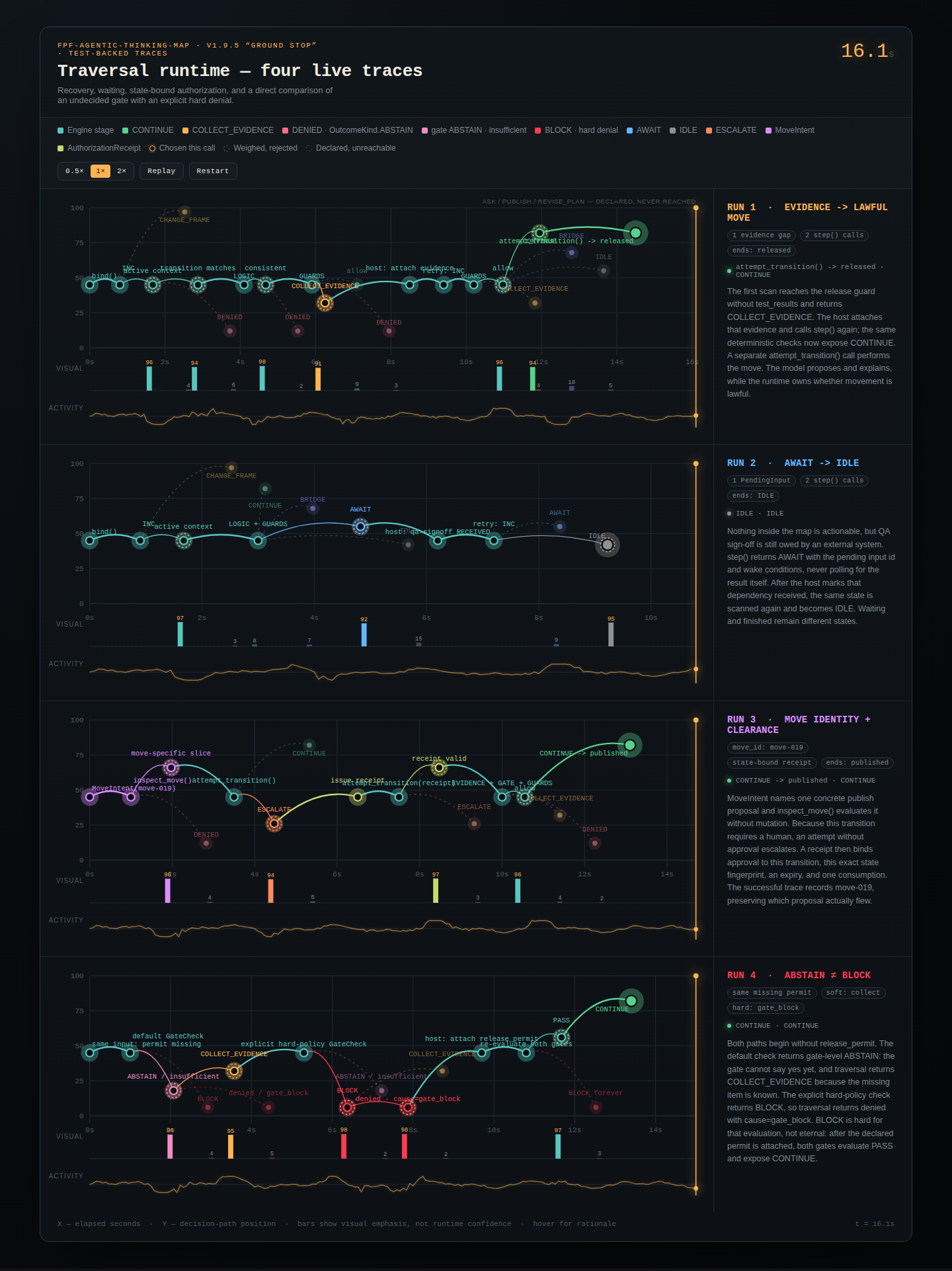
Open the interactive three-run trace
The visual follows evidence recovery, PendingInput/AWAIT, MoveIntent,
state-bound authorization, and successful traced movement in the current
runtime.
Minimal example
from fpf_thinking_map import (
    SemanticMap,
    ContextPrimitive,
    RolePrimitive,
    GatePrimitive,
    GateCheck,
    TransitionPrimitive,
    RuntimeBinding,
    ThinkingMapTraversal,
)

semantic_map = SemanticMap()
semantic_map.register_context(ContextPrimitive("deploy", "Deploy"))
semantic_map.register_role(RolePrimitive("owner", "Owner", "deploy"))
semantic_map.register_gate(
    GatePrimitive(
        "release_gate",
        "Release gate",
        "deploy",
        checks=[
            GateCheck(
                "tests",
                "Tests are green",
                required_evidence=["test_results"],
            )
        ],
    )
)
semantic_map.register_transition(
    TransitionPrimitive(
        "ship",
        "Ship release",
        "deploy",
        "candidate",
        "released",
        required_evidence=["test_results"],
    )
)

traversal = ThinkingMapTraversal(semantic_map)
state = traversal.build_active_state(
    RuntimeBinding(
        task="release",
        actor_role_ids=["owner"],
        active_context_id="deploy",
        current_evidence=["test_results"],
    ),
    current_state="candidate",
)

inspection = traversal.step(state)
result = traversal.attempt_transition(state, "ship")

print(inspection.kind)
print(result.kind)
print(state.current_state)
The map is domain-agnostic. Replace the deployment vocabulary with your own contexts, roles, evidence, gates, and transitions.
Run the packaged scenarios:
python -m fpf_thinking_map.examples
What is enforced
Explicit state
The active position is a first-class object, not a conclusion the model must repeatedly reconstruct from chat history.
Evidence with age
Transitions can require evidence. Evidence can decay by semantic floor and TTL, allowing the runtime to distinguish present evidence from usable evidence.
Gates, guards, and logic
Gates test declared conditions. Guards enforce hard constraints. A small propositional layer composes facts without asking the model to reinterpret the rules on every step.
Validated bridges
Cross-context movement is explicit. High-risk substitution without a sufficient bridge contract is refused or escalated rather than silently treated as equivalent.
Human authorization
requires_human_authorization separates "structurally legal" from "authorized
to execute."
For stronger integrations, AuthorizationReceipt binds approval to:
- one transition;
- the exact inspected state fingerprint;
- an expiry boundary;
- single consumption.
A denied move may expose declared safe_alternatives, so escalation does not
have to become a dead end.
External waiting
PendingInput and AWAIT distinguish "the workflow is finished" from "the
workflow is alive but waiting for something outside the map." The host owns
polling and resolution.
Concrete move identity
MoveIntent distinguishes a reusable transition type from one particular
proposed move. inspect_move() evaluates it without mutation; a successful
transition can stamp move lineage into the trace.
Why the versions matter
The project has grown by closing specific ambiguities in traversal state, not by expanding into a general agent framework.
| Release line | Capability added |
|---|---|
| v1.0 | Runnable semantic primitives, deterministic guards, lawful traversal |
| v1.2 | Evidence TTL, response contracts, IDLE and BRIDGE |
| v1.3 | Enforced bridge crossing and lean state slices |
| v1.4 | Stagnation detection, integrator advisories, verified documentation |
| v1.5 | Stable public package boundary |
| v1.6 | Human authorization and safe denial routes |
| v1.7 | State-bound, expiring authorization receipts |
| v1.8 | External dependency tracking and AWAIT |
| v1.9 | Concrete move identity, inspection, lineage, authorization-clock fix |
The complete reader-facing history is in docs/VERSION_TRACKER.md. Technical changes are in CHANGELOG.md, and full release bodies remain in GitHub Releases.
This separation is intentional: the README describes the stable product; the tracker records how that product became stronger.
Evidence, verification, and limits
The repository includes three different kinds of support. They should not be confused:
- Deterministic verification checks runtime invariants directly.
- Scenario and adversarial tests exercise integration behavior and known failure shapes.
- Model experiments show behavior under stated conditions; they are evidence, not universal guarantees.
python -m fpf_thinking_map.verify
python -m fpf_thinking_map.examples
The compiled state slice was also measured against injecting the corresponding raw FPF sections at five shipped decision points. The measured slice was much smaller, but this is a traversal-context result, not a claim about general intelligence or total application cost. Method and limitations: TRIPLE_TAX_CALCULUS.md.
For the authorization experiments, threat boundaries, failures found, and claims deliberately not made, see IGNITION_LOCK_WIND_TUNNEL.md.
Scope
Use this library when you need:
- bounded multi-step traversal;
- explicit next-move legality;
- evidence-aware workflow state;
- inspectable reasons for blocking or escalation;
- human authorization for selected transitions;
- a clean distinction between waiting, resting, and acting;
- compact state projections for an LLM or agent host.
Do not use it as:
- a universal reasoning engine;
- a semantic ingestion system for all of FPF;
- an embeddings or vector database;
- a tool runner, queue, scheduler, or worker supervisor;
- a substitute for application-specific policy;
- a certification that an entire agent system is safe.
Correct map authoring and correct host integration remain part of the trust boundary. Known sharp edges and deliberate non-goals are recorded in ADVISORIES.md.
Repository guide
| Path | Purpose |
|---|---|
fpf_thinking_map/ |
Zero-dependency runtime published to PyPI |
dev_mcp/ |
Separate development and compliance-testing harness |
| ARCHITECTURE.md | Verified control flow and module architecture |
| docs/VERSION_TRACKER.md | Every release, with three practical consequences |
| docs/DECISIONS_REJECTIONS_ADOPTIONS.md | Design provenance and rejected scope |
| docs/deep/ADVISORIES.md | Integration boundaries and known sharp edges |
| SHA256SUMS | Repository-wide source fingerprints |
Design rules
- Keep the model free to generate and compare.
- Keep movement legality explicit and deterministic.
- Add structure only when it changes observable behavior.
- Keep each decision payload small.
- Keep host responsibilities outside the core.
- Record rejected ideas as carefully as adopted ones.
- Prefer a narrow mechanism with inspectable limits over a broad claim.
Relationship to FPF
This project is inspired by ailev/FPF by Anatoly Levenchuk. It is an independent, MIT-licensed implementation with its own runtime scope.
FPF provides the broad conceptual frame. This package compiles a selected part of that frame into a practical traversal runtime. It may omit or reject patterns that do not improve this package's observable agent behavior.
See NOTICE and SOURCES.md for attribution and scope boundaries.
License and contact
MIT License. See LICENSE.
Maintained by igareosh.com · @igareosh · igareosh@igareosh.com
Agent freedom. Explicit movement rules.
1 maintainer

Download files
Download the file for your platform. If you're not sure which to choose, learn more about installing packages.
Source Distribution
Built Distribution
Filter files by name, interpreter, ABI, and platform.
If you're not sure about the file name format, learn more about wheel file names.
Copy a direct link to the current filters
File details
Details for the file fpf_thinking_map-1.9.4.tar.gz.
File metadata
- Download URL: fpf_thinking_map-1.9.4.tar.gz
- Upload date:
- Size: 71.5 kB
- Tags: Source
- Uploaded using Trusted Publishing? Yes
- Uploaded via:
twine/6.1.0 CPython/3.13.14
File hashes
| Algorithm | Hash digest | |
|---|---|---|
| SHA256 |
cb020a4aa43e15e3891cf21153148b16ba5ceb34111ab3f0a67ff923edb6f0ea
|
|
| MD5 |
1ff975a91f3dfd6fc4ba46c41fd85a55
|
|
| BLAKE2b-256 |
b4ad2d84aa650a97d90e222c0a162e0b0fa0c0e518795b2f0754730d62cbee74
|
Provenance
The following attestation bundles were made for fpf_thinking_map-1.9.4.tar.gz:
Publisher:
publish.yml on igareosh/fpf-agentic-thinking-map
-
Statement:
-
Statement type:
https://in-toto.io/Statement/v1 -
Predicate type:
https://docs.pypi.org/attestations/publish/v1 -
Subject name:
fpf_thinking_map-1.9.4.tar.gz -
Subject digest:
cb020a4aa43e15e3891cf21153148b16ba5ceb34111ab3f0a67ff923edb6f0ea - Sigstore transparency entry: 2249012324
- Sigstore integration time:
-
Permalink:
igareosh/fpf-agentic-thinking-map@37e58c7394c549785902136e1c86b0fd6e674ce4 -
Branch / Tag:
refs/tags/v1.9.4 - Owner: https://github.com/igareosh
-
Access:
public
-
Token Issuer:
https://token.actions.githubusercontent.com -
Runner Environment:
github-hosted -
Publication workflow:
publish.yml@37e58c7394c549785902136e1c86b0fd6e674ce4 -
Trigger Event:
release
-
Statement type:
File details
Details for the file fpf_thinking_map-1.9.4-py3-none-any.whl.
File metadata
- Download URL: fpf_thinking_map-1.9.4-py3-none-any.whl
- Upload date:
- Size: 73.9 kB
- Tags: Python 3
- Uploaded using Trusted Publishing? Yes
- Uploaded via:
twine/6.1.0 CPython/3.13.14
File hashes
| Algorithm | Hash digest | |
|---|---|---|
| SHA256 |
04b91ce34742289f7dd17122aaeb4e10683af35914c2c64fee5ea2097a0098dd
|
|
| MD5 |
5e2063a388d496780fb315e271d76417
|
|
| BLAKE2b-256 |
82a39d668831fbe3730d2d6c9d974be731179398345450b0df109a74f53cc554
|
Provenance
The following attestation bundles were made for fpf_thinking_map-1.9.4-py3-none-any.whl:
Publisher:
publish.yml on igareosh/fpf-agentic-thinking-map
-
Statement:
-
Statement type:
https://in-toto.io/Statement/v1 -
Predicate type:
https://docs.pypi.org/attestations/publish/v1 -
Subject name:
fpf_thinking_map-1.9.4-py3-none-any.whl -
Subject digest:
04b91ce34742289f7dd17122aaeb4e10683af35914c2c64fee5ea2097a0098dd - Sigstore transparency entry: 2249013155
- Sigstore integration time:
-
Permalink:
igareosh/fpf-agentic-thinking-map@37e58c7394c549785902136e1c86b0fd6e674ce4 -
Branch / Tag:
refs/tags/v1.9.4 - Owner: https://github.com/igareosh
-
Access:
public
-
Token Issuer:
https://token.actions.githubusercontent.com -
Runner Environment:
github-hosted -
Publication workflow:
publish.yml@37e58c7394c549785902136e1c86b0fd6e674ce4 -
Trigger Event:
release
-
Statement type:














