
free-search-mcp



free-search-mcp is a local-first Model Context Protocol server that needs no API key. It lets any LLM (Claude, GPT, a local Ollama model, …) search the web, fetch and clean up pages, and read documents, and you never sign up for a search API.
It combines ideas from several open-source MCP servers in one Python package, and adds the output shaping for LLMs and the reliability work that each of them lacked.
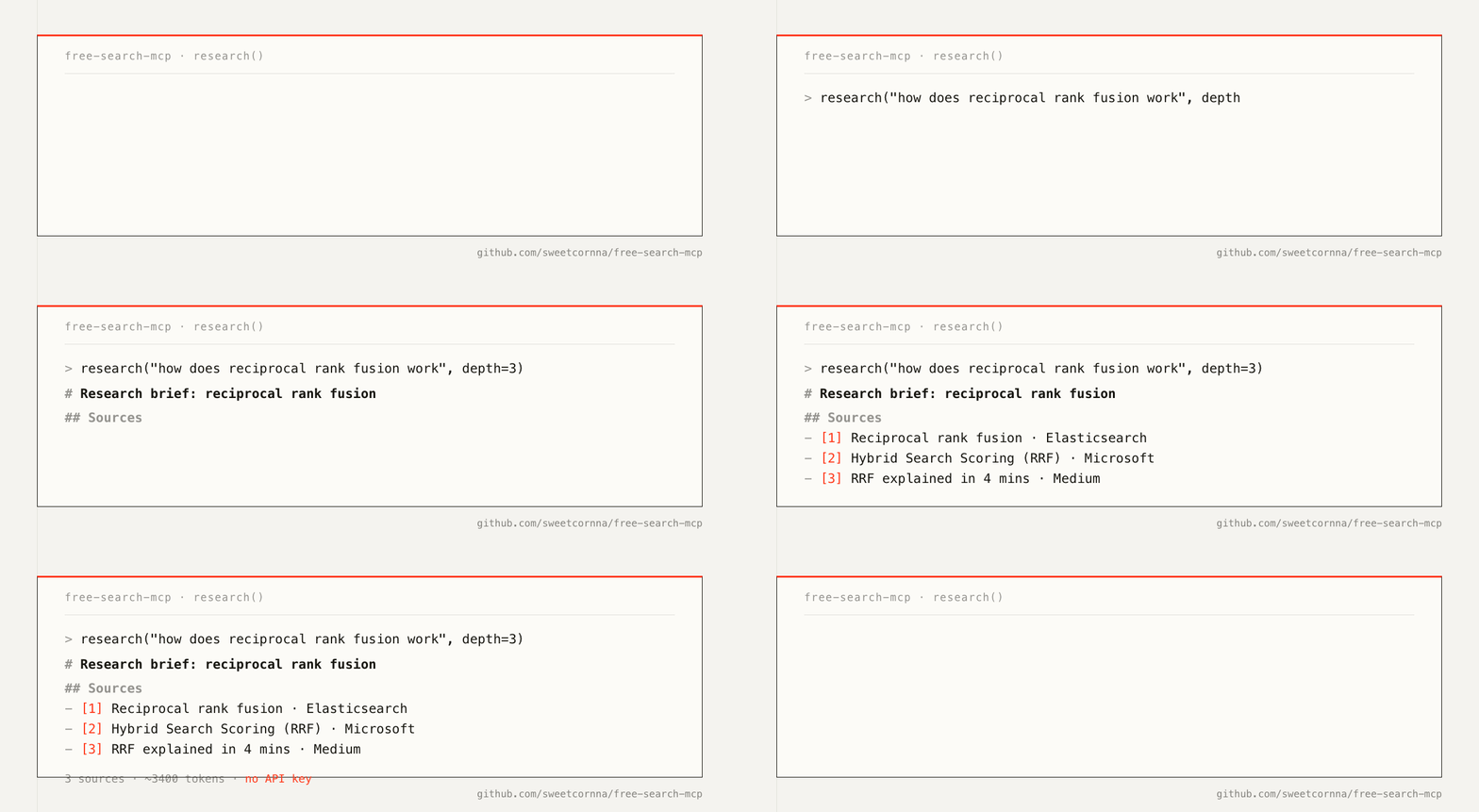
research("how does reciprocal rank fusion work", depth=3)
   ↓
# Research brief: how does reciprocal rank fusion work
_engines: duckduckgo, bing, anysearch · sources: 3 · ~3,400 tokens_

## Sources
- [1] Reciprocal rank fusion | Elasticsearch Reference — <https://…>
- [2] Hybrid Search Scoring (RRF) | Microsoft Learn — <https://…>
- [3] RRF explained in 4 mins — Medium — <https://…>

## Documents
…full Markdown bodies of each page, ready for the LLM to read…
That was one tool call. It returned three sources with their full text, and no API key was involved.
Quick start
You need uv and nothing else: no sign-up, no API key, no clone.
In Claude Code, inside a session:
/plugin marketplace add sweetcornna/free-search-mcp
/plugin install free-search@free-search-mcp
In Codex:
codex plugin marketplace add sweetcornna/free-search-mcp
codex plugin add free-search@free-search-mcp
(In Codex, a [mcp_servers.search] entry left in ~/.codex/config.toml by an
earlier codex mcp add silently shadows the plugin's server. Remove it with
codex mcp remove search.)
The plugin brings the 11 tools, the verified-research skill (how to check a
snippet against its page and its date) and, in Claude Code, the
free-search:quick-search agent, all pinned to one version.
/plugin update free-search moves to the next release.
Optionally, install Chromium once for the browser-rendered engines (brave,
startpage, zhihu, …) and JavaScript-heavy pages. Everything else works
without it, and a call that needs it returns this command as its error:
uvx --from free-search-mcp playwright install chromium
Claude Desktop, other clients, a source checkout and Docker are under Install.
Why this exists
| Multi-engine | No API key | Smart fallback | PDF/DOCX | FTS5 cache | Filters | Trafilatura | LLM-tuned | |
|---|---|---|---|---|---|---|---|---|
nickclyde/duckduckgo-mcp-server |
✗ | ✓ | ✗ | ✗ | ✗ | ✗ | ✗ | ~ |
mrkrsl/web-search-mcp |
✓ | ✓ | ✓ | ✗ | ✗ | ✗ | ✗ | ~ |
Aas-ee/open-webSearch |
✓ | ✓ | ~ | ✗ | ✗ | ✗ | ✗ | ~ |
VincentKaufmann/noapi-google-search-mcp |
✗ | ✓ | ✓ | ✓ | ✓ | ✗ | ✗ | ~ |
| free-search-mcp | ✓ | ✓ | ✓ | ✓ | ✓ | ✓ | ✓ | ✓ |
"LLM-tuned" means Markdown-first output with token estimates, errors that name
the next step, and a research() that turns a search and its fetches into one
call. docs/HOW_IT_WORKS.md explains the less obvious
columns.
Tools (11)
| Tool | Description |
|---|---|
search(query, ...filters) |
Parallel multi-engine search, RRF-merged, title-fuzzy + host-canonical deduped, with optional extractive lead_snippet |
research(question, depth?, ...filters) |
One-shot: search + fetch top N + return Markdown brief |
paper_graph(paper, direction?, limit?) |
Walk one paper's citation graph: references, citing works ranked by influence, and Crossref retraction/correction notices. Takes a DOI, an OpenAlex ID, an exact title, or an arXiv reference (arXiv:1706.03762, an arxiv.org/abs/… URL, a 10.48550/arXiv.… DOI, or a bare id such as 1706.03762, 2401.12345v3 or hep-th/9901001 when it is the whole input) |
compare(question, urls=[2..5]) |
Concurrent fetch of 2-5 URLs, side-by-side excerpts keyed by question |
fetch(url, render?, inline?, ...) |
Fetch any resource: reader-mode Markdown for pages, parsed text for documents, or a description (type/size/dimensions/sha256) for images and binaries. inline=True returns the image itself for vision models |
fetch_batch(urls, ...) |
Concurrent multi-URL fetch (max 20 per call) |
read_doc(source, start?, length?, ...) |
Parse PDF / DOCX / XLSX / PPTX / EPUB / CSV / code / zip-tar / HTML / TXT / MD with pagination |
extract_structured(url, ...) |
Pull JSON-LD / OpenGraph / Twitter cards / microdata via extruct. Long prose fields (articleBody and the like) are clipped, and the result says so in trimmed. This tool returns metadata; use fetch for the text |
cache_search(query, limit?, ...) |
FTS5 search across previously fetched pages |
engines(group?) |
The source tree (group, then sub-group, then engine), one line each. group is an enum of the groups that own engines, so a typo fails schema validation |
download(url, ...) |
Save a file to ${SEARCH_MCP_CACHE_DIR}/downloads by default; files auto-delete after 24h. Set SEARCH_MCP_DOWNLOAD_ENABLED=false to disable it. |
There are also 5 MCP prompts and 2 resource templates (cache://page/{url},
cache://search/{query_hash}). A twelfth tool, ask, appears only when an
answer backend is configured (see Delegating a lookup).
search and research take these filters:
| Param | Values | Effect |
|---|---|---|
freshness |
day / week / month / year |
Only results from the last N. Results with no date are kept, and freshness_note says when that is most of them. day / week also add googlenews |
include_domains |
["python.org", "djangoproject.com"] |
Restrict to these domains |
exclude_domains |
["pinterest.com"] |
Remove these |
category |
a group (paper, finance, news, software, security, weather, …) or a sub-group (paper.biomed, finance.filings, finance.fx, software.python, dataset.ml, …) |
Routes to the sources that natively index that kind of thing; the enum in the tool schema lists every value |
include_text |
"async" |
Substring required in title/snippet |
exclude_text |
"beginner" |
Substring forbidden |
max_age_hours |
24 |
Accept a cached answer only if it is younger than this. Default 7 days; the tightest of this, the freshness window's TTL, the 6-hour news cap and the category's own cap (weather, finance.fx 1 hour; software, security 6 hours) wins |
Output is Markdown by default, with provenance and a token estimate in the
header. format="json" returns structured data.
How a search runs
- A search that names no engines asks a small keyless pool:
duckduckgo,bing,anysearchandmojeek.googlenewsjoins when recency is asked for, andso360when the query is written in Chinese. category=routes to sources that index that kind of thing (papers, filings, datasets, packages, CVEs, …). Record sources such aspypi,nvdoropenmeteoalso join by themselves when the question is one they can answer directly.- An engine that serves a CAPTCHA, a login wall or an off-topic page is
benched, a reserve takes its seat, and the response says what happened. A
proxy (
SEARCH_MCP_PROXY) is the fix for IP gating. - Every result says how old it is and where its date came from, so the agent can tell a lead from a checked fact.
engines()prints the whole source tree.engines=["so360", "baidu"]runs exactly the engines named.
No engine that a search reaches by itself needs a key. The details, with measurements, are in docs/HOW_IT_WORKS.md; walls and proxies in docs/PROXY_AND_GATES.md; a tour of the tools with examples in docs/USAGE.md.
Install
The plugin in Quick start is the recommended path, because the server is pinned to the plugin's version and updates with it. The other routes run the same server:
| Where | How |
|---|---|
| Claude Desktop | open free-search-mcp-<version>.mcpb from the latest release |
| MCP Registry | io.github.sweetcornna/free-search-mcp |
| Claude Code, without the plugin | claude mcp add search -s user -- uvx free-search-mcp |
| Codex, without the plugin | codex mcp add search -- uvx free-search-mcp |
| Any other MCP client | the stdio command uvx free-search-mcp |
| Docker | docker compose build, then docker compose run --rm search-mcp |
A source checkout with Chromium, a smoke test and client registration in one step:
curl -LsSf https://raw.githubusercontent.com/sweetcornna/free-search-mcp/main/scripts/install.sh | bash -s -- --client claude-code
Over HTTP, uvx free-search-mcp --transport streamable-http --port 8000
serves http://127.0.0.1:8000/mcp. That endpoint has no authentication and
fetches any URL for whoever reaches it, so keep it on loopback or put an
authenticating proxy in front.
The JSON for Claude Desktop, Cursor, Cline, Continue and Zed, the installer's options and the plugin's token cost are in docs/INSTALL.md. Operating rules for agents are in docs/AGENT_USAGE.md.
Search on your own account: codex and antigravity
Two opt-in engines search on an account you sign in with instead of an API key. Neither is in any pool or route: a search reaches one only when the call names it, and nothing changes for anyone who never signs in.
codex |
antigravity |
|
|---|---|---|
| Searches with | OpenAI's web search, the one Codex uses | Google Search, run by a Gemini model |
| Account | a ChatGPT plan that includes Codex | a Google account with Antigravity |
| Each search counts against | the plan's Codex usage | the account's Antigravity quota |
| The provider allows it | yes | no, see the warning below |
| Opens a sign-in page by itself | on first use, over stdio on a desktop | never |
| Full guide, with 中文速览 | docs/CODEX_SEARCH.md | docs/ANTIGRAVITY_SEARCH.md |
Warning: Google's Antigravity terms forbid using its sign-in from third-party tools and name suspension of the Antigravity and Gemini CLI accounts as the consequence, and Google has suspended accounts for it. Sign in to
antigravityonly with an account you accept that risk for.
1. Sign in once
Run the sign-in on the machine the server runs on:
uvx --from free-search-mcp search-mcp-login codex         # the ChatGPT page `codex login` shows
uvx --from free-search-mcp search-mcp-login antigravity   # prints the warning, then Google's consent page
uvx --from free-search-mcp search-mcp-login status        # account, plan, token expiry
(uv run search-mcp-login … in a source checkout.) The settings page,
search-mcp-admin, has the same Sign in / 登录 buttons. Tokens are stored in
~/.config/search-mcp/oauth/ (0600) and refreshed automatically. The plugin,
uvx and the Desktop bundle all read that directory, so a running server picks
up a new sign-in without a restart.
codexcan skip this step: the first search that names it opens the sign-in page and finishes once you approve (stdio on a desktop only;SEARCH_MCP_CODEX_AUTO_SIGNIN=falseturns it off). A machine already signed in to the Codex CLI can reuse that sign-in read-only withsearch-mcp-login codex --use-codex-cli.antigravitysigns in with Antigravity's own OAuth client, which is not shipped in this package. The sign-in reads it from the Antigravity app installed on the machine (checked on macOS). Without Antigravity installed, setSEARCH_MCP_ANTIGRAVITY_CLIENT_IDandSEARCH_MCP_ANTIGRAVITY_CLIENT_SECRET; a machine that has signed in keeps both in~/.config/search-mcp/oauth/antigravity.json.
2. Name the engine
search("rust 2024 edition changes", engines=["codex"])
research("what changed in python 3.14 asyncio", engines=["antigravity"])
search("rust 2024 edition changes", engines=["codex", "duckduckgo", "bing"])
In Claude Code or Codex, ask for it in words ("search this with the codex
engine"). Filters apply as usual, and results are cached like any other
search. Measured on 2026-09-26, a codex search took about 3 s and an
antigravity search 10 to 20 s.
3. Settings (all optional)
| Var | Default | Meaning |
|---|---|---|
SEARCH_MCP_CODEX_MODEL, SEARCH_MCP_ANTIGRAVITY_MODEL |
latest |
latest follows the account's model catalogue, so a new model is used once it is listed; a model name pins one |
SEARCH_MCP_CODEX_TIMEOUT, SEARCH_MCP_ANTIGRAVITY_TIMEOUT |
60 |
seconds for one search |
SEARCH_MCP_CODEX_AUTO_SIGNIN |
true |
open the sign-in page on first use |
SEARCH_MCP_ANTIGRAVITY_CLIENT_ID, SEARCH_MCP_ANTIGRAVITY_CLIENT_SECRET |
read from the Antigravity install | for a machine without Antigravity; set both or neither |
SEARCH_MCP_PROXY |
empty | the sign-in and the searches go through it |
On a server, over SSH, or in Docker
- Sign in with
--no-browser(search-mcp-login codex --no-browser, orantigravity --no-browser), open the printed address in any browser, and approve. The browser then fails to load a127.0.0.1:1455orlocalhost:51121address; paste that whole address into the terminal. - Over
streamable-http,codexnever opens a sign-in page by itself, since it would open on the server. Sign in there with the command above first. - In Docker, point
SEARCH_MCP_CONFIG_DIRat a mounted volume so the tokens outlive the container, and run the sign-in inside it with--no-browser.antigravitythere needs the two client variables.
search-mcp-login logout codex or logout antigravity deletes the stored
tokens. To revoke Antigravity's access itself, remove it under "Third-party
apps and services" in the Google account.
When it does not work
| The error says | Do this |
|---|---|
codex not configured / antigravity not configured |
no sign-in is stored on this machine; run the sign-in above |
port 1455 and 1457 … are in use, or port 51121 |
another sign-in (codex login, an open sign-in page) holds the port; close it and retry |
| the usage limit, quota or rate limit was reached | wait until the reset time the error gives; the keyless engines still work |
needs Antigravity's OAuth client |
install Antigravity, or set the two client variables |
HTTP 403 no valid license from antigravity |
set SEARCH_MCP_ANTIGRAVITY_VERSION to the installed Antigravity release; it can also mean Google restricted the account |
has expired or was revoked |
sign in again |
Optional: your own API key
You do not need one, and agents should never ask for one. Five engines run only when a call names them and the operator has set their own key:
| Engine | Provider | Key |
|---|---|---|
brave_api |
Brave Search API | SEARCH_MCP_BRAVE_API_KEY |
serper |
Serper | SEARCH_MCP_SERPER_API_KEY |
tavily |
Tavily | SEARCH_MCP_TAVILY_API_KEY |
google_cse |
Google Custom Search | SEARCH_MCP_GOOGLE_CSE_API_KEY + SEARCH_MCP_GOOGLE_CSE_CX |
github_code |
GitHub | SEARCH_MCP_GITHUB_TOKEN |
Set a key as an environment variable or .env line, or on the local settings
page:
uv run search-mcp-admin # local settings / 本地设置 — http://127.0.0.1:8765
(uvx --from free-search-mcp search-mcp-admin for a plugin or uvx install.)
The page is bilingual (中英双语), binds to 127.0.0.1 only, applies a saved
key without a restart, and never shows a stored value again. The walkthrough
per provider is docs/API_KEYS.md.
Delegating a lookup
Delegation keeps page text out of the caller's context and returns a short answer with dated sources. None of it is on by default:
| You want | Use | It needs |
|---|---|---|
| The agent to search and read by itself | the tools, as installed | nothing |
| Your host's own subagents to do the lookup | the quick-search agent definition |
a host with subagents |
| The server to dispatch through Claude Code | SEARCH_MCP_AGENT_BACKEND=claude-code |
the claude CLI, logged in |
| The server to dispatch through Codex | SEARCH_MCP_AGENT_BACKEND=codex |
the codex CLI, logged in |
| The server to call a model endpoint you choose | SEARCH_MCP_AGENT_BACKEND=api |
an OpenAI-compatible or Anthropic-compatible URL |
| Your own code to supply the model | ask(question, answer_with=...) in Python |
nothing else |
The settings, the agent files and measured timings are in docs/DELEGATION.md.
Configuration
Nothing is required. Settings are SEARCH_MCP_* variables, read from the
environment first, then ./.env, then ~/.config/search-mcp/.env
(SEARCH_MCP_CONFIG_DIR moves that directory). The ones people change most:
| Var | Default | Meaning |
|---|---|---|
SEARCH_MCP_PROXY |
empty | outbound proxy (http, https or socks5) for the engines, the browser and fetch |
SEARCH_MCP_PROXY_ENGINES |
empty | proxy only these engines |
SEARCH_MCP_DEFAULT_ENGINES |
["duckduckgo","bing","anysearch","mojeek"] |
the pool a search uses when it names no engines |
SEARCH_MCP_REGION |
us-en |
locale for engines that take one |
SEARCH_MCP_CACHE_DIR |
~/.cache/search-mcp |
search and page cache |
SEARCH_MCP_TOOLS |
empty | register only these tools |
Every setting is listed in docs/CONFIGURATION.md and documented in .env.example.
Development
git clone https://github.com/sweetcornna/free-search-mcp.git && cd free-search-mcp
uv sync && uv run playwright install chromium
uv run pytest -q                              # offline
SEARCH_MCP_TEST_NETWORK=1 uv run pytest -v    # live, hits the real web
Running claude inside the checkout picks up the repo's .mcp.json, which
starts the working tree's server. The architecture is in
docs/HOW_IT_WORKS.md, and cutting a
release in docs/RELEASING.md.
Credits
This project builds on:
mrkrsl/web-search-mcp: the httpx-then-Playwright fetch strategy and the multi-engine fallback chainAas-ee/open-webSearch: multi-engine breadth (Bing/DDG/Baidu/Brave/Startpage)VincentKaufmann/noapi-google-search-mcp: anti-detection patterns (navigator.webdriver, UA, cookies), the SQLite FTS5 cache idea, and multi-formatread_documentnickclyde/duckduckgo-mcp-server: per-engine rate limiting and LLM-friendly content cleanup- Mojeek, an independent search index that doesn't gate on User-Agent
- Model Context Protocol and the official Python SDK
License
MIT. See LICENSE.
1 maintainer

Release files for free-search-mcp 0.13.1
For a detailed explanation of source distributions (sdists) and built distributions (wheels), please see the package formats documentation.
Source distribution (sdist)
| File | Size | Uploaded | |
|---|---|---|---|
| free_search_mcp-0.13.1.tar.gz | 840.8 kB | Details |
Built distribution (wheel)
| File | Interpreter | ABI | Platform | Reset |
|---|---|---|---|---|
| free_search_mcp-0.13.1-py3-none-any.whl | Python 3 | none | any | Details |
Total release size: 1.3 MB
Release files / free_search_mcp-0.13.1.tar.gz
| Download URL | free_search_mcp-0.13.1.tar.gz |
|---|---|
| Size | 840.8 kB |
| Tags | Source |
|
SHA-256 checksum How to use checksums |
f9253daf8b5a3291bbe60e8374630ffdea49a66b4aa7867fa2703f7b99c0cca7
|
|
BLAKE2b-256 checksum How to use checksums |
6a9735a43118d38c92fc7eb0d159722ffcb05bc0a706d4e8e2314cf2b532d705
|
| Upload date | |
|
Uploaded using Trusted Publishing? What is trusted publishing? |
No |
| Uploaded via |
twine/7.0.0 CPython/3.13.14
|
Release files / free_search_mcp-0.13.1-py3-none-any.whl
| Download URL | free_search_mcp-0.13.1-py3-none-any.whl |
|---|---|
| Size | 441.4 kB |
| Tags | Python 3 |
|
SHA-256 checksum How to use checksums |
3a98889d97cdc22cbf540db2d8bba0f51020cc8905830f40345b0f02b09a8a99
|
|
BLAKE2b-256 checksum How to use checksums |
f9487dd7f2bc5196876e2c0a43ae12810ce7a1cac33ac51b00199ad6403c491b
|
| Upload date | |
|
Uploaded using Trusted Publishing? What is trusted publishing? |
No |
| Uploaded via |
twine/7.0.0 CPython/3.13.14
|














