
freerdp-tk
A small launcher window for the FreeRDP 3 SDL client. It runs on Linux, Windows and macOS and needs Python with its built-in Tkinter, plus the keyring package, which installs with it.
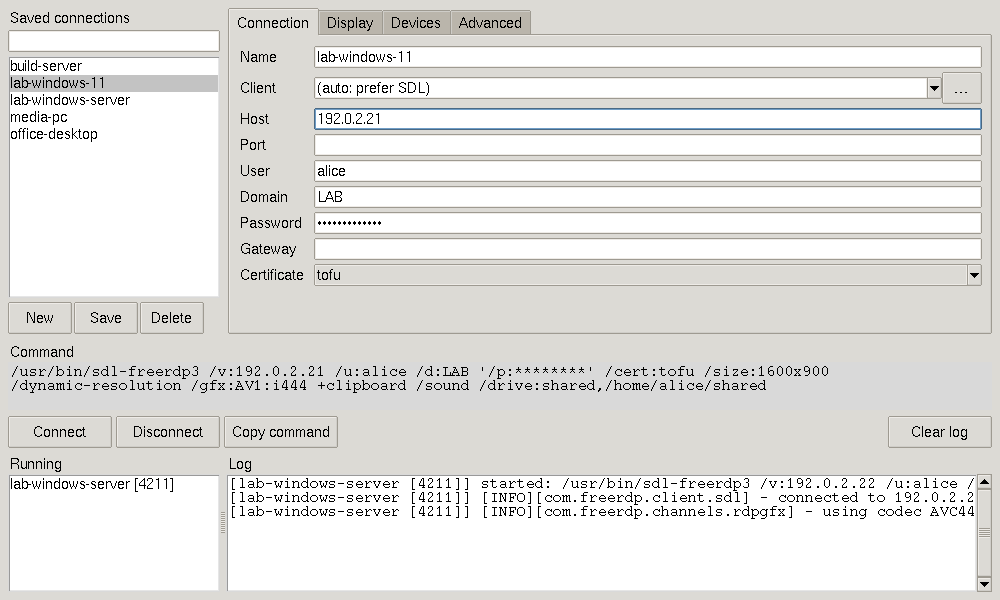
- Saved connections: a list you can filter. Double-click one to connect, or select several and connect them all at once.
- Finds the client for you: "(auto)" takes the first FreeRDP SDL client on your
PATH(sdl-freerdp,sdl-freerdp3,sdl3-freerdp) or in a local build tree.PATHorder decides, whatever the names: a release that puts its ownbin/first gets its own client, not the system's. The SDL client is the one FreeRDP actively develops, and the same on Linux, Windows and macOS. You can still pick another FreeRDP 3 program with …. - Form instead of flags: display, monitors (List… asks the client which ones it sees, then you tick them), graphics codec (including AV1), clipboard, sound, microphone, drive sharing, log level, plus a box for extra arguments.
- Live command preview: shows the exact command line, with the password hidden, and copies it for you.
- Session log: runs several sessions at once and shows each client's output.
Install
uvx freerdp-tk               # run it once, without installing
uv tool install freerdp-tk   # or install it: then just freerdp-tk (pipx install freerdp-tk works too)
You also need FreeRDP 3 with its SDL client:
| Platform | Client |
|---|---|
| Debian / Ubuntu | sudo apt install freerdp3-sdl |
| Fedora | sudo dnf install freerdp |
| macOS | brew install freerdp |
| Windows | a FreeRDP 3 build containing sdl-freerdp.exe, on your PATH |
Tk: the window needs a Python with Tk. The Pythons that uv installs include it; a Linux system Python often does not (sudo apt install python3-tk, sudo dnf install python3-tkinter). uv takes the system Python when there is one, so:
- started by
uvx, freerdp-tk notices a Python without Tk and starts again with uv's own Python (it downloads one the first time);uvx --managed-python freerdp-tkgoes there directly; - installed with
uv tool install, useuv tool install --managed-python freerdp-tkon such a system; - anywhere else, it says what to install and exits.
On Linux, the Tk in uv's Pythons draws with the X core fonts (it is built without Xft), which often lack … and •: freerdp-tk then shows ... and * instead.
Passwords
- Saved in the system keyring, never in a file. With Remember it in the system keyring ticked (the default), the password goes to the system's own store: Credential Manager on Windows, the Keychain on macOS, the Secret Service (GNOME Keyring, KeePassXC) or KWallet on Linux. From then on a double-click connects without asking. The connections file only keeps whether the box is ticked.
- The password dialog has the same box: untick it, and the password stays in memory only, until the window closes. Forget removes a saved password. Deleting a connection removes its password too, unless another saved connection logs in to the same account.
- A rejected password is asked for again. When the client exits because the server turned the password down (exit codes 132, 134, 154 and 159 of the SDL client), freerdp-tk asks for another one and connects again; with the box ticked, the new password replaces the saved one. A locked, expired or disabled account is not asked again, since another password would not help.
- An entry is named after the account it logs in to,
freerdp-tk/<domain\user>@<host>:<port>, not after the connection. Renaming a connection keeps its password, and two connections to one account share it. - No usable keyring (on Linux: no Secret Service or KWallet, or no D-Bus session, as over plain SSH): the box is greyed out with the reason, and passwords are asked for and kept in memory only. freerdp-tk never falls back to a file. A locked keyring is unlocked through the system's own prompt; if that fails or is cancelled, freerdp-tk asks for the password instead. The keyring is used from a thread of its own, so a slow one (an unlock prompt, a Secret Service that D-Bus takes two minutes to give up on) never freezes the window.
- What the keyring protects: the password on disk, and from the other users of the computer. A program that runs as you can usually read it: Credential Manager and an unlocked Secret Service hand it to any process of your session, while the Keychain asks you first unless the program is on the entry's access list.
- All arguments are passed to the client through standard input (
/args-from:stdin), so the password never appears in the process list (ps, Task Manager). FreeRDP 2 has no such option, so freerdp-tk refuses to start a FreeRDP 2 client rather than put the password on its command line.
Before and after commands (SSH tunnels and more)
The Before / after tab runs your own commands around a session:
- Before connecting: runs to the end before the client starts; if it fails, the client does not start. Tick Keep it running during the session for a command that stays up beside the session, such as a tunnel. Then wait until
host:portholds the client back until that port answers. - Stop it when the session ends: ends the before command and everything it started, also if freerdp-tk itself crashes or is killed:
- Linux: a small supervisor runs the command as a child subreaper, so even daemons that fork twice and leave the process group stay under it. Each is sent SIGTERM, then SIGKILL after 3 seconds.
- Windows: the command runs in a job object that the system closes, and with it everything inside, when freerdp-tk lets go of it.
- macOS: the same supervisor, but macOS has no subreaper: a daemon that forks twice and leaves the process group survives.
- After disconnecting: runs once the session is over, however it ended.
- Client proxy: passed to the client as
/proxy:.
Placeholders work in all of these and in the extra arguments: %h host, %p port, %u user, %L a free local port picked for this session, %% a percent sign.
Fill in: SSH tunnel… sets it all up for the common case. It asks for a jump host and fills in:
before:      ssh -N -D 127.0.0.1:%L -o ExitOnForwardFailure=yes -o BatchMode=yes me@bastion
wait until:  127.0.0.1:%L
proxy:       socks5://127.0.0.1:%L
The RDP server then only has to be reachable from the jump host, and the client still connects by its real name, so the certificate check is unchanged. ssh runs without a terminal, so it must log in with a key or an agent, and it must already know the jump host's key (connect once with ssh in a terminal).
Where things are kept
| What | Where |
|---|---|
| Saved connections | ~/.config/freerdp-tk/profiles.json (Linux), ~/Library/Application Support/freerdp-tk/ (macOS), %APPDATA%\freerdp-tk\ (Windows) |
| Extra FreeRDP source trees to search for built clients | FREERDP_TK_TREES, separated like PATH. ~/projects/FreeRDP is always searched. |
Limitation
The client runs without a terminal, so it cannot ask questions while connecting, such as whether to trust a new certificate. Pick a certificate policy (tofu, ignore or deny) on the Connection tab instead. The default, tofu, trusts a server's certificate the first time you connect.
Development
uv run --with-editable . python -m freerdp_tk   # run from the checkout
uv build                                         # build the sdist and wheel into dist/
The screenshot above is rendered from demo data in a virtual X server, so no real hosts end up in it. Regenerate it after changing the UI:
xvfb-run -s "-screen 0 1400x1000x24" \
    uv run --with pillow --with-editable . python scripts/screenshot.py docs/screenshot.png
Releasing to PyPI
Releases are published by GitHub Actions through trusted publishing, so no API token is needed. The version is taken from the git tag.
One-time setup:
- On PyPI, open Your projects → Publishing → Add a new pending publisher and enter: project
freerdp-tk, ownercongzhangzh, repositoryfreerdp-tk, workflowrelease.yml, environmentpypi. - On GitHub, create an environment named
pypi(Settings → Environments).
Each release after that:
git tag 0.2.0          # the version, no prefix
git push origin 0.2.0
The workflow builds the package, checks that it installs on Linux, Windows and macOS, and then uploads it to PyPI.
License
Apache-2.0, the same license as FreeRDP.
1 maintainer

Metadata
1 maintainer
Release files for freerdp-tk 0.3.2
For a detailed explanation of source distributions (sdists) and built distributions (wheels), please see the package formats documentation.
Source distribution (sdist)
| File | Size | Uploaded | Provenance | Actions |
|---|---|---|---|---|
| freerdp_tk-0.3.2.tar.gz | 120.0 kB | With provenance | Details for freerdp_tk-0.3.2.tar.gz |
Built distribution (wheel)
| File | Interpreter | ABI | Platform | Actions Reset |
|---|---|---|---|---|
| freerdp_tk-0.3.2-py3-none-any.whl | Python 3 | none | any | Details for freerdp_tk-0.3.2-py3-none-any.whl |
Total release size: 151.8 kB
Release files / freerdp_tk-0.3.2.tar.gz
| Download URL | freerdp_tk-0.3.2.tar.gz |
|---|---|
| Size | 120.0 kB |
| Tags | Source |
|
SHA-256 checksum How to use checksums |
d8e2e35a7bdf47c261bcc2aa302af635e55403f2e1f5f16a3929169d0c80b3d5
|
|
BLAKE2b-256 checksum How to use checksums |
c8f089ad40a528b11bd4b92187971f395d9d8e41bc144d7c40852268dd98ed88
|
| Upload date | |
|
Uploaded using Trusted Publishing? What is trusted publishing? |
Yes |
| Uploaded via |
twine/7.0.0 CPython/3.13.16
|
Provenance
Provenance describes where a file came from. On PyPI, provenance is shared via attestations, which provide a verifiable record of the build or publishing details. View details, limitations and caveats.


PyPI Publish Attestation
PyPI verified that this artifact, at this checksum, originated from the publisher listed below.
Signed by GitHub Actions, verified by PyPI on Oct 30, 2026.
Transparency logRelease files / freerdp_tk-0.3.2-py3-none-any.whl
| Download URL | freerdp_tk-0.3.2-py3-none-any.whl |
|---|---|
| Size | 31.8 kB |
| Tags | Python 3 |
|
SHA-256 checksum How to use checksums |
685c9ca6b1d4c03acea086309dc4cc84eae24965da58ad9913ebabc249be53c5
|
|
BLAKE2b-256 checksum How to use checksums |
090df1acf3b3039d673f355bbc11a2e20c16c7780dfba6335c48a3fe4a01e335
|
| Upload date | |
|
Uploaded using Trusted Publishing? What is trusted publishing? |
Yes |
| Uploaded via |
twine/7.0.0 CPython/3.13.16
|
Provenance
Provenance describes where a file came from. On PyPI, provenance is shared via attestations, which provide a verifiable record of the build or publishing details. View details, limitations and caveats.
PyPI Publish Attestation
PyPI verified that this artifact, at this checksum, originated from the publisher listed below.
Signed by GitHub Actions, verified by PyPI on Oct 30, 2026.
Transparency logSecurity for freerdp-tk 0.3.2
Provenance
Provenance describes where a file came from. On PyPI, provenance is shared via attestations, which provide a verifiable record of the build or publishing details. View details, limitations and caveats.
Full provenance
Both files in this release have been uploaded with provenance metadata.
Attestation for freerdp_tk-0.3.2.tar.gz
PyPI Publish Attestation
PyPI verified that this artifact, at this checksum, originated from the publisher listed below.
Signed by GitHub Actions, verified by PyPI on Oct 30, 2026.
Transparency logA note on package security
PyPI is a repository for distributing packages, not a service for auditing them. While third-party security researchers and our staff do their best to detect and remove malicious packages, PyPI cannot guarantee the quality, security or suitability of any given package.
To learn more about protecting yourself from malicious actors, visit our package security documentation.














