
Industrial-grade speech recognition: 170x realtime, 50+ languages, speaker diarization, emotion detection.

Project description

Industrial speech recognition toolkit for offline, streaming, and edge deployment.
ASR · VAD · punctuation · speaker pipelines · emotion and audio-event models · OpenAI-compatible serving





Quick Start · Colab · Benchmark · Model selection · Migration guide · Use cases · Community integrations · Deployment matrix · Models · Agent Integration · Docs · Contribute
Quick Start

No local setup? Open the Colab quickstart to transcribe a public sample or upload your own audio in a browser.
pip install torch torchaudio
pip install funasr
Flagship model — Fun-ASR-Nano (LLM-ASR for Chinese, English, and Japanese, plus Chinese dialect groups and regional accents; needs a GPU):
from funasr import AutoModel

model = AutoModel(model="FunAudioLLM/Fun-ASR-Nano-2512", device="cuda")
result = model.generate(input="https://isv-data.oss-cn-hangzhou.aliyuncs.com/ics/MaaS/ASR/test_audio/asr_example_zh.wav")
print(result[0]["text"])
# 欢迎大家来体验达摩院推出的语音识别模型。
For the separate 31-language checkpoint, use Fun-ASR-MLT-Nano-2512. Language coverage is checkpoint-specific, so Nano and MLT-Nano should be treated as distinct model choices.
On CPU (or for five-language ASR plus emotion and audio-event tags), use SenseVoiceSmall. The pipeline below composes SenseVoiceSmall with FSMN-VAD and CAM++; diarization is provided by the separate CAM++ model, not by the SenseVoiceSmall checkpoint:
from funasr import AutoModel
from funasr.utils.postprocess_utils import rich_transcription_postprocess

model = AutoModel(model="iic/SenseVoiceSmall", vad_model="fsmn-vad", spk_model="cam++", device="cuda")  # use device="cpu" if you don't have a GPU
result = model.generate(
    input="https://isv-data.oss-cn-hangzhou.aliyuncs.com/ics/MaaS/ASR/test_audio/asr_example_zh.wav",
    batch_size_s=300,
)

# The AutoModel pipeline returns VAD segments with speaker ids and timestamps:
for seg in result[0]["sentence_info"]:
    print(f"[{seg['start']/1000:.1f}s] Speaker {seg['spk']}: {rich_transcription_postprocess(seg['sentence'])}")
Output — structured text with speaker labels, timestamps, and punctuation:
[0.6s] Speaker 0: 欢迎大家来体验达摩院推出的语音识别模型
One AutoModel pipeline call coordinates the configured ASR, VAD, and speaker
models and returns the combined result.
Scale & deploy the flagship
At scale, accelerate Fun-ASR-Nano with vLLM (batch processing):
from funasr.auto.auto_model_vllm import AutoModelVLLM

model = AutoModelVLLM(model="FunAudioLLM/Fun-ASR-Nano-2512", tensor_parallel_size=1)
results = model.generate(["audio1.wav", "audio2.wav"], language="auto")
Deploy as API server:
funasr-server --device cuda→ OpenAI-compatible endpoint at localhost:8000Use with AI agents: MCP Server for Claude/Cursor · OpenAI API for LangChain/Dify/AutoGen
Why FunASR?
Whisper is a single model; FunASR is a toolkit — you pick the right model per job: Fun-ASR-Nano (Chinese, English, Japanese, and Chinese dialects; GPU), Fun-ASR-MLT-Nano (31 languages), SenseVoiceSmall (five-language ASR plus emotion and audio events), and Paraformer (low-latency streaming). The table shows toolkit-level capabilities and names the model or pipeline that provides each one:
| FunASR (toolkit) | Whisper | Cloud APIs | |
|---|---|---|---|
| Top speed | 340x realtime (Fun-ASR-Nano + vLLM) | 13x realtime | ~1x realtime |
| Speaker ID | ✅ via VAD + CAM++ pipeline | ❌ Needs pyannote | ✅ Extra cost |
| Emotion | ✅ via SenseVoice | ❌ | ❌ |
| Languages | Checkpoint-specific (for example Qwen3-ASR 52, MLT-Nano 31, Nano zh/en/ja) | 57 | Varies |
| Streaming | ✅ WebSocket (Paraformer) | ❌ | ✅ |
| CPU viable | ✅ 17x realtime (SenseVoice) | ❌ Too slow | N/A |
| Self-hosted | ✅ Yes (toolkit: MIT; model licenses vary) | ✅ MIT license | ❌ Cloud only |
| Cost | Free | Free | $0.006/min+ |
Trying FunASR for the first time? Use the Colab quickstart before setting up a local environment. Choosing a first model? Start with the model selection guide. Planning a switch from Whisper or a cloud ASR provider? Use the migration guide and benchmark example to test representative audio, map features, and roll out safely.
Installation
pip install funasr
From source / Requirements
git clone https://github.com/modelscope/FunASR.git && cd FunASR
pip install -e ./
Requirements: Python ≥ 3.8. Install PyTorch + torchaudio first (pytorch.org), then pip install funasr.
Model Zoo
| Model | Task | Languages | Params | Links |
|---|---|---|---|---|
| Fun-ASR-Nano | ASR | zh/en/ja + Chinese dialects and accents | 800M | ⭐ 🤗 |
| Fun-ASR-MLT-Nano | ASR | 31 languages | 800M | ⭐ 🤗 |
| SenseVoiceSmall | ASR + emotion + events | zh/en/ja/ko/yue | 234M | ⭐ 🤗 |
| Paraformer-zh | ASR + timestamps | zh/en | 220M | ⭐ 🤗 |
| Paraformer-zh-streaming | Streaming ASR | zh/en | 220M | ⭐ 🤗 |
| Qwen3-ASR | ASR, 52 languages | multilingual | 1.7B | usage |
| GLM-ASR-Nano | ASR, 17 languages | multilingual | 1.5B | usage |
| Whisper-large-v3 | ASR + translation | multilingual | 1550M | usage |
| Whisper-large-v3-turbo | ASR + translation | multilingual | 809M | usage |
| ct-punc | Punctuation | zh/en | 290M | ⭐ 🤗 |
| fsmn-vad | VAD | zh/en | 0.4M | ⭐ 🤗 |
| cam++ | Speaker diarization | — | 7.2M | ⭐ 🤗 |
| emotion2vec+large | Emotion recognition | — | 300M | ⭐ 🤗 |
Usage
Full examples with parameter docs: Tutorial →
from funasr import AutoModel

# Chinese production (VAD + ASR + punctuation + speaker)
model = AutoModel(model="paraformer-zh", vad_model="fsmn-vad", punc_model="ct-punc", spk_model="cam++", device="cuda")
result = model.generate(input="https://isv-data.oss-cn-hangzhou.aliyuncs.com/ics/MaaS/ASR/test_audio/asr_example_zh.wav", hotword="关键词 20")


# Streaming real-time (feed audio chunk by chunk)
import soundfile as sf
model = AutoModel(model="paraformer-zh-streaming", device="cuda")
audio, sr = sf.read("speech.wav", dtype="float32")   # 16 kHz mono
chunk_size = [0, 10, 5]                               # 600 ms chunks
chunk_stride = chunk_size[1] * 960
cache = {}
n_chunks = (len(audio) - 1) // chunk_stride + 1
for i in range(n_chunks):
    chunk = audio[i * chunk_stride : (i + 1) * chunk_stride]
    res = model.generate(input=chunk, cache=cache, is_final=(i == n_chunks - 1),
                         chunk_size=chunk_size, encoder_chunk_look_back=4, decoder_chunk_look_back=1)
    if res[0]["text"]:
        print(res[0]["text"], end="", flush=True)

# Emotion recognition
model = AutoModel(model="emotion2vec_plus_large", device="cuda")
result = model.generate(input="audio.wav", granularity="utterance")
CLI (Agent-Friendly)
# Transcribe audio (simplest)
funasr audio.wav

# JSON output (for AI agents)
funasr audio.wav --output-format json

# SRT subtitles
funasr audio.wav --output-format srt --output-dir ./subs

# Speaker diarization + timestamps
funasr audio.wav --spk --timestamps -f json

# Choose model and language
funasr audio.wav --model paraformer --language zh

# Batch transcribe
funasr *.wav --output-format srt --output-dir ./output
Available models: sensevoice (default), paraformer, paraformer-en, fun-asr-nano
Deploy
# OpenAI-compatible API (recommended)
pip install torch torchaudio
pip install funasr vllm fastapi uvicorn python-multipart
funasr-server --device cuda
# → POST /v1/audio/transcriptions at localhost:8000
Verify it with a public sample:
curl -L https://isv-data.oss-cn-hangzhou.aliyuncs.com/ics/MaaS/ASR/test_audio/BAC009S0764W0121.wav -o sample.wav
curl http://localhost:8000/v1/audio/transcriptions \
  -F file=@sample.wav \
  -F model=sensevoice \
  -F response_format=verbose_json
# Docker streaming service
docker pull registry.cn-hangzhou.aliyuncs.com/funasr_repo/funasr:funasr-runtime-sdk-online-cpu-0.1.12
CPU / Edge — llama.cpp / GGUF (no GPU, no Python)
Run SenseVoice / Paraformer / Fun-ASR-Nano as a single self-contained binary on CPU and edge devices — this is to FunASR what whisper.cpp is to Whisper, but with ~3× lower CER than whisper.cpp on Chinese. Built-in FSMN-VAD, no Python at runtime.
# Linux / macOS: run from the extracted release directory
bash download-funasr-model.sh sensevoice ./gguf        # or: paraformer | nano
./llama-funasr-sensevoice -m ./gguf/sensevoice-small-q8.gguf --vad ./gguf/fsmn-vad.gguf -a audio.wav
# → 欢迎大家来体验达摩院推出的语音识别模型
# Windows PowerShell: run from the extracted archive root (with the `hf` CLI installed)
hf download FunAudioLLM/SenseVoiceSmall-GGUF sensevoice-small-q8.gguf --local-dir .\gguf
hf download FunAudioLLM/fsmn-vad-GGUF fsmn-vad.gguf --local-dir .\gguf
.\llama-funasr-sensevoice.exe -m .\gguf\sensevoice-small-q8.gguf --vad .\gguf\fsmn-vad.gguf -a audio.wav
Prebuilt binaries: Releases · Download & quickstart: funasr.com/llama-cpp · GGUF models: Hugging Face · Docs & benchmarks: runtime/llama.cpp/
OpenAI API example → · Gradio demo → · Client recipes → · JavaScript/TypeScript recipes → · Kubernetes template → · Workflow recipes → · Postman collection → · OpenAPI spec → · Security guide → · Deployment matrix → · Deployment docs → · Agent integration →
Benchmark
184 long-form audio files (192 min). Full report → · RTFx and reproducibility notes →
| Model | Chinese CER ↓ | GPU Speed | CPU Speed | vs Whisper-large-v3 |
|---|---|---|---|---|
| Fun-ASR-Nano (vLLM) | 8.20% | 340x realtime | — | 🚀 26x faster |
| SenseVoice-Small | 7.81% | 170x realtime | 17x realtime | 🚀 13x faster |
| Paraformer-Large | 10.18% | 120x realtime | 15x realtime | 🚀 9x faster |
| Whisper-large-v3-turbo | 21.71% | 46x realtime | ❌ | 3.4x faster |
| Whisper-large-v3 | 20.02% | 13x realtime | ❌ | baseline |
Key takeaway: FunASR models run on CPU faster than Whisper runs on GPU.
What's new
- 2026/06/20: llama.cpp / GGUF runtime — run SenseVoice / Paraformer / Fun-ASR-Nano on CPU & edge as a single self-contained binary (a whisper.cpp-style alternative), built-in FSMN-VAD, no Python at runtime. Prebuilt binaries for Linux / macOS / Windows + q8 quantized models (~half the size, same accuracy). runtime/llama.cpp/ · Releases
- 2026/06/21: v1.3.12 on PyPI — rolling fixes (qwen3-asr language codes, glm_asr, vLLM repetition_penalty).
pip install --upgrade funasr - 2026/05/24: vLLM Inference Engine — 2-3x faster LLM decoding for Fun-ASR-Nano. Streaming WebSocket service with VAD + Speaker Diarization. Guide → · Realtime WS tuning → · API stability checklist →
- 2026/05/24: Dynamic VAD — adaptive silence threshold (default on). Short sentences stay intact, long segments get auto-split. Details →
- 2026/05/24: v1.3.3 —
funasr-serverCLI, OpenAI-compatible API, MCP Server for AI agents.pip install --upgrade funasr - 2026/05/20: Added Qwen3-ASR (0.6B/1.7B) — 52 languages, auto detection. usage
- 2026/05/20: Added GLM-ASR-Nano (1.5B) — 17 languages, dialect support. usage
- 2026/05/19: Fun-ASR-Nano and SenseVoice can be combined with VAD and CAM++ for speaker diarization.
- 2025/12/15: Fun-ASR-Nano-2512 — Chinese, English, Japanese, and Chinese dialect support; trained on tens of millions of hours.
Older
- 2024/10/10: Whisper-large-v3-turbo support added.
- 2024/07/04: SenseVoice — ASR + emotion + audio events.
- 2024/01/30: FunASR 1.0 released.
Community
| 📖 Documentation | 🐛 Issues |
| 💬 Discussions | 🤗 HuggingFace |
| 🤝 Contributing | 🌐 funasr.com |
| 🗺️ Repository roles & roadmap | 📈 Growth plan |
| 🧩 Community projects | 💡 Use-case showcase |
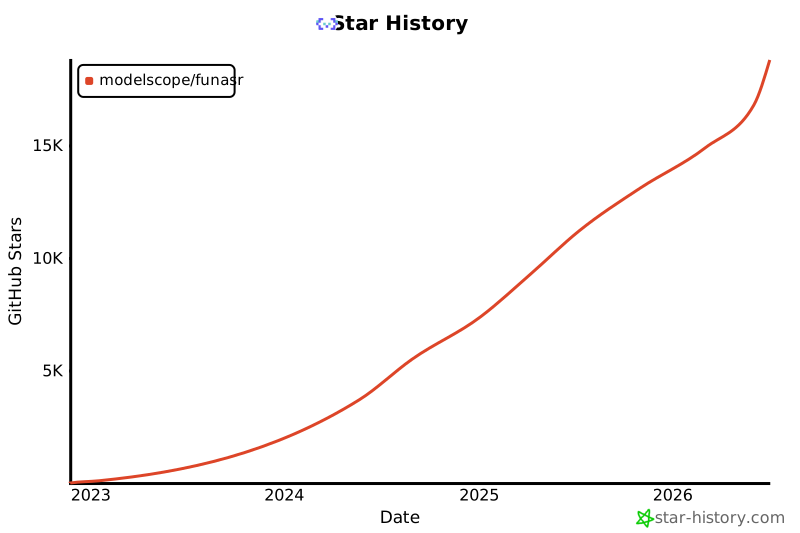
Star History
License
- FunASR toolkit source code in this repository: MIT License.
- Pretrained model weights are licensed separately. Check the license shown on each model card; when a model card links to the FunASR Model Open Source License Agreement, those terms apply.
Citations
@inproceedings{gao2023funasr,
  author={Zhifu Gao and others},
  title={FunASR: A Fundamental End-to-End Speech Recognition Toolkit},
  booktitle={INTERSPEECH},
  year={2023}
}
Release history Release notifications | RSS feed


Download files
Download the file for your platform. If you're not sure which to choose, learn more about installing packages.
Source Distribution
Built Distribution
Filter files by name, interpreter, ABI, and platform.
If you're not sure about the file name format, learn more about wheel file names.
Copy a direct link to the current filters
File details
Details for the file funasr-1.3.15.tar.gz.
File metadata
- Download URL: funasr-1.3.15.tar.gz
- Upload date:
- Size: 787.1 kB
- Tags: Source
- Uploaded using Trusted Publishing? No
- Uploaded via: twine/6.2.0 CPython/3.12.3
File hashes
| Algorithm | Hash digest | |
|---|---|---|
| SHA256 |
fec01a880eca5c0fc305d0bb2483b21c1e1be867326280aba5bb16bc73f70faf
|
|
| MD5 |
4631c5497432ab02d34e04fa06d28f80
|
|
| BLAKE2b-256 |
a1bd06a601b1504fcb4e5f19a5c89001ae27fa689e20c67763e080548920212a
|
File details
Details for the file funasr-1.3.15-py3-none-any.whl.
File metadata
- Download URL: funasr-1.3.15-py3-none-any.whl
- Upload date:
- Size: 936.8 kB
- Tags: Python 3
- Uploaded using Trusted Publishing? No
- Uploaded via: twine/6.2.0 CPython/3.12.3
File hashes
| Algorithm | Hash digest | |
|---|---|---|
| SHA256 |
b08f60f5385b834e163aa234fc128081218e6582559238b2808e7ddf46728ab9
|
|
| MD5 |
6882c7b895eca09d4bd29d7cd3319a61
|
|
| BLAKE2b-256 |
5a0cc3445afd8cda3ba185cee719f53bf1866ff084a02354be54ef0b95d7f0d9
|






