
gbp-purge
A Gentoo Build Publisher plugin to purge old builds.
Description
This is a plugin to purge old builds of one's Gentoo Build Publisher instance. It was spun off from core some of the core functionality in Gentoo Build Publisher. The main reason for spinning out from GBP is that the strategy for determining which builds to purge are specific and subjective, the purge process was optional to begin with and, well, the satisfaction of writing another plugin.
Usage
Simply install it into the same environment as your Gentoo Build Publisher, restart the services and that's it. So if you've installed GBP via the Install Guide it would look like this:
cd /home/gbp
sudo -u gbp -H ./bin/pip install git+https://github.com/enku/gbp-purge.git
systemctl restart gentoo-build-publisher-wsgi gentoo-build-publisher-worker
How it works?
The system starts off by listening for "pull" events from Gentoo Build Publisher. Whenever a build is pulled, a worker task is created to purge builds belonging to the same machine as the build that was pulled.
In my (rq) logs it looks something like this (summarized):
09:05:19 gbp: gentoo_build_publisher.worker.tasks.pull_build('web.2815', note=None, tags=None) (fba40994-bbfb-4aef-be8f-5adbc1dd3d5e)
09:05:35 Successfully completed gentoo_build_publisher.worker.tasks.pull_build('web.2815', note=None, tags=None) job in 0:00:16.334798s on worker bb259ab3c5d14539940c50b35ffb624e
09:05:35 gbp: gbp_purge.worker.tasks.purge_machine('web') (69b9f4e6-d4bb-4c26-af24-95a366ede59a)
09:05:35 Successfully completed gbp_purge.worker.tasks.purge_machine('web') job in 0:00:00.012854s on worker bb259ab3c5d14539940c50b35ffb624e
09:05:36 gbp: gbp_fl.worker.tasks.index_build('web', '2815') (16978e09-fb3d-40e6-bc20-70735744b546)
09:05:51 Successfully completed gbp_fl.worker.tasks.index_build('web', '2815') job in 0:00:14.332937s on worker bb259ab3c5d14539940c50b35ffb624e
09:05:51 gbp: gentoo_build_publisher.worker.tasks.delete_build('web.2795') (fb01267d-ed5a-4ca9-a483-917f980bd2f5)
09:05:53 Successfully completed gentoo_build_publisher.worker.tasks.delete_build('web.2795') job in 0:00:02.805851s on worker bb259ab3c5d14539940c50b35ffb624e
09:05:53 gbp: gentoo_build_publisher.worker.tasks.delete_build('web.2811') (a81e42ca-9914-446d-a6f0-1be0dae25234)
09:05:57 Successfully completed gentoo_build_publisher.worker.tasks.delete_build('web.2811') job in 0:00:03.305191s on worker bb259ab3c5d14539940c50b35ffb624e
09:05:57 gbp: gbp_fl.worker.tasks.deindex_build('web', '2795') (62c9f6ff-ce70-476e-a582-310b0bfbdfcf)
09:05:57 Successfully completed gbp_fl.worker.tasks.deindex_build('web', '2795') job in 0:00:00.059129s on worker bb259ab3c5d14539940c50b35ffb624e
09:05:57 gbp: gbp_fl.worker.tasks.deindex_build('web', '2811') (0303373e-8e17-49a6-a3b7-38b076b89cbb)
09:05:57 Successfully completed gbp_fl.worker.tasks.deindex_build('web', '2811') job in 0:00:00.144880s on worker bb259ab3c5d14539940c50b35ffb624e
Purge strategy
gbp-purge will get the list of builds for the machine, look at the time they were submitted (pulled) by GBP and keep:
- All from yesterday or later
- One for each day of the past week
- One for each week of the past month
- One for each month of the past year
- One per year
- The published build, if there is one
- All tagged builds
- All builds with the "keep" flag.
All other builds for that machine will be deleted. In all of the "one for each" scenarios if there are more than one then it prefers the most recent. For example in the "one for each day of the past week" scenario, if there is a Thursday build and a Friday build it will keep the Friday build.
This is the same method I use for my backup script.
Depending how many machines you have, how often they are build and how often builds build new packages this will resemble something like a long tail over time. For example, presently on my GBP instance the number of builds kept over time looks like this
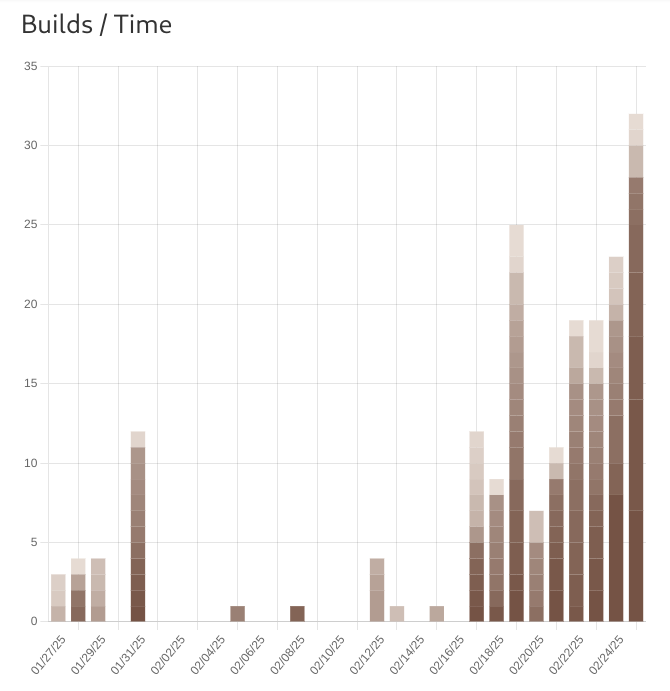
Perhaps in the future I will add the capability of choosing different purge strategies and add configuration to decide which strategy to use.
1 maintainer

Metadata
1 maintainer
Release files for gbp-purge 1.2.0
For a detailed explanation of source distributions (sdists) and built distributions (wheels), please see the package formats documentation.
Source distribution (sdist)
| File | Size | Uploaded | Provenance | Actions |
|---|---|---|---|---|
| gbp_purge-1.2.0.tar.gz | 11.0 kB | Without provenance | Details for gbp_purge-1.2.0.tar.gz |
Built distribution (wheel)
| File | Interpreter | ABI | Platform | Actions Reset |
|---|---|---|---|---|
| gbp_purge-1.2.0-py3-none-any.whl | Python 3 | none | any | Details for gbp_purge-1.2.0-py3-none-any.whl |
Total release size: 19.6 kB
Release files / gbp_purge-1.2.0.tar.gz
| Download URL | gbp_purge-1.2.0.tar.gz |
|---|---|
| Size | 11.0 kB |
| Tags | Source |
|
SHA-256 checksum How to use checksums |
42a6907ba6a5afc40c0f5b6710645d808affbf9b9cbe2321a61ccff2e1b7dfc5
|
|
BLAKE2b-256 checksum How to use checksums |
a01d260c8fd7a34c5f22c6681d34417eb92bfcf83cd70bdaf5a9895a3aa051cb
|
| Upload date | |
|
Uploaded using Trusted Publishing? What is trusted publishing? |
No |
| Uploaded via |
twine/7.0.0 CPython/3.14.7
|
Release files / gbp_purge-1.2.0-py3-none-any.whl
| Download URL | gbp_purge-1.2.0-py3-none-any.whl |
|---|---|
| Size | 8.6 kB |
| Tags | Python 3 |
|
SHA-256 checksum How to use checksums |
09e2aeae09a31e601cefe323e678f35125ca4b85f084e09c094853747ad48fff
|
|
BLAKE2b-256 checksum How to use checksums |
fed65d24923a268ebbcdd45d4040d80c39fb28ecee72f08a9824aaa2fbf8a0c2
|
| Upload date | |
|
Uploaded using Trusted Publishing? What is trusted publishing? |
No |
| Uploaded via |
twine/7.0.0 CPython/3.14.7
|
Security for gbp-purge 1.2.0
Provenance
Provenance describes where a file came from. On PyPI, provenance is shared via attestations, which provide a verifiable record of the build or publishing details. View details, limitations and caveats.
No provenance found
None of the files in this release were uploaded with provenance metadata.
A note on package security
PyPI is a repository for distributing packages, not a service for auditing them. While third-party security researchers and our staff do their best to detect and remove malicious packages, PyPI cannot guarantee the quality, security or suitability of any given package.
To learn more about protecting yourself from malicious actors, visit our package security documentation.














