
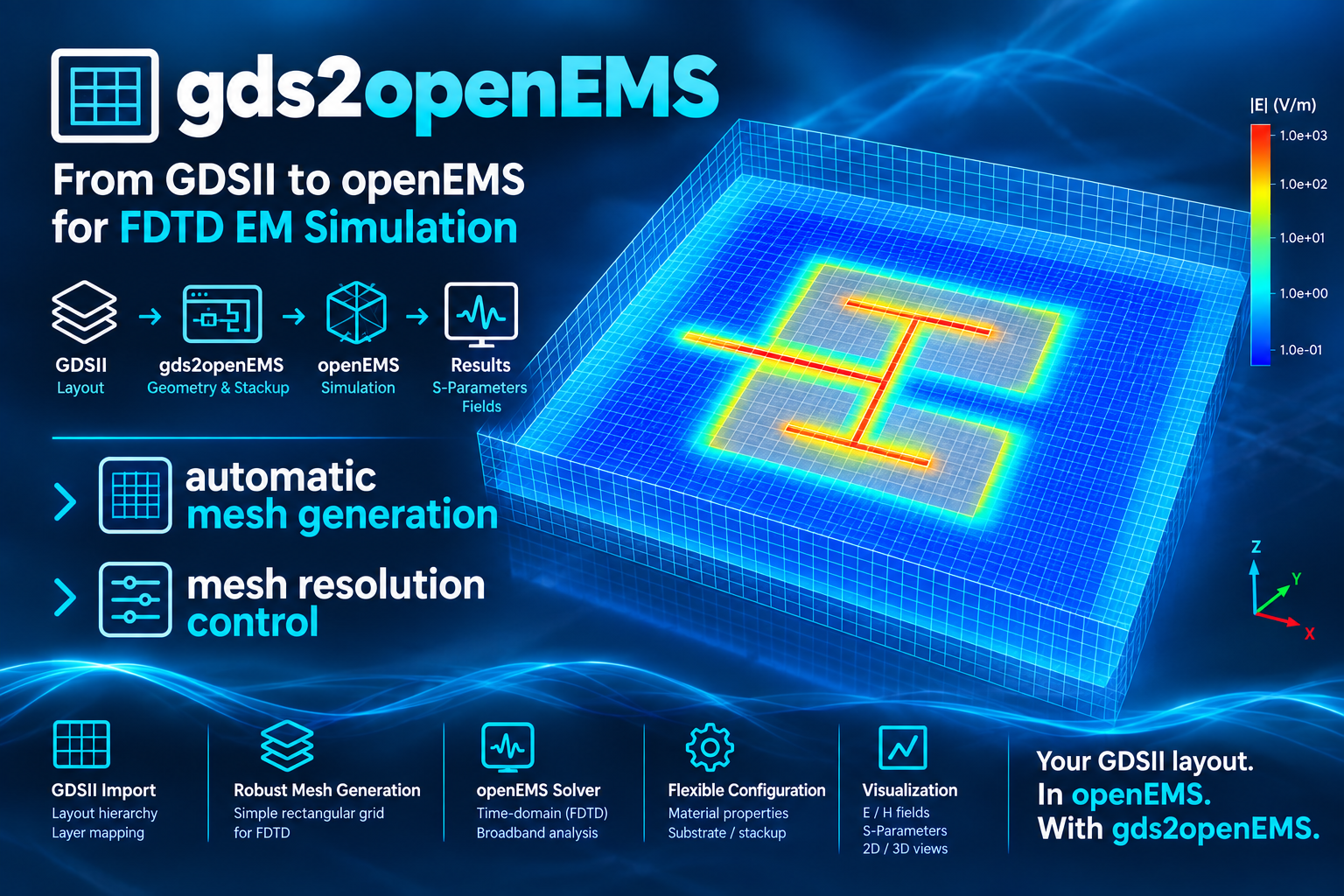
gds2openEMS: FDTD simulation workflow for RFIC
The files provided here enable openEMS EM simulation with layouts created for the IHP SG13G2 RFIC technology.
Install
pip install gds2openEMS
Full documentation, installation guide, and usage walkthrough: https://github.com/VolkerMuehlhaus/gds2openEMS
Recent changes
28-Sep-2026
New study L6n2 inductor with openEMS vs. measurement: step by step from the default model to a result within 3% of the measured low-frequency resistance and 0.1% of the measured SRF, with via fill factor correction, the energy end criterion (use −60 dB, or at least −50 dB, for low-frequency R), a passivation cut stackup, and a comparison with gds2palace.
Rewrote the z mesher util_meshlines.create_z_mesh(). Metal subdivision lines now respect dielectric interfaces inside a metal, and z lines closer than 1 nm are merged. The old code created unnecessarily small cells in some cases: 0.1 µm instead of 0.4 µm for the L6n2 passivation-cut stackup at 0.8–1.4 µm refined_cellsize, and sub-picometer cells from floating point noise in Reference= stackups with the MIM layer. Both force a very small FDTD time step. For standard stackups, the z mesh is unchanged. A scan over all example stackups and refined_cellsize 0.3–3 µm changed only the cases with these artifacts. The previous function is still available as create_z_mesh_legacy, see Meshing.
settings['air_around'] as a 6-element list [xmin, xmax, ymin, ymax, zmin, zmax] now works, as the user guide already stated. Previously the mesh functions only accepted a single value and failed on a list.
setupSimulation() now warns when a field dump's source_layernum has no polygons. The dump box then silently covered the bounding box of the entire layout, which happens when the dump layer was not passed to read_gds(). The fix is to add layernumbers.extend(field_dumps.dumplayers) before read_gds(); the Field dumps section now says so.
settings[] keys are now case-insensitive, e.g. settings['numthreads'] works like settings['numThreads']. Previously a key in the wrong case was silently ignored and the default used. setupSimulation() prints a note for each key used in a different case, and a warning if both spellings are set with different values; the canonical spelling wins.
27-Sep-2026
New option settings['fill_factor_correction'] (default False), ported from gds2palace: with via array merging (merge_polygon_size > 0), the conductivity of each merged via polygon is multiplied by its via fill factor (original via area / merged area, rounded to 2 decimals), because the stackup via conductivity is derived from the per-via resistance. Scaled vias get their own material, e.g. TopVia2_x0.49. See Input files. With the option off, the generated model is unchanged.
Stackup Editor (stackup_editor/), ported from setupEM:
- Stackup Preview: metals that extend past the dielectric boundary above are drawn up to their true height, and the distance to that boundary shows as a negative value in red instead of 0. A dielectric fill layer anchored to a metal (
Reference=, e.g. conformal passivation) is drawn at its real position, straddling the boundaries it crosses, in its own amber color; one that overlaps another conductor is flagged in orange. - Saving a stackup without a file extension appends
.xml. - The editor pins a light color scheme, so it stays readable on Windows accounts with dark mode enabled.
22-Sep-2026
The hash-based skip in runSimulation() now also hashes the calling model script itself (up to and including the runSimulation() call), not just the generated CSX file. This catches changes to solver-runtime settings like numThreads or EndCriteria that never end up in the CSX file and were previously missed, causing stale results to be silently reused. Code after the call (post-processing, plotting, ...) is still excluded from the hash, so editing that still doesn't force a re-solve. Existing simulation_model.hash files from before this change will mismatch once, forcing one re-simulation per cached result.
Full history: CHANGES.md
Note: the gds2openEMS PyPI package itself only requires:
- gdspy>1.6.0
- CSXCAD
- openEMS
- numpy
- shapely
- PySide6
(Other Python modules mentioned above are only needed to run the example/model scripts in this repository, not to use the installed package.)
1 maintainer

Metadata
1 maintainer
Release files for gds2openEMS 0.5.0
For a detailed explanation of source distributions (sdists) and built distributions (wheels), please see the package formats documentation.
Source distribution (sdist)
| File | Size | Uploaded | |
|---|---|---|---|
| gds2openems-0.5.0.tar.gz | 185.7 kB | Details |
Built distribution (wheel)
| File | Interpreter | ABI | Platform | Reset |
|---|---|---|---|---|
| gds2openems-0.5.0-py3-none-any.whl | Python 3 | none | any | Details |
Total release size: 374.3 kB
Release files / gds2openems-0.5.0.tar.gz
| Download URL | gds2openems-0.5.0.tar.gz |
|---|---|
| Size | 185.7 kB |
| Tags | Source |
|
SHA-256 checksum How to use checksums |
e68f2a0e91885f338097f826cd99eb6285b4cd1d5f899eb1019e92fb9723431b
|
|
BLAKE2b-256 checksum How to use checksums |
331a30bf694f17e4661a87e7d5ccee7d8637d77687b3c143678b84d1a91028f3
|
| Upload date | |
|
Uploaded using Trusted Publishing? What is trusted publishing? |
No |
| Uploaded via |
twine/7.0.0 CPython/3.13.14
|
Release files / gds2openems-0.5.0-py3-none-any.whl
| Download URL | gds2openems-0.5.0-py3-none-any.whl |
|---|---|
| Size | 188.6 kB |
| Tags | Python 3 |
|
SHA-256 checksum How to use checksums |
a4d8abf75c60463ed563ae5f253b2f6507f13d27ab303a30eaca5979a25d0292
|
|
BLAKE2b-256 checksum How to use checksums |
5db3a27a14300caae9c2518253e965ee7817fd16943caddb86a4dc8e581e763b
|
| Upload date | |
|
Uploaded using Trusted Publishing? What is trusted publishing? |
No |
| Uploaded via |
twine/7.0.0 CPython/3.13.14
|














