
genmodelfit
English · 日本語
genmodelfit tells you which image, video, music, sound-effect, speech (TTS) and 3D generation models run well on your PC.

It is inspired by llmfit, which does this for LLMs. It is not an official llmfit project or fork. Status: alpha (CHANGELOG.md).
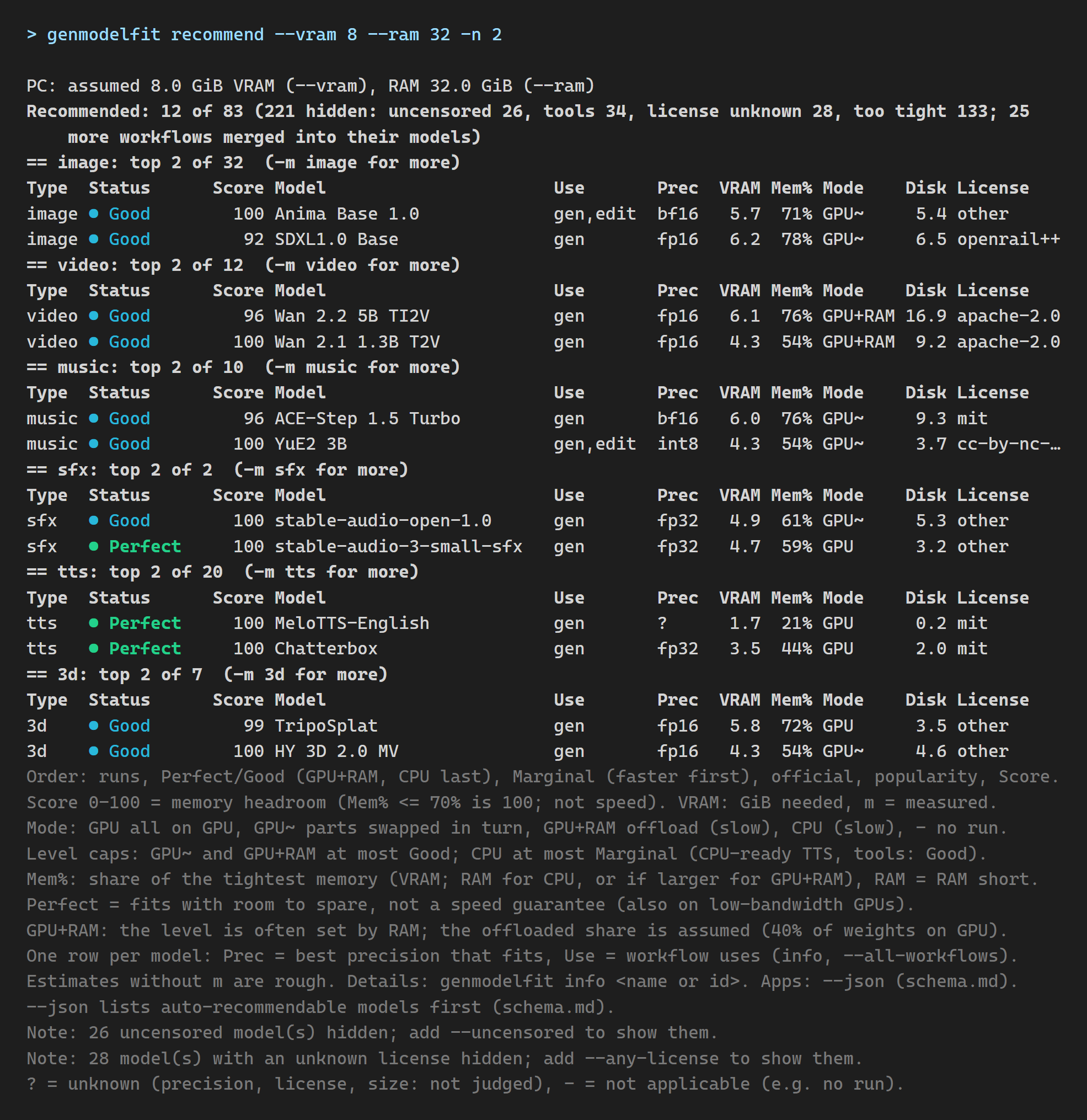
The top of genmodelfit recommend --vram 8 --ram 32 -n 2 (model list as of 2026-10-22). The list is updated weekly, so the models and counts change.
Quick start
Try it without installing. If you have uv, one command is enough. uv runs genmodelfit in its own temporary environment (and fetches Python if needed); nothing is added to your Python or PATH.
uvx genmodelfit recommend         # the best models for this PC, per type
uvx genmodelfit system            # what was detected on this PC
Every command in this README works this way: write uvx genmodelfit instead of genmodelfit.
uvx genmodelfit@latest … makes uv check for a newer version first.
Install it to use the genmodelfit command directly (details):
pipx install genmodelfit          # or: uv tool install genmodelfit / pip install genmodelfit
genmodelfit recommend             # the best models for this PC, per type
python -m genmodelfit recommend   # the same, if "genmodelfit" is not found
1. Prerequisites
What it does
- Judges whether each model in its list runs on this PC, and how comfortably (from VRAM, RAM, GPU generation).
- Recommends the best models per type: image, video, music, sfx (sound effects), tts (speech), 3d.
- Downloads the files of a model, after showing licenses and asking you.
- It does not generate anything. To run a model, use ComfyUI (or the runtime the model names). genmodelfit holds model information only, never weights.
- Why not llmfit: it covers LLMs only (llmfit#41); here memory changes several times over with precision, resolution, frames and offloading.
Requirements
- Windows, Linux or macOS, Python 3.10 or newer (with
uvx, uv provides Python if you have none). - GPU: NVIDIA (CUDA); the estimates are calibrated on NVIDIA runs. Without a usable NVIDIA GPU, AMD (ROCm: RDNA 2 or
newer, Windows 11 / Linux), Intel (XPU: Arc A / B, Core Ultra Arc Graphics, Windows 11 / Linux) and Apple silicon
(MPS, macOS 14 or newer) are judged as estimates (at most Good, unless a measurement at the same settings sets the
level: by the maintainer or on this PC on a same-vendor GPU, or by other users on the same GPU). Integrated GPUs and APUs (e.g. Radeon 780M / 680M, Steam Deck, Ryzen Z1) use shared memory. Other GPUs
(Intel UHD / Iris Xe, the 2-CU Radeon 610M, RDNA 1 and older) and PCs without a GPU are judged as CPU-only;
SD-family image models and Stable Audio count as running on CPU (slow). On Linux,
systemsuggestsupdate-pciidswhen lspci does not know the GPU's name (docs/hardware.md). Non-NVIDIA GPUs have no measurements yet, so their levels are kept low.genmodelfit benchworks on these GPUs too; your results let us tighten them (CONTRIBUTING.md).
Install
Not needed to try it: uvx genmodelfit … runs it without installing (Quick start).
To keep the genmodelfit command:
pipx install genmodelfit        # once: pipx ensurepath, then open a new terminal
uv tool install genmodelfit     # once: uv tool update-shell, then open a new terminal
pip install genmodelfit
pipx and uv put genmodelfit on PATH. python -m genmodelfit … always works, whatever PATH says
(on Windows also py -m genmodelfit …).
If pip printed "WARNING: The script genmodelfit.exe is installed in '…\Scripts' which is not on PATH" (common with python.org Python without "Add python.exe to PATH", Microsoft Store Python, user installs, or a venv not activated), add that folder to PATH or use one of the above. A terminal opened before PATH changed does not see it: open a new one.
What is sent over the network
Nothing, for judging: the hardware is read locally. Only update, download and bench connect, and only to public
data or the ComfyUI you name. No telemetry. Details: Privacy.
2. Procedure
-
Check your PC. Shows the GPU, VRAM, RAM, page file, free disk, and whether the model list is still fresh.
genmodelfit system -
Get recommendations. The top models of each type that run here, best first. Narrow down with a type (
-m) or a use inside a type (--task;genmodelfit typeslists them).genmodelfit recommend genmodelfit recommend -m image --task edit -
See everything that runs. One table of all models that run here (Perfect / Good / Marginal).
--alladds tools, models that do not run and unjudged ones;--sort scoreranks across types;--fit goodkeeps one level.genmodelfit fit genmodelfit fit --sort score --fit good -
Look at one model. Files, licenses, memory in each mode, limits, and why it is or is not Verified.
genmodelfit info "Z-Image-Turbo" -
Download it.
--listshows the files, licenses, sizes and free disk without downloading. Then download into your ComfyUI folders; you are asked before anything starts, and every file is sha256-checked.genmodelfit download "Z-Image-Turbo" --list genmodelfit download "Z-Image-Turbo" --comfyui-dir C:\ComfyUI # your ComfyUI folder -
Keep the list fresh. The list is rebuilt weekly. A model whose link check is older than 30 days stops being Verified. This fetches the latest signed list from this project.
genmodelfit update --from-release
For apps (Python / JSON)
The commands take --json (docs/schema.md).
The same in Python:
import genmodelfit as gmf

for f in gmf.recommend(modality="image", task="edit", limit=5):
    row = f.to_dict()  # the same dict as one item of `recommend --json`
    # memory_required_gb: what the chosen mode needs (the table's VRAM; RAM on CPU).
    # f.estimate.vram_gb is the all-on-GPU need, which can be larger than the GPU (GPU~ / GPU+RAM rows).
    print(f.model.id, f.model.precision, f.score, f.auto, f.estimate.fit, row["memory_required_gb"])

st = gmf.data_status()  # is the list fresh enough for Verified (auto) models?
if st.expired:
    print("run: genmodelfit update --from-release", st.expires_at)

# reading the list yourself: skip entries still waiting for review.
# on a malformed or wrongly typed list, load_db raises a RuntimeError (catch RuntimeError; the subclass
# genmodelfit.db.DatabaseError is not in gmf.__all__).
ok = [e for e in gmf.load_db().models if e.reviewed]

# one model, with the GPU your app detected (generation and precision are decided here)
fit = gmf.judge_model("image_sdxl_simple", gpu_name="NVIDIA GeForce RTX 3060", vram_gb=12, driver="560.94")
print(fit.to_dict()["fit_level"])  # only names in gmf.__all__ are stable API

# fetch the signed list with your own session, e.g. the app's CA bundle (network: only this and gmf.download)
db = gmf.update_from_release(session=my_session, dest=data_dir / "db.json", state_dir=data_dir)
Only names in gmf.__all__ are stable API (docs/schema.md).
Judge another PC
--vram and --ram (GiB) replace the detected sizes, e.g. genmodelfit recommend --vram 12 --ram 32.
With a usable NVIDIA GPU, its generation is kept and only the VRAM changes. On a non-NVIDIA GPU (or without a usable
GPU), --vram judges a hypothetical NVIDIA GPU of unknown generation. Other users' measurements apply only when
--vram is within 3% of the measured card's VRAM. --width, --height, --frames, --length and --precision judge a specific
setting.
3. Results
Example
genmodelfit recommend on a PC with 8 GiB VRAM and 32 GiB RAM, top 2 per type (COLUMNS=100):
$ genmodelfit recommend --vram 8 --ram 32 -n 2
PC: assumed 8.0 GiB VRAM (--vram), RAM 32.0 GiB (--ram)
Recommended: 12 of 80 (224 hidden: uncensored 26, tools 34, license unknown 28, too tight 136; 25
    more workflows merged into their models)
== image (画像): top 2 of 37  (-m image for more)
Type  Status      Score Model                    Use     Prec  VRAM Mem% Mode    License    Verified
image ● Marginal     54 Z-Image-Turbo            gen+5   int8  7.6m  96% GPU~    apache-2.0 yes
image ● Marginal     42 MOSS-Image SFT           gen+1   int8   4.2  53% GPU+RAM apache-2.0 yes
== video (動画): top 2 of 4  (-m video for more)
Type  Status      Score Model                    Use     Prec  VRAM Mem% Mode    License    Verified
video ● Marginal     50 Wan 2.1 1.3B T2V         gen     fp16  7.8m  97% GPU~    apache-2.0 yes
video ● Marginal     39 Wan 2.1 ControlNet 1.3B  edit    bf16   7.7  96% GPU+RAM apache-2.0 yes
== music (音楽): top 2 of 10  (-m music for more)
Type  Status      Score Model                    Use     Prec  VRAM Mem% Mode    License    Verified
music ● Good         65 ACE-Step 1.5 Turbo       gen+2   bf16  6.0m  76% GPU~    mit        yes
music ● Marginal     40 ACE-Step 1.5XL Turbo     gen     bf16   5.2  65% GPU+RAM mit        yes
== sfx (効果音): top 2 of 2  (-m sfx for more)
Type  Status      Score Model                    Use     Prec  VRAM Mem% Mode    License    Verified
sfx   ● Perfect      66 stable-audio-3-small-sfx gen     fp32   4.7  59% GPU     other      license
sfx   ● Good         54 stable-audio-open-1.0    gen+1   fp32   4.9  61% GPU~    other      license
== tts (読み上げ): top 2 of 20  (-m tts for more)
Type  Status      Score Model                    Use     Prec  VRAM Mem% Mode    License    Verified
tts   ● Perfect      80 Chatterbox               gen     fp32   3.5  44% GPU     mit        workflow
tts   ● Perfect      80 VieNeu-TTS-v3-Turbo      gen     q8     1.6  21% GPU     apache-2.0 workflow
== 3d (3D): top 2 of 7  (-m 3d for more)
Type  Status      Score Model                    Use     Prec  VRAM Mem% Mode    License    Verified
3d    ● Good         64 HY 3D 2.0                gen     fp16  6.7m  84% GPU     other      license
3d    ● Good         57 TripoSplat               gen     fp16   5.8  72% GPU     other      license
Order: runs, Verified, Perfect/Good, Marginal, Score. Score 0-100. VRAM: GiB needed, m = measured.
Mode: GPU all on GPU, GPU~ parts swapped in turn, GPU+RAM offload (slow), CPU (slow), - no run.
Level caps: GPU~ is at most Good; GPU+RAM and CPU are at most Marginal (Mem% can be low).
Mem%: share of VRAM (of RAM for CPU), RAM = system RAM short. Verified: yes, or first failed check.
One row per model: Prec = best precision that fits, +N = other workflows (--all-workflows).
Estimates without m are rough. Details: genmodelfit info <name or id>. Apps: --json (schema.md).
Note: 26 uncensored model(s) hidden; add --content all to show them.
Note: 28 model(s) with an unknown license hidden; add --include-unknown-license to show them.
? = unknown (precision, license, size: not judged), - = not applicable (e.g. no run).
The first lines show the PC and how many models were hidden and why. The last lines explain the marks.
fit prints one table (here 24 GiB VRAM, 128 GiB RAM, images only, first 6 rows):
$ genmodelfit fit --vram 24 --ram 128 -m image -n 6
PC: assumed 24.0 GiB VRAM (--vram), RAM 128.0 GiB (--ram)
All models: 6 of 60 (218 hidden: other types 166, uncensored 21, tools 19, license unknown 12; 51
    more workflows merged into their models)
Type  Status      Score Model                    Use     Prec  VRAM Mem% Mode    License    Verified
image ● Perfect      90 SDXL1.0 Base             gen+3   fp16  8.0m  33% GPU     openrail++ license
image ● Perfect      84 MOSS-Image SFT           gen+1   int8  13.8  58% GPU     apache-2.0 yes
image ● Perfect      83 FLUX.2 [Klein] 4B Base   edit    fp8   13.2  55% GPU     apache-2.0 yes
image ● Perfect      82 MOSS-Image Base          gen+1   int8  13.8  58% GPU     apache-2.0 yes
image ● Perfect      81 Anima Base 1.0           gen+3   bf16   7.1  30% GPU     other      license
image ● Perfect      80 Anima Preview 3 Base     gen     bf16   7.0  29% GPU     other      license
Order: Type, Status, Score (--sort). Score 0-100. VRAM: GiB needed, m = measured.
…
Columns
| column | meaning |
|---|---|
| Type | image, video, music, sfx, tts, 3d |
| Status | fit level (below) |
| Score | 0–100: fit level, VRAM headroom, Verified, measured or not, popularity (formula) |
| Censored | Y censored / N uncensored; only with --content all or uncensored |
| Model | one row per model (same weights); long names are cut in the middle with … |
| Use | gen, edit, i2v, … (genmodelfit types); +N = N more workflows of the same model (--all-workflows) |
| Prec | the best precision that fits (fp16, bf16, fp8, int8, …) |
| VRAM | GiB needed in that mode; m = measured by the maintainer or on this PC, c = median of other users' measurements of the same GPU (count: info, JSON sample_count) |
| Mem% | share of VRAM used (of RAM on CPU); RAM = system RAM is short |
| Mode | GPU all on GPU, GPU~ parts swapped in turn, GPU+RAM offload (slow), CPU (slow), - does not run (GPU req: needs a GPU, none usable here; RAM: not enough system RAM) |
| Disk | download size (GiB); dropped first when the width is short, so at 100 columns see info or --json |
| License | license of the files (other = read it yourself) |
| Verified | yes = can be recommended automatically; otherwise the first failed check (license, workflow, review, …) |
Fit levels
The level comes from how much of the memory the mode uses (VRAM on the GPU, RAM on CPU), as in llmfit:
| level | use of memory | cap by mode |
|---|---|---|
| Perfect | ≤ 60% | only when all on the GPU (GPU) |
| Good | ≤ 85% | highest level for GPU~, and for AMD / Intel / Apple GPUs unless a measurement at the same settings sets the level (by the maintainer or on this PC on a same-vendor GPU, or by other users on the same GPU) |
| Marginal | ≤ 98% | highest level for GPU+RAM, CPU or slightly short RAM (Mem% can be low) |
| Too tight | > 98% | does not run |
| ? | — | not judged: the download size is unknown |
Marks: m after VRAM = measured by the maintainer or on this PC, c = median of other users' measurements; without
a mark it is a formula estimate. Measurements win over the formula. Other users' measurements apply only to the same
GPU (same PCI model ID, else the same normalized name, and VRAM within 3%) and can move the needs either way. bench
values (torch_reserved) get +0.5 GiB when they set the level.
? = unknown (precision, license, size; not judged on it). - = not applicable (does not run, no VRAM on CPU, …).
recommend orders rows by: runs, Verified, Perfect/Good, Marginal, Score. fit orders by type, level, Score.
Accuracy
As of 0.9.1, the estimates are calibrated on a few runs on one GPU (RTX 5080 16 GB) and checked against a few more
(RTX 3070 8 GB); no measurements from other users are bundled yet. Treat values without m / c as rough.
ComfyUI uses more VRAM when more is free, so a peak measured on a large GPU is not the minimum.
Current counts and error figures: docs/accuracy.md.
4. Reference
Every page of the documentation, with who each one is for: docs/README.md.
Commands
| command | what it does |
|---|---|
system [--all-gpus] |
this PC and the freshness of the list |
recommend [-m TYPE] [--task USE] [-n N] [--auto-only] |
best models per type |
fit [-m TYPE] [--fit LEVEL] [--sort KEY] [--all] |
every model that runs, in one table |
search <text> |
models whose id or name contains the text, judged for this PC |
types |
the six types, their uses (--task names) and counts |
info <name or id> |
files, licenses, estimate, limits, Verified checks |
download <name or id> [--list] [--comfyui-dir DIR] |
download the files (Download) |
update [--from-release] |
rebuild the list from upstream, or fetch the signed list |
gate |
how many models are Verified, and why the rest are held |
diff [OLD] [NEW] [--all] |
what changed between two lists (below) |
review, bench, contrib |
maintenance and measurements (below) |
Each command's --help lists options, exit codes and examples. Common options: --json, --vram, --ram,
--content, --include-unknown-license, --license apache-2.0,mit, --comfyui-version.
Data sources
The list is built from the ComfyUI workflow templates (MIT) and the Hugging Face Hub API (licenses traced to the upstream, sizes, sha256), plus a few hand-added models. Like llmfit, Hugging Face models need 10,000+ all-time downloads (1,000+ for models that are clearly trending). Civitai is not used (its terms limit automated access). Details: docs/sources.md.
Content marks
Models with safety filtering removed or made for adult output are marked uncensored and hidden by default.
--content all (or uncensored) shows them, with the Censored column. They are never Verified by default.
Models aimed at sexual content involving minors are excluded entirely
(docs/sources.md).
Verified (auto-recommendation)
Verified: yes (JSON auto) only when all checks pass: every file's license is on a commercial-use allowlist,
nothing is gated, an official ComfyUI workflow without custom nodes, a supported ComfyUI version, every URL answered
an anonymous HEAD within 30 days, sha256 and size are known, content is sfw, and no review is pending.
Otherwise the reasons are in held_reasons. Details: docs/gate.md.
Download
Only https URLs in the list, redirects only to Hugging Face / GitHub hosts, sha256-checked while writing, resumable after Ctrl-C, never outside the destination. Gated, uncensored and unknown-license files are not downloaded unless allowed. Details and Python API: docs/download.md.
Maintenance
The list is rebuilt every week. New models, models whose files changed (URL, size, sha256) and riskier changes are
marked pending and are not Verified until a person approves them with primary-source evidence (genmodelfit review). Only reviewed data is signed and published
for update --from-release. Details: docs/release.md.
What changed in the list
genmodelfit diff compares the bundled list with the one fetched by update --from-release (run that first; without
it, diff only prints how to). diff NEW.json compares the bundled list with a file, diff OLD.json NEW.json two
files. It shows models as name (type) — id: added and removed models, auto-recommendation changes, and for each
changed model its license (! = toward the permissive side), size, precision, prompt / speech languages, added /
removed files with their license, newly uncensored, review status, and the names of any other changed fields
(「その他の変化」), in three sections (files / license / uncensored / runtime, then auto-recommendation with ids,
then license provenance, languages, size and the rest), most important first; the same minor change on many models is one
line with a count. Changes of popularity numbers, dates and HEAD results, old HEAD failures and the sources numbers
are only counted; --all lists them (the content of the weekly pull request). --json: docs/schema.md.
Contributing measurements
Measured runs on more GPUs make the estimates better. On your running ComfyUI (NVIDIA, AMD, Intel or Apple GPU),
genmodelfit bench <id> --url http://127.0.0.1:8188 --submission data/contrib/ measures and writes a submission file
(a saved result can be converted with genmodelfit contrib make --from <file>). genmodelfit contrib show <file>
shows exactly what it holds: the GPU name, VRAM, driver, vendor / backend, for AMD / Intel GPUs the PCI model ID
(such as 1002:744c), ComfyUI version, OS family, RAM rounded to GiB, the model, settings and results. bench does
not write host or user names, paths, GPU UUID, PCI address, IP, CPU name or exact time. genmodelfit does not send
measurements; you open the pull request yourself. Steps: CONTRIBUTING.md.
Privacy
- Judging commands and the Python API (except
update_from_releaseanddownload, which you call on purpose) make no network access (tested with every socket blocked). updatereads public data only (GitHub, Hugging Face API, HEAD on model URLs);--from-releaseonly fetchesdb.jsonand its signature.downloadonly fetches model files.benchtalks only to your--url.- genmodelfit never sends hardware details, measurements or prompts. A measurement is shared only if you open a
pull request yourself (Contributing measurements).
No
~/.netrccredentials, no telemetry. - Per-command table: docs/schema.md ("Side effects").
License
Mozilla Public License 2.0 (MPL-2.0), including the bundled
data. You may use genmodelfit unmodified in closed-source apps. If you distribute modified genmodelfit files, publish
those files under MPL-2.0. When you bundle genmodelfit in your app (e.g. a PyInstaller exe), keep its license notices
and tell users where its source is (https://github.com/laxshmate/genmodelfit, MPL-2.0 §3.2); the same applies to
certifi (MPL-2.0). Third-party data: THIRD_PARTY_NOTICES.
Model licenses are reported, not granted.
1 maintainer

Metadata
1 maintainer
Release files for genmodelfit 0.9.2
For a detailed explanation of source distributions (sdists) and built distributions (wheels), please see the package formats documentation.
Source distribution (sdist)
| File | Size | Uploaded | Provenance | Actions |
|---|---|---|---|---|
| genmodelfit-0.9.2.tar.gz | 1.3 MB | With provenance | Details for genmodelfit-0.9.2.tar.gz |
Built distribution (wheel)
| File | Interpreter | ABI | Platform | Actions Reset |
|---|---|---|---|---|
| genmodelfit-0.9.2-py3-none-any.whl | Python 3 | none | any | Details for genmodelfit-0.9.2-py3-none-any.whl |
Total release size: 1.8 MB
Release files / genmodelfit-0.9.2.tar.gz
| Download URL | genmodelfit-0.9.2.tar.gz |
|---|---|
| Size | 1.3 MB |
| Tags | Source |
|
SHA-256 checksum How to use checksums |
98d0992f9ad5f97dc52086b2f5f03f907f40f09cf020670e5f1138494990bc9a
|
|
BLAKE2b-256 checksum How to use checksums |
5fc12bbaa6d0529b1515beed47d7604e6d9d655d8946780dcd9a17c91e1ba300
|
| Upload date | |
|
Uploaded using Trusted Publishing? What is trusted publishing? |
Yes |
| Uploaded via |
twine/7.0.0 CPython/3.13.16
|
Provenance
Provenance describes where a file came from. On PyPI, provenance is shared via attestations, which provide a verifiable record of the build or publishing details. View details, limitations and caveats.


PyPI Publish Attestation
PyPI verified that this artifact, at this checksum, originated from the publisher listed below.
Signed by GitHub Actions, verified by PyPI on Oct 23, 2026.
Transparency logRelease files / genmodelfit-0.9.2-py3-none-any.whl
| Download URL | genmodelfit-0.9.2-py3-none-any.whl |
|---|---|
| Size | 529.2 kB |
| Tags | Python 3 |
|
SHA-256 checksum How to use checksums |
42ecc0994eff2501a5bd7e1d2af7aa5576080f32d21a316c668d3314d5c2cd02
|
|
BLAKE2b-256 checksum How to use checksums |
b2a620fd85d2fbac7d036207e43b52d018dedf376f57680d35694c4311b0c6ed
|
| Upload date | |
|
Uploaded using Trusted Publishing? What is trusted publishing? |
Yes |
| Uploaded via |
twine/7.0.0 CPython/3.13.16
|
Provenance
Provenance describes where a file came from. On PyPI, provenance is shared via attestations, which provide a verifiable record of the build or publishing details. View details, limitations and caveats.
PyPI Publish Attestation
PyPI verified that this artifact, at this checksum, originated from the publisher listed below.
Signed by GitHub Actions, verified by PyPI on Oct 23, 2026.
Transparency logSecurity for genmodelfit 0.9.2
Provenance
Provenance describes where a file came from. On PyPI, provenance is shared via attestations, which provide a verifiable record of the build or publishing details. View details, limitations and caveats.
Full provenance
All 2 files in this release have been uploaded with provenance metadata.
Attestation for genmodelfit-0.9.2.tar.gz
PyPI Publish Attestation
PyPI verified that this artifact, at this checksum, originated from the publisher listed below.
Signed by GitHub Actions, verified by PyPI on Oct 23, 2026.
Transparency logA note on package security
PyPI is a repository for distributing packages, not a service for auditing them. While third-party security researchers and our staff do their best to detect and remove malicious packages, PyPI cannot guarantee the quality, security or suitability of any given package.
To learn more about protecting yourself from malicious actors, visit our package security documentation.














