Glasses classification, detection, and segmentation.

Project description
 Glasses Detector







About
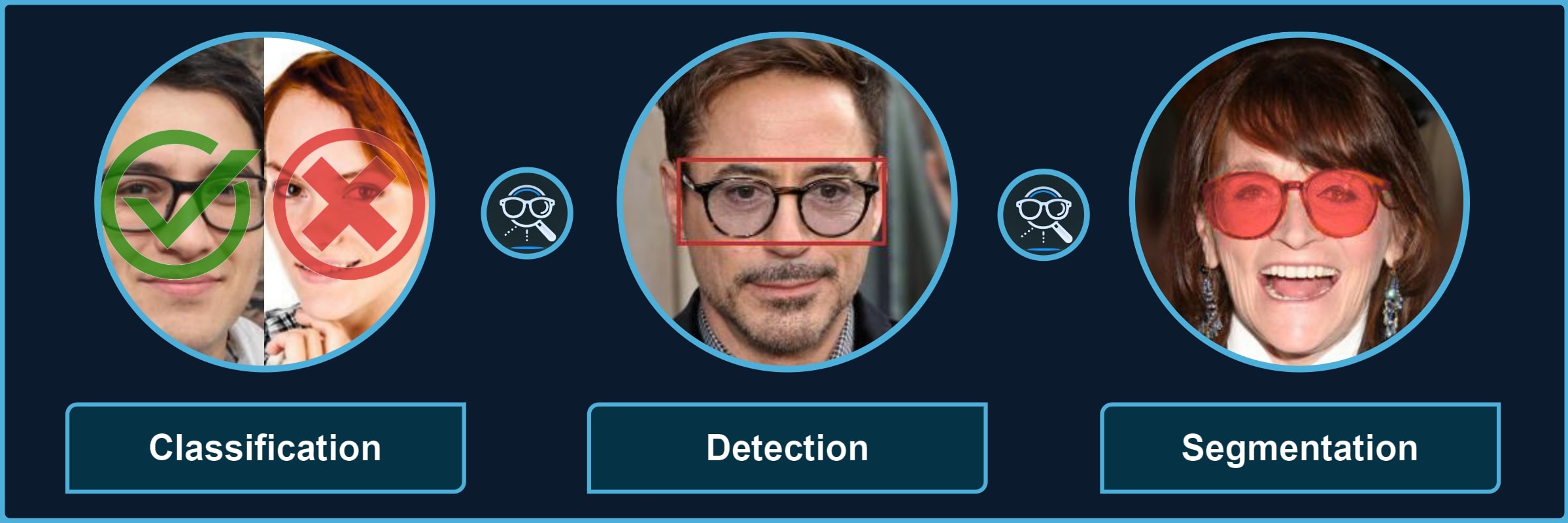
Package for processing images with different types of glasses and their parts. It provides a quick way to use the pre-trained models for 3 kinds of tasks, each divided into multiple categories, for instance, classification of sunglasses or segmentation of glasses frames.
| Classification | 👓 transparent 🕶️ opaque 🥽 any ➿shadows |
| Detection | 🤓 worn 👓 standalone 👀 eye-area |
| Segmentation | 😎 full 🖼️ frames 🦿 legs 🔍 lenses 👥 shadows |
$\color{gray}{\textit{Note: }\text{refer to}}$ Glasses Detector Features $\color{gray}{\text{for visual examples.}}$
Installation
[!IMPORTANT] Minimum version of Python 3.12 is required. Also, you may want to install Pytorch (select Nightly for compatibility) in advance to select specific configuration for your device and environment.
Pip Package
If you only need the library with pre-trained models, just install the pip package and see Quick Start for usage (also check Glasses Detector Installation for more details):
pip install glasses-detector
You can also install it from the source:
git clone https://github.com/mantasu/glasses-detector
cd glasses-detector && pip install .
Local Project
If you want to train your own models on the given datasets (or on some other datasets), just clone the project and install training requirements, then see Running section to see how to run training and testing.
git clone https://github.com/mantasu/glasses-detector
cd glasses-detector && pip install -r requirements.txt
You can create a virtual environment for your packages via venv, however, if you have conda, then you can simply use it to create a new environment, for example:
conda create -n glasses-detector python=3.12
conda activate glasses-detector
To set-up the datasets, refer to Data section.
Quick Start
Command Line
You can run predictions via the command line. For example, classification of a single image and segmentation of images inside a directory can be performed by running:
glasses-detector -i path/to/img.jpg -t classification -d cuda -f int # Prints 1 or 0
glasses-detector -i path/to/img_dir -t segmentation -f mask -e .jpg  # Generates masks
[!TIP] You can also specify things like
--output-path,--size,--batch-sizeetc. Check the Glasses Detector CLI and Command Line Examples for more details.
Python Script
You can import the package and its models via the python script for more flexibility. Here is an example of how to classify people wearing sunglasses:
from glasses_detector import GlassesClassifier

# Generates a CSV with each line "<img_name.jpg>,<True|False>"
classifier = GlassesClassifier(size="small", kind="sunglasses")
classifier.process_dir("path/to/dir", "path/to/preds.csv", format="bool")
And here is a more efficient way to process a dir for detection task (only single bbox per image is currently supported):
from glasses_detector import GlassesDetector

# Generates dir_preds with bboxes as .txt for each img
detector = GlassesDetector(kind="eyes", device="cuda")
detector.process_dir("path/to/dir", ext=".txt", batch_size=64)
[!TIP] Again, there are a lot more things that can be specified, for instance,
output_sizeandpbar. It is also possible to directly output the results or save them in a variable. See Glasses Detector API and Python Script Examples for more details.
Demo
Feel free to play around with some demo image files. For example, after installing through pip, you can run:
git clone https://github.com/mantasu/glasses-detector && cd glasses-detector/data
glasses-detector -i demo -o demo_labels.csv --task classification:eyeglasses
You can also check out the demo notebook which can be also accessed via Google Colab.
Credits
For references and citation, please see Glasses Detector Credits.


Download files
Download the file for your platform. If you're not sure which to choose, learn more about installing packages.
Source Distribution
Built Distribution
Hashes for glasses_detector-1.0.0-py3-none-any.whl
| Algorithm | Hash digest | |
|---|---|---|
| SHA256 | 498ea91f626731071a84f55f3f86d9e15f2e9770e003aa4634443f0216f483b0 |
|
| MD5 | fd2a78697d62dc91da2d6ff99769be40 |
|
| BLAKE2b-256 | db548fb3615933949974d45575afdf7c040fa8cad4eaf315745e707c5df14a4b |