A local inference platform for Apple Silicon: run, chat with, serve, and fine-tune the GGUF ecosystem's quantized models natively on MLX, straight off the file.

Project description

gmlx

CI build status License: BSL 1.1

The fastest way to run GGUF models on Apple Silicon.

gmlx is a local inference platform for Apple Silicon: chat with an open model, serve it over OpenAI- and Anthropic-compatible APIs, talk to it by voice, and fine-tune it. One command, entirely on your Mac.

gmlx takes the highest-quality quants available and serves them with the best performance on Apple Silicon. Today that means the community's K-quant and IQ-quant builds, which, size for size, keep more of the original model's accuracy than any other open format, and markedly more than MLX's built-in affine quantization (accuracy per byte). Nearly every open-weight release gets these builds within days, published as GGUF files, and gmlx runs them exactly as published: nothing converted, nothing re-quantized, none of that accuracy given back. The companion project mlx-kquant supplies the Metal kernels that run these formats natively on Apple's MLX framework.

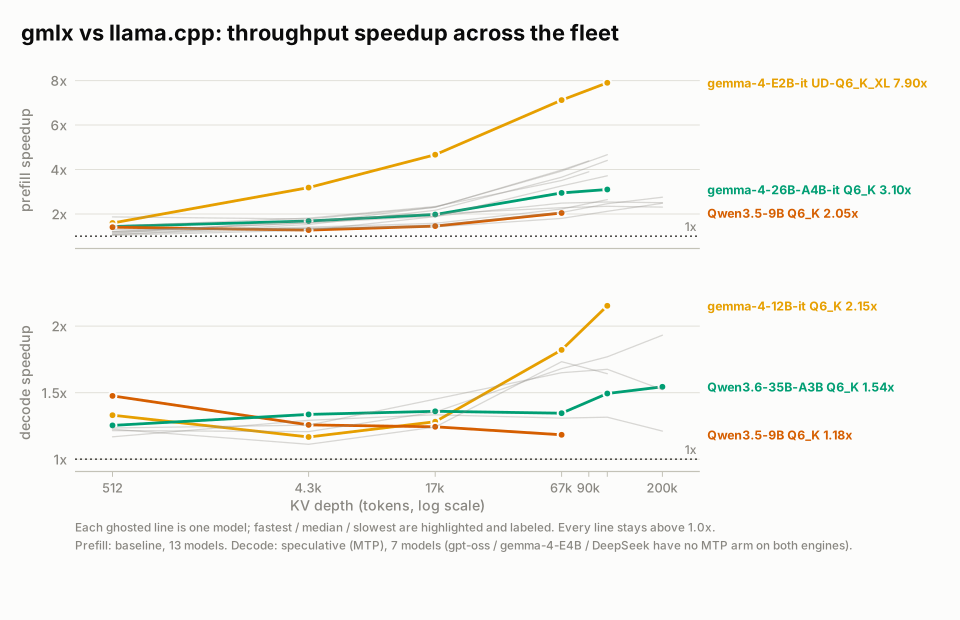
On the same file, gmlx benchmarks faster than llama.cpp: prefill leads on every model at every depth we've measured, reaching 2-4x past 100k tokens of context, and with speculative decoding active on both engines, decode runs 1.1-2x ahead, widening with depth (performance guide). Coverage runs from Llama, Qwen, and Gemma through DeepSeek, GLM, and gpt-oss. A family is listed in the generated coverage matrix only after token-parity certification against llama.cpp at 16k context. A 100B+ model starts generating within seconds of launch, and a MoE bigger than RAM still runs, streaming its experts from disk while everything every token needs stays on the GPU (bigger than memory).

gmlx vs llama.cpp: fleet throughput speedup vs KV depth
Prefill Decode (speculation on both engines) MTP lift at depth
faster on every model at every depth; 2-4x past 100k tokens 1.1-2x ahead, widening with depth 1.4-1.8x held from 17k to 110k
MTP decode lift vs KV depth: gmlx holds its speedup where llama.cpp's decays

The depth curve is the point: coding harnesses and agent sessions live at 50-200k tokens of context, and that is where the gap is widest. Full data and methodology: benchmarks.md; what makes it fast: the performance guide.

The rest of the platform:

  • hands-free voice chat with a built-in assistant that calls MCP tools mid-turn and keeps long-term memory (voice chat)
  • a continuously batched server speaking OpenAI Chat Completions, OpenAI Responses, and Anthropic Messages on one port, with tool calling, structured output, logprobs, and vision (serve an API)
  • MTP speculative decoding that holds its speedup deep into long context (performance)
  • run MoE models bigger than RAM, experts streamed from disk with decode served from a popularity-managed GPU arena (bigger than memory)
  • chat in your browser: one command wires the Open WebUI app to your server (getting started)
  • one-command hookups for coding agents and chat clients: pi, opencode, hermes, Open WebUI, and more (connect clients)
  • embeddings, reranking, speech-to-text, and text-to-speech, a fully local RAG and voice stack (embeddings and speech)
  • LoRA training directly on the quantized weights, with llama.cpp adapter interop in both directions (fine-tune)
  • a macOS menu-bar app to watch and manage the server, with gmlx service install to keep everything running from login (launch guide)

The command is gmlx.

Quickstart

Requires an Apple Silicon Mac and Python 3.11+, and installs like a Python developer tool. On macOS 26 and newer the Metal kernels install as a prebuilt wheel; older macOS builds them from source (Xcode Command Line Tools, a few minutes).

mkdir ~/gmlx && cd ~/gmlx
python3 -m venv .venv && source .venv/bin/activate
pip install "gmlx[chat]"        # [chat] = upgraded chat TUI, optional

# start small: a ~0.4 GB model, downloaded into the current directory
gmlx pull hf:unsloth/Qwen3-0.6B-GGUF/Qwen3-0.6B-Q4_K_M.gguf --to .
gmlx run  Qwen3-0.6B-Q4_K_M.gguf --prompt "Explain entropy in one paragraph."
gmlx chat Qwen3-0.6B-Q4_K_M.gguf                # interactive, multi-turn
gmlx serve Qwen3-0.6B-Q4_K_M.gguf --port 8080   # OpenAI + Anthropic API server

curl localhost:8080/v1/chat/completions -d \
  '{"model": "qwen3-0.6b", "messages": [{"role": "user", "content": "hi"}]}'
gmlx stop                                       # the server ran detached

The core install carries the whole platform - serving, vision, embeddings, the menu bar. Voice chat and the MCP assistant are extras (gmlx[talk], gmlx[assistant]), and gmlx[all] turns on everything; the full list is in the getting-started guide. In new terminals, source ~/gmlx/.venv/bin/activate brings the gmlx command back. A model typically needs roughly its file size in memory, plus the KV cache; the exception is MoE models, which can run bigger than memory. If anything misbehaves, gmlx doctor checks the runtime, config, model paths, and services in one pass. The full walkthrough, from install to a configured server with a connected client, is the getting-started guide.

Performance

gmlx and llama.cpp run the same GGUF file, so the comparison is direct: on an M5 Max (128 GB), gmlx prefills faster on every model in our fleet at every depth measured, 1.2-1.6x at short context and 2-4x past 100k tokens. At matched non-speculative baselines, decode starts at parity and wins fleet-wide from 16k tokens as the KV cache deepens; with speculative decoding active on both engines, gmlx decodes 1.1-2x ahead at every depth measured. The speed comes from kernels built for exactly this work: mlx-kquant's fused K-quant and IQ matmuls, attention tuned for decode at depth, and a custom MTP verify path built for this server. Where llama.cpp still leads, the performance guide says so. Reference points on the same machine at short context, with llama.cpp on the same file alongside: gemma-4-12B-it (dense, Q6_K) decodes at ~72 tok/s with MTP vs llama.cpp's ~54 with speculation (1.3x), prefilling at ~850 vs ~730 tok/s; Qwen3.5-9B (dense, Q6_K) decodes at ~112 vs ~76 tok/s (1.5x), prefilling at ~1600 vs ~1140 tok/s; the full fleet tables are in benchmarks.md. Absolute numbers scale with the machine's memory bandwidth; measure your own with gmlx run model.gguf --bench "128,512,2048".

When you want more, the levers are: MTP speculative decoding, which roughly doubles decode throughput at short context and still delivers 1.4-1.8x from 17k through 110k over the same server with MTP off, automatic on models with a native draft head (Qwen3.5/3.6) and available to gemma-4 through a small companion drafter (1.9-2.1x at short context); the prompt cache, which removes repeated prefill for agent workloads; KV-cache quantization for long contexts; and disk-streamed execution for MoE models larger than memory (below). The file you pick matters too: a uniform K-quant decodes meaningfully faster than a heavily mixed one at similar or better quality. When and why, with numbers: the performance guide.

Bigger than memory

MoE models whose files exceed RAM still run. --stream-experts keeps attention, the routers, and the KV cache on the GPU and streams the experts from disk, serving decode from a wired, popularity-managed expert arena sized to the machine and reading only the misses from the GGUF at SSD queue depth; --stream-cpu instead streams the whole model from disk through the page cache, running everything on the CPU. Both placements stage prefill straight from the file into GPU-visible slots, one trip per byte. The arena is also a good citizen: under system memory pressure it shrinks, keeping its most popular experts, and regrows once pressure clears, so a long-running model coexists with a build or a second model. Expect single-digit decode on what the SSD can deliver: this is a capacity feature that makes a 200B-class MoE usable on a 64 GB machine, not a speed feature. Placements, feeder mechanics, and measured numbers: the performance guide.

Accuracy per byte

K-quants are not just fast here; they are more accurate per byte than MLX's native (affine) quantization, carrying roughly half the KL divergence at the same bitrate (1.8-2.8x across the models measured). Qwen3.6-27B at a 4-bit budget: KLD 0.0577 at 4.69 bpw for MLX affine vs 0.0208 at 4.88 bpw for Q4_K_M, a 2.8x cut. The full table and methodology are in mlx-kquant's README. Converting a GGUF to MLX-native quantization gives up that margin; running it directly keeps it.

What you get

Run and chat

run generates, benchmarks (--bench), or inspects the load plan without running the model (--report-only). chat is a multi-turn terminal REPL over a persistent KV cache: streaming markdown rendering, sessions with --resume, /commands for live sampling changes, /! to stage shell output into a message, and image or audio input with a vision-language model (drag a file in). Sampling defaults come from each model family's model card, and @intents switch the operating point per call:

gmlx run model.gguf@creative --prompt "Write a haiku about entropy."
gmlx chat qwen3.6-27b-q6 --profile instruct   # --profile NAME = the flag form of @NAME

A .gguf path works with no setup; a bare id like qwen3.6-27b-q6 names a model from your server config - gmlx list shows yours (the getting-started guide sets one up).

Details: the CLI reference.

Find and download models

validate checks that a file will load before you download gigabytes, by range-reading just the header. Point it at a repo and it lists every quant variant as a ready-to-paste ref. pull downloads validated files (sharded, resumable, multi-file) into your model library, and an existing LM Studio library serves as-is.

gmlx validate hf:unsloth/Qwen3.6-27B-GGUF
gmlx pull hf:unsloth/Qwen3.6-27B-GGUF/Qwen3.6-27B-Q4_K_S.gguf

Details: picking a model for your Mac.

Serve an API

serve runs a continuously batched, multi-model server speaking three dialects on one port: OpenAI Chat Completions, OpenAI Responses, and Anthropic Messages, all streaming. It handles tool calling, structured output (response_format: json_schema, grammar-constrained), logprobs, and vision messages. A YAML config gives named models, reusable sampling profiles, aliases, and directory discovery. Residency is managed (LRU with pinning and idle unload), and repeated prefixes are served from a cross-request prompt cache with an optional SSD tier. The server never contacts Hugging Face to satisfy a request. It binds loopback by default, hardened against browser-borne attacks, with static-key auth for anything wider. Config-defined assistant ids run the built-in MCP tool loop server-side, so a thin client gets tools (and optionally memory) with no loop of its own.

Details: the server config reference and the assistant guide.

Connect coding agents and chat apps

One command points your tools at the local server, writing each tool's native config without touching your dotfiles and auto-starting the server if it is down:

gmlx launch pi --model qwen3.6-27b-q6@coding

Supported: pi, opencode, omp, claude-code, hermes, goose, the aichat and elia chat clients, and the Open WebUI browser app. A macOS menu-bar app shows what is resident and offers unload, restart, and logs.

Details: the launch guide.

Voice chat

gmlx talk is hands-free voice chat with any served model: a wake phrase (any text, no training), Whisper speech-to-text, and replies spoken sentence-by-sentence as they stream. With talk.brain: assistant the built-in assistant can call MCP tools mid-turn and keeps long-term memory, stored locally and retrieved through the server's own embeddings endpoint. The same assistant drives gmlx chat --assistant in the terminal and the served assistant ids above.

Details and worked examples: the voice-chat guide and the assistant guide.

Embeddings, reranking, and speech

The same server exposes OpenAI-compatible /v1/embeddings (GGUF decoder-LM or encoder embedders), Cohere-shaped /v1/rerank, /v1/audio/transcriptions (mlx-whisper), and /v1/audio/speech (Kokoro, Qwen3-TTS). Together they make a fully local RAG and voice stack for clients like Open WebUI.

Details: the RAG guide and the server config reference.

Fine-tune with LoRA

train finetunes directly through the quantized matmul, so you can tune a model you could never hold in fp16, and writes the adapter as a small GGUF in llama.cpp's adapter format (interop in both directions). --adapter applies it live at run, chat, or serve, so one base can serve several adapted variants side by side.

gmlx train model.gguf --data ./my-data --adapter-out my-lora.gguf
gmlx run   model.gguf --adapter my-lora.gguf --prompt "..."

Details: the LoRA training guide.

Supported architectures

Every family below loads end to end. New architectures land regularly, so the authoritative list is the generated architecture coverage matrix, with per-arch parity notes.

A GGUF is loadable when its general.architecture is an architecture gmlx recognizes and can synthesize a config for, or you supply hf_source. Preflight runs the architecture gate and checks each tensor's codec (its GGUF quantization type, like Q4_K_M) before any tensor bytes are read.

Family GGUF archs Notes
Llama llama, mistral3 Llama-2/3, Mistral, Vicuna. Mixtral routes to mixtral (stacked experts)
Qwen qwen2, qwen2moe, qwen3, qwen35, qwen3moe, qwen35moe, qwen3vlmoe, qwen3next dense + MoE. Qwen3.5/3.6 and Qwen3-Next gated-DeltaNet hybrids (both GGUF layouts); qwen3vlmoe is the Qwen3-Omni thinker tower
Gemma gemma, gemma2, gemma3, gemma3n [1], gemma4 norm bake undone on load; tied embeddings; gemma-3n text tower (AltUp, LAuReL, MatFormer)
DiffusionGemma diffusion-gemma [2] early support: non-autoregressive block-diffusion denoiser on the gemma-4 MoE backbone
GLM glm4, glm4moe, glm-dsa GLM-4 dense; GLM-4.5/4.6 fine-grained MoE; GLM-5.2 MLA + sparse-attention indexer
DeepSeek deepseek2, deepseek4 MLA attention + fine-grained MoE (DeepSeek-V3/R1, GLM-4.x MLA conversions); V4-Flash MLA-lite + sparse indexer + MTP drafter (parity reference: the ds4 engine)
Phi phi3 mini / small / medium; hf_source for 128K long-context variants
Nemotron nemotron_h_moe hybrid Mamba + attention MoE
gpt-oss gpt-oss native MXFP4 experts, attention sinks, YaRN rope, alternating sliding/full attention
Seed seed_oss ByteDance Seed-OSS 36B dense
SmolLM smollm3 SmolLM3-3B; Llama backbone with NoPE every 4th layer
Granite granite, granitehybrid IBM Granite dense; Granite 4.x hybrid (Mamba2 + attention + MoE)
ERNIE ernie4_5-moe Baidu ERNIE-4.5-MoE (21B-A3B)
MiniMax minimax-m2, minimax-m3 MiniMax-M2 (230B-A10B) and M3 (428B-A23B); every-layer fine-grained MoE. M3 adds per-head qk-norm + a shared expert; its sparse attention runs dense (exact to 2048 tokens)
Hunyuan hunyuan-moe, hy_v3 Tencent Hunyuan-A13B; Hy3 (299B-A21B) with its native MTP head
Falcon falcon-h1 TII Falcon-H1 (0.5B-34B); parallel attention + Mamba2 in every layer

[1] gemma3n is implemented but gate-disabled: every published gemma-3n GGUF carries mis-converted LAuReL weights (an upstream llama.cpp conversion bug at all quant levels), so the loader refuses them rather than run a degraded model. It re-enables the moment a correctly converted file exists.

[2] diffusion-gemma is early support and the one architecture with no token-parity oracle at all (llama.cpp does not implement it). It is GPU-validated by output coherence instead, currently Q8_0 only, and loads, runs, chats, and serves through mlx-vlm's denoising engine.

One further mapped arch, gemma-embedding, backs the /v1/embeddings endpoint (EmbeddingGemma from GGUF) rather than chat. Codec coverage spans all 19 K-quant, legacy, and IQ codecs plus the native-fp pair mxfp4/nvfp4 (run directly from the file when the model is bigger than RAM, repacked for speed when it fits - GMLX_NATIVE_FP overrides the choice); in the rare case a file uses a type with no kernel (ternary TQ, for example), preflight names it and lists what is supported so you can pick another variant.

Vision-language models load as a K-quant LLM GGUF paired with its float mmproj GGUF: supported families and caveats in the VLM guide. Want a family that is missing? What it takes, and the acceptance gate every family clears, is in the adding-architectures guide.

How it works

At the core of the platform is the gmlx loader and runtime, which turns a GGUF file into a running MLX model. mlx-kquant is the op and kernel layer it builds on (the kq.* namespace plus the C++ GGUF wire-byte reader); the split is one-directional: gmlx depends on mlx-kquant, never the reverse.

flowchart TB
  gguf[("GGUF model")]

  subgraph load["gmlx loader: zero-copy"]
    direction LR
    pre["preflight<br/>shards, codecs, arch gate"]
    bytes["mmap wire bytes<br/>no dequant"]
    synth["remap +<br/>synth config + tokenizer"]
    asm["assemble mlx-lm model<br/>leaves -> kq.* modules"]
    pre --> bytes --> synth --> asm
  end

  rt["mlx-lm model + KV cache<br/>+ mlx-kquant kernels"]

  gguf --> pre
  asm --> rt

  rt --> run["run<br/>generate + bench"]
  rt --> chat["chat<br/>multi-turn + VLM"]
  rt --> serve["serve: OpenAI + Anthropic<br/>batched, multi-model"]

  serve --> caps["chat + tools + structured<br/>vision + logprobs + MTP"]
  serve --> aux["embeddings + rerank<br/>STT + TTS"]

The loader: preflight (shards, codecs, arch gate), mmap the wire bytes, remap GGUF tensor names to mlx-lm parameter names, synthesize the config and tokenizer from the GGUF metadata, assemble the model with quantized leaves swapped for kq.*-backed modules, and generate with mlx-lm's sampler and KV cache. Serving-side mechanics: docs/serving-architecture.md.

Python API

from gmlx import load_model, generate, bench

model, config, tokenizer = load_model("model.gguf")   # also: arch=, chat_template=, ...
print(generate(model, tokenizer, "Explain entropy.", max_tokens=128))

load_model returns a ready-to-run mlx-lm model, the synthesized config dict, and the tokenizer. generate applies the tokenizer's chat template to string prompts by default (apply_chat_template=False for base models or pre-tokenized input), and bench sweeps prefill and decode throughput at chosen lengths. The full surface, including preflight and the mlx-lm server bridge, is in docs/python.md.

Documentation

The full index, routed by task, is docs/README.md.

Start here:

  • docs/getting-started.md: install to a served model with a connected client, including model picks per machine size.

Guides:

  • docs/launch.md: each supported coding agent and chat app, what gets written where, and the menu-bar app.
  • docs/talk.md: voice chat, wake word to spoken reply, with worked examples.
  • docs/assistant.md: the built-in tool-loop assistant: MCP tools, long-term memory, chat --assistant, and served assistant ids.
  • docs/lora.md: train a LoRA on a GGUF base and apply it live.
  • docs/vlm.md: vision and audio input from paired GGUFs.
  • docs/rag.md: a fully local RAG stack (embeddings + rerank + Open WebUI).
  • docs/performance.md: what makes it fast, what the levers cost, and how to measure.
  • docs/troubleshooting.md: the common failures and their fixes.
  • docs/migrating.md: coming from llama.cpp, Ollama, or LM Studio - what carries over and what maps to what.

Reference:

Internals and contributing:

Contributing

PRs welcome. Dev setup, test tiers, and the seam-patch ground rules are in CONTRIBUTING.md; the test suite guide is docs/testing.md. New architectures: docs/adding-architectures.md.

Acknowledgments

gmlx builds on several excellent projects: llama.cpp / ggml (the GGUF format and the K-quant reference implementations mlx-kquant's kernels derive from), MLX and mlx-lm (the runtime and model zoo), mlx-vlm (the batching server engine and VLM towers), mlx-whisper (speech-to-text), and mlx-audio (text-to-speech).

License

Business Source License 1.1: source-available, not open source. You may use, modify, and run gmlx for your own purposes, including commercial and professional work. You may not redistribute or sublicense it, incorporate it into another product, or offer it to third parties as a hosted service. Each released version converts to the Apache License 2.0 four years after its release. No claims are made against inference outputs, and downloaded model weights carry their own licenses.

Third-party code vendored into gmlx is documented in THIRD_PARTY_NOTICES.md, with license texts under licenses/.

Project details


Download files

Download the file for your platform. If you're not sure which to choose, learn more about installing packages.

Source Distribution

gmlx-0.1.0.tar.gz (5.3 MB view details)

Uploaded Source

Built Distribution

If you're not sure about the file name format, learn more about wheel file names.

gmlx-0.1.0-py3-none-any.whl (4.5 MB view details)

Uploaded Python 3

File details

Details for the file gmlx-0.1.0.tar.gz.

File metadata

  • Download URL: gmlx-0.1.0.tar.gz
  • Upload date:
  • Size: 5.3 MB
  • Tags: Source
  • Uploaded using Trusted Publishing? Yes
  • Uploaded via: twine/6.1.0 CPython/3.13.14

File hashes

Hashes for gmlx-0.1.0.tar.gz
Algorithm Hash digest
SHA256 809b3a20b87c30733bf193f0a33537968176f3bf3179d87893be77589f0502b6
MD5 289809ffffdd0e445753ce13bd52bf0f
BLAKE2b-256 25079c8cc2a2f98f16667db773a829fd443bf784ba71e3b204ce36d39bf9a908

See more details on using hashes here.

Provenance

The following attestation bundles were made for gmlx-0.1.0.tar.gz:

Publisher: release.yml on asher/gmlx

Attestations: Values shown here reflect the state when the release was signed and may no longer be current.

File details

Details for the file gmlx-0.1.0-py3-none-any.whl.

File metadata

  • Download URL: gmlx-0.1.0-py3-none-any.whl
  • Upload date:
  • Size: 4.5 MB
  • Tags: Python 3
  • Uploaded using Trusted Publishing? Yes
  • Uploaded via: twine/6.1.0 CPython/3.13.14

File hashes

Hashes for gmlx-0.1.0-py3-none-any.whl
Algorithm Hash digest
SHA256 5e0a95ccc5b0a4058142dada544b0bb0f5bf7fc0fae1901bb767975e41a64bdd
MD5 61e5c4f8d9f0606257a18e41d5540ebc
BLAKE2b-256 a01bd107a83675aa6eb7bbd29298b755c93d271b09bfa970a1f8de2e58aabf9f

See more details on using hashes here.

Provenance

The following attestation bundles were made for gmlx-0.1.0-py3-none-any.whl:

Publisher: release.yml on asher/gmlx

Attestations: Values shown here reflect the state when the release was signed and may no longer be current.

Supported by

AWS Cloud computing and Security Sponsor Datadog Monitoring Depot Continuous Integration Fastly CDN Google Download Analytics Pingdom Monitoring Sentry Error logging StatusPage Status page