
google-browser-scraper
Self-hosted SERP API alternative: Google search results from a real Chrome browser and your own residential proxy.





Quickstart · Output · HTTP API · MCP · Docker · How it works · Options
Latest version benchmarks (v0.1):
- 99.6% success rate (548 of 550 searches)
- 0.4 MB per search once an exit is warm; warming a new exit costs 30-110 MB
- 1.4 seconds per search on a warm exit (median)
Scrape Google search results (SERP) with a real Chrome browser and your own residential proxy, and get clean JSON back. Use it as a CLI, a Python library, a local HTTP API, or an MCP server that gives AI agents live Google search.
Plain HTTP is no longer a reliable way to scrape Google: it often expects a browser that runs JavaScript, and a fresh browser on a fresh proxy exit can be refused quickly. This tool takes a browser path instead. It warms a sticky proxy session with ordinary browsing, opens Google's results page for each query in that browser, checks whether Google served results or refused, and writes one JSON record per results page. Captchas, blocks and failures are reported as such, never as "no results".
Once Google serves the browser, most results pages come over direct HTTPS requests with the browser's own cookies and request headers, and the browser runs only when Google asks for its check again or a request does not bring a usable page. A results page fetched that way is a single document instead of a fully rendered page, so it costs a fraction of the traffic.
Features
- Real browser scraping: real Chrome via Patchright, with a warm-up before every new identity
- Low traffic: results pages over HTTP with the browser's cookies between Google's checks; the browser takes over by itself when that stops working
- Bring your own proxy: any residential proxy with sticky sessions, built-in NodeMaven support
- SERP API alternative: JSON with
organic_results,ads,related_questions,related_searches,pagination,ai_overviewandlocal_results - Honest failures: captchas and blocks come back labeled, not as empty results; an exit that keeps getting results unrelated to the queries is dropped
- Cost tracking: bytes per page and cost per 1000 pages in every run summary
- Four ways to run it: CLI, Python library, HTTP API, MCP server for AI agents
- Docker image for self-hosted deployment
Use cases
- SEO rank tracking and SERP monitoring for your own keywords
- Keyword and competitor research from live Google results
- Web search for AI agents and LLM apps through MCP
- A self-hosted alternative to paid Google search APIs when you already pay for proxies
Install
pip install google-browser-scraper
patchright install chromium
Quickstart
You need a residential proxy with sticky sessions. Put {session} where
your provider expects a session id in the username:
google-browser-scraper search "best running shoes" \
  --proxy "http://USER-session-{session}:PASS@gate.example.com:7000" \
  -o results.jsonl
The first query takes a few minutes, because a new exit is warmed up first, and the warm-up costs noticeably more traffic than a search. Later queries on the same exit take seconds. A summary of pages served and traffic used, with the hosts that took most of it, is printed at the end of every run.
With NodeMaven residential proxies, the session id is handled for you and the credentials come from the environment:
pip install "google-browser-scraper[nodemaven]"
export NODEMAVEN_LOGIN=... NODEMAVEN_PASSWORD=...
google-browser-scraper search -f queries.txt --nodemaven --country us -o results.jsonl
To cap a run's traffic, --nodemaven-demo creates a sub-user with a traffic limit
from your dashboard API key, shares it across workers, and deletes it when the run
ends (--keep-subuser keeps it). The account needs sub-users enabled. A fresh
warm-up alone uses about 60 MB, so keep the cap well above that:
export NODEMAVEN_API_KEY=...
google-browser-scraper search -f queries.txt --nodemaven-demo --traffic-limit-mb 300 -o results.jsonl
To try it without a proxy, use your own connection:
google-browser-scraper search "best running shoes" --no-proxy
Google then sees one address for every query, so it starts answering with
captchas sooner than it would across a pool of exits. Those pages come back as
captcha in page_verdict, not as empty results.
From Python:
from google_browser_scraper import ProxyTemplate, Scraper, Settings

proxy = ProxyTemplate("http://USER-session-{session}:PASS@gate.example.com:7000")
for page in Scraper(proxy, Settings(pages=2)).run(["best running shoes"]):
    for result in page.get("organic_results", []):
        print(result["position"], result["title"], result["link"])
What you get
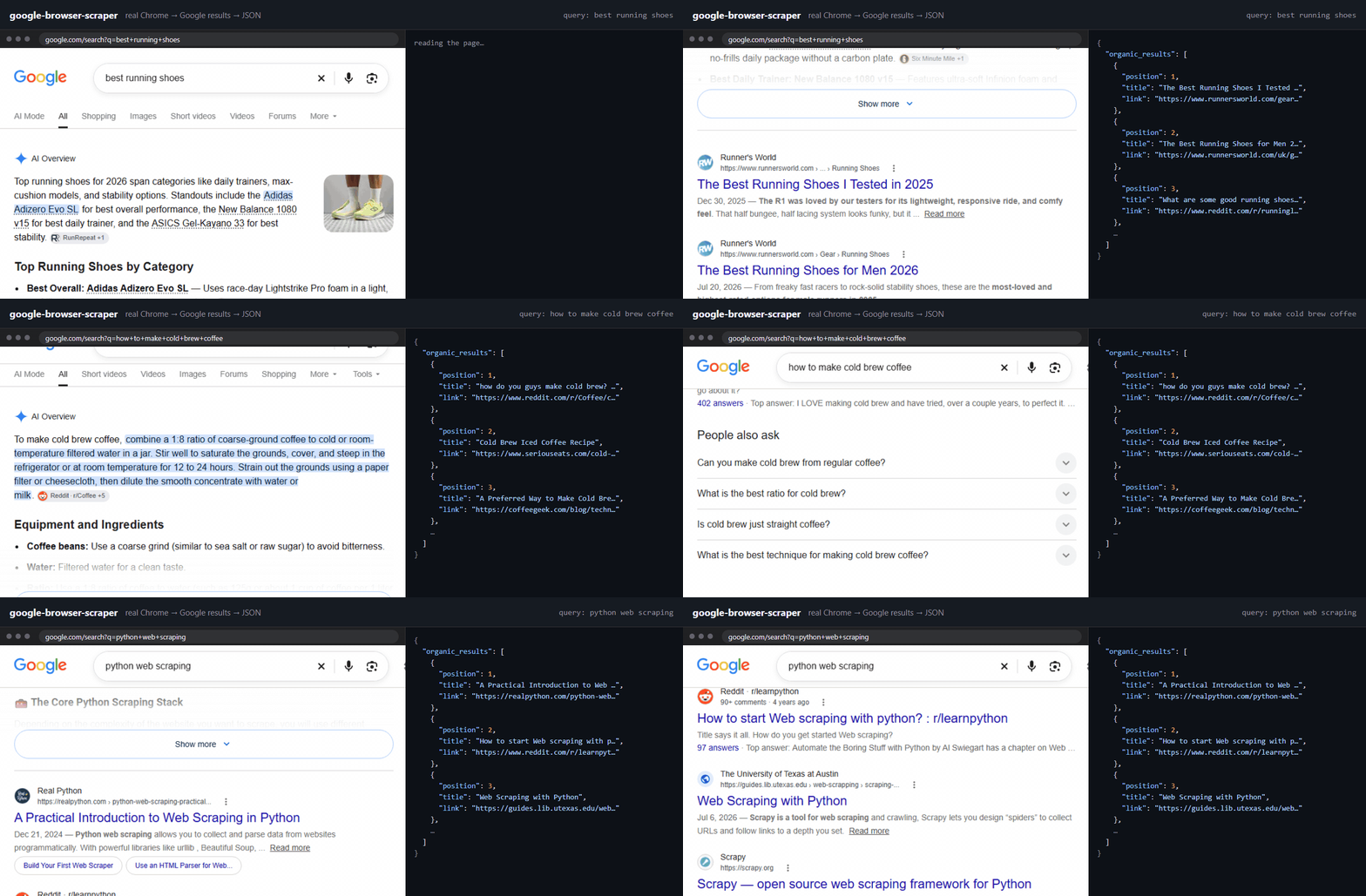
One JSON object per results page:
{
  "search_metadata": {"status": "Success", "page_verdict": "ok"},
  "search_parameters": {"engine": "google", "q": "best running shoes", "page": 1},
  "organic_results": [
    {"position": 1, "title": "...", "link": "https://...", "snippet": "..."}
  ],
  "related_questions": [{"question": "..."}],
  "exit": {"session": "...", "queries_on_exit": 1, "bytes": "..."}
}
The schema uses the field names common to SERP APIs: organic_results, ads,
related_questions, related_searches, pagination and search_metadata, so
simple consumers can often switch with minimal mapping. ai_overview holds the
text of Google's AI Overview when the page shows one, and local_results the
places of the map pack on local queries (name, rating, reviews, type, address,
phone, opening hours). The AI Overview is found by its English heading, so it is read
on pages in English (--hl en, the default).
Knowledge panels, shopping, images and other special blocks are not parsed.
Each record also has an exit block: which proxy session answered and how many
bytes the page cost. search_metadata.fetched_with is http or browser.
search_metadata.timings says where the page's time went, in seconds per step
(http for a page fetched over HTTP; type, load, ready and read for one
the browser rendered; parse; and links, which overlaps the next query and is
not part of total_time_taken). A query that
failed is a record too, with an error. --format csv writes the organic
results as a table, and --price-per-gb adds the cost per 1000 pages to the
summary.
Run it as an API
google-browser-scraper serve --nodemaven --country us --prewarm
curl "http://127.0.0.1:8000/search.json?q=best+running+shoes"
Same record format as above. hl (language, e.g. de) and gl (country,
e.g. at) can be set per request: /search.json?q=...&hl=de&gl=at. Requests
run one at a time on one held identity.
--prewarm searches once at startup, moving to a new exit until Google serves
one, so a request sent after it does not wait for a warm-up. /health answers
503 warming until then; a request sent earlier waits in line behind it. Set
GBS_API_KEY to require a key; without one the server only listens on
localhost.
Use it from an AI agent (MCP)
{
  "mcpServers": {
    "google-search": {
      "command": "google-browser-scraper",
      "args": ["mcp", "--nodemaven", "--country", "us", "--prewarm"],
      "env": {"NODEMAVEN_LOGIN": "...", "NODEMAVEN_PASSWORD": "..."}
    }
  }
}
It exposes one tool, google_search(query, pages, hl, gl). The answer carries
the organic results, "People also ask", related searches, and the AI Overview and
map places when Google shows them.
Docker
A ready image is published to GitHub Container Registry with every release:
docker run --rm ghcr.io/nodemaven/google-browser-scraper doctor
docker run --rm -p 8000:8000 -e GBS_API_KEY=change-me \
  -e GBS_PROXY='http://USER-session-{session}:PASS@gate.example.com:7000' \
  ghcr.io/nodemaven/google-browser-scraper serve --host 0.0.0.0
To build it yourself: docker build -t google-browser-scraper .
How it works
- New identity: a sticky proxy session and a fresh browser profile.
- Warm-up: a few ordinary pages, staying on each for 20-45 seconds.
- Search: an exit's first query opens Google's results page in the browser. Once Google serves it, the following results pages are fetched over HTTP with the browser's cookies and headers, until Google asks for its check again; the browser then runs one query, passes it, and HTTP carries on with the fresh cookies.
- Check before parsing: the page is classified first, so a captcha or a block is reported as one and never parsed as an empty result.
- Keep or drop: an exit Google answers is reused for the next queries; an exit it refuses is dropped and the query is retried on a new one. If exit after exit is refused, the run stops instead of spending more traffic.
More detail: HTTP between checks, holding exits, copied cookies, result links, traffic
HTTP between checks. The request headers come from Chromium itself: once per
run, the first served browser search is recorded in a Chromium NetLog and its
headers are reused in Chromium's order, through curl_cffi with Chrome's TLS and
HTTP/2 fingerprint, on the same exit and the same counting relay. When the HTTP
side stops getting pages (several short runs between checks in a row, errors, or
pages that parse to nothing, which is what a change in Google's markup looks
like), that exit goes back to the browser; when several exits in a row do, the
whole run does. --no-hybrid uses the browser for every page.
Unrelated results. Google is reported to answer some automated traffic with a normal-looking page of results for other queries instead of a block. When three pages in a row on one exit have almost no title that carries the query's words, the exit is dropped and the query asked again on a new one. One-word queries are not judged.
Holding exits. A served exit is kept for up to 300 queries. Every new exit pays for a warm-up, so a short cap mostly buys more warm-up traffic. Every 50 results pages it renders, the browser is restarted on the same profile and exit, which keeps its memory from growing over a long hold. A browser error on a search is retried once on the same exit before the exit is dropped; a network error, running out of memory or a crashed browser drops it at once.
Copying cookies. The command line copies the cookies of the first exit Google serves and starts new exits from that copy, on new sticky sessions, instead of warming each one; all workers share the copy. Google's acceptance follows the cookies more than the address, so a copy usually starts out served and costs a few MB instead of a full warm-up. A copy waits 40-60 seconds after its browser starts before the first search.
Copying the cache. Pages get cheaper as an exit is held, because the
browser cache fills with Google's shared scripts and images. Copies carry that
cache too, so a new exit starts with cheap pages, and the copy is refreshed
from the held exit at each browser restart, when its cache is warm. If two
copies carrying the cache are refused on their first search, the rest of the
run copies cookies only (--no-clone-cache does that from the start).
Result links. Google wraps result links in encrypted /goto redirects.
Each one is resolved with a small request through a separate short-lived proxy
session, a few at a time, in the background while the browser goes on to the
next query. Records still come out in the order each browser searched them.
Traffic. Everything goes through a small local relay that counts bytes per host and blocks a large model download Chrome otherwise makes on every fresh profile.
The defaults come from measurements in proxy-benchmark.
Options
All search options
| Option | Default | What it does |
|---|---|---|
--workers N |
1 | Search on N exits at once, one browser each, from one list of queries |
--max-per-exit N |
300 | Queries before a served exit is retired |
--restart-every N |
50 | Results pages the browser rendered before it restarts on the same profile and exit; 0 never |
--no-hybrid |
Fetch every results page in the browser instead of over HTTP between Google's checks | |
--hl, --gl |
en, unset |
Language and country of the results |
--clone N |
10 | New exits started from copied cookies; 0 turns copying off |
--clone-max-age |
180 | Minutes copied cookies stay in use |
--clone-refusals N |
1 | Copies refused in a row on their first query that end the copying |
--no-clone-cache |
Copies carry cookies only, not the browser cache | |
--warmup |
L3 |
Pages a fresh exit opens before its first query: L3, light (without Google Trends: much less traffic, served on the first query less often), L2, L1, off |
--spare N |
0 | Exits warmed in the background so a retired one is replaced at once; each costs a warm-up |
--direct |
all |
Open results pages directly: all, follow-ups (all but an exit's first query), none |
--input |
type |
How a query goes into the search box: type, insert, words |
--gap LOW,HIGH |
2,5 | Seconds between queries on one exit |
--pages N |
1 | Result pages per query |
--format |
jsonl |
jsonl or csv |
--price-per-gb |
Your proxy price, to print the cost per 1000 pages | |
--no-resolve-links |
Keep result links as Google /goto redirects |
|
--save-html DIR |
Keep every page's HTML, gzipped |
google-browser-scraper search --help lists the rest.
Proxies
Any provider with sticky sessions works through --proxy and a {session}
placeholder. A proxy without one is accepted with a warning: if the exit changes
on every request, warming it does nothing. SOCKS5 needs an IP-whitelisted
endpoint, because Chrome cannot send a SOCKS5 username and password.
Check your machine
google-browser-scraper doctor
Starts the browser on a blank page, sends nothing, and reports what a website would see: whether the browser looks headless, whether WebGL works, the screen size. Google answers some machines much less than others, so run this first.
What this is not
Not a free Google Search API, and not a guarantee that every proxy exit will work. It is a browser-based collector that makes failures explicit, drops exits Google refuses, and tells you what each page cost.
Status
Early. The cloak engine (--engine cloak) is experimental; patchright is
the default.
Google changes its pages often. If results come back empty or wrong, run with
--save-html DIR and open an issue with what you see.
You are responsible for using this within Google's terms and the law where you run it.
Adding an engine
An engine joins this tool only after it has been measured on proxy-benchmark. Add it there and run the warm-up ladder against Google:
python scripts/run_ladder.py --engines your-engine
Then open a pull request here with the run file. The ladder runs identities with and without the warm-up in the same hours, so the result shows whether the engine actually gets served, not whether it got lucky once.
License
1 maintainer

Metadata
1 maintainer
Release files for google-browser-scraper 0.1.0
For a detailed explanation of source distributions (sdists) and built distributions (wheels), please see the package formats documentation.
Source distribution (sdist)
| File | Size | Uploaded | Provenance | Actions |
|---|---|---|---|---|
| google_browser_scraper-0.1.0.tar.gz | 115.6 kB | With provenance | Details for google_browser_scraper-0.1.0.tar.gz |
Built distribution (wheel)
| File | Interpreter | ABI | Platform | Actions Reset |
|---|---|---|---|---|
| google_browser_scraper-0.1.0-py3-none-any.whl | Python 3 | none | any | Details for google_browser_scraper-0.1.0-py3-none-any.whl |
Total release size: 194.6 kB
Release files / google_browser_scraper-0.1.0.tar.gz
| Download URL | google_browser_scraper-0.1.0.tar.gz |
|---|---|
| Size | 115.6 kB |
| Tags | Source |
|
SHA-256 checksum How to use checksums |
5710a5c20fa84a74c643478f8377f5f892f794be5207f3c389b87f7b74f72172
|
|
BLAKE2b-256 checksum How to use checksums |
b21824dcc3dbbb113dddc76fb7343237fef05d3c908ff61f962af8d62c81c26d
|
| Upload date | |
|
Uploaded using Trusted Publishing? What is trusted publishing? |
Yes |
| Uploaded via |
twine/7.0.0 CPython/3.13.16
|
Provenance
Provenance describes where a file came from. On PyPI, provenance is shared via attestations, which provide a verifiable record of the build or publishing details. View details, limitations and caveats.


PyPI Publish Attestation
PyPI verified that this artifact, at this checksum, originated from the publisher listed below.
Signed by GitHub Actions, verified by PyPI on Oct 29, 2026.
Transparency logRelease files / google_browser_scraper-0.1.0-py3-none-any.whl
| Download URL | google_browser_scraper-0.1.0-py3-none-any.whl |
|---|---|
| Size | 79.0 kB |
| Tags | Python 3 |
|
SHA-256 checksum How to use checksums |
0c468939a1bf4acb9d8abca5ec4d6861889e1b80a31b3d9a7efd9c686a9b5f19
|
|
BLAKE2b-256 checksum How to use checksums |
1eff3a8c01cc490f93ed4511222b1fd5c35e3cb1c2ebc787ffcef36eb18fad71
|
| Upload date | |
|
Uploaded using Trusted Publishing? What is trusted publishing? |
Yes |
| Uploaded via |
twine/7.0.0 CPython/3.13.16
|
Provenance
Provenance describes where a file came from. On PyPI, provenance is shared via attestations, which provide a verifiable record of the build or publishing details. View details, limitations and caveats.
PyPI Publish Attestation
PyPI verified that this artifact, at this checksum, originated from the publisher listed below.
Signed by GitHub Actions, verified by PyPI on Oct 29, 2026.
Transparency logSecurity for google-browser-scraper 0.1.0
Provenance
Provenance describes where a file came from. On PyPI, provenance is shared via attestations, which provide a verifiable record of the build or publishing details. View details, limitations and caveats.
Full provenance
Both files in this release have been uploaded with provenance metadata.
Attestation for google_browser_scraper-0.1.0.tar.gz
PyPI Publish Attestation
PyPI verified that this artifact, at this checksum, originated from the publisher listed below.
Signed by GitHub Actions, verified by PyPI on Oct 29, 2026.
Transparency logA note on package security
PyPI is a repository for distributing packages, not a service for auditing them. While third-party security researchers and our staff do their best to detect and remove malicious packages, PyPI cannot guarantee the quality, security or suitability of any given package.
To learn more about protecting yourself from malicious actors, visit our package security documentation.














