
gpushift




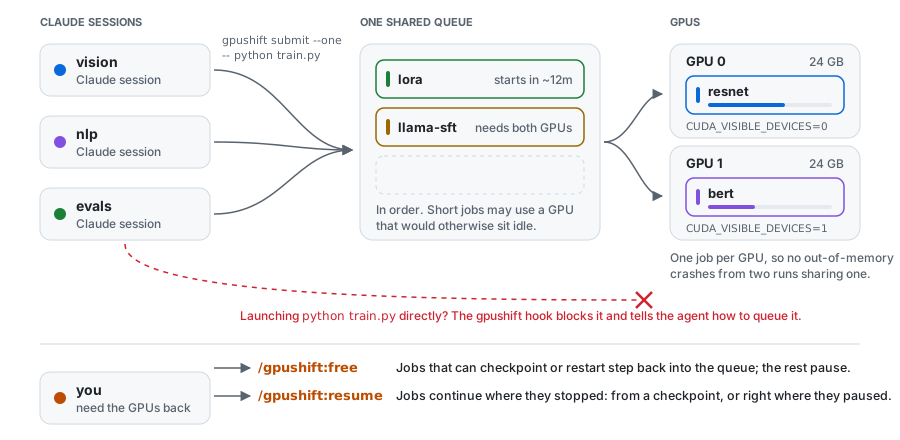
Share one GPU machine between your Claude Code agents and yourself. Agents queue their GPU work instead of launching it, so they never crash each other's runs; jobs run in the order they were queued, share a GPU when they fit, and step aside when you start a game or Blender, then carry on when you're done.
- One queue for every session. A Claude Code hook stops agents that launch training directly and tells them how to queue it.
- The machine is still yours.
/gpushift:free(or just starting a heavy GPU program) makes running jobs save a checkpoint and step aside; they resume later. - Efficient. First come, first served, but short jobs fill idle GPUs or go ahead of long ones when that cuts everyone's waiting, and jobs whose memory use is known share a GPU.
- You stay informed. Agents are told when their jobs end, you get desktop notifications for failures, and a web dashboard shows everything.
- Windows, Linux and macOS, any number of NVIDIA GPUs (or none). No configuration.
Quickstart
uv tool install gpushift          # or: pipx install gpushift
gpushift init                     # detect GPUs, write the config, start the daemon (and at login)
Then, in Claude Code:
/plugin marketplace add EdwardGlockner/gpushift
/plugin install gpushift@gpushift
Agents now queue their GPU work. You can too:
$ gpushift submit --one --eta 40m -- python train.py --epochs 90
job 14 queued (one: 1 GPU, 2 slots) tag=resnet
position 2 of 3, estimated start: ~40m (14:52)
logs: gpushift logs 14 -f
gpushift status (or gpushift ui for the dashboard) shows what runs where,
what waits, and when it should start:
gpushift  mode: normal  |  daemon: running  |  slots: 4/4 used

GPU 0 GTX 1070         6.1/8.0 GB            job 12   one       resnet          1h02m  python train.py --cfg a.yaml
GPU 1 GTX 1060 6GB     2.3/6.0 GB   (shared) job 15   light     eval              3m  python eval.py --ckpt last.pt
                                             job 16   light     eval              1m  python eval.py --ckpt best.pt

Queue (2 waiting)
  pos  id   preset    tag            waiting  est. start           command
    1  17   two       llama-sft          12m  ~40m (14:52)         torchrun --nproc_per_node 2 sft.py
    2  18   cpu       data                3m  ~41m (14:53)         python tokenize.py
Submitting jobs
| Preset | Use for | Gets |
|---|---|---|
--light |
Small evals/inference that fit in a fraction of VRAM | Shares the shared GPU with other light jobs, never with a training run |
--one (default) |
A normal single-GPU job | 1 GPU (a whole one, unless its memory need is known; see below) |
--two |
Multi-GPU (DDP, torchrun) | All GPUs gpushift manages |
--exclusive |
Benchmarks, jobs that need the whole box | Everything; nothing else runs alongside |
--cpu |
Preprocessing, CPU-only work | No GPU (CUDA_VISIBLE_DEVICES="") |
Options:
--eta 40m: how long it takes. Gives better start estimates and lets the job use idle GPUs (below). Without it, gpushift learns from earlier runs of the same command.--vram 6G: GPU memory it needs, so it can share a GPU. Also learned from earlier runs.--restartable: safe to stop and run again (it skips finished work); see free mode.--after 12(or--after 12,13): start only once those jobs finished successfully, e.g. an eval after its training run. Until then it doesn't hold anything else up; if one of them fails or is cancelled, this job is cancelled too. Use it whenever order matters: queue order alone doesn't make jobs run one after another (two jobs can run side by side on two GPUs). A job can't be moved ahead of a job it waits for.--priority(front of the queue),--tag,--gpus N/--slots N(override the preset).
The job runs with the cwd and environment of the submit call (your venv/conda
env, env vars), with CUDA_VISIBLE_DEVICES set to its GPUs and
CUDA_DEVICE_ORDER=PCI_BUS_ID, so GPU numbers match nvidia-smi. Give the command
as separate words, or as one quoted string to run it in a shell: on Windows, the Git
Bash it was submitted from (what Claude Code's Bash tool uses), or cmd.exe if it uses
backslash paths or comes from cmd/PowerShell; /bin/sh on Linux and macOS. A
missing program or script is rejected right away, not when the job starts.
How jobs are scheduled
First come, first served. Jobs start in the order they were queued. Jobs moved
up with --priority / gpushift priority, and evicted jobs waiting to resume, go
first. With fair_share = true, Claude sessions (and you, from a terminal) take
turns instead: the next job comes from whoever has used the least GPU time in the
last 24 hours, so one session's list of thirteen jobs doesn't hold up everyone else.
Sharing GPUs. A job whose memory need is known (--vram, or the peak of earlier
successful runs of the same command plus 15%) can share a GPU with other such jobs,
as long as they fit in what's left of its memory. Shared GPUs fill up first, so
whole GPUs stay free for jobs that need one. Jobs with an unknown need always get a
whole GPU. packing = false turns this off.
No starvation, no idle GPUs. A job waiting for several GPUs never starves behind a stream of small ones: it holds back the jobs behind it. They may still use a GPU that would otherwise sit idle, if their estimate says they finish before the waiting job could start anyway. When a running job is past its estimate, nobody knows when it ends, so then nothing jumps ahead.
Short jobs before long ones, within limits. Strict order can leave a GPU idle
for hours: a 4-hour one-GPU job starts, and a batch of 15-minute whole-machine jobs
queued after it waits for it. Before starting anything, gpushift
forecasts the queue and checks whether running some jobs ahead of their turn cuts
the total waiting. It does that only if no job starts more than an hour (or half its
own run time, if that is longer) later than it would in queue order, counted from
the first time it was passed, and never for jobs moved up with --priority. Equal
jobs keep their order. reorder_slack sets the hour; 0 turns this off.
Slots are the machine's concurrency budget (default: 2 per GPU). --light,
--cpu and GPU-sharing jobs use 1, --one and --two use 2, --exclusive all.
GPUs used outside gpushift: an unclaimed GPU only counts as free if at least
gpu_free_perc (default 75%) of its memory is free.
When you need the GPUs
gpushift free      # pause the queue and clear the GPUs (/gpushift:free in Claude Code)
gpushift resume    # carry on                            (/gpushift:resume)
free pauses the queue, then:
- Resumable jobs (they use
gpushift.checkpoint, below) save a checkpoint, exit and go back to the front of the queue. A job that doesn't exit withinevict_timeout(300 s) is frozen instead. - Restartable jobs (
--restartable) are stopped and go back to the front, to run again. Use it for jobs that skip work they already finished, like most eval scripts. - Other jobs are frozen. They stop computing but keep their GPU memory, and
freesays which GPU they hold and how to release it.
free --soft freezes everything instead (instant, but all GPU memory stays in use).
Free mode survives reboots. Agents can't run free or resume; only you can.
Automatically. When a program you started yourself uses the GPU heavily (a game,
Blender, your own training script), gpushift frees the GPUs after 10 seconds and
resumes two minutes after the last such program closes. "Heavily" means over 1 GB of
GPU memory, or any use by a program you list in [auto_free] apps; the desktop,
browsers and chat apps are ignored. A free you start by hand is never resumed for you,
and if you resume by hand, gpushift waits for the program to close before freeing again.
Notifications and the dashboard
- Agents are told when their jobs end. The plugin adds a short note to the session that submitted the job ("job 34 (r2-trial) failed: exit code 2 after 0s: can't open file ...") on its next step, so agents don't need to poll.
- Desktop notifications for failed jobs and automatic free/resume
(
[notify] desktop = "all"for every job,"off"for none). gpushift uiopens a live dashboard athttp://127.0.0.1:8237: GPUs and their memory, load, temperature and power, the CPU, free space on each drive, a timeline of what runs on which GPU and when, running jobs and their logs, the queue (drag a job by its handle to move it), recent results with failure reasons, and buttons to free/resume or cancel. It only listens on your own machine.
Commands
| Command | |
|---|---|
gpushift submit [preset] [options] -- <cmd> |
Queue a job (--json for machine output) |
gpushift status [--json] |
GPUs, running jobs, queue, estimated starts, mode |
gpushift ui |
Open the web dashboard |
gpushift logs <id> [-f] [-n N] |
Job output |
gpushift wait <id> [--timeout 30m] |
Block until the job ends; exit code mirrors the job |
gpushift show <id> |
One job's details |
gpushift priority <id> / gpushift swap <a> <b> |
Reorder the queue |
gpushift cancel <id>... / gpushift retry <id> [--priority] |
Cancel / queue a copy |
gpushift free [--soft] / gpushift resume |
Free the machine / continue |
gpushift init / gpushift doctor / gpushift config [--edit] |
Setup, health check, config |
gpushift start / gpushift stop / gpushift autostart on|off |
Daemon control |
gpushift status --json has a stable schema ("schema": 1) for scripts and agents.
Claude Code plugin
- Skill
gpu-queue: never launch GPU work directly; how to pick a preset; checkgpushift statusfirst; give an ETA and memory need;--restartablefor jobs that can rerun;--priorityonly when the user asks; never free/resume; make new training scripts resumable; keep working while jobs run. - Slash commands:
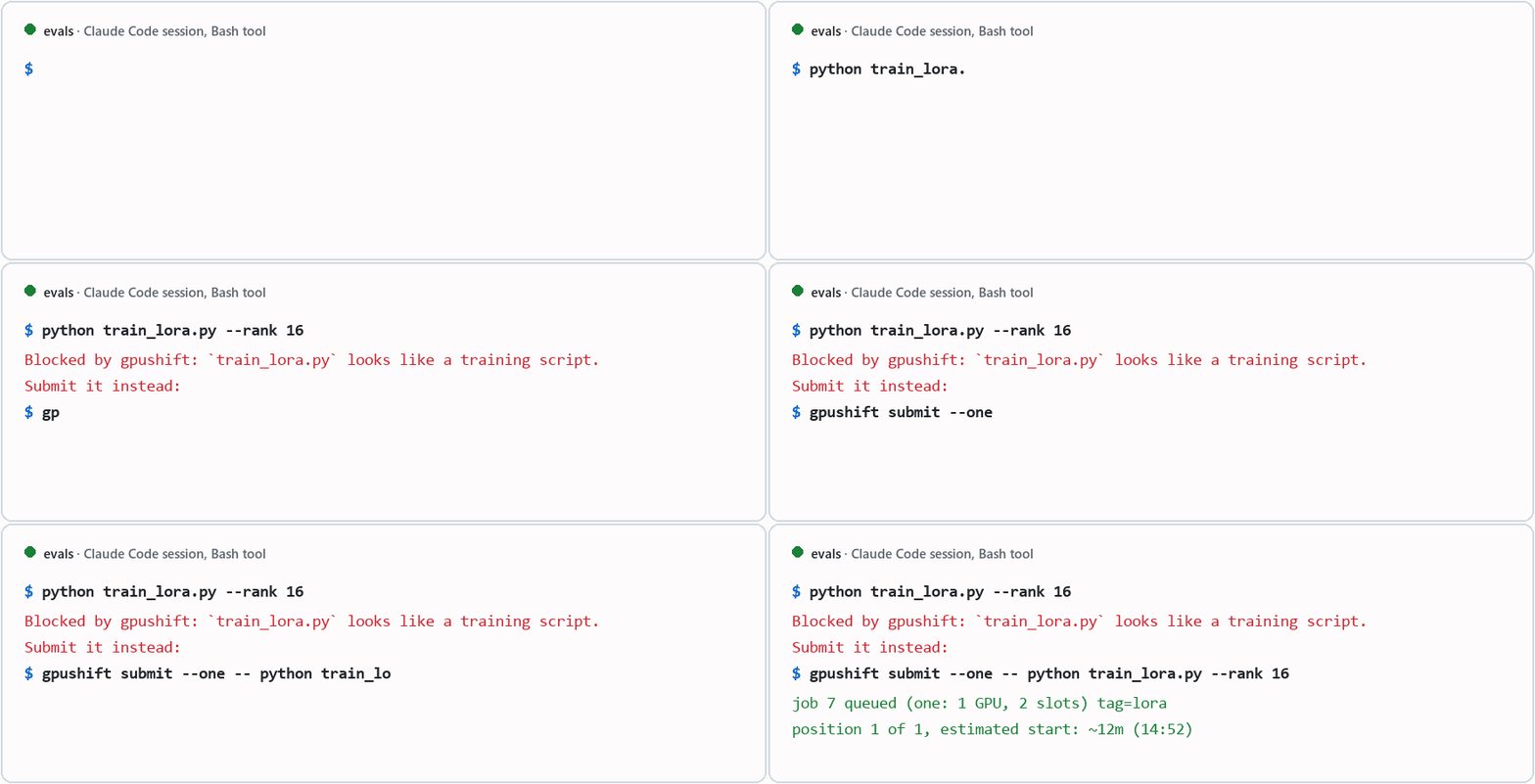
/gpushift:queue,/gpushift:priority <id>,/gpushift:cancel <id>,/gpushift:free [--soft],/gpushift:resume. - Hooks: before a Bash/PowerShell command, block direct GPU launches and show the
gpushift submitcommand to use instead; after each step, tell the session about its jobs that ended.- Blocked:
python train*.py/finetune*/pretrain*/*_train.py/python -m pkg.train,torchrun,accelerate launch,deepspeed,python -m torch.distributed.*, andCUDA_VISIBLE_DEVICES=… python …, also behinduv run,conda run,nohupand&&chains. - Never blocked: commands through
gpushift,python -c,--help, pytest, pip, editors, and text that only mentions a command (commit messages, echo, grep). - Escape hatches: append
# no-queue(or prefixGPUSHIFT_NO_QUEUE=1); regexes in[hook] allow/deny;[hook] enabled = false. It's a guardrail, not a security boundary.
- Blocked:
Not using the plugin? Add this to your CLAUDE.md:
Never launch GPU jobs directly; submit them with
gpushift submit(gpushift submit --help,gpushift status).
Making jobs resumable: gpushift.checkpoint
A dependency-free helper. Every gpushift job can import it, even in an environment where gpushift isn't installed.
from gpushift import checkpoint as ckpt

last = ckpt.latest_checkpoint("checkpoints", "step*.pt")  # None on a fresh start
step = load(last) if last else 0
while step < total:
    train_step()
    step += 1
    if step % 1000 == 0 or ckpt.should_stop():
        with ckpt.atomic_path(f"checkpoints/step{step:08d}.pt") as tmp:
            torch.save(state, tmp)  # never leaves a half-written checkpoint
    if ckpt.should_stop():
        break  # exit 0 -> gpushift requeues and resumes it
should_stop(): call it every step (it's cheap). The first call also marks the job as resumable, sofreeevicts it instead of freezing it.resuming(): True when gpushift restarted the job after an eviction (GPUSHIFT_RESUME=1).latest_checkpoint(dir, pattern)andatomic_path(path).
Examples: plain PyTorch,
HF Trainer + accelerate,
Lightning. For multi-process jobs, reduce the flag
across ranks so they all stop at the same step. Scripts that handle SIGTERM
themselves can be submitted with --resumable (Linux/macOS).
Configuration
~/.config/gpushift/config.toml (gpushift config --edit). Everything is optional;
gpushift init writes a commented template with the values for your machine. The
daemon picks up changes automatically.
gpus = [0, 1]               # GPUs gpushift may use (default: all detected)
slots = 4                   # default: 2 per GPU (CPU-only: half the cores)
shared_gpu = 1              # GPU for --light jobs (default: the last GPU)
gpu_free_perc = 75          # an unclaimed GPU is free if this % of its memory is free
starvation_guard = true
fair_share = false          # true: sessions take turns
packing = true              # jobs with a known memory need may share a GPU
reorder_slack = 3600        # seconds a job may be passed to cut total waiting (0 = off)
free_mode_default = "full"  # or "soft"
evict_timeout = 300         # seconds a resumable job gets to checkpoint during `free`
ui_port = 8237              # dashboard on 127.0.0.1 (0 = off)

[notify]
desktop = "failures"        # "all", "failures" or "off"

[auto_free]
enabled = true
apps = ["blender.exe"]      # always count these programs
min_vram_mb = 1024          # other programs count above this much GPU memory
after = 10                  # seconds before freeing
resume_after = 120          # seconds after the last one closes before resuming

[hook]
enabled = true
allow = []                  # regexes never blocked
deny = []                   # regexes always blocked
- 1 GPU:
--twoand--exclusiveboth mean "the GPU", and light jobs share it. - 4 GPUs: 8 slots,
--twotakes all 4 GPUs (use--gpus 2for a pair), GPU 3 is shared. - No GPU: CPU-only mode; use
--cpu(and--exclusive).
How it works
 agents / terminal ── gpushift CLI ──┐            ┌── runner ── job (GPU 0)
                                     ├─ SQLite ───┤
 gpushift daemon (1 per user) ───────┘   queue    └── runner ── job (GPU 1)
- CLI: writes jobs to a SQLite queue (WAL).
status,cancel,freeandresumework directly on it, even while the daemon is down. - Daemon: once a second it decides what may start, starts a runner per job,
recovers runners lost to a crash or reboot, measures each job's GPU memory, watches
for your own GPU programs, sends notifications and serves the dashboard. It starts at
login: HKCU Run key on Windows, a systemd user service on Linux (run
loginctl enable-lingerto keep it alive after logout), a LaunchAgent on macOS. - Runner: one per job. It sets the environment, streams output to the job log and records the exit code, even if the daemon restarts meanwhile.
- GPU memory per process comes from Windows' GPU performance counters (what Task
Manager shows) or
nvidia-smion Linux. Freezing suspends the whole process tree.
State lives in %LOCALAPPDATA%\gpushift (Windows), ~/.local/state/gpushift (Linux) or
~/Library/Application Support/gpushift (macOS); GPUSHIFT_HOME overrides it.
Development
python -m venv .venv && .venv/bin/pip install -e ".[dev]"   # Windows: .venv\Scripts\pip
pytest
ruff check . && ruff format --check .
The integration tests run a real daemon on fake GPUs (GPUSHIFT_FAKE_GPUS=8192,6144,
GPUSHIFT_FAKE_GPU_PROCS for per-process memory) with real processes, covering
free/evict/resume, auto free, packing, notifications, the dashboard, crashes while
frozen, reboots in free mode and the starvation scenario. They need no GPU.
1 maintainer

Metadata
1 maintainer
Release files for gpushift 0.1.0
For a detailed explanation of source distributions (sdists) and built distributions (wheels), please see the package formats documentation.
Source distribution (sdist)
| File | Size | Uploaded | Provenance | Actions |
|---|---|---|---|---|
| gpushift-0.1.0.tar.gz | 92.2 kB | With provenance | Details for gpushift-0.1.0.tar.gz |
Built distribution (wheel)
| File | Interpreter | ABI | Platform | Actions Reset |
|---|---|---|---|---|
| gpushift-0.1.0-py3-none-any.whl | Python 3 | none | any | Details for gpushift-0.1.0-py3-none-any.whl |
Total release size: 174.9 kB
Release files / gpushift-0.1.0.tar.gz
| Download URL | gpushift-0.1.0.tar.gz |
|---|---|
| Size | 92.2 kB |
| Tags | Source |
|
SHA-256 checksum How to use checksums |
08e5996cc2f91573f499786467d42fe29afdefb43eda70ff8781f8f36db1eeb8
|
|
BLAKE2b-256 checksum How to use checksums |
5aa7e07c10007143fee7a907e7cb42330ce9132486e532ad9c60ba87c5727f5e
|
| Upload date | |
|
Uploaded using Trusted Publishing? What is trusted publishing? |
Yes |
| Uploaded via |
twine/7.0.0 CPython/3.13.16
|
Provenance
Provenance describes where a file came from. On PyPI, provenance is shared via attestations, which provide a verifiable record of the build or publishing details. View details, limitations and caveats.


PyPI Publish Attestation
PyPI verified that this artifact, at this checksum, originated from the publisher listed below.
Signed by GitHub Actions, verified by PyPI on Nov 12, 2026.
Transparency logRelease files / gpushift-0.1.0-py3-none-any.whl
| Download URL | gpushift-0.1.0-py3-none-any.whl |
|---|---|
| Size | 82.7 kB |
| Tags | Python 3 |
|
SHA-256 checksum How to use checksums |
b17e64fd825ea76808a7d70f4077c20286e44a082624d055f918b7137358cff8
|
|
BLAKE2b-256 checksum How to use checksums |
310366a50f10766183b918723e792abe82159535740c766f4c194d12de521c83
|
| Upload date | |
|
Uploaded using Trusted Publishing? What is trusted publishing? |
Yes |
| Uploaded via |
twine/7.0.0 CPython/3.13.16
|
Provenance
Provenance describes where a file came from. On PyPI, provenance is shared via attestations, which provide a verifiable record of the build or publishing details. View details, limitations and caveats.
PyPI Publish Attestation
PyPI verified that this artifact, at this checksum, originated from the publisher listed below.
Signed by GitHub Actions, verified by PyPI on Nov 12, 2026.
Transparency logSecurity for gpushift 0.1.0
Provenance
Provenance describes where a file came from. On PyPI, provenance is shared via attestations, which provide a verifiable record of the build or publishing details. View details, limitations and caveats.
Full provenance
Both files in this release have been uploaded with provenance metadata.
Attestation for gpushift-0.1.0.tar.gz
PyPI Publish Attestation
PyPI verified that this artifact, at this checksum, originated from the publisher listed below.
Signed by GitHub Actions, verified by PyPI on Nov 12, 2026.
Transparency logA note on package security
PyPI is a repository for distributing packages, not a service for auditing them. While third-party security researchers and our staff do their best to detect and remove malicious packages, PyPI cannot guarantee the quality, security or suitability of any given package.
To learn more about protecting yourself from malicious actors, visit our package security documentation.














