
grafli
A keyboard-driven, plain-text diagram tool for developers.
grafli lets you sketch architecture diagrams, code-review notes, and design
sketches without leaving the keyboard. Files are line-oriented .grafli text
that diffs cleanly in git and that LLMs can read and produce reliably.
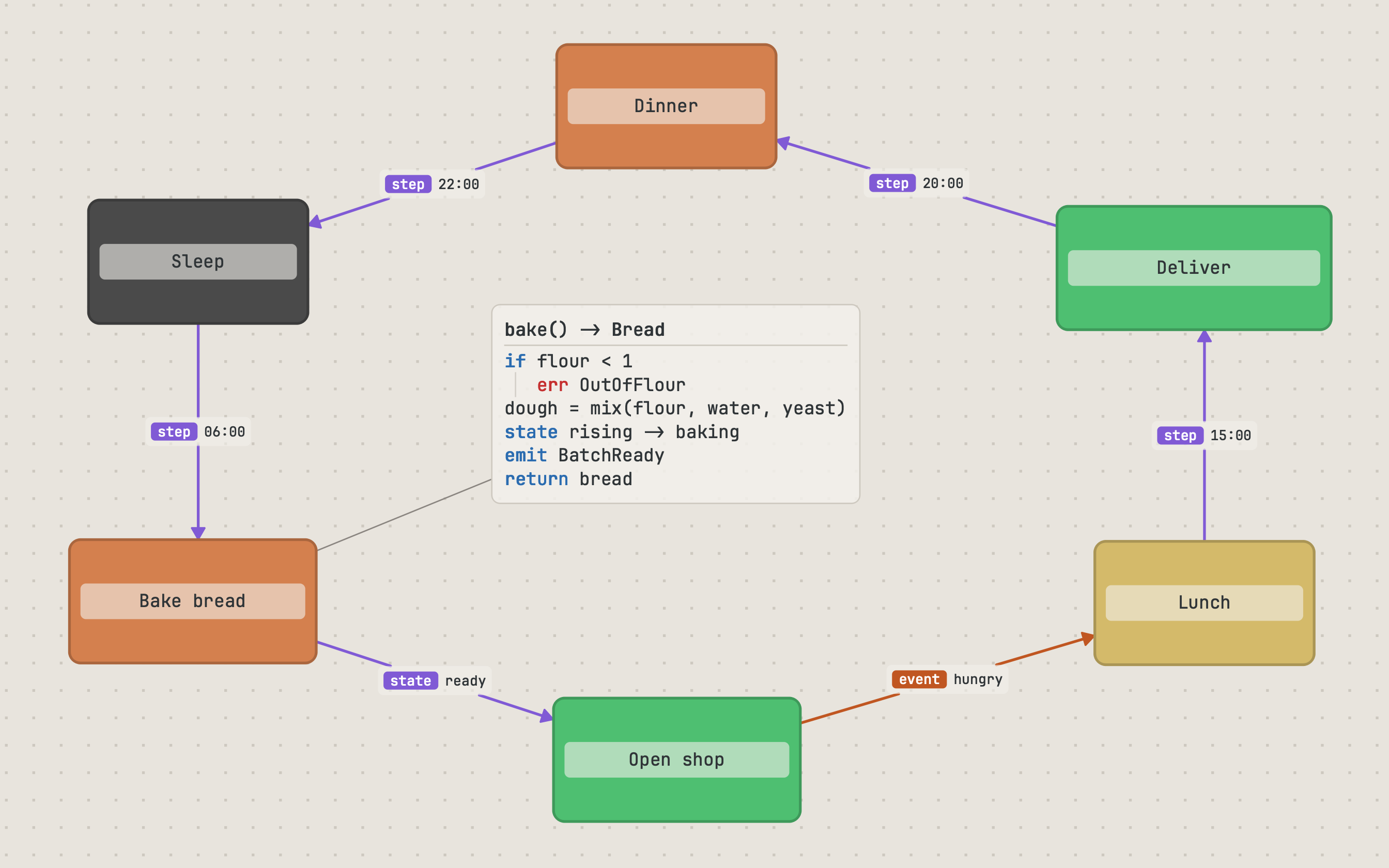
Documentation and feature tour: https://grafli.mistergc.dev
Pair grafli with your AI
grafli isn't just a diagram editor — it's the canvas your coding agent
uses to communicate complex systems back to you. The bundled grafli
skill teaches the agent how to produce idiomatic .grafli files —
proper layouts, semantic edge labels, code-mode notes for
review-oriented diagrams, plus a "plan before you write" loop that
keeps the output focused and readable.
Extract the skill from your installed copy and point your agent at it:
# Save to a file, or pipe straight into the right place for your tool.
grafli skill -o SKILL.md
grafli skill --where        # path of the bundled SKILL.md
grafli skill --help         # install URLs for Claude Code, OpenCode, Codex
| AI tool | Where the skill goes | Docs |
|---|---|---|
| Claude Code | ~/.claude/skills/grafli/SKILL.md |
https://code.claude.com/docs/en/skills |
| OpenCode | ~/.config/opencode/skills/grafli/SKILL.md |
https://opencode.ai/docs/skills |
| Codex CLI | append to ~/.codex/AGENTS.md |
https://agents.md/ |
Once installed, ask your agent to "draw a diagram of …", "visualize the
data flow in this module", or "sketch the OAuth callback as a grafli" —
the skill triggers and produces a .grafli you can open in the
desktop app or render headless via grafli render.
Install
pip install grafli
grafli my-diagram.grafli
grafli                      # no file? opens your scratch board
Requirements: Python 3.12+, PySide6 (Qt 6.7+).
Design philosophy
- Keyboard-first. Modal editing in the spirit of vim — Select, Rect, Text, Connect — composes a small set of keystrokes into rich diagrams.
- Less is more. Three primitives (boxes, arrows, notes) plus visible containment cover the cases that matter, without a menu maze.
- Text for AI, git, humans.
.graflifiles are line-oriented plain text; there are no binary blobs and no cloud dependency.
Capabilities at a glance
- Modal vim-style editing with directional creation (one keystroke spawns a connected neighbor box or note).
- Semantic edge labels — prefixes such as
call:,data:,event:,verify:,risk:render as colored chips and tint their arrow. - Connector routing — straight by default,
!splinefor a curve,!orthofor a right-angle stair that slides clear of boxes in its way. Anchors are derived from the layout rather than stored, so a board renders the same in the app and ingrafli render. - Code-mode notes — minimal pseudocode for review-oriented diagrams: a
bold function signature on the first line, control/effect keywords
(
if,for,call,emit, …) in blue, contract keywords (pre,post,verify,risk, …) in red, and clickable@file:linerefs. - Sketchnote symbols — a curated 30-symbol vocabulary (20 semantic actors
and concepts, 10 emphasis marks) drawn from one hand-editable SVG sheet:
*lightbulbfills a node,*lead:locksits beside the label,*badge:flameoverlays a corner, and*badge:3numbers a sequence (1–99). Picked visually via style mode → i. - Tasks (
T:/TODO:), questions (Q:/QUESTION:, both case-insensitive), and threaded discussions inside notes. - Find and focus — combine these at will:
- Subgraph focus (B) — fade everything not reachable from the selection; cycle direction (incoming / outgoing / both) and depth (1-hop / unlimited).
- Complexity heatmap (A) — color nodes by connectivity to find hot spots.
- Dim connectors (,) / dim notes (Shift+N) — fade arrows or text-notes to 8% opacity to read the rest.
- Minimap (M) — corner overview with boxes, notes, and connector density.
- Jump labels and graph navigation — every visible element is one or two keys away; hold Alt to follow connectors edge by edge.
- Sub-graflis — link any node to a deeper diagram in its own file.
- Bookmarks & flows — save labeled viewpoints (semantic anchors, not pixel
coords) and string them into guided tours: step through, auto-play, present
fullscreen (F5), or export a slide PDF (
grafli export … --flow). Plain text, so an AI can author an explanatory tour through a big graph. - Markdown resources — attach a markdown note to any element and edit it in textli, grafli's full-window Markdown editor (its own project, bundled as a dependency).
- Images as first-class nodes — paste or drag in raster and
.svgfiles (in-tree files are referenced in place, external ones copied into the board's vault), press i to place an SVG mockup that opens in your drawing app, and let the file watcher refresh every external edit live on the board. SVGs render vector-crisp at any zoom and in exports. - Auto-save and external file watching — open a
.graflinext to your editor; changes flow both ways. - Scratch board — start
grafliwith no file and you land on a persistent~/grafli-scratch.grafli, autosaved like any other board, so a quick sketch is still there next time. - Light and dark themes — the same warm paper style in two grounds, switched
live with the sun/moon button or
⌘+Shift+D and remembered across restarts.
%colortokens are semantic, so a board reads correctly in either theme. - Yank as PNG (Y), SVG export (Ctrl+E).
File format
@ box frontend "Frontend" 100,100 160x60 %secondary
@ box backend  "Backend"  320,100 160x60 %primary
@ box db       "Database" 320,240 160x60 %subtle

@ arrow frontend -> backend "REST API"
@ arrow backend  -> db      "data: queries" !dashed

@ note 100,240 "SPA with React"
@ note logic 100,320 """
code:
handleRequest(req) -> Response
pre req.id is set
call validate(req)
emit RequestAccepted(req.id)
return ok  @api/handler.py:42
"""
| Element | Syntax |
|---|---|
| Box | @ box <id> "<label>" <x>,<y> <w>x<h> [color] [^anchor] [~size] [!style] [>parent] |
| Arrow | @ arrow <from> <op> <to> ["label"] [!style] [!routing] [~size] |
| Note | @ note [<id>] <x>,<y> "<text>" [color] [~size] [!style] [>parent] |
Arrow operators: -> right, <- left, <-> both, -- none.
Triple-quoted block notes are supported when a note contains quote characters or spans multiple lines.
Keybindings (selection)
| Key | Action |
|---|---|
| v / n / t / c | Switch mode: Select / Rect / Text / Connect |
Shift+click in n/t mode |
Stay in create mode for rapid placement |
| h j k l | Move selection (vim directions) |
| Ctrl+h/k/l | Create connected box (left/up/right) |
| Alt (hold) | Graph navigation — follow connectors |
| / | Search by label |
| Ctrl+J | Jump mode (all visible items) |
| B / Shift+B | Subgraph focus (cycle direction / toggle depth) |
| , / Shift+N | Dim arrows / dim notes (focus on the rest) |
| Y / Ctrl+E | Yank PNG to clipboard / Export SVG |
| ⌘+Shift+D | Toggle light / dark theme |
| F1 | In-app cheat sheet and text-annotation reference |
The full set is in the in-app F1 dialog and on the documentation site.
Project
- Documentation: https://grafli.mistergc.dev
- Source: https://github.com/MisterGC/grafli
- Issues: https://github.com/MisterGC/grafli/issues
License
MIT
1 maintainer

Metadata
1 maintainer
Release files for grafli 0.10.0
For a detailed explanation of source distributions (sdists) and built distributions (wheels), please see the package formats documentation.
Source distribution (sdist)
| File | Size | Uploaded | |
|---|---|---|---|
| grafli-0.10.0.tar.gz | 4.5 MB | Details |
Built distribution (wheel)
| File | Interpreter | ABI | Platform | Reset |
|---|---|---|---|---|
| grafli-0.10.0-py3-none-any.whl | Python 3 | none | any | Details |
Total release size: 7.7 MB
Release files / grafli-0.10.0.tar.gz
| Download URL | grafli-0.10.0.tar.gz |
|---|---|
| Size | 4.5 MB |
| Tags | Source |
|
SHA-256 checksum How to use checksums |
b4b993a52102b449b0d901ee6203d654339751d6d0f008c798d5abc62632d875
|
|
BLAKE2b-256 checksum How to use checksums |
4bc4d5a032c0a3e7601bb54f3bbfd6dd7a542eb3f1d94bfe83ab35b17100912a
|
| Upload date | |
|
Uploaded using Trusted Publishing? What is trusted publishing? |
Yes |
| Uploaded via |
twine/7.0.0 CPython/3.13.14
|
Provenance
Provenance describes where a file came from. On PyPI, provenance is shared via attestations, which provide a verifiable record of the build or publishing details. View details, limitations and caveats.


PyPI Publish Attestation
PyPI verified that this artifact, at this checksum, originated from the publisher listed below.
Signed by GitHub Actions, verified by PyPI on Aug 15, 2026.
Transparency logRelease files / grafli-0.10.0-py3-none-any.whl
| Download URL | grafli-0.10.0-py3-none-any.whl |
|---|---|
| Size | 3.2 MB |
| Tags | Python 3 |
|
SHA-256 checksum How to use checksums |
f3f183965b8d1d37f29cddf42773bceb3e3bf0053b4066d8d157ce8e3190df4a
|
|
BLAKE2b-256 checksum How to use checksums |
107762aa1c8d654ec3f2ba91381f55a99b1d00d5348296e71f1054aeb49f076b
|
| Upload date | |
|
Uploaded using Trusted Publishing? What is trusted publishing? |
Yes |
| Uploaded via |
twine/7.0.0 CPython/3.13.14
|
Provenance
Provenance describes where a file came from. On PyPI, provenance is shared via attestations, which provide a verifiable record of the build or publishing details. View details, limitations and caveats.
PyPI Publish Attestation
PyPI verified that this artifact, at this checksum, originated from the publisher listed below.
Signed by GitHub Actions, verified by PyPI on Aug 15, 2026.
Transparency log













