
Gram Newton-Schulz: A Fast, Hardware-Aware Newton-Schulz Algorithm for Muon
Authors: Jack Zhang, Noah Amsel, Berlin Chen, Tri Dao
Blogpost: https://dao-ailab.github.io/blog/2026/gram-newton-schulz/
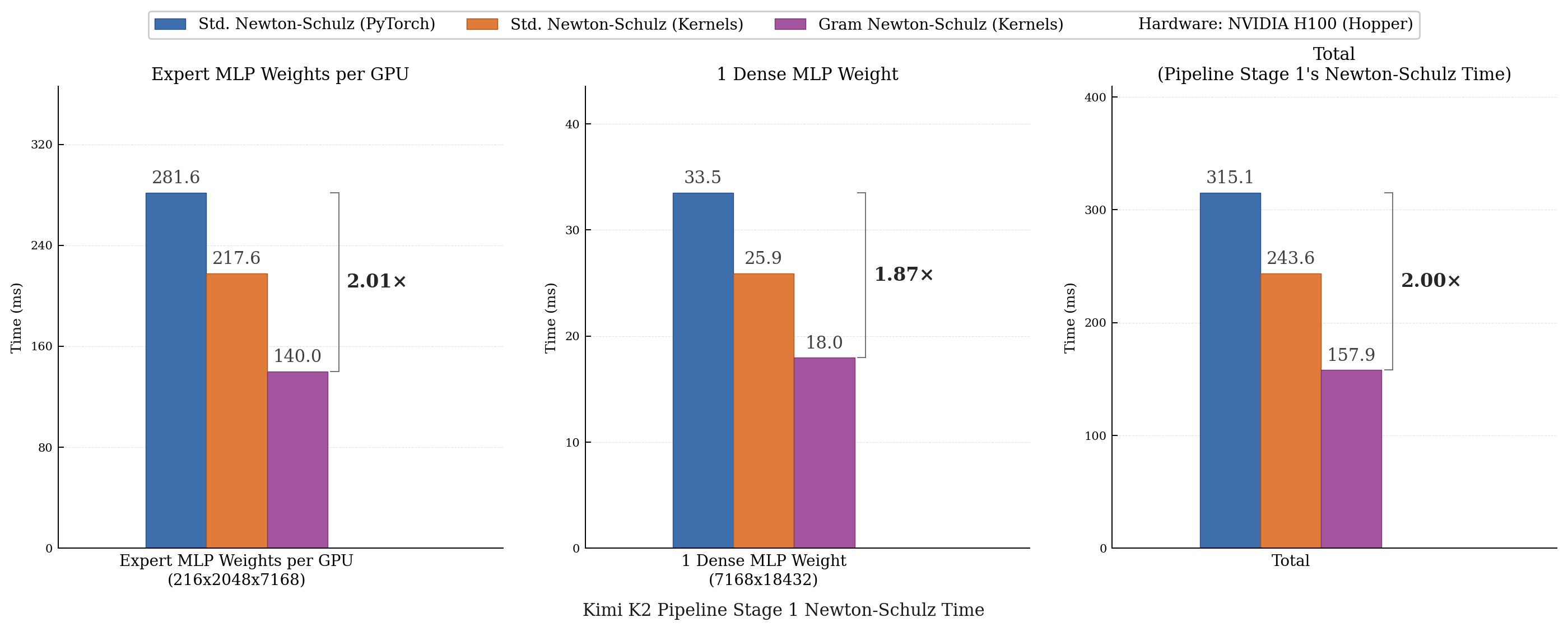
Achieve up to 2x faster Newton-Schulz with Gram Newton-Schulz and symmetric CuTeDSL GEMM kernels!
What you're probably here for:
- Gram Newton-Schulz: https://github.com/Dao-AILab/gram-newton-schulz/blob/main/gram_newton_schulz/gram_newton_schulz.py
- Gram Newton-Schulz Restart Autotune: https://github.com/Dao-AILab/gram-newton-schulz/blob/main/gram_newton_schulz/restart_autotune.py
- Symmetric GEMMs for Hopper and Blackwell in CuTeDSL: https://github.com/Dao-AILab/quack/blob/main/quack/gemm_symmetric.py
About
Gram Newton-Schulz is a hardware-aware algorithm for polar decomposition that is mathematically equivalent to and faster than Newton-Schulz. Polar decomposition is most commonly used in Muon, and Gram Newton-Schulz serves as a direct drop-in for standard Newton-Schulz with no training accuracy tradeoff.
Instead of iterating on the expensive $X \in \mathbb{R}^{n \times m}$ matrix, Gram Newton-Schulz iterates on the small, square, symmetric Gram matrix $XX^\top \in \mathbb{R}^{n \times n}$, lowering FLOPs and enabling more symmetric GEMM kernels.
Gram Newton-Schulz
Input: $X \in \mathbb{R}^{n \times m}$ with $n \leq m$, coefficients ${(a_t, b_t, c_t)}_{t=1}^5$
- $X \gets X / (\|X\|_{F} + \epsilon)$ // Normalize sing vals to $[0, 1]$. $\epsilon = 10^{-7}$
- $X \gets \texttt{float16}(X)$ // Cast to half precision for speed
- If $m < n$: $X \gets X^\top$ // Trick to make $XX^\top$ cheaper
- $R_0 \gets XX^\top$
- $Q_0 \gets I$
- For $t = 1, \ldots, 5$:
- If $t = 3$: // Restart to stabilize
- $X \gets Q_2 X$
- $R_2 \gets XX^\top$
- $Q_2 \gets I$
- $Z_t \gets b_t R_{t-1} + c_t R_{t-1}^2$
- $Q_t \gets Q_{t-1} Z_t + a_t Q_{t-1}$
- $RZ_t \gets R_{t-1} Z_t + a_t R_{t-1}$
- $R_t \gets Z_t (RZ_t) + a_t (RZ_t)$
- $X \gets Q_4 X$
- If $m < n$: $X \gets X^\top$ // Undo trick
- Return $X$
Installation
Requirements:
- NVIDIA Hopper (H100) or Blackwell (B200/B300) GPU
- PyTorch 2.7.1+
- CUDA 12.9+
Install PyTorch first, then install from PyPI with pip install gram-newton-schulz --no-build-isolation or from source:
pip install . --no-build-isolation
--no-build-isolation is required so that pip uses your existing CUDA-enabled PyTorch instead of installing torch-cpu in an isolated build environment.
This will install:
- gram-newton-schulz (this package)
- nvidia-cutlass-dsl 4.5.2
- quack-kernels 0.5.0
Usage
WARNING: torch.compile is known to sometimes have issues with Blackwell, TORCH_COMPILE_DISABLE=1 to disable torch.compile.
Gram Newton-Schulz
from gram_newton_schulz import GramNewtonSchulz, POLAR_EXPRESS_COEFFICIENTS

gram_NS = GramNewtonSchulz(
            ns_coefficients=POLAR_EXPRESS_COEFFICIENTS,
            gram_newton_schulz_reset_iterations=[2]
        )
result = gram_NS(X)
GramNewtonSchulz is a callable function that is initialized with ns_coefficients (List of List of floats) and a list of gram_newton_schulz_reset_iterations immediately after which to restart Gram Newton-Schulz's iterative loop (List of ints) for stability. For example, [2] means a restart occurs after the 2nd iteration and [2,4] means a restart occurs after the 2nd iteration and then after the 4th.
To find the best num-restarts restart location(s) for a set of coefficients, run
python -m gram_newton_schulz.autotune_restarts --num-restarts 1 --coefs "4.0848,-6.8946,2.9270;3.9505,-6.3029,2.6377;3.7418,-5.5913,2.3037;2.8769,-3.1427,1.2046;2.8366,-3.0525,1.2012"
For 5 steps of Newton-Schulz, we recommend num-restarts = 1 for maximum speed while maintaining numerical stability. However, users who experience numerical instability or use more than 5 steps should consider using more restarts.
Muon
The Muon class supports an auxiliary scalar optimizer that updates all non-Muon parameters, custom functions that split model weights for orthogonalization, and Gram Newton-Schulz with autotuned restart locations.
import torch
from torch.optim import AdamW
from gram_newton_schulz import Muon, YOU_COEFFICIENTS

qkv_params = []
regular_2d_params = []
scalar_params = []

for name, param in model.named_parameters():
    if 'qkv_weight' in name:
      qkv_params.append(param)
    elif param.ndim >= 2:
      regular_2d_params.append(param)
    else:
      scalar_params.append(param)

scalar_optimizer = AdamW(
    scalar_params,
    lr=1e-3,
    betas=(0.9, 0.95),
    weight_decay=0.1,
)

def qkv_split_fn(param: torch.Tensor):
    """
    Split Wqkv into [Wq, Wk, Wv].

    Assumes param has shape (3*hidden_dim, hidden_dim) where the first dimension
    is concatenated [Q, K, V] weights.
    """
    hidden_dim = param.size(1)
    Wq = param[:hidden_dim, :]
    Wk = param[hidden_dim:2*hidden_dim, :]
    Wv = param[2*hidden_dim:, :]
    return [Wq, Wk, Wv]

def qkv_recombine_fn(splits):
    """Recombine [Wq, Wk, Wv] back into Wqkv."""
    return torch.cat(splits, dim=0)

muon_param_groups = []

muon_param_groups.append({
    'params': qkv_params,
    'param_split_fn': qkv_split_fn,
    'param_recombine_fn': qkv_recombine_fn,
    'lr': 3e-3,
    'weight_decay': 0.1,
    'momentum': 0.95,
})

muon_param_groups.append({
    'params': regular_2d_params,
    'lr': 3e-3,
    'weight_decay': 0.1,
    'momentum': 0.95,
})

optimizer = Muon(
    params=muon_param_groups,
    scalar_optimizer=scalar_optimizer,
    lr=3e-3,
    weight_decay=0.1,
    momentum=0.95,
    nesterov=True,
    adjust_lr='rms_norm',
    ns_algorithm='gram_newton_schulz',
    ns_use_kernels=True,
    ns_coefficients=YOU_COEFFICIENTS,
    gram_newton_schulz_num_restarts=1,
)
See example.py for a full training example.
Citation
If you use this codebase, or otherwise find our work valuable, please cite Gram Newton-Schulz:
@misc{GramNewtonSchulz,
  title   = {Gram Newton-Schulz},
  author  = {Jack Zhang and Noah Amsel and Berlin Chen and Tri Dao},
  year    = {2026},
  url     = {https://dao-ailab.github.io/blog/2026/gram-newton-schulz/}
}
1 maintainer

Release files for gram-newton-schulz 0.1.6
For a detailed explanation of source distributions (sdists) and built distributions (wheels), please see the package formats documentation.
Source distribution (sdist)
| File | Size | Uploaded | |
|---|---|---|---|
| gram_newton_schulz-0.1.6.tar.gz | 18.3 kB | Details |
Built distribution (wheel)
| File | Interpreter | ABI | Platform | Reset |
|---|---|---|---|---|
| gram_newton_schulz-0.1.6-py3-none-any.whl | Python 3 | none | any | Details |
Total release size: 37.5 kB
Release files / gram_newton_schulz-0.1.6.tar.gz
| Download URL | gram_newton_schulz-0.1.6.tar.gz |
|---|---|
| Size | 18.3 kB |
| Tags | Source |
|
SHA-256 checksum How to use checksums |
6e13ab3000845968c78ef7b5be882c2eba4b3f36eedc74ca3f2e38acdecce21b
|
|
BLAKE2b-256 checksum How to use checksums |
5fd55a6863847b504aac78ea7f0501fd2d25c766d452e2ab4d94f7a714c17823
|
| Upload date | |
|
Uploaded using Trusted Publishing? What is trusted publishing? |
No |
| Uploaded via |
twine/6.2.0 CPython/3.10.20
|
Release files / gram_newton_schulz-0.1.6-py3-none-any.whl
| Download URL | gram_newton_schulz-0.1.6-py3-none-any.whl |
|---|---|
| Size | 19.1 kB |
| Tags | Python 3 |
|
SHA-256 checksum How to use checksums |
5608c834bb0989d640eb1608bd2a9f1a4a908c46c9887847de98fa383b759c1c
|
|
BLAKE2b-256 checksum How to use checksums |
a6625de8e75b44e7f7980b140fdaf145880e3232a97a1a14d0fc0dc264dd70cc
|
| Upload date | |
|
Uploaded using Trusted Publishing? What is trusted publishing? |
No |
| Uploaded via |
twine/6.2.0 CPython/3.10.20
|














