
A graph-based transliteration tool

Project description







A graph-based transliteration tool that lets you convert the symbols of one language or script to those of another using rules that you define.
Free software: MIT license
Documentation: https://graphtransliterator.readthedocs.io
Repository: https://github.com/seanpue/graphtransliterator
Transliteration… What? Why?
Moving text or data from one script or encoding to another is a common problem:
Many languages are written in multiple scripts, and many people can only read one of them. Moving between them can be a complex but necessary task in order to make texts accessible.
The identification of names and locations, as well as machine translation, benefit from transliteration.
Library systems often require metadata be in particular forms of romanization in addition to the original script.
Linguists need to move between different methods of phonetic transcription.
Documents in legacy fonts must now be converted to contemporary Unicode ones.
Complex-script languages are frequently approached in natural language processing and in digital humanities research through transliteration, as it provides disambiguating information about pronunciation, morphological boundaries, and unwritten elements not present in the original script.
Graph Transliterator abstracts transliteration, offering an “easy reading” method for developing transliterators that does not require writing a complex program. It also contains bundled transliterators that are rigorously tested. These can be expanded to handle many transliteration tasks.
Contributions are very welcome!
Features
Provides a transliteration tool that can be configured to convert the tokens of an input string into an output string using:
user-defined types of input tokens and token classes
transliteration rules based on:
a sequence of input tokens
specific input tokens that precede or follow the token sequence
classes of input tokens preceding or following specified tokens
“on match” rules for output to be inserted between transliteration rules involving particular token classes
defined rules for whitespace, including its optional consolidation
Can be setup using:
Automatically orders rules by the number of tokens in a transliteration rule
Checks for ambiguity in transliteration rules
Can provide details about each transliteration rule match
Allows optional matching of all possible rules in a particular location
Permits pruning of rules with certain productions
Validates, as well as serializes to and deserializes from JSON and Python data types, using accessible marshmallow schemas
Provides full support for Unicode, including Unicode character names in the “easy reading” YAML format
Constructs and uses a directed tree and performs a best-first search to find the most specific transliteration rule in a given context
Includes bundled transliterators that you can add to hat check for full test coverage of the nodes and edges of the internal graph and any “on match” rules
Includes a command-line interface to perform transliteration and other tasks
Sample Code and Graph
from graphtransliterator import GraphTransliterator
GraphTransliterator.from_yaml("""
    tokens:
      h: [consonant]
      i: [vowel]
      " ": [whitespace]
    rules:
      h: \N{LATIN SMALL LETTER TURNED I}
      i: \N{LATIN SMALL LETTER TURNED H}
      <whitespace> i: \N{LATIN CAPITAL LETTER TURNED H}
      (<whitespace> h) i: \N{LATIN SMALL LETTER TURNED H}!
    onmatch_rules:
      - <whitespace> + <consonant>: ¡
    whitespace:
      default: " "
      consolidate: true
      token_class: whitespace
    metadata:
      title: "Upside Down Greeting Transliterator"
      version: "1.0.0"
""").transliterate("hi")
'¡ᴉɥ!'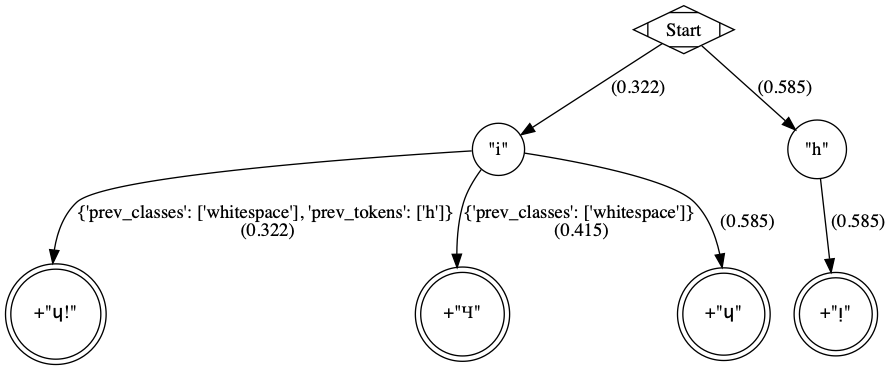
Sample directed tree created by Graph Transliterator. The rule nodes are in double circles, and token nodes are single circles. The numbers are the cost of the particular edge, and less costly edges are searched first. Previous token classes and previous tokens that must be present are found as constraints on the edges incident to the terminal leaf rule nodes.
Get It Now
$ pip install -U graphtransliteratorCitation
To cite Graph Transliterator, please use:
Pue, A. Sean (2019). Graph Transliterator: A graph-based transliteration tool. Journal of Open Source Software, 4(44), 1717, https://doi.org/10.21105/joss.01717
Release history Release notifications | RSS feed


Download files
Download the file for your platform. If you're not sure which to choose, learn more about installing packages.
Source Distribution
Built Distribution
Filter files by name, interpreter, ABI, and platform.
If you're not sure about the file name format, learn more about wheel file names.
Copy a direct link to the current filters
File details
Details for the file graphtransliterator-1.3.2.tar.gz.
File metadata
- Download URL: graphtransliterator-1.3.2.tar.gz
- Upload date:
- Size: 32.4 kB
- Tags: Source
- Uploaded using Trusted Publishing? No
- Uploaded via: poetry/2.4.1 CPython/3.12.3 Linux/6.17.0-1018-azure
File hashes
| Algorithm | Hash digest | |
|---|---|---|
| SHA256 |
af5db58b02c2c2f8fdd498c8509aeab56e70ed23b95a7f5f52d184a544e22670
|
|
| MD5 |
e6514601aa1b5c604db4ed163aba6d01
|
|
| BLAKE2b-256 |
d257b1f3bec0f351553089ef879bc1cdceca7caca1fa2d7806dbee1decdc7c43
|
File details
Details for the file graphtransliterator-1.3.2-py3-none-any.whl.
File metadata
- Download URL: graphtransliterator-1.3.2-py3-none-any.whl
- Upload date:
- Size: 39.7 kB
- Tags: Python 3
- Uploaded using Trusted Publishing? No
- Uploaded via: poetry/2.4.1 CPython/3.12.3 Linux/6.17.0-1018-azure
File hashes
| Algorithm | Hash digest | |
|---|---|---|
| SHA256 |
a0ca4428d4ab5af136eeb81eaa9e21fd20a32898b85e005f256c1afe48b7f269
|
|
| MD5 |
e19b86135e111da39d2c54b6200c1c55
|
|
| BLAKE2b-256 |
a0ba3a38a057c228b6affaac4835fba993c74ebde3b9f054c8ae2f44c8e33b4f
|






