
Give your AI tools architecture-aware reasoning. Build a knowledge graph from any codebase — dependency analysis, impact analysis, governed AI answers with confidence scores. Works with Claude Code, Cursor, VS Code Copilot. 14 LLM backends, fully offline capable.
Verified details
These details have been verified by PyPIProject links
GitHub Statistics
Maintainers

Project description
GraQle — query your architecture, prove your AI's decisions
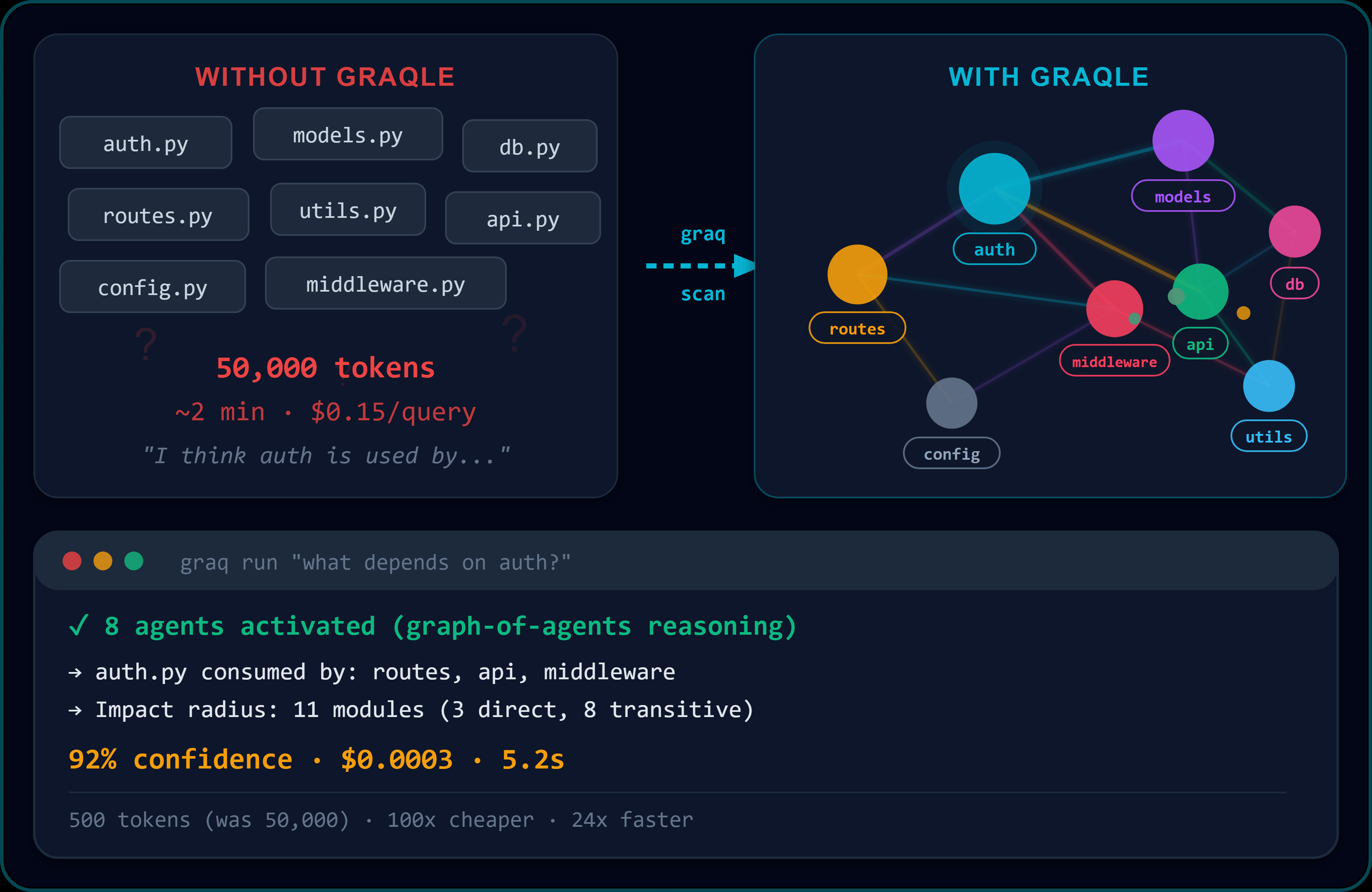
Index any codebase as a knowledge graph so AI agents reason about architecture instead of grepping files. Every decision they make — at build-time or in production — gets a cryptographic receipt anchored to a public transparency log. One Python package, two surfaces: dev intelligence for engineers, runtime governance for regulators.




pip install graqle
Website · Quickstart · Runtime governance · EU AI Act docs · Changelog · VS Code Extension
Two surfaces, one substrate
| Build-time (dev intelligence) | Run-time (production governance) | |
|---|---|---|
| Governs | how your AI writes code | what your deployed AI decides |
| Trigger | a code change | a production decision (loan, hiring, triage, …) |
| Emits | reviewed, impact-analysed, audit-logged changes | a tamper-evident, third-party-verifiable record per decision |
| Built on | typed code knowledge graph + multi-agent reasoning | Layer 5 cryptographic substrate (RFC 8785 JCS → RFC 6962 Merkle → ed25519 → Sigstore Rekor) |
| Status | GA | GA — attest() capture (v0.60.0) + FastAPI middleware / @governed (v0.61.0) + continuous anchoring worker graqle govern serve (v0.62.0) |
Build-time governance proves we hold ourselves to this standard — GraQle is developed through its own governance. Run-time governance lets you hold your deployed AI to the same cryptographically-verifiable standard. Same substrate, both surfaces.
90-second quickstart
Build-time — query your codebase as a graph
# 1. Scan any codebase into a knowledge graph
graq scan repo .
# → typed graph: functions, classes, modules, imports, calls — full architecture mapped in seconds

# 2. Ask GraQle to audit it
graq run "find every authentication bypass risk"
# → Graph-of-agents activates across relevant nodes
# → Traces cross-file attack chains the LLM alone cannot see
# → Returns: confidence score + evidence trail + active nodes + tool hints

# 3. Fix it — GraQle shows exact before/after for each file (governed)

# 4. Teach it back — the graph never forgets
graq learn "cancel endpoint must require admin auth"
# → Lesson persists. Every future audit activates this rule.
Run-time — attach governance to a deployed AI in one line
from graqle.governance.runtime import GovernedRuntime

gov = GovernedRuntime(salt="your-deploy-salt")

def score_application(app):
    decision = model.predict(app)                # your deployed AI, untouched
    gov.attest(                                  # <-- the one added line
        domain="loan", model_id="credit-risk-v4",
        inputs={"applicant_ref": gov.pseudonymize_ref(app.id)},   # PII-safe
        output={"decision": decision.label, "reason_code": decision.reason},
    )
    return decision
Each call produces a durable, PII-safe governed record. Its leaf hash is computed with the same shipped primitive the build-time batcher uses, so a runtime record is byte-compatible with the cryptographic substrate (RFC 8785 JCS → RFC 6962 Merkle → ed25519 → Sigstore Rekor). Capture is out-of-band — it adds 0 ms to your write path.
See examples/runtime_attest_production_decisions.py and examples/runtime_govern_serve_anchoring.py.
Run it as a continuous service (v0.62.0)
# Long-lived anchoring worker — flushes batches + drains the replay queue every tick
graqle govern serve --config graqle.yaml

# Cron-style one-shot tick (single flush + single replay-drain)
graqle govern serve --once

# Article-72-style monitoring snapshot — JSON suitable for any external monitor
graqle govern health
# → { "running": true, "ticks": 47, "records_anchored": 3120, "replay_queue_depth": 0, ... }
The serve loop writes .graqle/govern.health.json atomically after every tick — pipe it into your existing monitoring (Prometheus, Datadog, an oncall dashboard, a simple curl).
Independently verifiable, by anyone. Committed batches anchor to the public Sigstore Rekor transparency log. Any third party can verify a record — auditor, regulator, counter-party — without access to your infrastructure, or ours. Verification doesn't depend on Quantamix staying online.
💰 Token economics — a worked case study
A 4-developer team on a 50,000-node enterprise codebase burns ~$40 per developer per day on flat-file AI-coding tokens in 2026. The same team using GraQle's substrate:
| Scenario | Annual (4 devs) | Saving |
|---|---|---|
| Flat-file baseline (Cursor / Claude Code default) | $42,240 | — |
| GraQle + frontier API (Sonnet 4.6) | $19,874 | −53% |
| GraQle + local SLM (Year 2, 90% migrated) | $5,174 | −88% |
Every number is auditable. Every assumption is sourced (Anthropic pricing, Cursor power-user data, Microsoft's killed Claude Code pilot, NCBI biomedical-KG research showing >50% token reduction, Qwen3-Coder SWE-Bench benchmarks). Scale linearly to a 40-developer enterprise: ~$224k/year saved in Year 1, ~$371k/year in Year 2.
Plus six things Cursor / Copilot / Codex do not offer at any subscription tier: cryptographic audit trail, EU AI Act Article 26 readiness (€15M fine exposure), patent-defensible substrate, survive-vendor-disappearance, multi-agent governance, public Sigstore Rekor anchoring.
→ Read the full case study — math, sources, and a bash snippet to re-run it on your own team's numbers.
What is GraQle
A governance-led multi-agent reasoning system for code, with a built-in cryptographic audit substrate for the AI you ship to production. Scan any codebase into a persistent knowledge graph. Every module becomes a reasoning agent. Agents decompose, debate, and synthesize answers with clearance-level governance. Every change — and every production decision — is impact-analysed, gate-checked, and cryptographically committed.
AI assistants see files. GraQle sees architecture. That's why it catches the cross-file bugs they can't, and why its audit trail survives every level of tampering.
Built for engineering teams who need:
- Cross-file reasoning — impact analysis, lesson recall, dependency-aware refactor (the kind of thing that requires reading 5 files; we read the graph instead).
- Auditable AI decisions — confidence scores, evidence trails, tamper-evident logs anchored to a public transparency log.
- EU AI Act–aligned behaviour out of the box — for European customers, regulated deployments, and analyst-grade due diligence.
- Model-agnostic operation — 14 LLM backends, offline-capable via Ollama, runs entirely on your machine by default. No telemetry. Code stays on your machine.
How it works
- Scan → AST + dependency analysis builds a typed graph (functions, classes, modules, imports, calls).
- Activate → A pre-reasoning safety layer scores each node for relevance, confidence, and risk before the LLM runs.
- Reason → Multiple agents debate. Outputs carry
confidence,graph_health,active_nodes, evidence pointers. - Gate → Governance gates (CG-01..CG-20) intercept write-class operations. Plans required. Risks surfaced. Trade-secret + path-traversal hardening enforced.
- Audit → Every tool call is logged to
.graqle/governance/audit/with redaction + secret scanning. - Commit → For runtime decisions, the audit record gets canonicalised (RFC 8785), Merkle-rooted (RFC 6962), ed25519-signed, and anchored to the public Sigstore Rekor log.
- Learn → Lessons become weighted edges. The graph remembers across sessions, teams, and git operations.
The pipeline runs through five named phases — ANCHOR → ACTIVATE → GENERATE → VALIDATE → COMMIT. Each phase is governance-gated, evidence-attached, and audit-logged.
API defaults: confidence_threshold=0.65 (refusal floor), gate_threshold=0.60 (gate-status floor). Both are configurable per-call.
Model agnostic
Anthropic · OpenAI · AWS Bedrock · Ollama · Gemini · Groq · DeepSeek · Together · Mistral · OpenRouter · Fireworks · Cohere · Azure OpenAI · custom HTTP.
# graqle.yaml — smart task routing
backends:
  reasoning:  anthropic/claude-sonnet-4-6   # quality work
  embedding:  bedrock/titan-v2              # cheap + fast
  summaries:  ollama/llama3                 # local + free
Runs fully offline with Ollama. No telemetry. Code stays on your machine. API keys stay in your local graqle.yaml.
Governance gate — drop-in for Claude Code, Cursor, VS Code
graq gate-install # one-time, project-local
Routes every native write/edit/bash through GraQle's governance gates. Plans required for risky changes. Trade-secret scanning on git commits. Path-traversal hardening on subprocess capture. CG-01 through CG-20 — all on, all auditable.
MCP-first
// .mcp/config.json
{ "graqle": { "command": "graq", "args": ["mcp", "serve"] } }
76+ MCP tools — every operation Claude Code / Cursor / VS Code Copilot needs is exposed as a governed tool with confidence scores, evidence pointers, and audit-trail entries. No prompt engineering, no glue code.
🇪🇺 EU AI Act–aligned
Articles 6, 9, 12, 13, 14, 15, 25, 50 become applicable on 2026-08-02. GraQle gives your high-risk AI system the signals, audit trail, and disclosure primitives it needs — so the parts of your compliance file you can quote from us, you can quote today.
# One switch flips every EU-AI-Act-aware subsystem at once
graq compliance switch on        # shell snippet → eval to enable
graq compliance switch status    # what's actually armed, in one envelope
graq compliance switch off       # symmetric disable

# Per-subsystem CLI surface
graq compliance status                                      # legacy + new subsystems block
graq compliance export --since 2026-08-01 --sha256-sidecar  # Article 12 evidence
graq compliance baseline-doc generate --output baseline.jsonl  # Q16.1 baseline
graq compliance periodic-assessment run --period-start ... --period-end ...  # Q16.3
graq compliance feedback record --rating 5 --note "..."     # Q16.5 observation
graq compliance eur-lex-check                               # weekly drift guard
| Article | What GraQle provides | Where |
|---|---|---|
| Art 4 — AI literacy | Integration guidance for providers + deployers | Art 4 doc |
| Art 9 — Risk management | Periodic-assessment artefacts with auto-remediation triggers | graq compliance periodic-assessment run |
| Art 11 — Technical documentation | Dated, content-addressed baseline document at deployment | graq compliance baseline-doc generate |
| Art 12 — Record-keeping | JSONL audit export + SHA-256 tamper-detection sidecar | graq compliance export |
| Art 13 — Deployer transparency | graph_health + confidence on every reasoning envelope |
every graq_reason call |
| Art 14 — Human oversight | Confidence-gated refusal of auto-apply + claim-limits vocabulary | GRAQLE_EU_AI_ACT_MODE=on + graq edit/apply/auto |
| Art 15 — Accuracy / robustness / cybersecurity | 17 named defences + 7 measurable claims | graq compliance status --include-robustness |
| Art 25 — Value-chain responsibility | Intended-purpose declarations + PCT (Proof-Claims Token) x-ai-eu extension (11 fields) |
Art 25 doc + graq pct issue/validate |
| Art 43 — Conformity assessment | Substrate evidence inputs (baseline-doc + audit log + periodic assessment + robustness + Article 14 gate) for the deployer's Annex VI internal-control file | Art 43 doc |
| Art 50 — Transparency for users | Auto banner + ai_disclosure machine field |
GRAQLE_EU_AI_ACT_MODE=on |
| Art 72 — Post-market monitoring | graqle govern serve continuous anchoring + graqle govern health snapshot |
v0.62.0 |
Three substantive non-claims kept legally clean:
- GraQle is NOT itself a high-risk AI system (no Annex III category applies).
- GraQle is NOT a GPAI provider under Article 51 (we use third-party LLMs, we don't place one on the EU market).
- We provide signals, audit primitives, and conformity-assessment evidence inputs. We never say compliant or certified. The discipline is enforced in code —
TestNonClaimsInvariantsblocks any release that introduces acompliant/certifiedfield.
→ Full Article-by-Article mapping in docs/compliance/eu-ai-act/
Contributions welcome on the compliance docs
The EU AI Act docs are deliberately open to contribution — corrections, translations (DE/FR/ES/IT have highest demand), compliance gap reports from deployers building Annex VI internal-control files, and cross-framework mappings (NIST AI RMF, ISO 42001, ENISA, etc.) are all welcome. See CONTRIBUTING-COMPLIANCE.md for the contribution guide, the vocabulary discipline the CI enforces, and what kinds of changes go through which review path.
Security & integrity
| No telemetry | GraQle does not phone home, collect usage data, or send analytics. |
| No code upload | Source never leaves your machine unless you opt in to cloud sync. |
| Secret scanning | 200+ regex patterns + Shannon-entropy detection + AST scan on every output candidate. |
| PyPI Trusted Publishing | OIDC-only — no long-lived API tokens in our pipeline. |
| Sigstore signatures | Every wheel signed by our GitHub Actions identity. Verify with graq trustctl verify --version <v>. |
| CycloneDX SBOM | Attached to every GitHub Release. |
.pth-file guard |
Publish pipeline rejects any wheel containing .pth files (the LiteLLM-class attack vector). |
| Reproducible builds | SOURCE_DATE_EPOCH-pinned, rebuild from tagged source and compare checksums. |
| Survive-disappearance | Production audit records anchor to public Sigstore Rekor — verifiable even if Quantamix disappears. |
→ Full disclosure policy: SECURITY.md · Report vulnerabilities to security@quantamixsolutions.com
What's new in v0.62.0
Runtime Governance Layer R2 — continuous anchoring as a service. The cryptographic substrate (v0.59.0) and the attest() capture path (v0.60.0) and FastAPI middleware (v0.61.0) were always meant to be operated continuously in production. v0.62.0 lands that operator surface as first-class CLI:
graqle govern serve— long-lived anchoring worker over the shipped Layer 5 Committer + LocalReplayQueue. Fail-closed precondition (refusesattestation.security.fail_open_on_anchor_error=true), bounded shutdown, atomic health snapshots.graqle govern serve --once— cron-style single-tick mode for environments where a long-lived service isn't appropriate.graqle govern health— reads.graqle/govern.health.jsonand prints the Article-72-style monitoring snapshot as JSON. Pipes cleanly into any external monitor.WorkerHealth.to_dict()— programmatic Article 72 surface for libraries:running,ticks,records_committed,records_anchored,backfill_count,replay_queue_depth,seconds_since_last_anchor,last_error_type,status_counts.- Comprehensively tested — full statement+branch coverage on the worker, end-to-end dogfooded from a clean PyPI wheel, CI matrix across Linux + Windows on Python 3.10 / 3.11 / 3.12.
Recent releases
- v0.61.0 — Runtime R1: FastAPI middleware +
@governeddecorator. Drop-in governance for any FastAPI app. - v0.60.0 — Runtime R0 Mode A:
GovernedRuntime.attest()and PII-safepseudonymize_ref(). - v0.59.0 — Layer 5 cryptographic substrate GA: RFC 8785 canonicalisation + RFC 6962 Merkle commitments + ed25519 signatures + Sigstore Rekor anchoring + local replay queue.
- v0.58.0 — EU AI Act Wave 3 substrate (Article 43 conformity-assessment evidence) + OPSF PCT alignment +
GRAQLE_WORKTREE_ROOTfor parallel-worktree dev. - v0.57.0 — EU AI Act Wave 2:
graq compliance switchsingle entry-point, Article 14 confidence-gated refusal, claim-limits vocabulary, EUR-Lex drift guard.
Pricing
| Tier | What you get |
|---|---|
| Free | Local-only graphs · core SDK · governance gates · EU AI Act surfaces · attest() runtime · govern serve anchoring (self-hosted, anchored to public Rekor) |
| Pro — $19/mo | Cloud sync · priority models · hosted Rekor relay |
| Team — $29/dev/mo | Shared KGs · team-wide lessons · audit log retention · SOC 2 evidence pack |
| Enterprise | On-prem · custom backends · dedicated support · regulated-deployment SLAs · contact us |
The free tier is real: the verifier, the runtime attestation path, and the continuous anchoring worker are all in the open-source SDK. Paid tiers add operational scale, team features, and a managed Rekor relay.
Patent & license
Core methods are patent-pending: EP26167849.4 (filed 2026-03-25), EP26162901.8 (CIP), and EP26166054.2 (CogniGraph divisional). The SDK source is fully auditable under the GraQle License — see LICENSE. Reimplementation of the patented methods outside this SDK requires a separate patent license.
→ github.com/quantamixsol/graqle — issues, discussions, contributions welcome.
GraQle is built by Quantamix Solutions. Query your architecture. Prove your AI's decisions.
Project details
Verified details
These details have been verified by PyPIProject links
GitHub Statistics
Maintainers
Release history Release notifications | RSS feed


Download files
Download the file for your platform. If you're not sure which to choose, learn more about installing packages.
Source Distribution
Built Distribution
Filter files by name, interpreter, ABI, and platform.
If you're not sure about the file name format, learn more about wheel file names.
Copy a direct link to the current filters
File details
Details for the file graqle-0.62.2.tar.gz.
File metadata
- Download URL: graqle-0.62.2.tar.gz
- Upload date:
- Size: 4.8 MB
- Tags: Source
- Uploaded using Trusted Publishing? Yes
- Uploaded via: twine/6.1.0 CPython/3.13.12
File hashes
| Algorithm | Hash digest | |
|---|---|---|
| SHA256 |
68306d4c0ce8eb8a6f618172547d203a704e2cb569c7f33b0eb08b66c6aab49c
|
|
| MD5 |
0918830ef8f644a7a714275076e8eb70
|
|
| BLAKE2b-256 |
eafa66bc373490c7f114e4e2839b4e066709375c0bd1a8d61067f6d5a8a909e2
|
Provenance
The following attestation bundles were made for graqle-0.62.2.tar.gz:
Publisher:
ci.yml on quantamixsol/graqle
-
Statement:
-
Statement type:
https://in-toto.io/Statement/v1 -
Predicate type:
https://docs.pypi.org/attestations/publish/v1 -
Subject name:
graqle-0.62.2.tar.gz -
Subject digest:
68306d4c0ce8eb8a6f618172547d203a704e2cb569c7f33b0eb08b66c6aab49c - Sigstore transparency entry: 1640654188
- Sigstore integration time:
-
Permalink:
quantamixsol/graqle@e1f833844c36cd2913eeebce6a7129a03e1d809e -
Branch / Tag:
refs/tags/v0.62.2 - Owner: https://github.com/quantamixsol
-
Access:
public
-
Token Issuer:
https://token.actions.githubusercontent.com -
Runner Environment:
github-hosted -
Publication workflow:
ci.yml@e1f833844c36cd2913eeebce6a7129a03e1d809e -
Trigger Event:
push
-
Statement type:
File details
Details for the file graqle-0.62.2-py3-none-any.whl.
File metadata
- Download URL: graqle-0.62.2-py3-none-any.whl
- Upload date:
- Size: 2.2 MB
- Tags: Python 3
- Uploaded using Trusted Publishing? Yes
- Uploaded via: twine/6.1.0 CPython/3.13.12
File hashes
| Algorithm | Hash digest | |
|---|---|---|
| SHA256 |
225a07df9b90c31e272f91a6b9e5530d9be510ad9a3942298ca748cc543843cc
|
|
| MD5 |
e2998f8904c6fffb13e0fbcfe3da0418
|
|
| BLAKE2b-256 |
90c208519887fb3140d2af7137c32f2ea8ab09900d315740cf14b7d5a42a99b7
|
Provenance
The following attestation bundles were made for graqle-0.62.2-py3-none-any.whl:
Publisher:
ci.yml on quantamixsol/graqle
-
Statement:
-
Statement type:
https://in-toto.io/Statement/v1 -
Predicate type:
https://docs.pypi.org/attestations/publish/v1 -
Subject name:
graqle-0.62.2-py3-none-any.whl -
Subject digest:
225a07df9b90c31e272f91a6b9e5530d9be510ad9a3942298ca748cc543843cc - Sigstore transparency entry: 1640654295
- Sigstore integration time:
-
Permalink:
quantamixsol/graqle@e1f833844c36cd2913eeebce6a7129a03e1d809e -
Branch / Tag:
refs/tags/v0.62.2 - Owner: https://github.com/quantamixsol
-
Access:
public
-
Token Issuer:
https://token.actions.githubusercontent.com -
Runner Environment:
github-hosted -
Publication workflow:
ci.yml@e1f833844c36cd2913eeebce6a7129a03e1d809e -
Trigger Event:
push
-
Statement type:






