







A zero-dependency, standards-anchored AI security toolkit that any developer or security reviewer can run in seconds — in the IDE, in CI, or from the terminal.
🔌 MCP-native. Grey Panda secures MCP and ships as an MCP server — wire it into Claude Code, Cursor, Windsurf, or VS Code with one command and review code without leaving your editor. Jump to setup ↓
👋 Not a developer? Start with the ELI5 — a plain-English explainer for non-technical readers & leaders (no jargon).
Deterministic by design — no LLM in the loop. Same code, same verdict, every run; fully offline, private, and free. Your CI gate never flakes and your source never leaves your machine.
ELI5 (non-technical) · Quick start · The bundle · How it works · Standards · In your IDE · Honest limits · Contributing
"Stop trying to build a model that cannot be fooled. Build the system around it, so that when the model is fooled — and it will be — nothing important breaks."
Grey Panda makes the secure path the easy path for anyone building LLM-powered, agentic, or Model Context Protocol (MCP) features — from a solo indie developer to an enterprise AppSec team.
⚡ Quick start
pip install grey-panda        # pure Python, zero dependencies
gp scan .                     # scan your repo — real findings, beautiful report
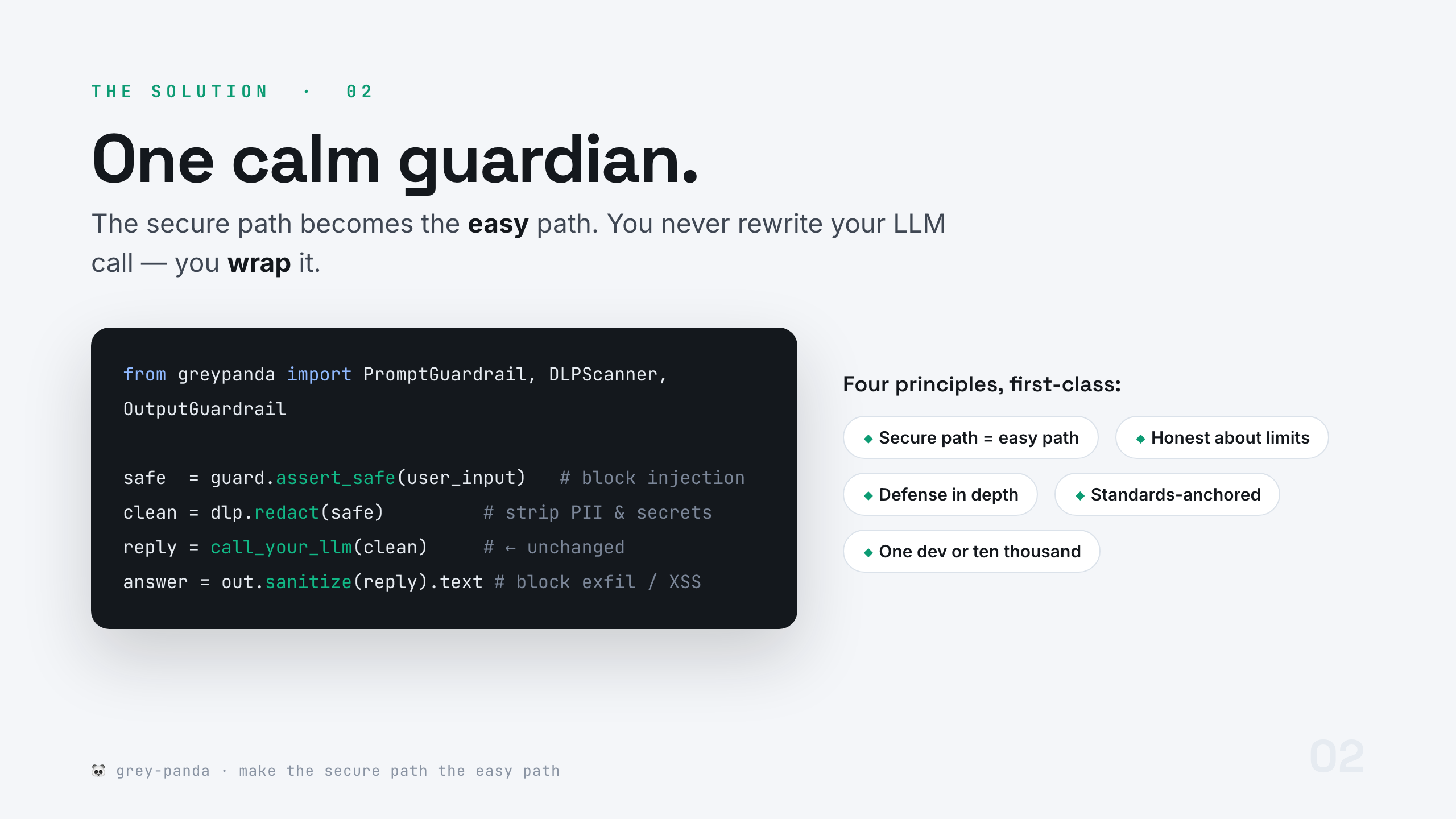
Add drop-in guardrails to an existing LLM call in under two minutes — you never rewrite the call, you wrap it:
from greypanda import PromptGuardrail, DLPScanner, OutputGuardrail

guard, dlp, out = PromptGuardrail(), DLPScanner(), OutputGuardrail()

safe   = guard.assert_safe(user_input)        # block known injection + strip invisible Unicode
clean  = dlp.redact(safe)                       # remove PII & secrets before the model sees them
reply  = call_your_llm(clean)                   # ← your existing call, unchanged
answer = out.sanitize(reply).sanitized_text     # XSS-safe by default (HTML-escapes model output)
🎯 Why this exists
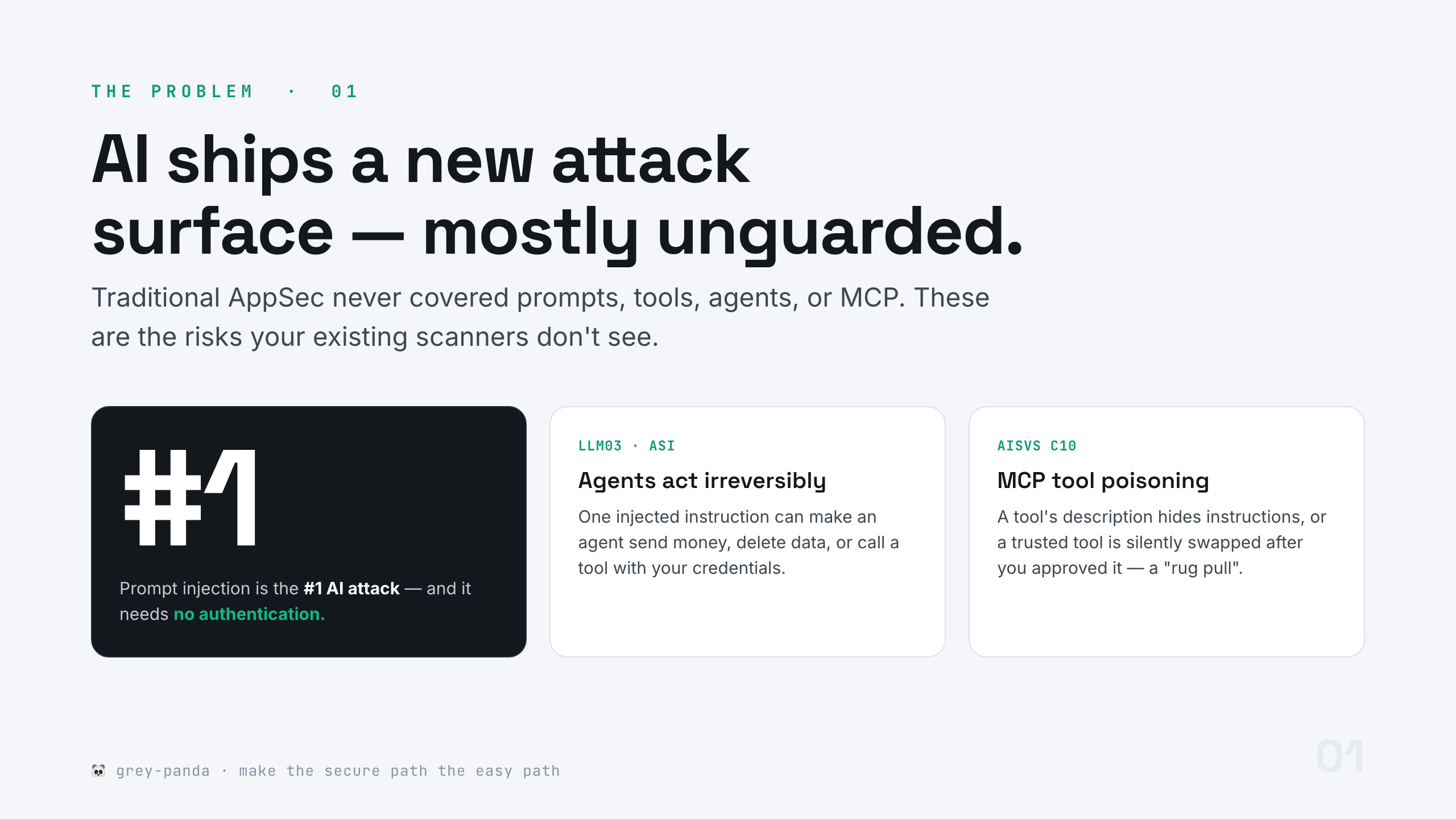
Prompt injection is the #1 AI attack pattern and it needs no authentication (OWASP LLM01). Agentic systems can take an irreversible action from a single injected instruction. And MCP has opened a whole new surface — tool poisoning and rug pulls. Your existing AppSec tools don't see any of it.
🐼 The idea: one calm guardian
Grey Panda keeps two rare qualities as non-negotiable: intellectual honesty (a whole doc on what it can and cannot do) and standards-anchoring (every rule cites an OWASP ID). No neon-hacker theatre — just controls that are a joy to adopt.
📦 What's in the bundle
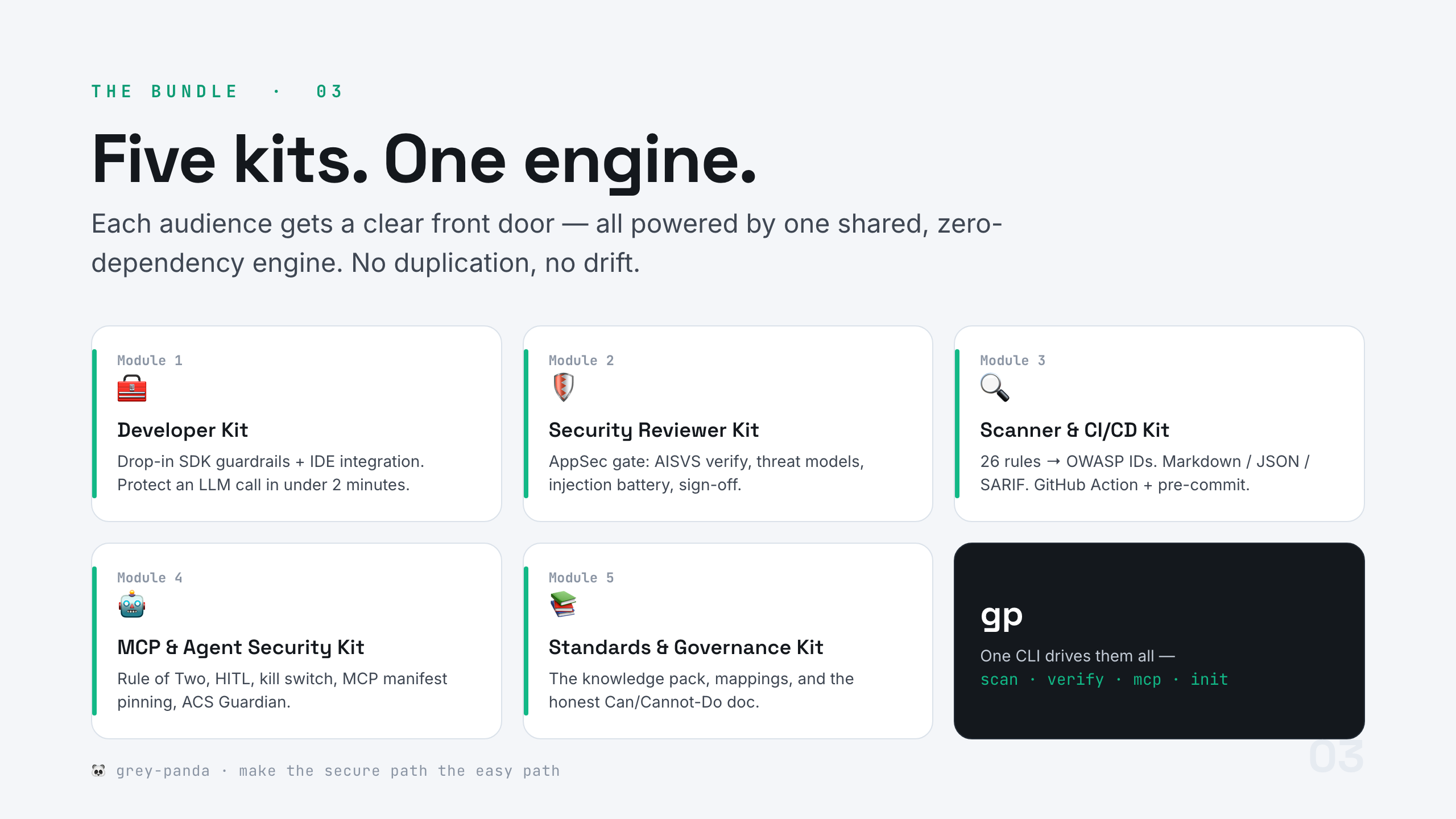
Five audience-facing module kits, all powered by one shared, zero-dependency engine:
| Kit | For | Start here |
|---|---|---|
| 🧰 Module 1 — Developer Kit | Building AI features | Drop-in SDK + IDE integration |
| 🛡️ Module 2 — Security Reviewer Kit | Reviewing / gating | AISVS verify, threat models, sign-off |
| 🔍 Module 3 — Scanner & CI/CD Kit | Platform / DevOps | 26 rules, SARIF, GitHub Action |
| 🤖 Module 4 — MCP & Agent Security Kit | Agents & MCP | Rule of Two, HITL, manifest pinning, ACS |
| 📚 Module 5 — Standards & Governance Kit | Everyone / compliance | Knowledge pack, mappings, Can/Cannot-Do |
⚙️ How it works
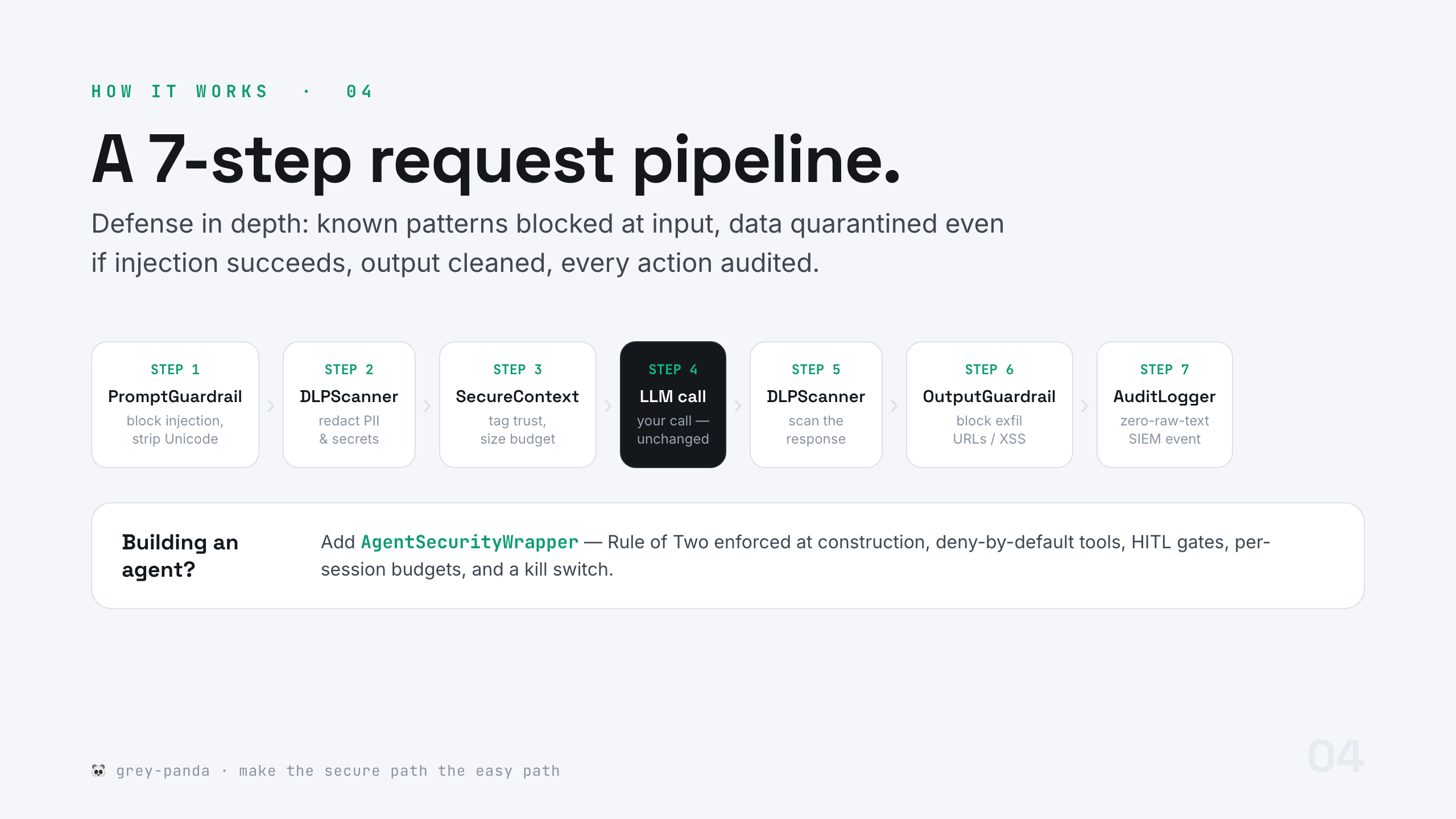
Defense in depth, not prevention theatre. Full walkthrough: HOW-TO-add-guardrails · architecture: docs/ARCHITECTURE.md.
🔐 Standards-anchored
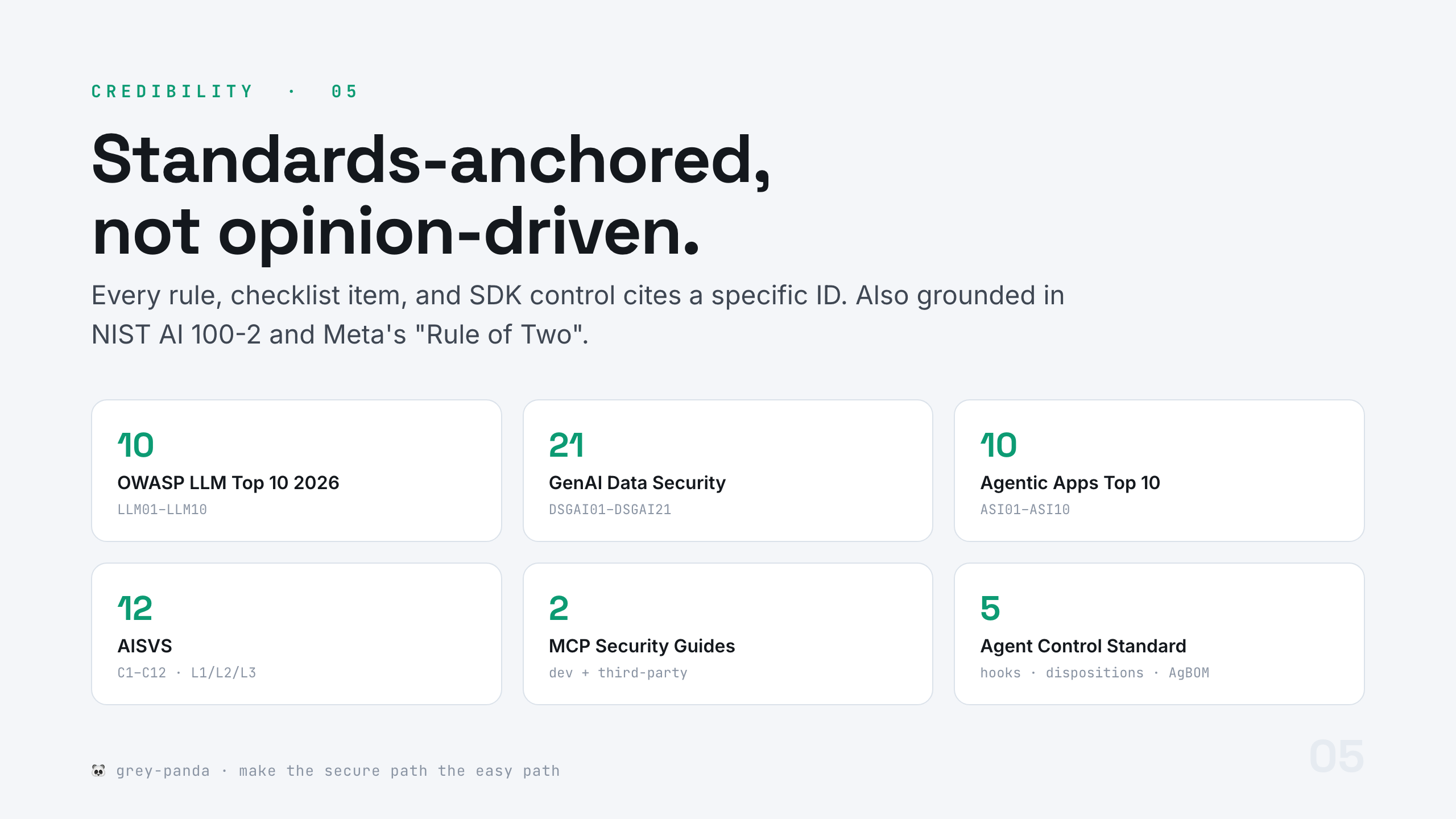
Every rule, checklist item, and SDK control cites a specific ID. Explore any control from the CLI:
gp standards LLM01:2026      # explain a control + its Grey Panda fix
gp standards                 # list every standard and control ID
Full mapping tables: Module 5 → mappings/.
✅ Proof
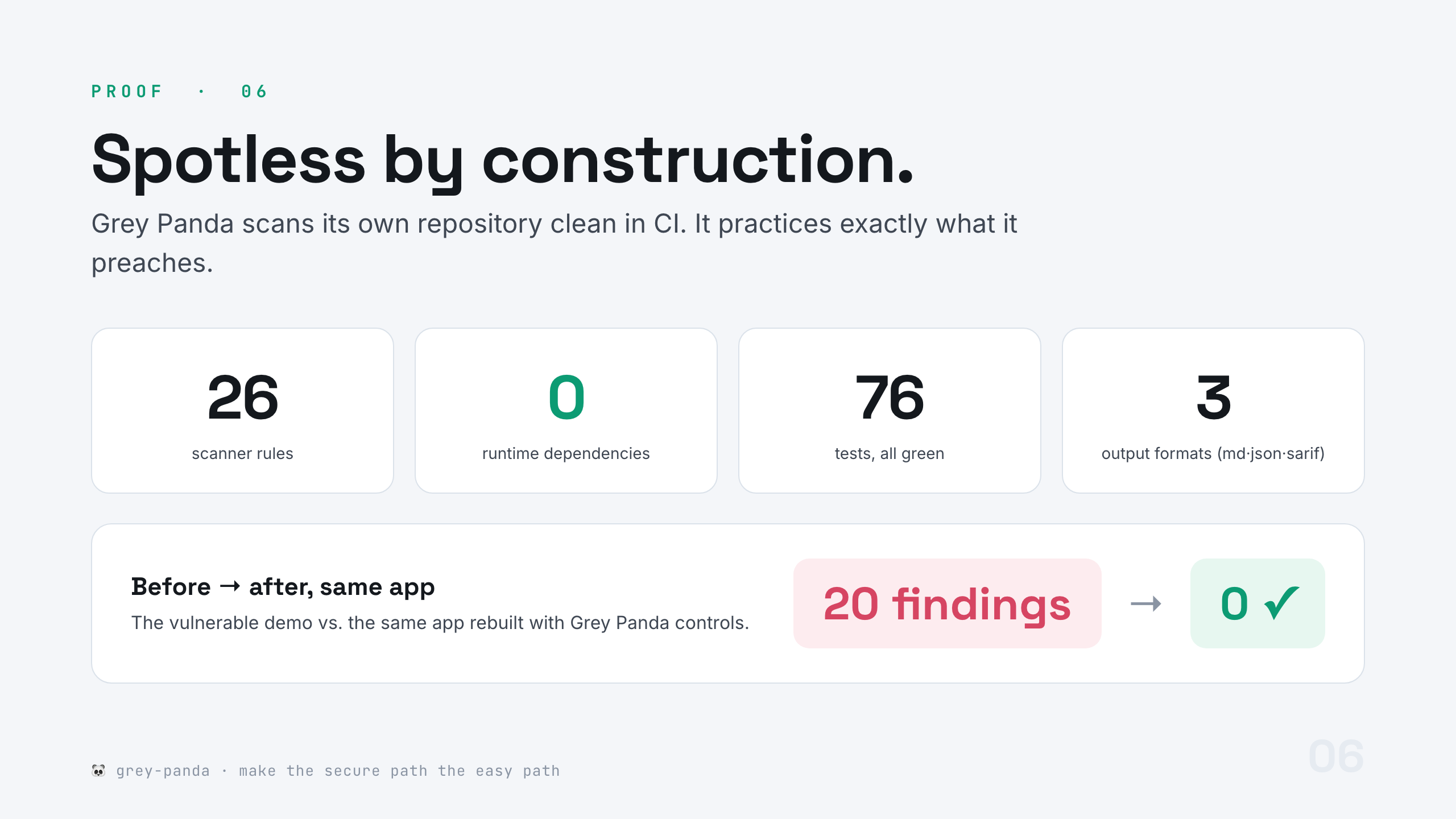
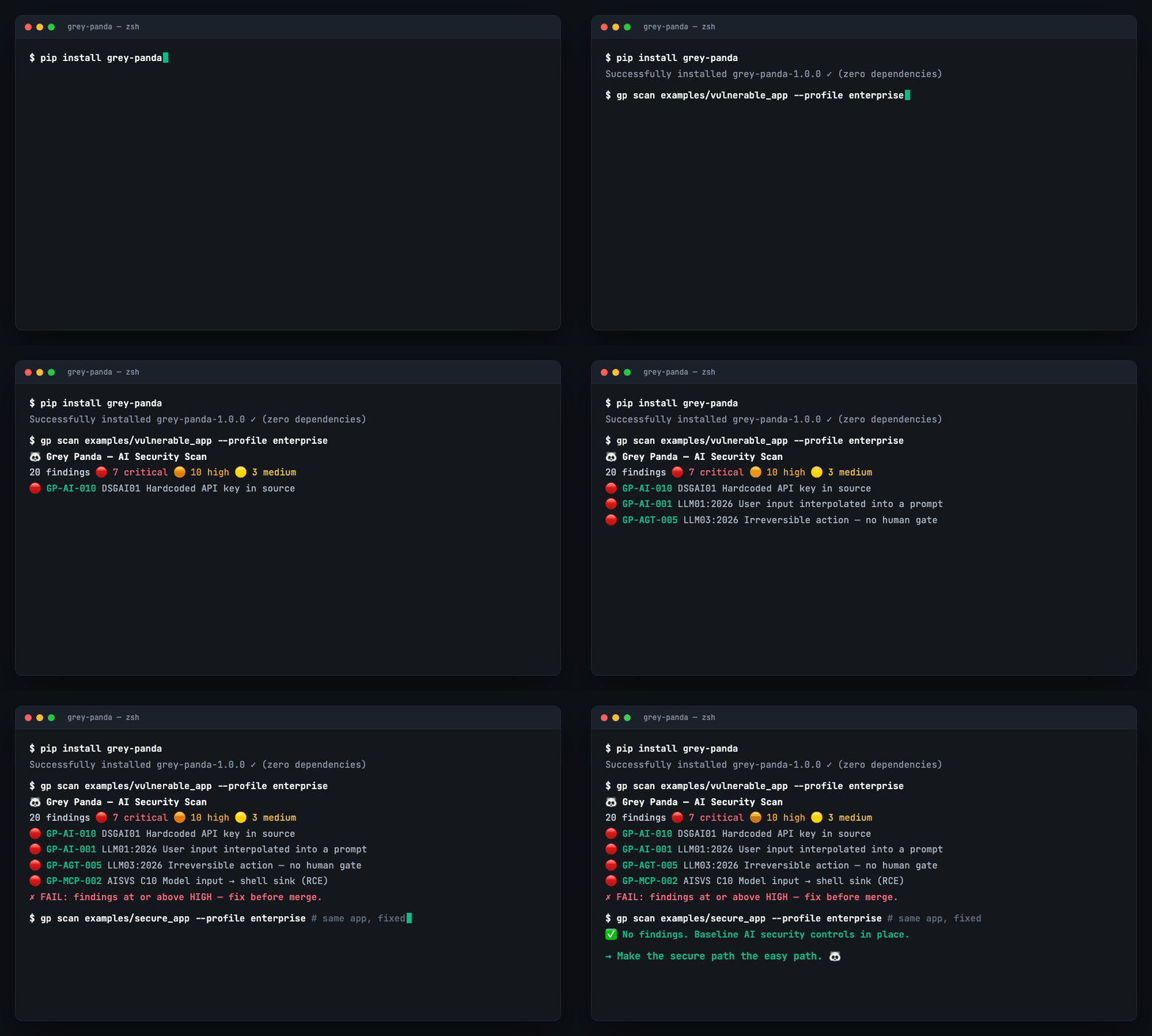
See the before/after for yourself — the same app, insecure vs. rebuilt with Grey Panda controls:
gp scan examples/vulnerable_app --profile enterprise    # 🔴 findings
gp scan examples/secure_app     --profile enterprise    # ✅ clean
👥 For everyone
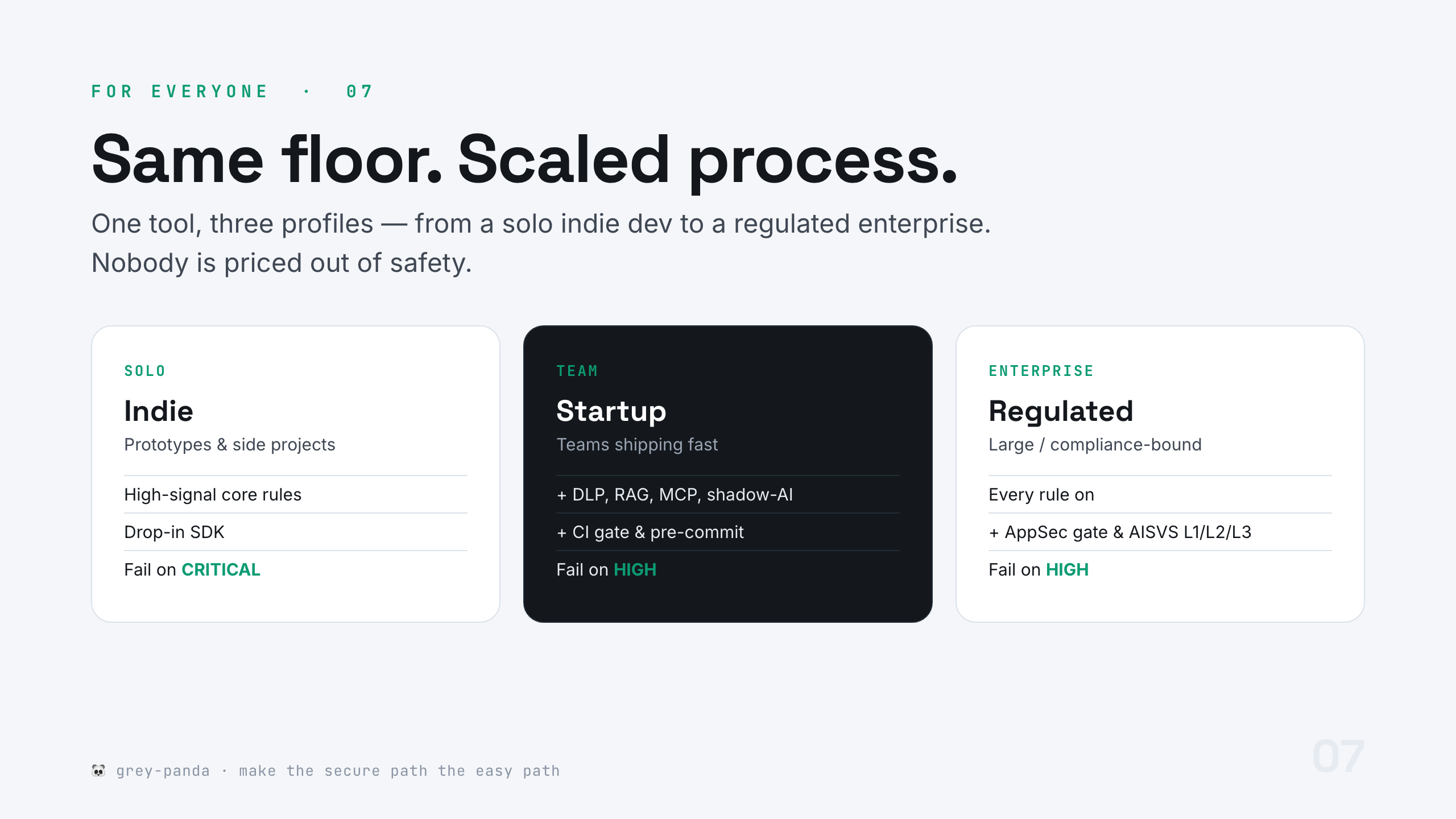
gp scan . --profile solo          # high-signal core, fail on CRITICAL
gp init  . --profile team         # scaffold config + GitHub Action + pre-commit
gp verify . --level 2             # AISVS Level 2 verification report
More: Module 1 → PROFILES.
🚀 Get started
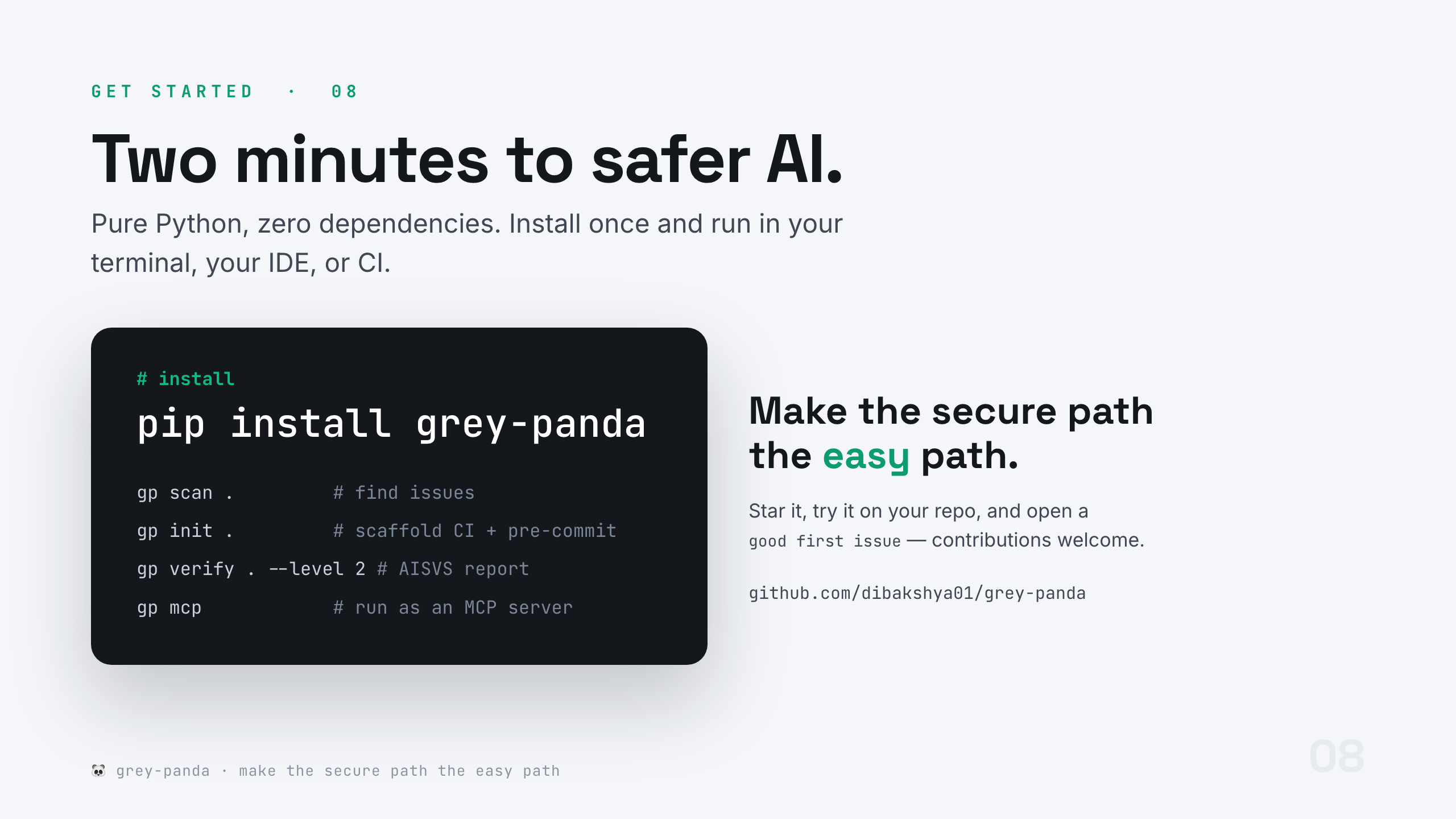
pip install grey-panda           # from PyPI
pipx install grey-panda          # isolated CLI
uvx grey-panda scan .            # zero-install run
| Command | Does |
|---|---|
gp scan [path] |
Scan for AI/agent/MCP issues (--profile, --format md/json/sarif, --fail-on) |
gp init [path] |
Scaffold config, GitHub Action, and pre-commit into a repo |
gp verify [path] |
AISVS Level 1/2/3 verification report |
gp checklist |
Print the AI security checklist |
gp standards [id] |
List or explain standards / control IDs |
gp agbom <agent> |
Emit an Agent Bill of Materials |
gp mcp |
Run Grey Panda as an MCP server (stdio) |
gp doctor |
Environment self-check + honest-limits pointer |
🤝 In your IDE
Grey Panda secures MCP — and ships as an MCP server, so Claude Code, Cursor, Windsurf, or VS Code can call it while you code. One command wires it into Claude Code:
claude mcp add grey-panda -- gp mcp
Cursor / Windsurf / VS Code use a tiny config file — see the how-to. The server is deterministic: the model in your IDE does the reasoning, Grey Panda hands back reproducible, OWASP-cited findings.
Then ask your assistant "review this file with grey panda", "are we AISVS Level 2 ready?", or "explain LLM01:2026". It exposes six tools — scan, review-snippet, verify, explain-risk, list-standards, checklist. Details: Module 1 → HOW-TO-use-in-your-ide and Module 4 → HOW-TO-run-the-mcp-server.
🧭 Honest about limits
Grey Panda is a strong floor, not a ceiling. Pattern matching cannot stop all prompt injection; regex DLP is language-specific; static analysis has false positives and negatives. We ship a whole document — with a confidence level and failure condition for every capability: WHAT_IT_CAN_AND_CANNOT_DO.md. Read it before you rely on the tool.
🌱 Contributing
Adding a scanner rule is editing one dataclass with a bad + good example — see CONTRIBUTING.md and Module 3 → HOW-TO-write-a-rule. Everyone is welcome under our Code of Conduct. Found a vulnerability in Grey Panda itself? See SECURITY.md.
Build from source:
git clone https://github.com/dibakshya01/grey-panda && cd grey-panda
pip install -e ".[dev]"
python -m unittest discover -s tests        # zero-dependency test suite
gp scan . --profile enterprise --fail-on HIGH   # Grey Panda scans itself, clean
📄 License
Apache-2.0. Standards cited are the property of their respective authors (see NOTICE). OWASP® is a registered trademark of the OWASP Foundation; Grey Panda is an independent, community project and is not affiliated with or endorsed by OWASP.
🐼 Grey Panda — make the secure path the easy path.
1 maintainer

Metadata
1 maintainer
Release files for grey-panda 1.0.7
For a detailed explanation of source distributions (sdists) and built distributions (wheels), please see the package formats documentation.
Source distribution (sdist)
| File | Size | Uploaded | Provenance | Actions |
|---|---|---|---|---|
| grey_panda-1.0.7.tar.gz | 126.9 kB | Without provenance | Details for grey_panda-1.0.7.tar.gz |
Built distribution (wheel)
| File | Interpreter | ABI | Platform | Actions Reset |
|---|---|---|---|---|
| grey_panda-1.0.7-py3-none-any.whl | Python 3 | none | any | Details for grey_panda-1.0.7-py3-none-any.whl |
Total release size: 207.3 kB
Release files / grey_panda-1.0.7.tar.gz
| Download URL | grey_panda-1.0.7.tar.gz |
|---|---|
| Size | 126.9 kB |
| Tags | Source |
|
SHA-256 checksum How to use checksums |
e101c58fb7bf982e0d66bba8185a5b60fb19cd1a17140357c2a05111a995568f
|
|
BLAKE2b-256 checksum How to use checksums |
b945ebbf8460a3c3778e1a4b55591e76ddf4d40837be60a7e6b091f7a9d96b31
|
| Upload date | |
|
Uploaded using Trusted Publishing? What is trusted publishing? |
No |
| Uploaded via |
twine/6.2.0 CPython/3.9.6
|
Release files / grey_panda-1.0.7-py3-none-any.whl
| Download URL | grey_panda-1.0.7-py3-none-any.whl |
|---|---|
| Size | 80.4 kB |
| Tags | Python 3 |
|
SHA-256 checksum How to use checksums |
6ac873e582436c8524cbacbe4e6a0f2f0211fe6cb7f8939dbfba287baf50693c
|
|
BLAKE2b-256 checksum How to use checksums |
ee4416002a899e082ab1f8686b5c24315594fb92619cede69dc051285d6bc149
|
| Upload date | |
|
Uploaded using Trusted Publishing? What is trusted publishing? |
No |
| Uploaded via |
twine/6.2.0 CPython/3.9.6
|
Security for grey-panda 1.0.7
Provenance
Provenance describes where a file came from. On PyPI, provenance is shared via attestations, which provide a verifiable record of the build or publishing details. View details, limitations and caveats.
No provenance found
None of the files in this release were uploaded with provenance metadata.
A note on package security
PyPI is a repository for distributing packages, not a service for auditing them. While third-party security researchers and our staff do their best to detect and remove malicious packages, PyPI cannot guarantee the quality, security or suitability of any given package.
To learn more about protecting yourself from malicious actors, visit our package security documentation.














