

groundgate
LLMs propose facts. groundgate decides which ones you can trust.
The problem
LLMs extract most values from a document correctly, but not all. In the benchmark below, 4,233 of 4,350 extractions were correct. Each of the other 117, about 1 in 37, cited a real place in the document. So nothing on the page tells you which values are wrong.
Grounded extraction tools check that the quoted text exists in the source. They do not check the value that you store: a scale word that the model dropped, a sign it missed, or the limit from the next line.
The solution
groundgate is a deterministic admission layer for LLM document extraction. It checks each proposed value against the text that the value cites, with fixed rules and no model in the decision. You give it a document, a schema, and the facts an extractor proposed. Every fact comes back with one of three outcomes:
- admitted: every check passed;
- needs_verification: nothing failed, but a person should look, and the decision says where;
- rejected: a check failed, with a stable reason code.
Every run writes a receipt with hashes of every input. Anyone can re-derive it byte for byte.
The goal of the project, and the two numbers that judge each rule, are in CONSTITUTION.md.
Why this exists
Grounded extraction tools check that the quoted text exists in the source. They don't check
the value you store. LangExtract is the clearest example, and a good tool. It aligns each
extraction_text to the source and reports MATCH_EXACT, MATCH_FUZZY and so on. It never
looks at the attributes that hold the typed value.
A real case from the benchmark: IRS Publication 560 states two limits a few lines apart.
The limit on elective deferrals, other than catch-up contributions, is $23,500 for 2025 ...
The limit on salary reduction contributions, other than catch-up contributions, is $16,500 for 2025 ...
The first is the 401(k) limit. The second is the SIMPLE plan limit. Asked for the 2025 elective
deferral limit, 4 of 14 runs proposed both, and LangExtract marked both quotes MATCH_EXACT.
groundgate sent both to a person with CONFLICTING_CANDIDATES, because two proposals for one
field disagree. In Publication 15-B, one model stored "$1 million" as 1, also an exact match, and
groundgate flagged it SCALE_WORD.
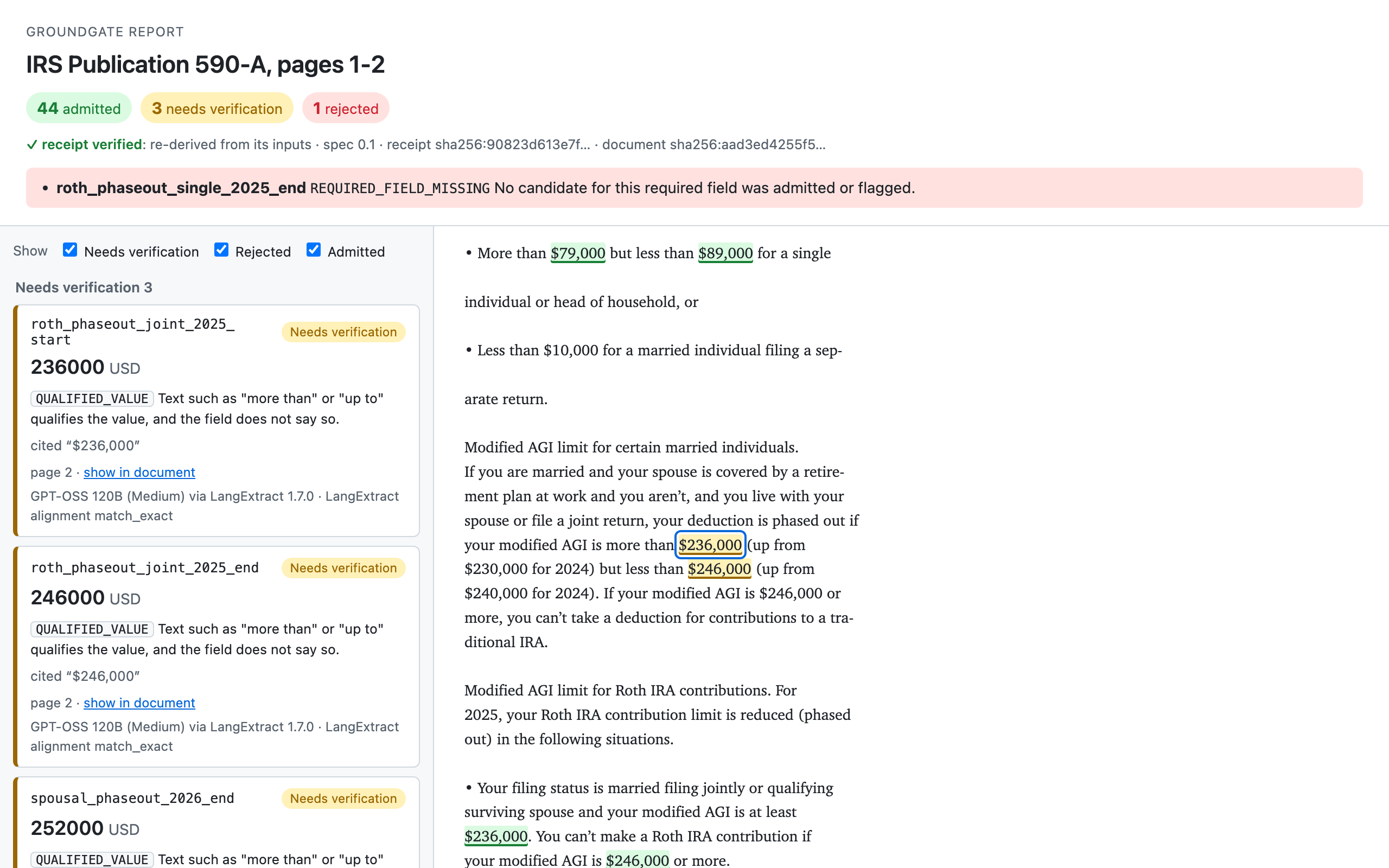
The same gap shows up on the document I used while building the library. I ran Gemini 3.6 Flash and GPT-OSS 120B through
LangExtract on two pages of IRS Publication 590-A. LangExtract aligned all 48 extractions as
MATCH_EXACT. groundgate then:
- rejected Gemini's reading of a misprinted
$252,0000as 2,520,000; - flagged three GPT-OSS facts: two took a Roth IRA limit from the spousal-deduction sentence, where the numbers match but the text says "more than" where the field says "at least", and one is a right value next to an "or more" that the schema did not declare;
- listed a required field both models missed;
- admitted 44 facts, all with the right value.
One admitted fact still cites the wrong rule. Its number is correct, its comparator matches, and no span check can tell. I checked every decision by hand; the details are in examples/irs-590a, which is also the page in the screenshot.
I measured the gap on purpose before writing the library. On 51 facts from two public-domain
government documents, LangExtract's strictest setting (MATCH_EXACT only) accepted 100% of
planted value and unit errors whose quote was correct. groundgate caught all of them and
rejected none of the correct facts. The method and full tables are in
spikes/m0_5.
LangExtract locates the text. groundgate checks the number in it.
Quickstart
pip install groundgate
import groundgate as gg

text = "The IRA contribution limit is $7,000. The deduction phases out above $79,000."
schema = {
    "fields": {
        "ira_limit": {"type": "integer", "unit": "USD"},
        "phaseout_start": {"type": "integer", "unit": "USD"},
    }
}


def cite(field, value, quote):
    """A candidate whose evidence is a quote: groundgate finds it in the text."""
    return {"field": field, "value": value, "unit": "USD", "evidence": [{"text": quote}]}


candidates = [
    cite("ira_limit", "7000", "$7,000"),
    cite("ira_limit", "70000", "$7,000"),  # a digit too many
    cite("phaseout_start", "79000", "$79,000"),  # "above" is not "at"
]
receipt = gg.admit(text, schema, candidates)
for d in receipt.decisions:
    print(f"{d.outcome:<19} {d.field:<15} {d.value:<6} {' '.join(d.codes)}".rstrip())

print(gg.verify(receipt.to_dict(), text, schema, candidates).ok)
rejected            ira_limit       70000  VALUE_NOT_IN_EVIDENCE
needs_verification  phaseout_start  79000  QUALIFIED_VALUE
admitted            ira_limit       7000
True
The core has no dependencies. groundgate[pdf] adds pdfminer.six for PDF text,
groundgate[ocr] adds pypdfium2 to OCR scanned pages with the tesseract program (opt-in), and
groundgate[langextract] installs LangExtract. docs/ has a guide to writing a
schema, a how-to guide for each task, and the reference. An evidence item can also give UTF-8 byte offsets
(start, end), and it can cite the sign, scale, unit, field or key of the value (spec 0.5).
With your own model
gg.extractor_schema(schema) turns your schema into a JSON Schema for the model's structured
output, so the model sends only your fields, units and keys, and quotes its evidence.
docs/howto/own-model.md goes from a document to a receipt, and
docs/howto/feedback.md sends the reasons back to the model.
With LangExtract
import langextract as lx
from groundgate.adapters.langextract import admit_document

result = lx.extract(text_or_documents=text, prompt_description=prompt, examples=examples)
receipt = admit_document(result, schema)
Each extraction's value and unit attributes are checked at the place LangExtract aligned its
extraction_text. The attributes sign_text, scale_text, unit_text, field_text and
key_text become role items. field_text can be a list, such as a row label and a column
header, for up to 8 field items. source_url (with source_quote and source_retrieved) or
knowledge becomes outside evidence. An extraction that LangExtract could not align, with no
outside evidence, is rejected NO_EVIDENCE.
From the command line
groundgate read p590a.pdf --pages 1-2 -o doc.txt --layout layout.json
groundgate admit   doc.txt schema.json candidates.json -o receipt.json
groundgate admit   --docs docs --candidates candidates --schema schema.json --out receipts
groundgate verify  receipt.json doc.txt schema.json candidates.json
groundgate report  receipt.json doc.txt schema.json candidates.json --layout layout.json -o report.html
groundgate schema  schema.json -o extractor.schema.json
groundgate schema check schema.json
read turns a PDF, HTML, XML, DOCX, XLSX or text file into the NFC text everything else reads,
and records the page and box of every word of a PDF. Text a reader can't see (proof marks drawn
off the page, hidden HTML, hidden runs, sheets, rows and columns) is dropped, and superscripts are marked so that 10⁹ reads 10^9, never 109.
admit, verify and report read the document from a pipe when DOC is -, and also take
--references, --document-source and --pack. report refuses to render a receipt that doesn't
re-derive from its inputs. schema writes the extractor schema, and schema check prints the
settings that make a check fail every time, or pass for the wrong key or field
(Check a schema).
examples/irs-590a runs the whole pipeline on an IRS publication with cached model output, so it reproduces without an API key.
For a batch, --docs holds <doc>.txt files and --candidates holds matching <doc>.json
candidate arrays. --out receives one receipt per document and summary.json with outcome and
code counts per document and in total, and the CLI prints the totals. With --store DIR, each
document also gets a packet, and summary.json names its key. The
guide describes missing and empty candidate files, shared policy
and references, per-document judgments, and the batch options and summary format.
Calibrate a new document family
A profile holds the terms and the thresholds of one document family
(SPEC §4.10). groundgate calibrate measure measures a profile on your own gold set.
It calls no model.
-
Write a profile: the schema of your fields and, if you use a judge, its policy.
-
Collect documents of the family. Put each text in
gold/docs/<doc>.txt. -
Run your extractor one time. Record its candidates in
gold/candidates/<doc>.json, and the judgments of your judge ingold/judgments/<doc>.json. -
Label each field of each document by hand, before you look at a decision. Write the labels to
gold/labels.json. For a field with keys, give one label for each key. -
Write a split file that puts each document in the
calibrationpart or thetestpart. -
Run the measure:
groundgate calibrate measure --profile invoice.json --gold ./gold --split split.json --out run1
-
Read
run1/REPORT.md. For each field and route, it gives the admitted error rate with its upper bound, the review share and the miss rate. A route ismeasuredonly when its bound is below the target. -
Read
run1/profile.json, the draft profile change. If you agree, use it as the next version of your profile.
docs/calibrate.md defines the gold set, the split file and the report.
Benchmark
Seven models (Gemini, GPT and Claude, each through its own CLI) ran through LangExtract on 30 public-domain FDA drug labels, NTSB accident reports and IRS publications, at two chunk sizes. A person checked every gold fact. These are spec 0.1's numbers on the first set, as published. Of 4,350 extractions, 117 were wrong: the wrong value, a value for a field the document doesn't state, the wrong unit, or not a number.
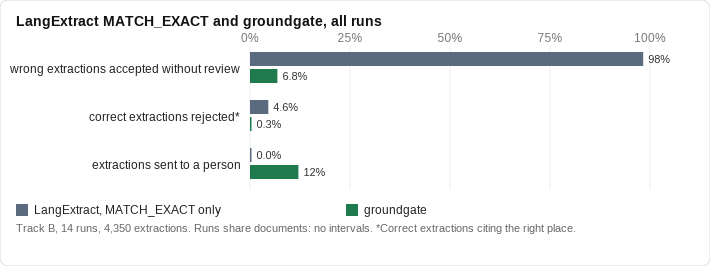
LangExtract, MATCH_EXACT |
groundgate | |
|---|---|---|
| wrong extractions accepted without review | 98.3% (115/117) | 6.8% (8/117) |
| correct extractions citing the right place, rejected | 4.6% (194/4,233) | 0.3% (14/4,233) |
| extractions sent to a person | 0% | 12.1% (526/4,350) |
| gold facts admitted with a right value | 92.5% (3,588/3,878) | 87.1% (3,379/3,878) |
A gold fact is one value that a document states for a field, so a field with 12 strengths counts
12 times, and each fact counts once in each run. groundgate admits fewer right facts than
MATCH_EXACT, and lets in 8 wrong values instead of 115. With the reviews, 96.5% (3,742/3,878)
of gold facts get a right value.
The goal is fewer misses on the fields that an app asks for, with 0 escapes. This table has one
row for each release with a requested-fields run. Each row is the groundgate.extract arm, and
bench/report.py --goal-table writes the table from each set's results.json.
| Release | Set | Split | Documents | Right admits | Reviews | Rejected right | Escapes | Miss rate |
|---|---|---|---|---|---|---|---|---|
| 0.9 | bench/requested |
heldout | 61 | 16 | 119 | 60 | 0 | 180/196 (91.84%) |
| 0.10 | bench/requested3 |
heldout | 111 | 97 | 160 | 16 | 0 | 208/305 (68.20%) |
| 0.11 | bench/requested4 |
heldout | 59 | 79 | 97 | 21 | 1 | 125/204 (61.27%) |
| 0.12 | bench/requested4/development |
development | 32 | 46 | 62 | 13 | 1 | 76/122 (62.30%) |
| 0.13 | bench/requested4/development-464 |
development | 32 | 50 | 58 | 14 | 2 | 72/122 (59.02%) |
| 0.14 | bench/requested4/development-646 |
development | 32 | 48 | 69 | 2 | 0 | 74/122 (60.66%) |
The miss rate is reviews plus silent misses over the stated values. A rejected right value is a silent miss for which the model proposed the right value. The rows use different sets, so only rows on one set and one split compare directly: 0.12 and 0.13. The development split is for tuning, so its rows are not a claim.
Each set, with its tables, method and caveats: bench/README.md. The write-up, with what got through and why: Grounding is a contract, not a citation.
What it checks
Checks run in a fixed order. The first failure rejects the fact.
| Code | Rejects when |
|---|---|
CANDIDATE_INVALID |
the candidate is malformed |
FIELD_UNKNOWN |
the field is not in the schema |
NULL_STRING_LITERAL |
the value is "null", "none", "nil" or "n/a", in any case |
TYPE_INVALID |
the value does not parse as the field's type |
RANGE_INVALID |
the value is outside the field's bounds |
UNIT_INVALID |
the unit is not the field's unit |
KEY_INVALID |
the field is keyed by condition, and the key is missing or not one of its keys |
NO_EVIDENCE |
the evidence has no value item and no outside item |
SPAN_INVALID |
the span is outside the document or splits a character |
OPTION_INVALID |
the value is not one of the options of a closed string field |
PASSAGE_NOT_AT_HEADING |
a passage span does not start at a heading of the outline |
PASSAGE_LABEL_MISMATCH |
the heading at the start of a passage does not have the label |
PASSAGE_CUT_SHORT |
a passage span ends before the end of its section |
PASSAGE_OVERRUN |
a passage span ends after the end of its section |
SOURCE_NOT_READ |
the quoted value text is not in the document, and the reading of the source is partial or has no text |
QUOTE_NOT_FOUND |
the quoted value text is not in the document, or in the reference it cites |
VALUE_NOT_IN_EVIDENCE |
no number in the span equals the value, with the sign and scale the evidence gives |
UNIT_NOT_IN_EVIDENCE |
the value is there, but with another unit |
SOURCE_REJECTED |
only outside evidence supports the value, and the policy rejects it |
A fact that passes every check can still be flagged for a person:
| Code | Flags when |
|---|---|
NON_VERBATIM_EVIDENCE |
the quote differs from the text at the span |
QUALIFIED_VALUE |
"up to", "approximately", "or more" changes the value, and the schema didn't declare it |
SCALE_WORD |
"million", "lakh" and similar follow the value, and the value was given unscaled |
PART_MISSING |
the value needs a sign, a scale or a unit that no evidence item supports |
SIGN_DROPPED |
a positive amount matches a number printed with a minus sign, as 3266 at "-3,266" (spec 0.12) |
SIGN_CITATION_INVALID, SCALE_CITATION_INVALID, UNIT_CITATION_INVALID, FIELD_CITATION_INVALID |
a cited part fails its check |
KEY_NOT_AT_VALUE |
the text puts no key, or another key, at the value, such as another indication's heading |
KEY_CITATION_INVALID |
the cited key item does not name the key |
COLUMN_NOT_AT_VALUE |
the field has columns, and the value is not in a column of the field (spec 0.12) |
MARKER_OTHER_FIELD |
a marker word of another field, such as "family", is next to the value (spec 0.12) |
READ_DOUBT |
a cited item is on a word that the reader, such as OCR, read with a low confidence (spec 0.12) |
PASSAGE_NOT_READ |
on a passage field, the reading is not complete, and a page that gave no text can be in the section |
EVIDENCE_QUOTED, EVIDENCE_STATED |
only an external quote, or the extractor's own knowledge, supports the value |
LOW_CONFIDENCE |
the extractor's confidence is below the policy minimum |
CONFLICTING_CANDIDATES |
another proposal for the same field and key has a different value |
NOT_CORROBORATED |
the policy says that this proposer needs a second proposer, and no other proposer gives the value at this span (spec 0.12) |
OTHER_SPAN |
another proposer gives the same value at a span that does not overlap, and one of the two needs a second proposer (spec 0.12) |
RELATION_FAILED |
a relation of the schema, such as a total and its parts, does not add up |
MODEL_DOUBT |
a recorded judgment of the policy's judge doubts the value |
Number matching is collision-safe. The span 500 mg inside 1,500 mg never reads as 500, a span
that stops at 29. inside 29.97 never reads as 29, and a malformed number like the $252,0000
printed in IRS Publication 590-A never equals 252,000 or 2,520,000. When a span misses the value
but its quote occurs exactly once elsewhere with the right value and unit, groundgate moves the
evidence there and records EVIDENCE_REANCHORED. Other info codes say how a fact passed:
VALUE_DERIVED (the evidence gave the sign or scale), KEY_CITED (a key item put the key at the
value in a table), ADMITTED_BY_POLICY (the policy admits its outside evidence) and
MODEL_CLEARED (a recorded judgment cleared KEY_NOT_AT_VALUE).
The rules are in SPEC.md. conformance/ holds 57 language-neutral vectors that pin every code, and 38 invalid packets that an implementation must refuse, so another implementation can prove it agrees.
Receipts
{"groundgate": "0.12",
 "document": {"id": "irs-p590a-2025-pages-1-2", "sha256": "sha256:9c0bb3f8d04b...", "source": null,
              "doubt_sha256": null},
 "references": [],
 "packs": [],
 "schema_sha256": "sha256:...", "policy_sha256": "sha256:...",
 "decisions": [{"candidate_id": "Gemini_3.6_Flash_Medium/0", "field": "ira_limit_2025", "key": null,
                "outcome": "admitted", "codes": [], "value": "7000", "unit": "USD",
                "source": "document", "ref": null, "url": null,
                "evidence": {"start": 2317, "end": 2323}, "parts": [], "missing": [], "packs": [],
                "candidate_sha256": "sha256:c64383ff..."},
               "..."],
 "coverage": [{"field": "roth_phaseout_single_2025_end", "code": "REQUIRED_FIELD_MISSING"}],
 "judgments": [],
 "summary": {"admitted": 44, "needs_verification": 3, "rejected": 1},
 "receipt_sha256": "sha256:..."}
Hashes are SHA-256 over RFC 8785 canonical JSON, so a receipt means the same thing in any
language. groundgate verify re-runs every decision from the inputs and fails on any difference:
a changed document, schema, policy, candidate or outcome.
What it does not do
- It does not judge meaning. If the model reports a number that really is in the sentence but
belongs to another field, every span check passes: a model that reads an age-50 limit of $8,000
as the IRA limit cites a real "$8,000" with the right unit. A second proposer plus
CONFLICTING_CANDIDATEScatches it only when the models disagree, and in the benchmark they mostly agreed: six of the eight escapes were this case. When the field depends on a condition the schema can name, such as a drug's indications, a keyed field checks it (spec 0.2). - English number formats only. A decimal comma (
1.234,56), space groups (1 234) and number words (five) have no value, so a fact that cites them is rejected. The guide lists what is read. Locale packs for other formats are a design (docs/design/locale-packs.md, #60). - OCR is opt-in.
groundgate read --ocrOCRs a scanned PDF page with thetesseractprogram. It is off by default, because an OCR word can be wrong andadmitdoes not read the confidence of each word in thedocument@1doubt list. Thus a value on low-confidence text is not sent to review yet. English only, no tables from a scan, and at most 200 OCR pages in one read. - No model calls in the decision. groundgate never asks an LLM whether an LLM was right.
Since spec 0.4, it reads a judge's answers only as recorded inputs, so a receipt still re-derives
byte for byte. This judge block is experimental: its one measure on real extractor output is the key
clear on 10-K filings (#120).
groundgate calibrate(#112, experimental) measures the thresholds on your own documents. How to measure a judge's thresholds runs it from start to end. - Too many reviews on requested fields. On the development split of
bench/requested4, 0.14 admits no wrong value (0 escapes) and rejects 2 right values, but it sends 69 of the 122 stated values to review against a target of 35 or fewer. Its miss rate is 60.66% (74 of 122) against a target of 40% or less (bench/requested4/development-646/RESULTS.md). 0.15 adds the document-family profile (#639) and its measure on a gold set of your own (#640). I did not runbench/requested4for 0.15, 0.16 or 0.17, so these are still the numbers of 0.14. 0.16 seals 76 labels for a held-out regulatory text family (#641). 0.17 runs its 9 held-out parts one time (#686): 28 right admitted values, 6 escapes and 4 reviews on 50 slots, a miss rate of 28.21% and a one-sided 95% upper bound of 31.89% on the admitted error rate (bench/regulatory/RESULTS.md).
Status
Alpha. groundgate 0.17.0 implements spec v0.12. CHANGELOG.md lists what each version
changes, with its measure. 0.17 adds the review API over HTTP with blind audit tasks (#649), a
standalone review and audit page on that API (#647), a guide for a run under a job runner
(#594), a bound by characters for the term scans of calibrate events suggest (#685), and the
held-out claim of the regulatory text family (#686). 0.16 adds the facts@2 export with review results and text selectors
(#675), a blind audit sample with an adaptive rate (#643), calibration events from an outside
approver (#642), the source format in reading@2 (#570), the status of each built-in kind pack
in groundgate pack list (#648), and the held-out regulatory text family (#641). 0.15 adds document-family profiles (#639) and groundgate calibrate measure (#640), the value kinds date (#612), record with checks across the documents of a
set (#613) and passage (#638), closed options for a string field (#530), source pins (#616),
the page and the box of each admitted value (#614), the completeness of each reading (#615),
the record id in the export (#659) and the model text input of review (#531). 0.14 adds the structure reader as a second proposer (#510) and
agreement between proposers (#509), column and marker words (#540), SIGN_DROPPED (#569),
READ_DOUBT (#535), DOCX and XLSX reading (#529), and groundgate export (#584). 0.11 adds the store (#288, #402 to #405), the review step and its local
page (#287, #408 to #412), and groundgate calibrate inside groundgate (#385). It reads currency
headings and currency names (#367, #368, #423), refuses a bad field name (#359), and cuts large
search regions in the extraction loop (#382). 0.10 adds vocabulary and kind packs (#333 to #339),
relations across fields (#321), currency scales and heading units (#301, #313, #315, #365), up to 8
field items for one value (#300), label cells (#316), dash variants in aliases (#317), and the
runner rules of #318 and #319. 0.9 moves the reader to groundgate.read (#289), adds the extraction
loop groundgate.extract (#281), keeps an empty table cell in its column and refuses ambiguous
column keys (#280), and keeps PDF running heads out of tables and blank cells in their column
(#279). 0.8 writes PDF table rows as lines with tabs (#230), scales a value by its scale item
(#242), takes the value's occurrence where the field item passes (#249), lets a title key reach a
table with one number column (#250), puts a string value at its first occurrence in its span (#140),
and offers the role key only on a field with keys (#256). 0.7 passes a unit item that is away from
the number only at a unit place of the value (#164). 0.6 passes a unit item that repeats the unit
(#145), reads between with words before an and range (#159) and a scale heading over a table
(#162), and adds a description to each field (#171). 0.6.1 adds gg.feedback_message (#173). 0.5
makes the evidence a list of items (#141): a value can cite its sign, scale, unit, field and key,
and outside sources, under the app's policy, and gg.candidate_schema() (#147) gives the
candidate's JSON Schema. 0.5.1 adds gg.extractor_schema and groundgate schema (#148), a JSON
Schema for a model's structured output. 0.5.2 adds groundgate schema check (#168) and batch
admit (#169). 0.4 added recorded judgments (#116), an experimental way for a judge's answers to
clear a key flag or add doubt, with no model call in the decision. 0.3 brought a wider change rule
(#51), abbreviation dots that no longer end a sentence for qualifiers (#63, #77), Indian digit
grouping (#59), ASCII digits (#94), and keys that stop at a label line (#52) or read a table by its
lines (#87). A receipt names the spec version it was decided under, and only that version verifies
it.
Locale packs for number formats outside English are a design, not yet code. Of the hybrid decisions design, 0.4 has the recorded judgments for the key and field questions, and the review step of 0.11 has the audit sample (#409). Model-proposed locations are not code yet.
License
Apache-2.0.
1 maintainer

Metadata
1 maintainer
Release files for groundgate 0.17.0
For a detailed explanation of source distributions (sdists) and built distributions (wheels), please see the package formats documentation.
Source distribution (sdist)
| File | Size | Uploaded | Provenance | Actions |
|---|---|---|---|---|
| groundgate-0.17.0.tar.gz | 1.0 MB | With provenance | Details for groundgate-0.17.0.tar.gz |
Built distribution (wheel)
| File | Interpreter | ABI | Platform | Actions Reset |
|---|---|---|---|---|
| groundgate-0.17.0-py3-none-any.whl | Python 3 | none | any | Details for groundgate-0.17.0-py3-none-any.whl |
Total release size: 1.5 MB
Release files / groundgate-0.17.0.tar.gz
| Download URL | groundgate-0.17.0.tar.gz |
|---|---|
| Size | 1.0 MB |
| Tags | Source |
|
SHA-256 checksum How to use checksums |
deb46353595bb26776079e2716a5f3157c7cc6639e4bd55dfac04a714be73986
|
|
BLAKE2b-256 checksum How to use checksums |
b489db1c8212c040d1ddb0bd3436bb38247888699174f9d7666e2f6b7201533e
|
| Upload date | |
|
Uploaded using Trusted Publishing? What is trusted publishing? |
Yes |
| Uploaded via |
twine/7.0.0 CPython/3.13.16
|
Provenance
Provenance describes where a file came from. On PyPI, provenance is shared via attestations, which provide a verifiable record of the build or publishing details. View details, limitations and caveats.


PyPI Publish Attestation
PyPI verified that this artifact, at this checksum, originated from the publisher listed below.
Signed by GitHub Actions, verified by PyPI on Nov 20, 2026.
Transparency logRelease files / groundgate-0.17.0-py3-none-any.whl
| Download URL | groundgate-0.17.0-py3-none-any.whl |
|---|---|
| Size | 425.3 kB |
| Tags | Python 3 |
|
SHA-256 checksum How to use checksums |
3f07491af2089d81ddc88603c5b298920db5a65a4810a7c925ad89af50695eca
|
|
BLAKE2b-256 checksum How to use checksums |
0278ac7365d163d1698912da3b6d10777032410af85da8f803d2e3610625a223
|
| Upload date | |
|
Uploaded using Trusted Publishing? What is trusted publishing? |
Yes |
| Uploaded via |
twine/7.0.0 CPython/3.13.16
|
Provenance
Provenance describes where a file came from. On PyPI, provenance is shared via attestations, which provide a verifiable record of the build or publishing details. View details, limitations and caveats.
PyPI Publish Attestation
PyPI verified that this artifact, at this checksum, originated from the publisher listed below.
Signed by GitHub Actions, verified by PyPI on Nov 20, 2026.
Transparency logSecurity for groundgate 0.17.0
Provenance
Provenance describes where a file came from. On PyPI, provenance is shared via attestations, which provide a verifiable record of the build or publishing details. View details, limitations and caveats.
Full provenance
Both files in this release have been uploaded with provenance metadata.
Attestation for groundgate-0.17.0.tar.gz
PyPI Publish Attestation
PyPI verified that this artifact, at this checksum, originated from the publisher listed below.
Signed by GitHub Actions, verified by PyPI on Nov 20, 2026.
Transparency logA note on package security
PyPI is a repository for distributing packages, not a service for auditing them. While third-party security researchers and our staff do their best to detect and remove malicious packages, PyPI cannot guarantee the quality, security or suitability of any given package.
To learn more about protecting yourself from malicious actors, visit our package security documentation.














