
groundgate
LLMs propose facts. groundgate decides which ones you can trust.
groundgate is a deterministic admission layer for LLM document extraction. You give it a document, a schema, and the facts an extractor proposed. Every fact comes back with one of three outcomes:
- admitted: every check passed;
- needs_verification: nothing failed, but a person should look, and the decision says where;
- rejected: a check failed, with a stable reason code.
Every run writes a receipt with hashes of every input. Anyone can re-derive it byte for byte.
Why this exists
Grounded extraction tools check that the quoted text exists in the source. They don't check the value you asked for.
LangExtract is the clearest example, and a good tool. It aligns each extraction_text to the
source and reports MATCH_EXACT, MATCH_FUZZY and so on. It never looks at the attributes that
hold the typed value. So this passes as an exact match:
extraction_text: "$8,000"     found in the source: MATCH_EXACT
value:           "80000"      not what the source says
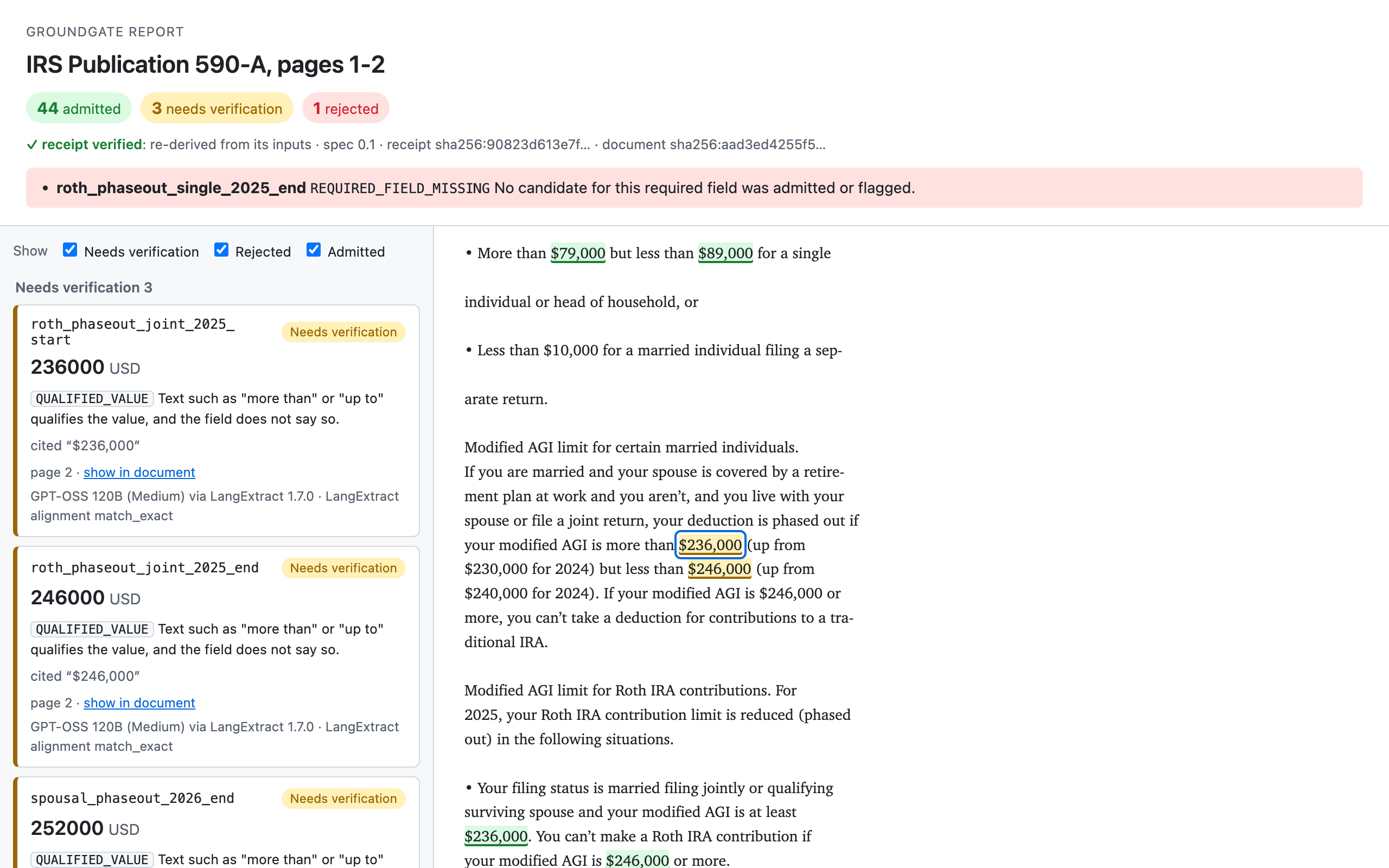
Here is what that looks like on a real document. I ran Gemini 3.6 Flash and GPT-OSS 120B through
LangExtract on two pages of IRS Publication 590-A. LangExtract aligned all 48 extractions as
MATCH_EXACT. groundgate then:
- rejected Gemini's reading of a misprinted
$252,0000as 2,520,000; - flagged two GPT-OSS facts that took a Roth IRA limit from the spousal-deduction sentence; the numbers match, but the text says "more than" where the field says "at least";
- listed a required field both models missed;
- admitted 44 facts, all with the right value.
One admitted fact still cites the wrong rule. Its number is correct, its comparator matches, and no span check can tell. I checked every decision by hand; the details are in examples/irs-590a, which is also the page in the screenshot.
I measured the gap on purpose before writing the library. On 51 facts from two public-domain
government documents, LangExtract's strictest setting (MATCH_EXACT only) accepted 100% of
planted value and unit errors whose quote was correct. groundgate caught all of them and
rejected none of the correct facts. The method and full tables are in
spikes/m0_5.
To be clear about scale: current models rarely get a value wrong. In the benchmark below, 117 of 4,350 real extractions were wrong. The point is not that models are bad. It is that when one is wrong, nothing downstream should have to trust it, and every fact that is admitted comes with proof you can re-check.
LangExtract verifies the text. groundgate verifies the value.
Benchmark
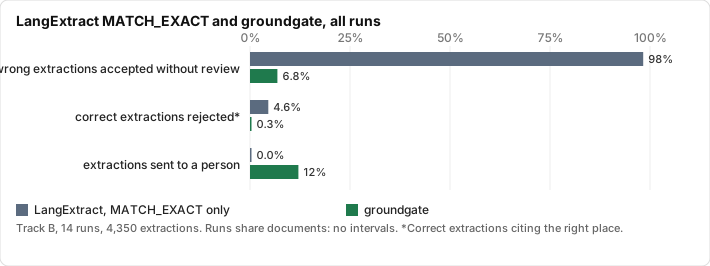
Seven models (Gemini, GPT and Claude, each through its own CLI) ran through LangExtract on 30 public-domain FDA drug labels, NTSB accident reports and IRS publications, at two chunk sizes. A person checked every gold fact. Of 4,350 extractions, 117 were wrong: the wrong value, a value for a field the document doesn't state, the wrong unit, or not a number.
LangExtract, MATCH_EXACT |
groundgate | |
|---|---|---|
| wrong extractions accepted without review | 98.3% (115/117) | 6.8% (8/117) |
| correct extractions rejected | 4.6% (194/4,233) | 0.3% (14/4,233) |
| extractions sent to a person | 0% | 12.1% (526/4,350) |
Most catches (84 of 109) were CONFLICTING_CANDIDATES: a model proposed two values for a
single-valued field, and groundgate sent both to review instead of picking one.
Six of the 8 that got through are the case groundgate says it cannot catch (see What it does not do). Five models took metoprolol's heart failure maximum (200 mg) as the hypertension maximum, and one took lisinopril's renal impairment dose as the usual starting dose. Each number is real and cited correctly; it belongs to another condition. The other two read levothyroxine's 1.6 mcg/kg/day as a flat 1.6 mcg, which the unit check allows. Putting all seven models through one gate caught one more, because when they were wrong they mostly agreed.
The benchmark also found a bug. When LangExtract's chunker cut "29.97" after "29.", groundgate read the span as 29, which its own spec forbids. It's fixed, and three wrong altimeter settings no longer get through.
Tables and planted-error results: bench/RESULTS.md. Method and caveats: bench/README.md.
Quickstart
pip install groundgate
import groundgate as gg

text = "The IRA contribution limit is $7,000. The deduction phases out above $79,000."
schema = {
    "fields": {
        "ira_limit": {"type": "integer", "unit": "USD"},
        "phaseout_start": {"type": "integer", "unit": "USD"},
    }
}


def cite(field, value, quote):
    """A candidate citing the first place `quote` appears, as UTF-8 byte offsets."""
    start = text.encode().index(quote.encode())
    span = {"start": start, "end": start + len(quote.encode()), "text": quote}
    return {"field": field, "value": value, "unit": "USD", "evidence": span}


candidates = [
    cite("ira_limit", "7000", "$7,000"),
    cite("ira_limit", "70000", "$7,000"),  # a digit too many
    cite("phaseout_start", "79000", "$79,000"),  # "above" is not "at"
]
receipt = gg.admit(text, schema, candidates)
for d in receipt.decisions:
    print(f"{d.outcome:<19} {d.field:<15} {d.value:<6} {' '.join(d.codes)}".rstrip())

print(gg.verify(receipt.to_dict(), text, schema, candidates).ok)
needs_verification  phaseout_start  79000  QUALIFIED_VALUE
admitted            ira_limit       7000
rejected            ira_limit       70000  VALUE_NOT_IN_EVIDENCE
True
The core has no dependencies. groundgate[pdf] adds pdfminer.six for PDF text, and
groundgate[langextract] installs LangExtract. docs/guide.md covers schemas,
policies, candidates and the Python API.
With LangExtract
import langextract as lx
from groundgate.adapters.langextract import admit_document

result = lx.extract(text_or_documents=text, prompt_description=prompt, examples=examples)
receipt = admit_document(result, schema)
Each extraction's value and unit attributes are checked at the place LangExtract aligned its
extraction_text. An extraction LangExtract could not align is rejected NO_EVIDENCE.
From the command line
groundgate extract p590a.pdf --pages 1-2 -o doc.txt --layout layout.json
groundgate admit   doc.txt schema.json candidates.json -o receipt.json
groundgate verify  receipt.json doc.txt schema.json candidates.json
groundgate report  receipt.json doc.txt schema.json candidates.json --layout layout.json -o report.html
extract turns a PDF, HTML, XML or text file into the NFC text everything else reads, and
records the page and box of every word. Text a reader can't see (proof marks drawn off the page,
hidden HTML) is dropped, and superscripts are marked so that 10⁹ reads 10^9, never 109. Pass
- as the document to read it from a pipe. report refuses to render a receipt that doesn't
re-derive from its inputs. examples/irs-590a runs the whole pipeline on an
IRS publication with cached model output, so it reproduces without an API key.
What it checks
Checks run in a fixed order. The first failure rejects the fact.
| Code | Rejects when |
|---|---|
CANDIDATE_INVALID |
the candidate is malformed |
FIELD_UNKNOWN |
the field is not in the schema |
NULL_STRING_LITERAL |
the value is "null", "none", "n/a" |
TYPE_INVALID |
the value does not parse as the field's type |
RANGE_INVALID |
the value is outside the field's bounds |
UNIT_INVALID |
the unit is not the field's unit |
NO_EVIDENCE |
no evidence is cited |
SPAN_INVALID |
the span is outside the document or splits a character |
VALUE_NOT_IN_EVIDENCE |
no number in the span equals the value |
UNIT_NOT_IN_EVIDENCE |
the value is there, but not with the field's unit |
A fact that passes every check can still be flagged for a person:
| Code | Flags when |
|---|---|
NON_VERBATIM_EVIDENCE |
the quote differs from the text at the span |
QUALIFIED_VALUE |
"up to", "approximately", "or more" changes the value, and the schema didn't declare it |
SCALE_WORD |
"million", "lakh" and similar follow the value |
LOW_CONFIDENCE |
the extractor's confidence is below the policy minimum |
CONFLICTING_CANDIDATES |
another proposal for the same field has a different value |
Number matching is collision-safe. The span 500 mg inside 1,500 mg never reads as 500, a span
that stops at 29. inside 29.97 never reads as 29, and a malformed number like the $252,0000
printed in IRS Publication 590-A never equals 252,000 or 2,520,000. When a span misses the value
but its quote occurs exactly once elsewhere with the right value and unit, groundgate moves the
evidence there and records EVIDENCE_REANCHORED.
The rules are in SPEC.md. conformance/ holds 16 language-neutral vectors that pin every code, so another implementation can prove it agrees.
Receipts
{"groundgate": "0.1",
 "document": {"id": "irs-p590a-2025-pages-1-2", "sha256": "sha256:387c5991b989..."},
 "schema_sha256": "sha256:...", "policy_sha256": "sha256:...",
 "decisions": [{"candidate_id": "Gemini_3.6_Flash_Medium/0", "field": "ira_limit_2025",
                "outcome": "admitted", "codes": [], "value": "7000", "unit": "USD",
                "evidence": {"start": 2634, "end": 2640}, "candidate_sha256": "sha256:37e4fbb8..."},
               "..."],
 "coverage": [{"field": "roth_phaseout_joint_2026_end", "code": "REQUIRED_FIELD_MISSING"}],
 "summary": {"admitted": 50, "needs_verification": 0, "rejected": 2},
 "receipt_sha256": "sha256:..."}
Hashes are SHA-256 over RFC 8785 canonical JSON, so a receipt means the same thing in any
language. groundgate verify re-runs every decision from the inputs and fails on any difference:
a changed document, schema, policy, candidate or outcome.
What it does not do
- It does not judge meaning. If the model reports a number that really is in the sentence but
belongs to another field, every span check passes: a model that reads an age-50 limit of $8,000
as the IRA limit cites a real "$8,000" with the right unit. A second proposer plus
CONFLICTING_CANDIDATEScatches it only when the models disagree, and in the benchmark they mostly agreed: six of the eight escapes were this case. - No dates, arrays of records, or cross-document checks in spec v0.1.
- No OCR. Scanned PDFs need a text layer first (for example
ocrmypdf). - No model calls. groundgate never asks an LLM whether an LLM was right.
Status
Alpha. groundgate 0.1.0 implements spec v0.1, and a receipt names the spec version it was decided under. The next spec version starts from what the benchmark found: values that depend on a condition (a dose per indication, a limit per year) and weight-based units. See CHANGELOG.md.
License
Apache-2.0.
1 maintainer

Metadata
1 maintainer
Release files for groundgate 0.1.0
For a detailed explanation of source distributions (sdists) and built distributions (wheels), please see the package formats documentation.
Source distribution (sdist)
| File | Size | Uploaded | |
|---|---|---|---|
| groundgate-0.1.0.tar.gz | 68.0 kB | Details |
Built distribution (wheel)
| File | Interpreter | ABI | Platform | Reset |
|---|---|---|---|---|
| groundgate-0.1.0-py3-none-any.whl | Python 3 | none | any | Details |
Total release size: 110.1 kB
Release files / groundgate-0.1.0.tar.gz
| Download URL | groundgate-0.1.0.tar.gz |
|---|---|
| Size | 68.0 kB |
| Tags | Source |
|
SHA-256 checksum How to use checksums |
ae55630afe8aafd4151a104f754d8f364b93d789276e2d34d2c2eca75f2d1868
|
|
BLAKE2b-256 checksum How to use checksums |
d4ceae381aab803fc7dea0eb65e6e270ed01123572067278c90ca7dfe8a80881
|
| Upload date | |
|
Uploaded using Trusted Publishing? What is trusted publishing? |
Yes |
| Uploaded via |
twine/7.0.0 CPython/3.13.14
|
Provenance
Provenance describes where a file came from. On PyPI, provenance is shared via attestations, which provide a verifiable record of the build or publishing details. View details, limitations and caveats.


PyPI Publish Attestation
PyPI verified that this artifact, at this checksum, originated from the publisher listed below.
Signed by GitHub Actions, verified by PyPI on Sep 30, 2026.
Transparency logRelease files / groundgate-0.1.0-py3-none-any.whl
| Download URL | groundgate-0.1.0-py3-none-any.whl |
|---|---|
| Size | 42.1 kB |
| Tags | Python 3 |
|
SHA-256 checksum How to use checksums |
423478cd8f8a601bcc4c61d0dba9f4bd8e8019ffb3b83d1bbf2c2919a477aca1
|
|
BLAKE2b-256 checksum How to use checksums |
29a4c1a8fa24590055ca83c659a78805209e0e2e16fb76ce92cbf83b7caea191
|
| Upload date | |
|
Uploaded using Trusted Publishing? What is trusted publishing? |
Yes |
| Uploaded via |
twine/7.0.0 CPython/3.13.14
|
Provenance
Provenance describes where a file came from. On PyPI, provenance is shared via attestations, which provide a verifiable record of the build or publishing details. View details, limitations and caveats.
PyPI Publish Attestation
PyPI verified that this artifact, at this checksum, originated from the publisher listed below.
Signed by GitHub Actions, verified by PyPI on Sep 30, 2026.
Transparency log













