
GWASLab




- A handy Python-based toolkit for handling GWAS summary statistics (sumstats).
- Each process is modularized and can be customized to your needs.
- Sumstats-specific manipulations are designed as methods of a Python object,
gwaslab.Sumstats.
Installation
install via pip
The latest version of GWASLab now supports Python 3.9, 3.10, 3.11, and 3.12.
pip install gwaslab
install in conda environment
Create a Python 3.9, 3.10, 3.11 or 3.12 environment and install gwaslab using pip:
conda env create -n gwaslab -c conda-forge python=3.12

conda activate gwaslab

pip install gwaslab
or create a new environment using yml file environment.yml
conda env create -n gwaslab -f environment.yml
install using docker (deprecated)
A docker file is available here for building local images.
Quick start
import gwaslab as gl

# load plink2 output
mysumstats = gl.Sumstats("sumstats.txt.gz", fmt="plink2")

# or load sumstats with auto mode (auto-detecting commonly used headers)
# assuming ALT/A1 is EA, and frq is EAF
mysumstats = gl.Sumstats("sumstats.txt.gz", fmt="auto")

# or you can specify the columns:
mysumstats = gl.Sumstats("sumstats.txt.gz",
             snpid="SNP",
             chrom="CHR",
             pos="POS",
             ea="ALT",
             nea="REF",
             eaf="Frq",
             beta="BETA",
             se="SE",
             p="P",
             direction="Dir",
             n="N",
             build="19")

# manhattan and qq plot
mysumstats.plot_mqq()
...
Documentation and tutorials
Documentation and tutorials for GWASLab are avaiable at here.
Functions
Loading and Formatting
- Loading sumstats by simply specifying the software name or format name, or specifying each column name.
- Converting GWAS sumstats to specific formats:
- LDSC / MAGMA / METAL / PLINK / SAIGE / REGENIE / MR-MEGA / GWAS-SSF / FUMA / GWAS-VCF / BED...
- check available formats
- Optional filtering of variants in commonly used genomic regions: Hapmap3 SNPs / High-LD regions / MHC region
Standardization & Normalization
- Variant ID standardization
- CHR and POS notation standardization
- Variant POS and allele normalization
- Genome build : Inference and Liftover
Quality control, Value conversion & Filtering
- Statistics sanity check
- Extreme value removal
- Equivalent statistics conversion
- BETA/SE , OR/OR_95L/OR_95U
- P, Z, CHISQ, MLOG10P
- Customizable value filtering
Harmonization
- rsID assignment based on CHR, POS, and REF/ALT
- CHR POS assignment based on rsID using a reference text file
- Palindromic SNPs and indels strand inference using a reference VCF
- Check allele frequency discrepancy using a reference VCF
- Reference allele alignment using a reference genome sequence FASTA file
Visualization
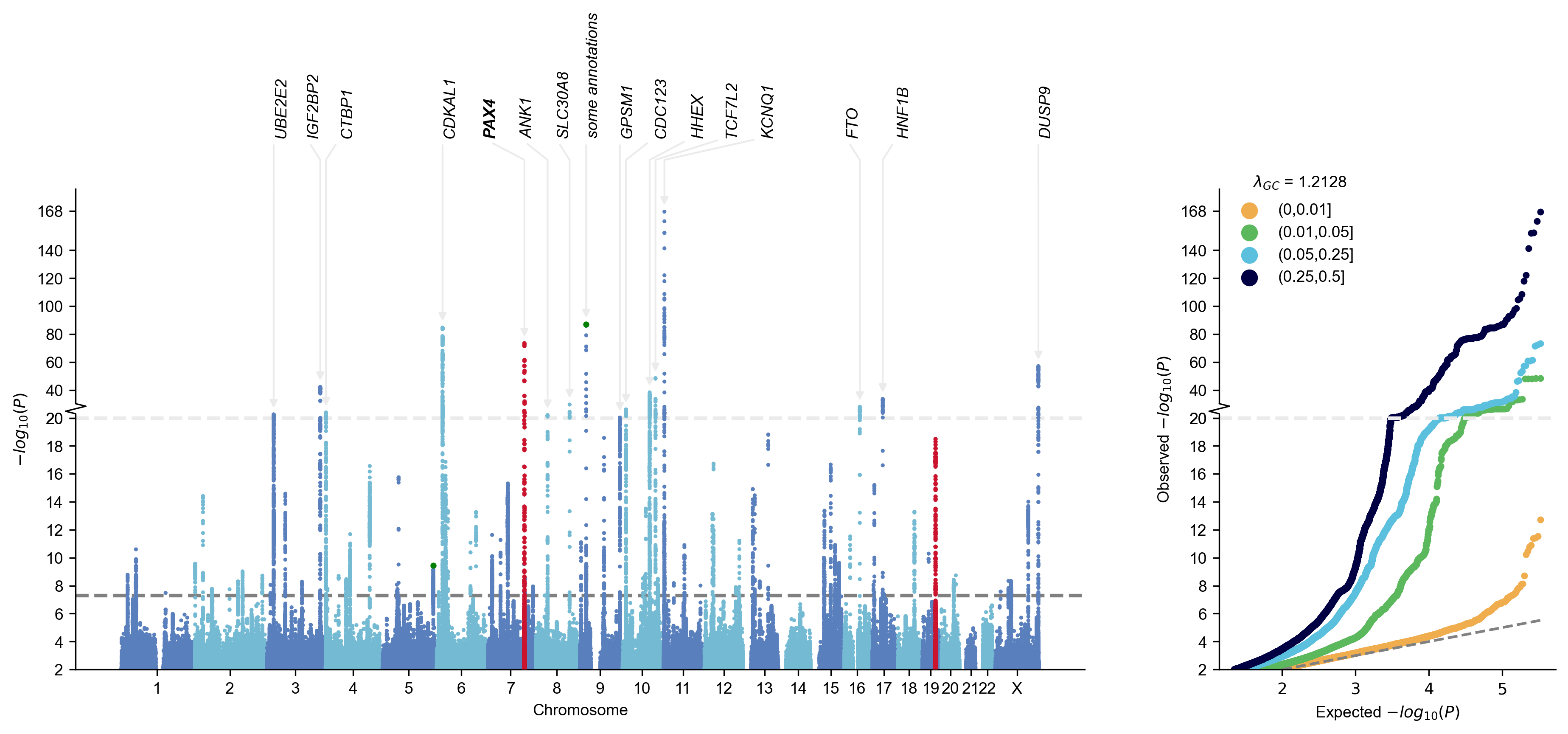
- Mqq plot: Manhattan plot, QQ plot or MQQ plot (with a bunch of customizable features including auto-annotate nearest gene names)
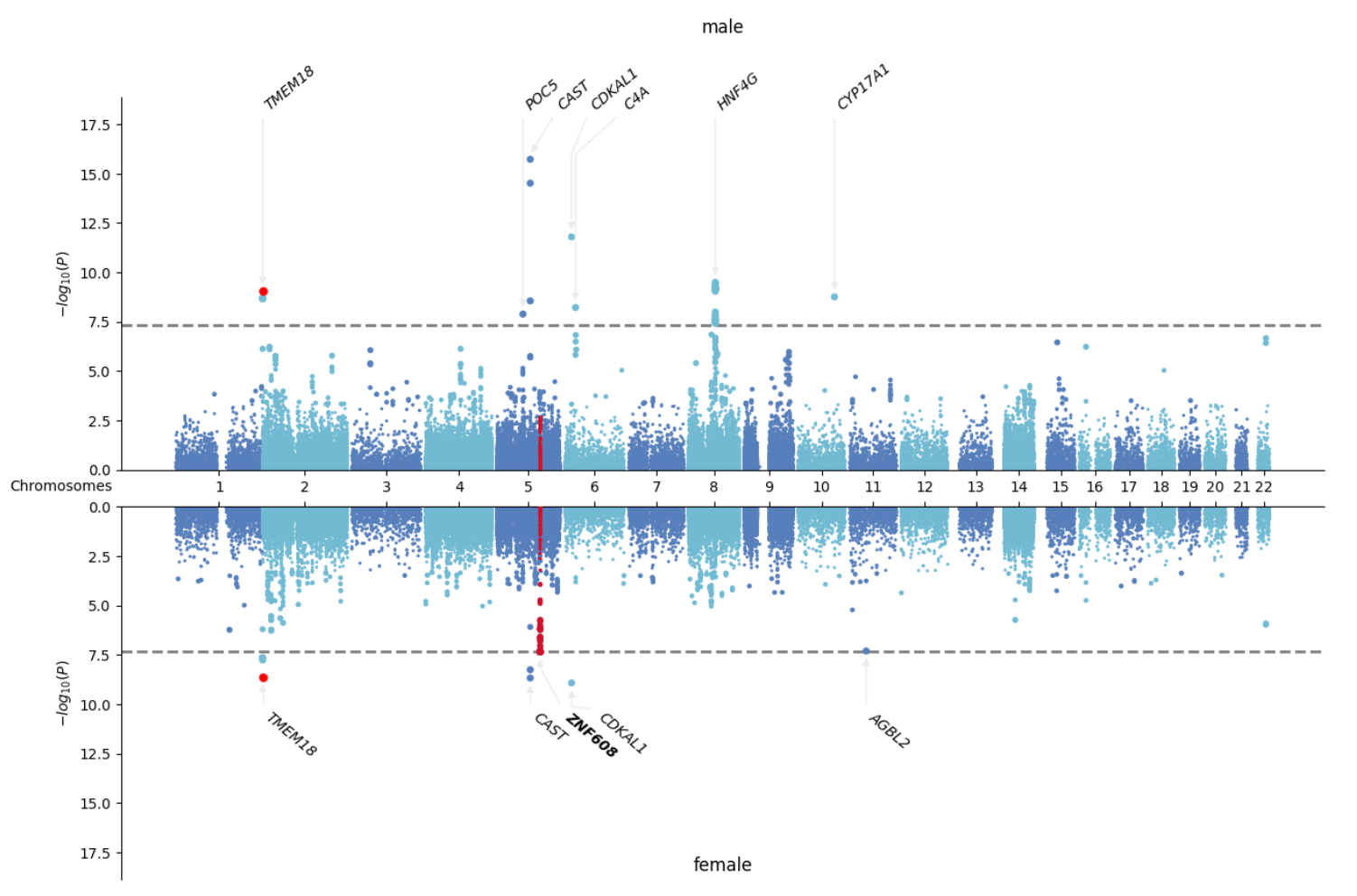
- Miami plot: mirrored Manhattan plot
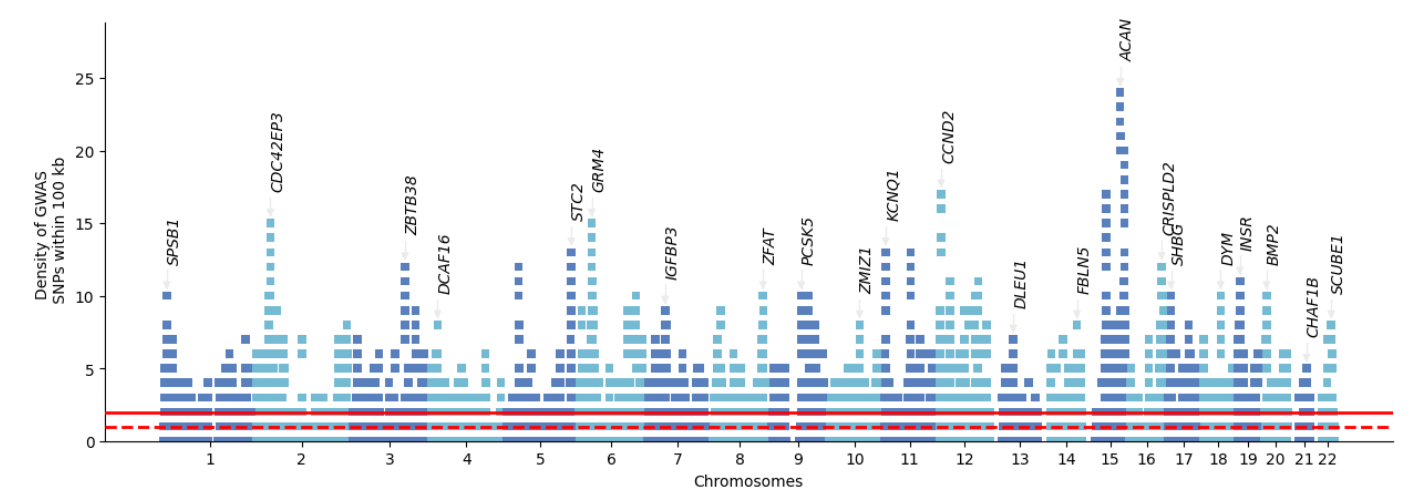
- Brisbane plot: GWAS hits density plot
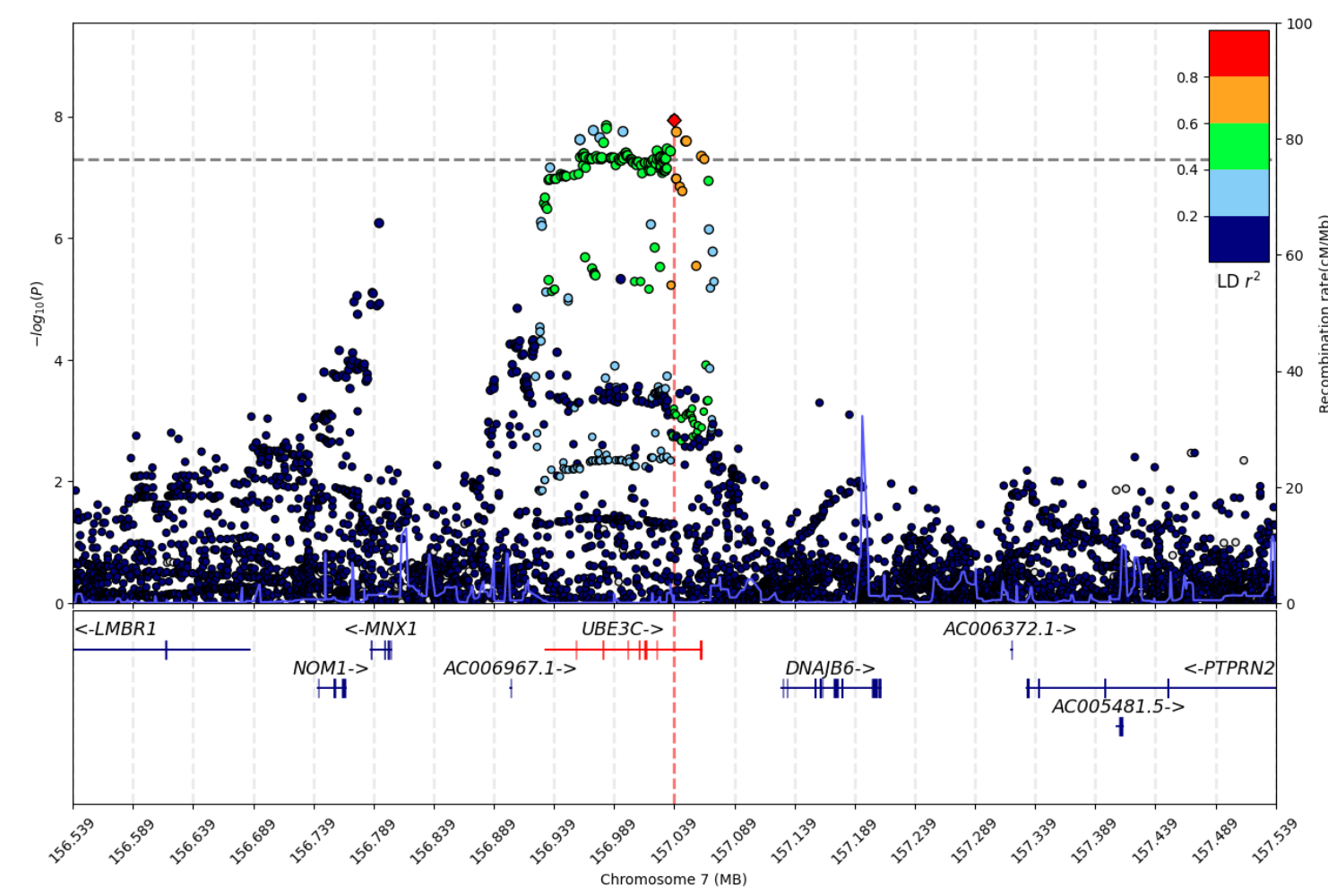
- Regional plot: GWAS regional plot
- Genetic correlation heatmap: ldsc-rg genetic correlation matrix
- Scatter plot: variant effect size comparison
- Scatter plot: allele frequency comparison
- Scatter plot: trumpet plot (plot of MAF and effect size with power lines)
Visualization Examples
Other Utilities
- Read ldsc h2 or rg outputs directly as DataFrames (auto-parsing).
- Extract lead variants given a sliding window size.
- Extract novel loci given a list of known lead variants / or known loci obtained from GWAS Catalog.
- Logging: keep a complete record of manipulations applied to the sumstats.
- Sumstats summary: give you a quick overview of the sumstats.
- ...
Issues
- GWASLab is currently under active development, with frequent updates.
- Note: Known issues are documented at https://cloufield.github.io/gwaslab/KnownIssues/.
How to cite
- GWASLab preprint: He, Y., Koido, M., Shimmori, Y., Kamatani, Y. (2023). GWASLab: a Python package for processing and visualizing GWAS summary statistics. Preprint at Jxiv, 2023-5. https://doi.org/10.51094/jxiv.370
Sample data used for tutorial
- Sample GWAS data used in GWASLab is obtained from: http://jenger.riken.jp/ (Suzuki, Ken, et al. "Identification of 28 new susceptibility loci for type 2 diabetes in the Japanese population." Nature genetics 51.3 (2019): 379-386.).
Acknowledgement
Thanks to @sup3rgiu, @soumickmj and @gmauro for their contributions to the source codes.
Contacts
- Github: https://github.com/Cloufield/gwaslab
- Blog (in Chinese): https://gwaslab.com/
- Email: gwaslab@gmail.com
- Stats: https://pypistats.org/packages/gwaslab
1 maintainer

Release files for gwaslab 4.2.3
For a detailed explanation of source distributions (sdists) and built distributions (wheels), please see the package formats documentation.
Source distribution (sdist)
| File | Size | Uploaded | |
|---|---|---|---|
| gwaslab-4.2.3.tar.gz | 27.1 MB | Details |
Built distribution (wheel)
| File | Interpreter | ABI | Platform | Reset |
|---|---|---|---|---|
| gwaslab-4.2.3-py3-none-any.whl | Python 3 | none | any | Details |
Total release size: 54.0 MB
Release files / gwaslab-4.2.3.tar.gz
| Download URL | gwaslab-4.2.3.tar.gz |
|---|---|
| Size | 27.1 MB |
| Tags | Source |
|
SHA-256 checksum How to use checksums |
2c3be32ed4c0dcc45519df2af202bbabfeecd0eea323370bb593a543dd9c4691
|
|
BLAKE2b-256 checksum How to use checksums |
c5c20172c52a87faf0eface3fd6f0a12034477f1e4874cb0d500cfe9c16d5538
|
| Upload date | |
|
Uploaded using Trusted Publishing? What is trusted publishing? |
No |
| Uploaded via |
twine/7.0.0 CPython/3.12.0
|
Release files / gwaslab-4.2.3-py3-none-any.whl
| Download URL | gwaslab-4.2.3-py3-none-any.whl |
|---|---|
| Size | 26.9 MB |
| Tags | Python 3 |
|
SHA-256 checksum How to use checksums |
f21e5e06c0464f3a29eed602958a4ebe192c62f9eba41c508ebfad683b00eebb
|
|
BLAKE2b-256 checksum How to use checksums |
639b628ecedd9c313ba8bad95ac4a9abb7aab772cc15f7197252b9cd12e2906c
|
| Upload date | |
|
Uploaded using Trusted Publishing? What is trusted publishing? |
No |
| Uploaded via |
twine/7.0.0 CPython/3.12.0
|














