
Health Agent Environment
Generation and Evaluation in One Pipeline
Generate synthetic patients and clinical scenarios, then evaluate health agents against code-derived ground truth.





English · 简体中文 | How it works · Packs · Results · Quick start · Your agent · Docs · Live demo · Cite
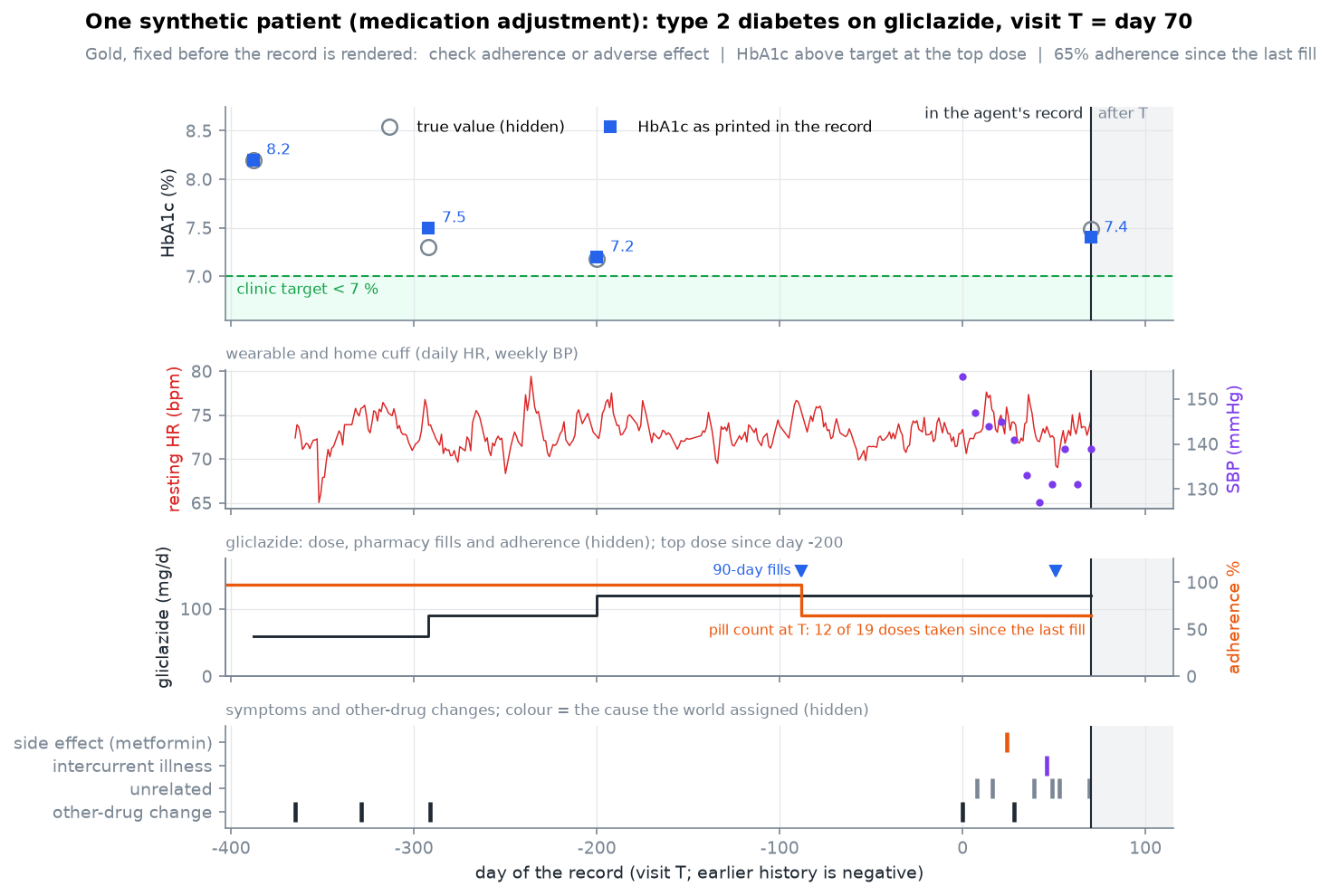
One item of the public-seed medication pack, up to the visit T; hollow markers, adherence and symptom colours are hidden from the agent. HbA1c is above target at the top dose, but only 12 of 19 doses were taken since the last fill, so the gold is to check adherence, not to raise the dose.
How it works
HAEnv builds every question from one hidden patient state. Define: a job file sets the patient's
facts (condition, drugs, dose steps, devices) and latent variables such as adherence and true lab values.
Render: the generator turns them into months or years of dated records, with the configured
artifacts and distractors. Check: a case ships only if it passes the release checks.
Run: the agent under test sees the record up to the visit T and makes one decision.
Score: code checks the decision against the gold derived from the same hidden state, and one
LLM judge rates the management plan.
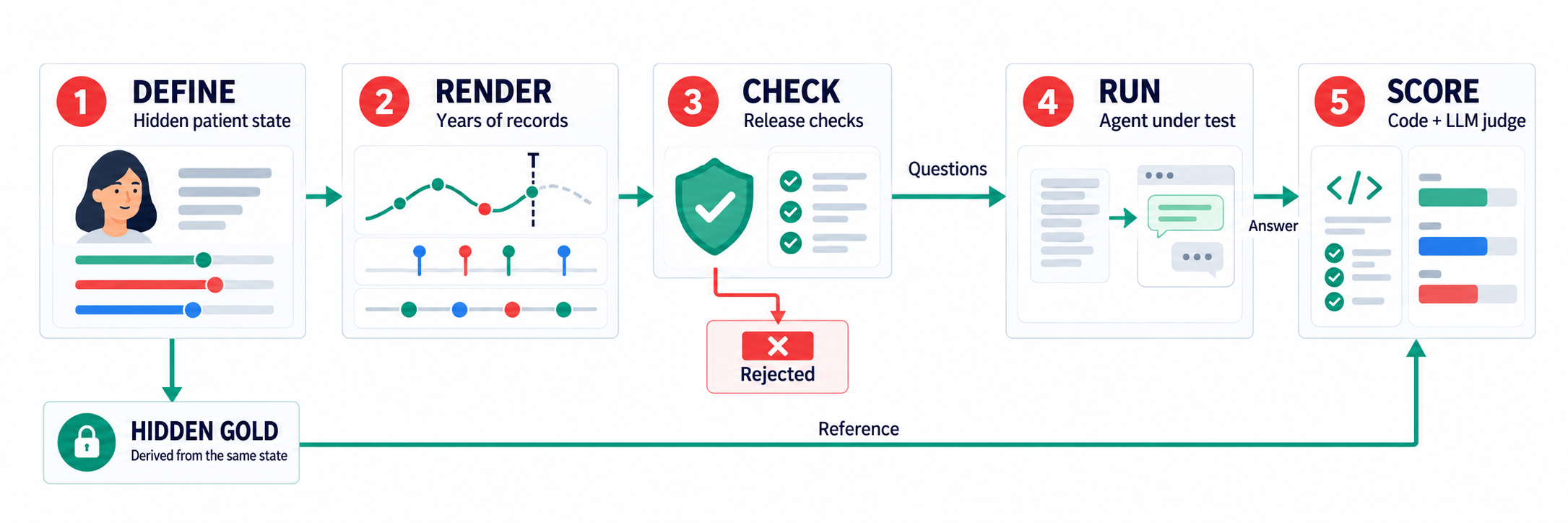
The agent sees records up to T; hidden gold goes only to the judges, which are code plus one LLM judge for management-plan quality Q (see Scoring).
The release checks work at three levels: a premise check rejects contradictory job files, every
stream and event of each item is verified, and a leak probe runs on every prompt. Batch gates and a
pack audit then check the pack as a whole, for example that real symptoms cannot be told from
distractors by their data footprint. The simulation kernel lives in src/haenv_kernel/.
- Packs are plugins. Each pack registers its gold, its question template and its scoring as a judge group; the core pipeline does not know which packs exist.
- Fingerprints follow definitions. The scoring and generation code each have a fingerprint, stamped on every row and batch; boards with mixed fingerprints are refused by the publish gate.
- Four formats. The same patients can be posed as
single,gated(tests ordered against a budget),slices(questions at several time points) ormulti(rounds the agent may revise).
The generator draws each patient's drug response, adherence and lab course from the bands its job declares, and difficulty (artifacts, distractors, the timing of the clinical turn) is a setting of the job. The live demo renders a patient in the browser; its knobs change the course, the labs and adherence.
What it measures
HAEnv (Health Agent Environment) is the haenv Python package and command-line tool in this
repository. Each question asks for one clinical decision on a synthetic record that grows over months
or years. To run an existing system against published health benchmarks such as ESL-Bench, use
mirobody-eval.
The four packs
| Pack | Decision at T |
Answer |
|---|---|---|
| ① Diagnosis (budgeted differential) | which conditions explain the record, including a second condition hidden behind findings the first explains; whether a clinician should review | a differential, the tests to order within a budget, a review flag |
| ② Triage | where the patient should go now | ed_now · within_24h · routine_followup · watchful_waiting |
| ③ Medication adjustment | what to do with the drug at this follow-up visit | uptitrate · downtitrate · maintain · switch · check_adherence_or_adverse_effect |
| ④ Lab-change attribution | whether the change since the last result is real | true_change · analytic_biological_noise · preanalytical · method_difference, plus the size of a true change |
In every pack the decision is checked by code against the world's truth; in pack ① registered aliases match the listed diagnoses to the gold, with no model call.
- Gold standard first. Disease, drug response, adherence, true lab values and measurement noise are set before the course is rendered; each pack's gold is derived from them by code.
- Coherent patients. Labs, medication, home and wearable streams and life events come from one set of rules on one timeline; a known comorbidity enters the world tables and changes the answer where it should.
- Difficulty as a parameter. Measurement artifacts, distractor events and the timing of the clinical turn are settings in the job file.
- Safety failures are not averaged away. Hard gates (an unauthorised medication change, fabricated evidence, a missed emergency, premature closure) zero the item whatever else scored well.
A pack is a pipeline, not a fixed file: one command builds a pack of any size from a seed and audits it, with no model call (see Quick start and the data card). Prompts and the free text of the records are in Chinese; field names, answer values and identifiers are in English.
Leaderboard
Both boards rank models on the four packs, 100 items per pack (N100), with 3 answers per item; the
current board is 1.3.1 (thirteen models), the 1.3.0 board (eight models) follows it. The main score averages the three answer scores S = G·D·(1+Q)/2 of each item (k3) and gives
the four packs equal weight; the preregistered first-answer score (pk1) is reported as a robustness check.
Intervals are 95% paired item-cluster bootstrap intervals (2,000 draws) that resample the same items
for every model; rank intervals come from the same draws.
1.3.1 board
The 1.3.1 board ranks 13 models with the 1.3.1 citation check on the same four N100 packs and the
same k3 aggregation, intervals and draws. Diagnosis scores of the eight models below differ from
the 1.3.0 table after refreshing affected answers under the current environment and applying the
current scorer (see CHANGELOG.md). Score readouts: docs/boards/1.3.1/k3.json
and the first-answer readout docs/boards/1.3.1/pk1.json.

| Rank | Model | Overall (95% CI) | ① | ② | ③ | ④ | All-3 |
|---|---|---|---|---|---|---|---|
| 1–2 | deepseek-v4.1-flash | 0.837 (0.813–0.861) | 0.655 | 0.932 | 0.928 | 0.833 | 0.823 |
| 1–2 | gpt-6-sol | 0.832 (0.808–0.856) | 0.693 | 0.893 | 0.959 | 0.785 | 0.878 |
| 3–5 | mimo-v2.6-flash | 0.793 (0.765–0.819) | 0.569 | 0.943 | 0.853 | 0.807 | 0.760 |
| 3–5 | gemini-3.8-flash | 0.792 (0.768–0.816) | 0.591 | 0.950 | 0.882 | 0.744 | 0.867 |
| 3–5 | qwen38-27b | 0.789 (0.763–0.815) | 0.617 | 0.930 | 0.885 | 0.722 | 0.765 |
| 6–7 | gpt-6-luna | 0.719 (0.692–0.747) | 0.494 | 0.859 | 0.897 | 0.627 | 0.693 |
| 6–7 | deepseek-v4-pro | 0.696 (0.666–0.724) | 0.533 | 0.933 | 0.689 | 0.629 | 0.668 |
| 8–10 | minimax-m3 | 0.633 (0.602–0.663) | 0.440 | 0.870 | 0.608 | 0.616 | 0.525 |
| 8–10 | deepseek-v4-flash | 0.632 (0.599–0.664) | 0.477 | 0.856 | 0.656 | 0.538 | 0.588 |
| 8–10 | glm-5.3-flash | 0.628 (0.597–0.658) | 0.484 | 0.813 | 0.668 | 0.547 | 0.530 |
| 11 | gemma-4-31b-it | 0.536 (0.506–0.567) | 0.382 | 0.767 | 0.514 | 0.482 | 0.580 |
| 12 | qwen3.7-flash | 0.446 (0.414–0.476) | 0.380 | 0.599 | 0.271 | 0.533 | 0.327 |
| 13 | qwen3-32b | 0.171 (0.150–0.192) | 0.069 | 0.307 | 0.058 | 0.249 | 0.073 |
1.3.0 overall

| Rank | Model | Overall (95% CI) | ① | ② | ③ | ④ | All-3 (all 3 correct) |
|---|---|---|---|---|---|---|---|
| 1 | gpt-6-sol | 0.831 (0.808–0.854) | 0.687 | 0.893 | 0.959 | 0.785 | 0.875 |
| 2 | gemini-3.8-flash | 0.792 (0.768–0.816) | 0.591 | 0.950 | 0.882 | 0.744 | 0.873 |
| 3 | gpt-6-luna | 0.718 (0.690–0.746) | 0.490 | 0.859 | 0.897 | 0.627 | 0.695 |
| 4 | deepseek-v4-pro | 0.659 (0.630–0.689) | 0.383 | 0.933 | 0.689 | 0.629 | 0.670 |
| 5–6 | deepseek-v4-flash | 0.627 (0.595–0.660) | 0.459 | 0.856 | 0.656 | 0.538 | 0.585 |
| 5–6 | glm-5.3-flash | 0.602 (0.571–0.632) | 0.381 | 0.813 | 0.668 | 0.547 | 0.533 |
| 7 | minimax-m3 | 0.562 (0.532–0.589) | 0.153 | 0.870 | 0.608 | 0.616 | 0.518 |
| 8 | qwen3.7-flash | 0.425 (0.394–0.457) | 0.299 | 0.599 | 0.271 | 0.533 | 0.325 |
① Diagnosis · ② Triage · ③ Medication adjustment · ④ Lab-change attribution. All-3 is the share
of items whose decision is correct in all three answers (equal-weight mean over the packs); it is a
reliability profile, not the ranking metric. G is passing the hard gates, D a correct core
decision, Q the plan quality (mean of two judgments by one LLM judge; intervals exclude judge
noise). Overlapping rank intervals do not establish an order.
The evaluated question sets ship as frozen pack files and regenerate byte for byte at the commits their batches record. Interactive board · board data (JSON) · earlier boards · recomputing the board
1.3.1 findings

Wrong diagnoses usually lack evidence. Of the wrong diagnoses (aborts excluded) on items with a list of decisive results, 766 had not obtained all of those results and 247 all of them: 75.6% lacked part of the decisive evidence.
Supplying the missed results corrects most of them. 142 wrong diagnoses with incomplete coverage (gpt-6-luna 44, glm-5.3-flash 50, qwen3-32b 48) were re-asked from just before the final answer. With the missed decisive results added, 64.1% became correct, against 12.7% with as many non-decisive results and 8.5% with nothing added (51.4 points over non-decisive results, 95% CI 40.1 to 61.4). On the 79 that missed at least two decisive results, adding a random half of them corrected 41.8% (nothing added 6.3%, all 75.9%).
A larger test budget helps some models more than others. Diagnosis accuracy on the 100 diagnosis items (first answers) at half, the default (the board) and twice the default test budget. Gain: percentage points from half to twice the budget, with its paired 95% interval; budget used: mean share of the default budget spent.
| Model | 0.5× | 1× | 2× | Gain [95% CI] | Budget used at 1× |
|---|---|---|---|---|---|
| deepseek-v4-flash | 66% | 70% | 76% | +10.0 [2.0, 18.0] | 66% |
| gpt-6-sol | 71% | 77% | 81% | +10.0 [2.0, 18.0] | 73% |
| minimax-m3 | 55% | 59% | 65% | +10.0 [0.0, 19.0] | 44% |
| glm-5.3-flash | 55% | 63% | 63% | +8.0 [−2.0, 18.0] | 35% |
| deepseek-v4-pro | 71% | 77% | 77% | +6.0 [−1.0, 13.0] | 55% |
| gemini-3.8-flash | 72% | 77% | 76% | +4.0 [−4.0, 12.0] | 53% |
| gpt-6-luna | 63% | 67% | 66% | +3.0 [−3.0, 9.0] | 50% |
| qwen3.7-flash | 56% | 57% | 56% | 0.0 [−9.0, 8.0] | 36% |
HTTP replay reproduces the stored tool results. Replaying the 256,609 tool calls of the 15,600 leaderboard answer sessions on the 400 items through haenv serve fhir and decoding the responses gives identical output to the function-call tools in 256,609 of 256,609 calls and reproduces every tool result stored in those sessions' traces, purchases and refusals included; the 4,621,363 returned resources are valid FHIR R4B (0 invalid). Run tools/release/replay_http.py on the leaderboard pool:
python tools/release/replay_http.py --work leaderboard-pool/ --workers 32 --out artifacts/replay-http-results.json
Expected summary: questions=400, responses=15600, calls=256609, identical=256609, differing=0, stored_differing=0, pending_purchases_replayed=234, validation_failures=0; missing=[], worker_errors=[]. The pool contains the stored leaderboard runs and is supplied separately from the source tree. An offline HTTP rehearsal is python tools/release/replay_http.py --offline.
Recompute and re-score the released re-ask answers offline: python tools/evaluation/reask_pooled.py --check (data and conditions).
Quick start
Generate, verify, answer and score offline. No API keys, no cost.
git clone https://github.com/thetahealth/mirobody-env && cd mirobody-env

# 8-core Linux timings: install ~2s; build ~10s; verify ~9s; offline run ~18s; report ~8s.
# Installation used a package mirror; PyPI and other machines may differ (docs/quickstart-timing.json).
uv run haenv build  benchmarks/inputs/example-ew.job.yaml --gen deterministic --fresh   # generate patients and cases
uv run haenv verify benchmarks/inputs/example-ew.job.yaml --gen deterministic           # verify every item
uv run haenv run    benchmarks/inputs/example-ew.job.yaml --offline                     # answer with offline reference solvers
uv run haenv report benchmarks/inputs/example-ew.job.yaml --offline                     # score and write the report

Each command exits 0, and verify prints:
[haenv] generation: 3/4 case(s) passed the emission gate
[haenv] per-item verification: 82 item(s) · failed 0 · text leaked in 0 case(s)
The fourth case, EWX-04, is refused with conflicts=['event_density_mismatch']: its high
distractor level injects five symptom events where its symptom rate allows one. Bundled jobs write
to artifacts/; --fresh opens a new batch, because rebuilding a batch that already holds answers
would score new questions against old answers.
Build a task pack
uv run --with scikit-learn --with joblib python tools/generation/make_pack.py --pack p4 --n 50 --out packs/p4
--pack is m2 (①), p2 (②), p3 (③) or p4 (④); --n sets the size and --seed (or
HAENV_PACK_SEED) the seed. The same pack, size and seed give the same pack; a batch records only
the seed's hash. The command exits 0 when the build and every audit gate pass, and haenv run
refuses a pack's items without a passing audit. Example jobs, class shares and the audit are in the
data card.
Serve a question over FHIR REST or MCP
B=$(ls -d artifacts/results/early_warning/ew-demo/*/ | tail -1)   # the batch built above
uv run haenv serve fhir --pack "$B" --question EWX-01 --port 8000 &   # one question, stdlib HTTP server
curl -s localhost:8000/metadata                                     # CapabilityStatement: routes and search parameters
uv run --extra serve haenv serve mcp --pack "$B" --question EWX-01  # the same tools over MCP stdio
The server answers the same searches, paging, row cap, date filters and test budget as the
function-call tools, with case days mapped to ISO dates; tools/release/replay_http.py replays
stored tool calls through it and checks that the decoded outputs are identical.
Install from PyPI
pip install haenv
JOBS=$(python -c "from haenv import data_root;print(data_root()/'benchmarks'/'inputs')")
cd ~/my-workdir                     # default output: ./artifacts/
haenv build "$JOBS/example-ew.job.yaml" --gen deterministic --fresh
haenv run   "$JOBS/example-ew.job.yaml" --offline
HAENV_OUTPUT_ROOT chooses another writable root; HAENV_CONFIG_OVERLAY names a YAML file of your
own merged over the packaged config.yaml (see Evaluate your own agent).
Run against real models (billed)
A paid run needs a ceiling and the shared ledger that keeps the spend; without both it stops before
the first call. Keys are read from the file named by HAENV_ENV_FILE.
uv run haenv run benchmarks/inputs/example-ew.job.yaml --models gemini-3.1-pro --limit 1 \
  --judge-budget-usd 5 --judge-budget-ledger ~/.haenv/budget.json
Runs resume by default and resend only cells without an answer. Caching, token budgets and
accounting: docs/REPRODUCE.md.
One case, end to end
What the agent sees, the hidden gold, and how two answers are judged (EWX-01 from the quick start)
The prompt is a fixed instruction block (in Chinese) followed by the record up to T as JSON.
An excerpt, with most of the 20 streams elided:
{
  "user_profile": {"age_range": "45-49", "sex": "F", "known_conditions": ["obesity"], ...},
  "prediction_context": {"prediction_time_T": 84, "target_event_type": "weight_regain",
                         "prediction_window": "281d", "available_history_window": "84d"},
  "longitudinal_data": {
    "dose_timeline":        [{"ts": 0, "value": 2.5}, {"ts": 28, "value": 5.0}, {"ts": 56, "value": 7.5}],
    "medication_adherence": [{"ts": 42, "value": 0.95}, {"ts": 56, "value": 0.88}, {"ts": 84, "value": 0.8}],
    "weight":               [{"ts": 0, "value": 98.70}, ..., {"ts": 84, "value": 87.10}],
    ...
  },
  "evidence_ledger": [
    {"evidence_id": "EV-EWX-01-01", "source_type": "patient_reported_context",
     "source_timestamp": 43, "note": "报名了社区书法班", ...},
    ...
  ]
}
The agent returns a risk forecast, drivers ranked from a fixed list with the evidence ids behind
each, and one action class from A0 (continue monitoring) to A5 (urgent escalation). The hidden
gold: weight regain occurs, driven by poor_medication_adherence, and clinician action is warranted.
| Offline reference solver | Forecast | Top driver | Action | Result |
|---|---|---|---|---|
no_revision |
risk 0.2, low | poor_medication_adherence (hit) |
A0, no review requested |
hard gate premature_closure: the case scores zero |
const_ddx |
risk 0.5, indeterminate (abstains) | unknown_or_multifactorial |
A3, review requested |
scored |
The first solver names the right driver and still fails the case: action was warranted and it chose to keep monitoring.
Scoring
- Answer score. Each answer scores
S = G·D·(1+Q)/2. The hard gatesGand the core decisionDare graded by code in all four packs. One LLM judge (gpt-6-luna) scores only the management-plan qualityQ. A pack's score is the item mean ofS. - Recompute, not re-run. Raw responses are stored, so a scoring fix is a recompute
(
tools/evaluation/restamp_batch.py <batch>) with no new calls to the models under test. - Auditable core.
src/verifier_core/holds the fingerprinting, the publish gate, the hard-gate multiplier and the noise-floor audit, with no clinical vocabulary.
Gate lists, the pack composites of the unreleased 2026-10-06 candidate and the scored, profile and retired measures are in the
data card. Self-checks
run in seconds without model calls: docs/REPRODUCE.md.
Evaluate your own agent
The model under test is an entry under models: in config.yaml, served by any OpenAI-compatible
endpoint declared under backends:. It receives the same patients, the same cut at T and the same
judges; an agent behind such an endpoint is evaluated the same way. Put the entry in
config.local.yaml next to config.yaml (after pip install, in a file named by
HAENV_CONFIG_OVERLAY); the key is read from the file named by HAENV_ENV_FILE:
backends:
  my-endpoint:
    url: http://localhost:8000/v1/chat/completions
    key_env: MY_ENDPOINT_KEY          # MY_ENDPOINT_KEY=... in $HAENV_ENV_FILE
models:
  my-agent:
    backend: my-endpoint
    model: my-agent-v1
    max_tokens: 8000
    price: {input_per_million_usd: 0, output_per_million_usd: 0}   # USD per million tokens
uv run haenv run benchmarks/inputs/example-ew.job.yaml --models my-agent --limit 1 \
  --judge-budget-usd 5 --judge-budget-ledger ~/.haenv/budget.json
With --limit the run checks the endpoint on a sample and exits 6 to say the scores are incomplete.
A full run also needs an OpenRouter key for the Q judge, whose cost counts against the same
budget. Model routes and prices:
docs/REPRODUCE.md.
| To change | Where | Code |
|---|---|---|
| the model or agent under test | config.yaml (models:, backends:) |
no |
| a judge or a new kind of gold standard | a registered function | yes |
| what the judges observe | subject plugin | yes |
| streams, events, drug effects, artifacts | world plugin | yes |
examples/ has five
plugin packages, each with a negative control. Guides:
judge plugins ·
external task types.
Documentation
| Topic | Where |
|---|---|
| Specifications, scoring details and additional results | docs/supplement.md |
| Packs, gold provenance, scoring details, earlier boards, known gaps | docs/DATA_CARD.md |
| Twin records: paired items that change one declared field | docs/DATA_CARD.md#twin-records |
| What is free to reproduce, what is billed, caching and self-checks | docs/REPRODUCE.md |
| Driving the pipeline from a conversation (three agent skills) | docs/README.md#agent-skills |
| Repository layout and design documents | docs/README.md |
| Data sources and limits of use | docs/ETHICS.md |
| Changing scoring or generation code | CONTRIBUTING.md |
Limitations
- Pack ④ RCV baseline. A reader using only the two printed values and the protocol RCV table reaches D around 0.5 on pack ④, so a pack ④ score near 0.5 demonstrates use of RCV alone.
- Rank uncertainty. Only 6 of 12 adjacent paired score-difference intervals exclude zero on the 1.3.1 board; overlapping intervals do not establish an order.
- Clinical review. The rules behind packs ② and ③ and several registry entries carry
review: pending; the medical content as a whole has not been reviewed by a practising clinician. - Single semantic judge. One model (
gpt-6-luna) scoresQ, and the same vendor's models are among those tested. A cross-family Gemini judge (the provider servedgemini-3.8-flash, itself a tested model) re-scored all 6,937 responses on the historical 1.3.0 board withG·D = 1: the eight-model order is unchanged and model-meanQcorrelates with the primary judge at r = 0.968. TheQrubric is calibrated on these board answers, without clinician validation. - Synthetic data. All patients are synthetic; nothing here is medical advice.
The full list is in the data card.
Related work
| Work | Evaluates |
|---|---|
| ESL-Bench (arXiv:2604.02834, dataset) | 100 synthetic users with 1–5 year device, exam and event trajectories and programmatically computed answers; leaderboard: Health Memory Arena |
| mirobody-eval (GitHub) | a harness that reproduces published health benchmarks against an existing system |
| MedAgentBench (arXiv:2501.14654) | 300 agent tasks in a FHIR virtual EHR |
| EHRSHOT (arXiv:2307.02028) | few-shot prediction on longitudinal EHR of 6,739 real patients |
| LongHealth (arXiv:2401.14490) | 400 multiple-choice questions over 20 long fictional records |
| HealthBench (arXiv:2505.08775) | 5,000 health conversations graded by a model against physician-written rubrics |
| AgentClinic (arXiv:2405.07960), CRAFT-MD (doi:10.1038/s41591-024-03328-5) | history-taking and diagnosis in dialogue with LLM-simulated patients |
HAEnv combines a longitudinal record cut at T, a gold standard fixed before the data, code scoring
of decisions and gates with one LLM judge for plan quality, and regenerable synthetic cases.
Data, ethics and reproduction
The whole pipeline is public: the world that renders the patients, the generators that write the questions, and the judges. The canary string (
CANARY.md) marks this pack's text so its presence in a corpus can be detected; training on the public sample is permitted; the 1.3.0 board is built from the public seed (earlier boards used private seeds).
All patients are synthetic. Nothing here is medical advice or suitable for clinical decisions.
Citation
@software{haenv,
  title  = {Health Agent Environment},
  author = {{Theta Health}},
  year   = {2026},
  url    = {https://github.com/thetahealth/mirobody-env},
  version = {1.3.1}
}
The same metadata is in CITATION.cff.
License and acknowledgements
Code is under the MIT License; the synthetic data and question packs are under
CC BY 4.0. Third-party notices are in NOTICE.md.
HAEnv is inspired by ESL-Bench.
Synthetic data · evaluation use only · not medical advice
Ask a failed diagnosis response again
haenv reask resumes a stored query conversation immediately before its final answer.
It reproduces the experiment's mechanism per unit. The pooled 1.3.1 re-ask results are
recomputed from the shipped package in benchmarks/results/1.3.1/reask/
(stored answers, inclusion list and diagnosis gold):
tools/evaluation/reask_pooled.py --check re-scores the 535 stored answers and checks the
61 reported readings, intervals included. A new haenv reask run selects its own units; it
does not apply the original per-model sampling, per-question inclusion caps or prefix-check
exclusions. Units with one missed result have no half request; the pooled half-evidence
analysis keeps their original D=0 rather than a new resample outcome.
It selects failed, answered diagnosis responses with an evidence list and asks the original
model once per arm: resample adds nothing, decisive adds results carrying the missed
evidence, placebo adds the same number of results carrying no evidence-list item, and
half adds a seeded subset of floor(k/2) of the decisive results, only when k >= 2. Failed responses with complete evidence coverage receive resample only.
haenv reask saved-batch/ --models glm-5.3-flash --questions QUESTION_ID \
  --sources saved-result-corpus/ --dry-run
haenv reask saved-batch/ --models glm-5.3-flash --questions QUESTION_ID \
  --sources saved-result-corpus/ --out reasked/ --model-cap glm-5.3-flash=32 \
  --judge-budget-ledger reask-ledger --judge-budget-usd 1
The source needs query_trace.jsonl, payloads.jsonl, and final-request fingerprints in
responses.jsonl or accounting receipts. Purchase observations in trace.jsonl rebuild the
stored tool declarations. Unrecorded decisive purchases use the environment's own purchase
path and require cases.jsonl. --sources adds recorded results only after matching the
question's solver/verifier payload identity, prediction time T and archived case fingerprints
where available. Same-question world mismatches and conflicting returns for the same call
stop preparation. Use
the same source corpus, --seed and --half-seed to reproduce a selection. A fingerprint
mismatch or insufficient placebo pool stops preparation before model calls. Placebo excludes
all attempted purchases, including refused ones, and can include purchased monitoring streams.
Every injected arm uses the same empty assistant tool-call wrapper and original result objects;
no evidence labels reach the model. Tools are closed for the final answer; the GLM Flash route
uses auto for compatibility, with any returned tool call scored as unanswered and never executed.
The dry run prints test names and carried evidence keys without loading a provider.
Before any model call, the current solver's canonical model, upstream, sampling, output
limit, reasoning effort and response format must match the source accounting manifest or
final-request receipts. Equivalent transport routes use the runtime's canonical answer
view. Missing source settings also stop execution. --allow-settings-override explicitly
permits missing or different settings and labels the output accordingly; it cannot claim
verified settings replay.
Output includes injection-rows.jsonl (model is the actual model id; source_model is the
original solver name; answer_settings records the actual settings; settings_replay is
verified, mismatch or unavailable; also question, repeat, kind, arm, status,
D, n_added; arm codes A/B/C/H), the exact request/selection manifest, answers, scheduler
receipts and normal cost accounting. D uses the shipped diagnosis scorer and stored gold;
transport and scoring errors have D: null. A scoring/conversion error saves the raw answer
and error details for that cell and allows the batch to continue. Such cells are complete
outcomes; transport failures can retry. Completed arms resume without another call; changed plans
require a new output directory. Repeats come from stored metadata, a batch's -pkN/-repN
suffix, or otherwise default to the first repeat.
The command defaults to 64 workers per model, raises legacy cell caps to that concurrency,
and remains bounded by configured backend limits and shared paid request lanes.
--model-cap MODEL=N takes precedence within these ceilings and the worker count.
Python callers can use haenv.reask.prepare(...), dry_rows(units) and
run(units, output, ledger_path=..., budget_usd=..., model_caps=...) with the same semantics.
1 maintainer

Metadata
1 maintainer
Release files for haenv 1.3.1
For a detailed explanation of source distributions (sdists) and built distributions (wheels), please see the package formats documentation.
Source distribution (sdist)
| File | Size | Uploaded | Provenance | Actions |
|---|---|---|---|---|
| haenv-1.3.1.tar.gz | 7.3 MB | Without provenance | Details for haenv-1.3.1.tar.gz |
Built distribution (wheel)
| File | Interpreter | ABI | Platform | Actions Reset |
|---|---|---|---|---|
| haenv-1.3.1-py3-none-any.whl | Python 3 | none | any | Details for haenv-1.3.1-py3-none-any.whl |
Total release size: 10.0 MB
Release files / haenv-1.3.1.tar.gz
| Download URL | haenv-1.3.1.tar.gz |
|---|---|
| Size | 7.3 MB |
| Tags | Source |
|
SHA-256 checksum How to use checksums |
3ed42b80984f300bc4b879ab19defc00739e81e0d0e244b9471794ab079df734
|
|
BLAKE2b-256 checksum How to use checksums |
32cc20bc46b7627921a60b2f8165413fac430aef6dda9bb7b0d4cfa8e4691cdb
|
| Upload date | |
|
Uploaded using Trusted Publishing? What is trusted publishing? |
Yes |
| Uploaded via |
twine/5.1.0 CPython/3.12.15
|
Release files / haenv-1.3.1-py3-none-any.whl
| Download URL | haenv-1.3.1-py3-none-any.whl |
|---|---|
| Size | 2.8 MB |
| Tags | Python 3 |
|
SHA-256 checksum How to use checksums |
fc66af2fe0f00371416b8af1a6cff5b0b9e14b32980366bdb65b3334f69c949b
|
|
BLAKE2b-256 checksum How to use checksums |
176ddc62a2f88458d7ff507149ff2a93b2fb021ce6ccb553233461cbb19097cf
|
| Upload date | |
|
Uploaded using Trusted Publishing? What is trusted publishing? |
Yes |
| Uploaded via |
twine/5.1.0 CPython/3.12.15
|
Security for haenv 1.3.1
Provenance
Provenance describes where a file came from. On PyPI, provenance is shared via attestations, which provide a verifiable record of the build or publishing details. View details, limitations and caveats.
No provenance found
None of the files in this release were uploaded with provenance metadata.
A note on package security
PyPI is a repository for distributing packages, not a service for auditing them. While third-party security researchers and our staff do their best to detect and remove malicious packages, PyPI cannot guarantee the quality, security or suitability of any given package.
To learn more about protecting yourself from malicious actors, visit our package security documentation.














