
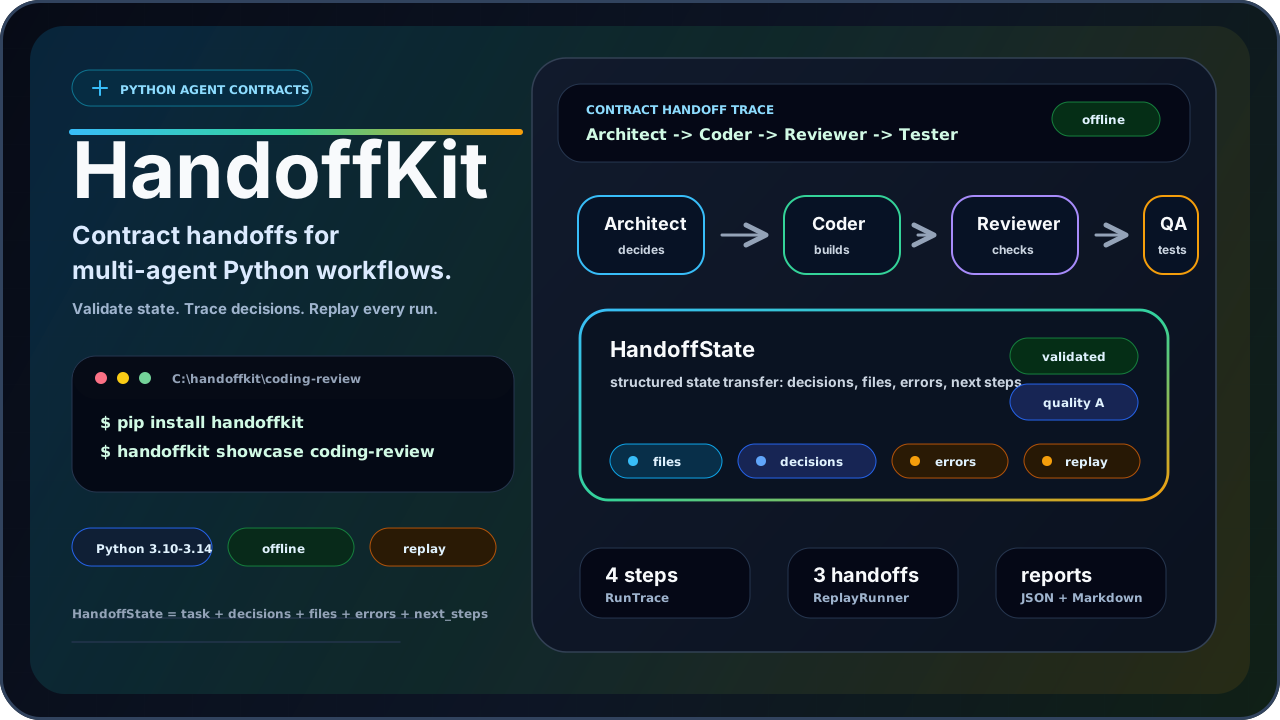
HandoffKit
Structured state transfer for multi-agent Python, JavaScript, Rust, and C++ workflows.
Build agent chains where each agent receives a clear contract: task, decisions, files, errors, next steps, and metadata. No messy context soup.




pip install handoffkit
| Contract-first Agents pass JSON-friendly state instead of vague summaries. |
Cross-runtime Python, JavaScript, Rust, and C++ share canonical fixtures. |
Replayable Trace team, recipe, and tool runs without re-running side effects. |
Offline by default Tests and demos run locally with deterministic providers. |
1.16.0: HK-CSP sessions, bounded channels, ACK/NACK, retries, cancellation, stdio, and cross-runtime protocol contracts.
1.9.0: browser-safe `@handoffkit/core` plus Node-only `@handoffkit/node` filesystem helpers.
1.8.8: installed-package-safe contract parity reports.
1.7.0: shared Python + JavaScript contracts with canonical JSON fixtures.
1.6.0: JavaScript core package with async runtime, provider tool formats, traces, and reports.
1.5.0: media workflow contracts for audiobook and translated video dubbing demos.
1.3.0: tool creation, OpenCode providers, and research-only evidence tools.
1.4.5: native NVIDIA, OpenRouter, Groq, Grok, and OpenAI-compatible provider routing.
1.19.5 security status: Python has an experimental real TLS 1.3/mTLS TCP path with configured/system roots, hostname checks, certificate-derived identity, local authorization, replay protection, and Ed25519 plus provider-detected ECDSA-P256-SHA256 artifact verification. Optional durable replay/local-revocation stores and atomic certificate/trust reload with transition-window rotation are integration-tested; without the durable replay store, replay state still resets on restart. Secure contexts and directly wrapped sockets cannot bypass
SecurityConfig. ECDSA is Python-provider-dependent and is not yet a five-runtime common capability. Hybrid-PQ, CRL/OCSP, OS keystores, zeroization guarantees, and durable channel/session buffers are unavailable. Python's optional scheduler file store preserves queued jobs/counters/dedup state; restarted in-flight assignments become interrupted and require explicit retry/fail by default. The opt-inauto_resume=Truepath requeues them as at-least-once work only; exactly-once effects are not claimed. SeeHK_CSP_SECURITY.md.
Contents
- Quickstart
- HK-CSP Sessions
- Unified Cross-runtime Contracts
- Provider Registry and Model Routing
- JavaScript Core
- Media Workflows
- Tool Creation and Evidence Tools
- Wow in 5 Minutes
- Research-only Benchmarks
- Integrations
- Stable API Surface
- Repository Layout
- Development
- Publishing
What It Is
HandoffKit is a lightweight Python framework for building multi-agent AI workflows where agents pass structured state instead of free-text summaries.
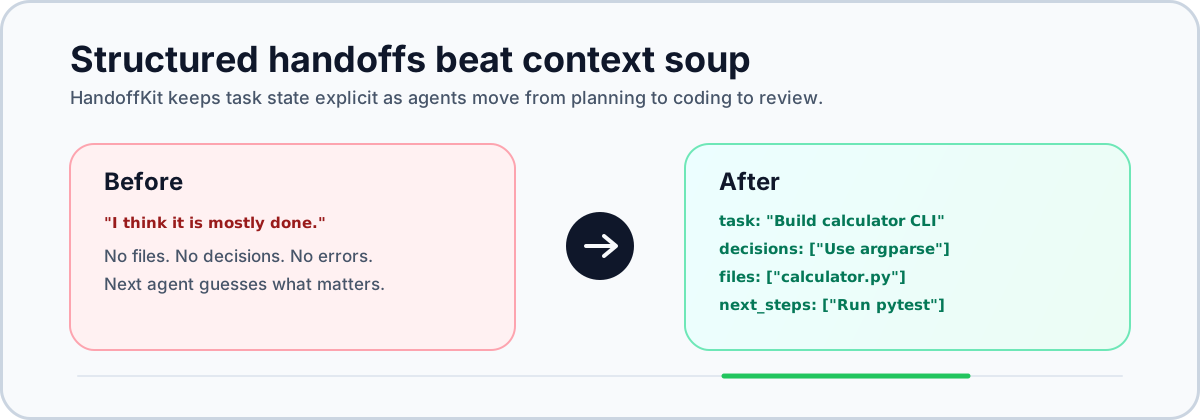
Most multi-agent demos do this:
Agent A -> "Here is roughly what happened..." -> Agent B
HandoffKit does this:
Architect
  task: "Build a calculator CLI"
  decisions: ["Use argparse", "Keep operations pure"]
  files: ["calculator.py", "test_calculator.py"]
  next_steps: ["Implement CLI", "Run pytest"]
        |
        v
Coder
  receives HandoffState, not a vague paragraph
        |
        v
Tester
  receives decisions, files, errors, and test evidence
That makes agent workflows easier to inspect, test, replay, and improve.
HK-CSP Sessions
HandoffState defines what information moves between agents. HK-CSP
defines how, when, and between which processes it moves.
from handoffkit import CspRuntime, RuntimeMode

runtime = CspRuntime(mode=RuntimeMode.SESSION)
session = runtime.create_session(session_id="review-run")
Python 1.16 provides asyncio bounded FIFO channels, blocking backpressure,
ACK/NACK, retry with stable message identity, in-memory deduplication,
cancellation, deadlines, and NDJSON stdio. Existing Agent, Team, and
RecipeRunner behavior remains classic unless session mode is requested.
handoffkit csp doctor
handoffkit csp demo
handoffkit csp inspect shared/contracts/fixtures/message_envelope.json
RuntimeMode.DISTRIBUTED selects the distributed execution label for local CSP
sessions; it is not a network worker router. Cross-runtime worker routing uses
the explicit distributed scheduler APIs, which remain experimental. See the
HK-CSP specification.
Unified Cross-runtime Contracts
HandoffKit 1.16 makes the Python, JavaScript, Rust, and C++ layers speak the
same wire format. The canonical JSON contracts live in
shared/contracts.
- Python uses
HandoffState.to_dict()andRunTrace.to_dict(). - JavaScript uses
toJSON()/JSON.stringify(). - Rust uses serde structs for the shared contract fixtures.
- C++ uses nlohmann/json adapters for the shared contract fixtures.
- The shared wire format uses
snake_case:from_agent,to_agent,important_files,next_steps,run_id,final_output, andtool_results. - JavaScript still exposes ergonomic camelCase properties in memory, such as
state.fromAgentandtrace.finalOutput.
from handoffkit import HandoffState

state = HandoffState.from_dict(shared_json)
state.validate()
import { HandoffState } from "@handoffkit/core";

const state = HandoffState.fromJSON(sharedJson);
console.log(state.fromAgent);
console.log(JSON.stringify(state));
The Python, JavaScript, Rust, and C++ test suites read the same fixture files, so contract drift becomes a CI failure instead of a surprise for users.
from handoffkit import build_contract_parity_report

report = build_contract_parity_report(runtime="python", version="1.16.0")
print(report.to_markdown())
Repository Layout
HandoffKit is organized as a clean monorepo. The Python package published to
PyPI lives in python/packages/handoffkit:
handoffkit/
  shared/
    contracts/         # Shared JSON schemas and cross-runtime fixtures
  python/
    packages/
      handoffkit/        # Python package published to PyPI
        handoffkit/      # import package
        examples/        # demos/, integrations/, fixtures/reports/
        tests/           # Python tests
      handoffkit-localize/  # hk-localize TUI (separate PyPI package)
  js/
    packages/
      core/            # JavaScript/TypeScript package: @handoffkit/core
      csp/             # Browser-safe HK-CSP package: @handoffkit/csp
      node/            # Node.js filesystem package: @handoffkit/node
      ...              # providers, recipes, templates, cli, browser packages
  rust/                # Rust contracts/protocol/runtime/transport workspace
  go/handoffkit/       # Go HK-CSP runtime (source-only module)
  cpp/
    packages/
      handoffkit/      # Native C++ runtime and CLI
      handoffkit-ml/   # C++ ML workers
  docs/
    python/            # Central Python guides, integrations, and demo index
  apps/
    studio-web/        # Next.js Studio and docs app
  validation/
    benchmarks/        # Benchmarks and validation corpora
See docs/MIGRATION-1.19.5.md for the
pre-1.19.5 to current path mapping.
Use the root pnpm workspace for common commands:
pnpm python:test
pnpm python:build
pnpm web:dev
pnpm web:lint
pnpm web:build
Wow in 5 Minutes
Start with a real coding-agent workflow, not an abstract toy:
pip install handoffkit
handoffkit demos
handoffkit showcase coding-review
handoffkit report runs/latest
Or scaffold the same workflow as a tiny editable project:
handoffkit init coding-review
cd coding-review
python coding_review.py
handoffkit report runs/latest
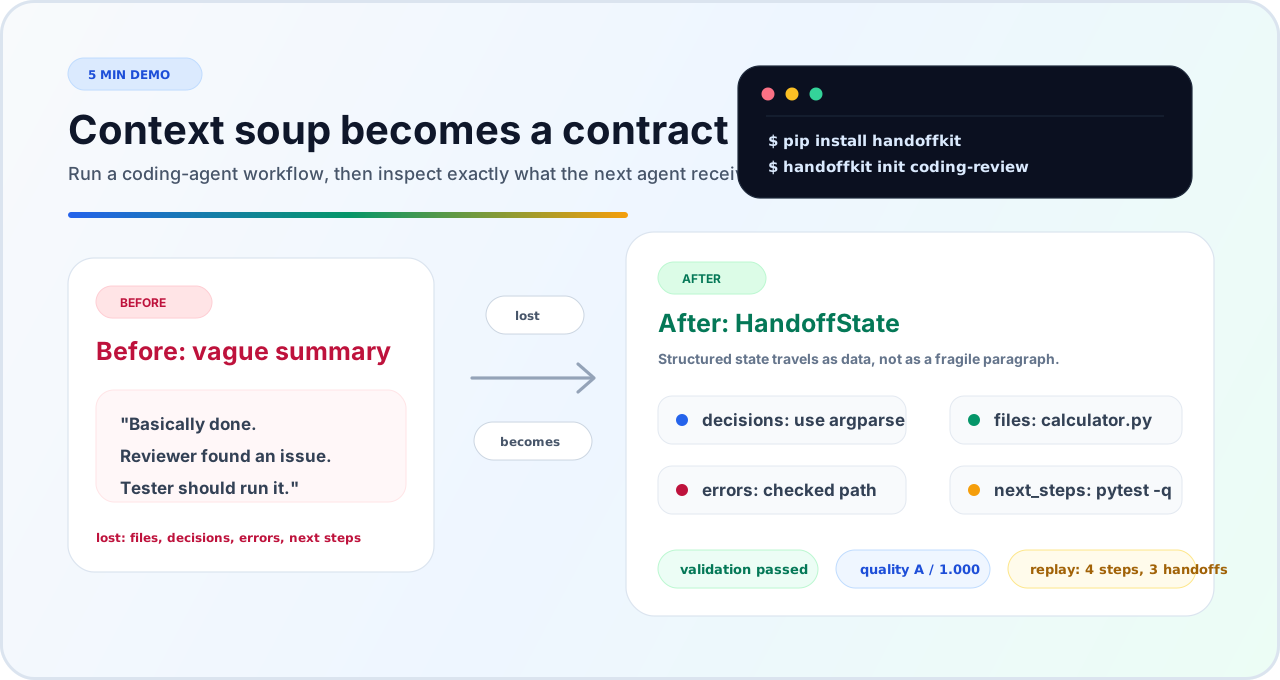
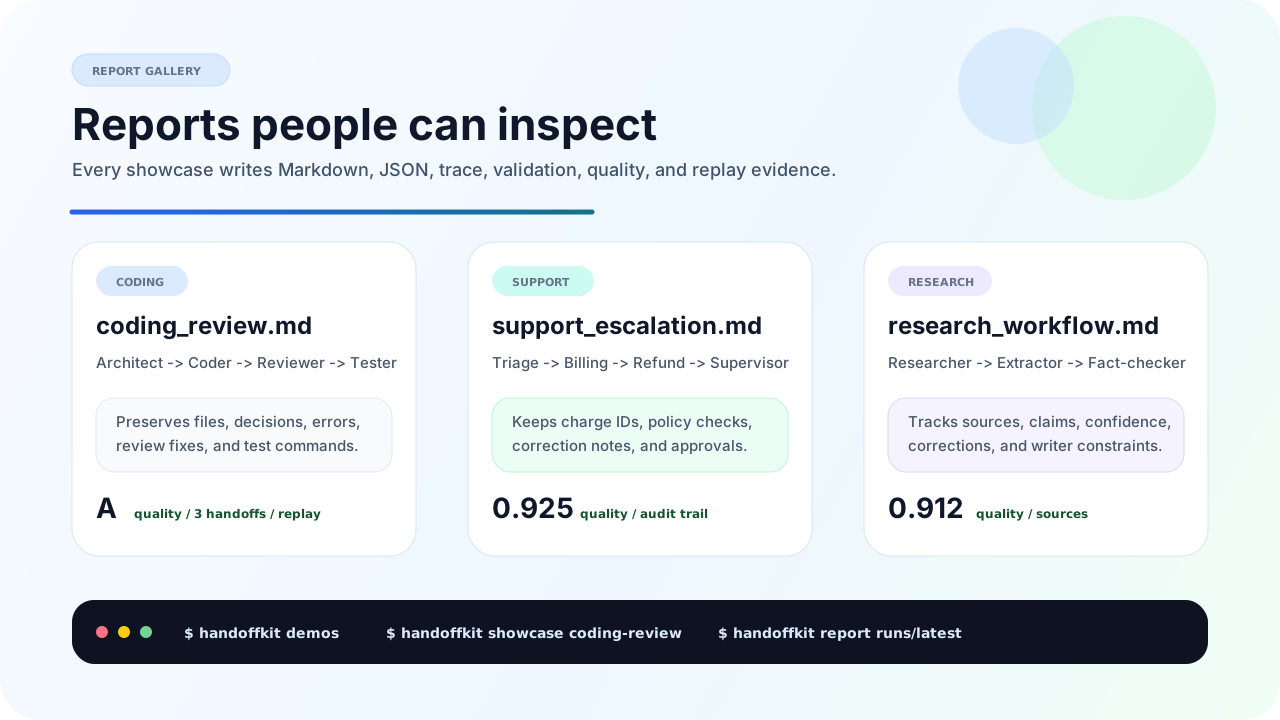
The demo shows the same handoff as a vague free-text summary and as structured
HandoffState: files, decisions, errors, next steps, validation, quality, and
replay evidence stay attached to the work.
Bonus educational healthcare workflow:
handoffkit showcase doctor-orchestrator
handoffkit report runs/latest
doctor-orchestrator is a synthetic demo inspired by virtual physician-panel
orchestration patterns: Intake -> Hypothesis -> Challenger -> Test Steward ->
Checklist -> Final Reviewer. It demonstrates structured uncertainty, missing
questions, red-flag tracking, cost-aware test reasoning, and replayable review
evidence. It is not medical advice.
Real open-access case benchmark preview:
handoffkit benchmark-doctor --cases 30
handoffkit report runs/latest
benchmark-doctor uses 30 real cases from the public MedCaseReasoning test
split, derived from PMC Open Access case reports. It runs in gold_replay mode
as a regression fixture only. It does not claim model diagnostic accuracy,
is not medical advice, and is not the 1.20 official 897-case lab. Use
handoffkit clinical (source checkout only; not in the PyPI wheel) and
/demos/clinical-lab for sequential scoring.
MAI/SDBench-style public benchmark preview:
handoffkit benchmark-doctor-mai --cases 30
handoffkit report runs/latest
benchmark-doctor-mai mirrors the public mechanics described for SDBench:
opening note, gatekeeper, targeted questions, tests, simulated costs, final
diagnosis, trace, and replay. It uses public MedCaseReasoning / PMC Open Access
cases, not private NEJM SDBench data.
Fusion-style model panel preview:
handoffkit demo-fusion
python examples/demos/fusion_style_demo.py
demo-fusion is inspired by multi-model deliberation systems: a panel of model
roles proposes moves, then a deterministic judge reports consensus,
contradictions, coverage gaps, blind spots, and a final next-step strategy.
It runs offline by default. Real provider calls are opt-in through the example
script with --real.
Media dubbing workflow preview:
handoffkit demo-media
handoffkit media inspect examples/output/media_dubbing_demo/transcript_zh.json
handoffkit media plan input_zh.mp4 --from zh --to es
demo-media shows how a Chinese video translation pipeline can pass structured
state through Extract -> Transcribe -> Speaker Map -> Translate -> TTS -> Mux.
It writes transcript JSON, Chinese/Spanish SRT subtitles, a reusable report,
and a handoff contract for the next audio/video stage. It does not call real
transcription, TTS, diarization, or video APIs by default.
Report Gallery
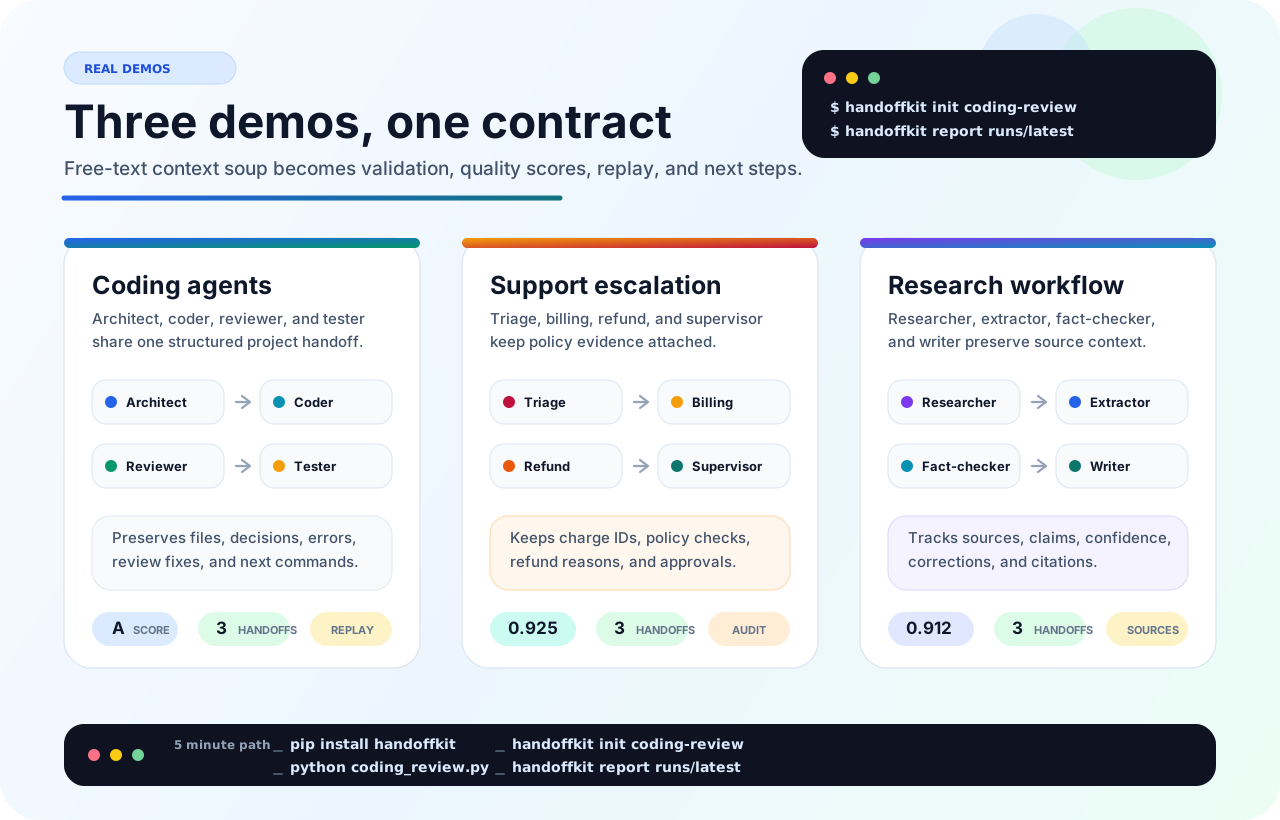
Reports generated by the offline demos:
| Demo | Report | Command |
|---|---|---|
| Coding agents | examples/fixtures/reports/coding_review.md |
handoffkit showcase coding-review |
| Support escalation | examples/fixtures/reports/support_escalation.md |
handoffkit showcase support-escalation |
| Research workflow | examples/fixtures/reports/research_workflow.md |
handoffkit showcase research-workflow |
| Doctor orchestrator | examples/fixtures/reports/doctor_orchestrator.md |
handoffkit showcase doctor-orchestrator |
| Doctor benchmark 30 | examples/fixtures/reports/doctor_benchmark_30.md |
handoffkit benchmark-doctor --cases 30 |
| MAI-style doctor benchmark 30 | examples/fixtures/reports/mai_style_doctor_benchmark_30.md |
handoffkit benchmark-doctor-mai --cases 30 |
| Fusion-style panel | examples/fixtures/reports/fusion_style_demo.md |
handoffkit demo-fusion |
| Media dubbing workflow | examples/fixtures/reports/media_dubbing_demo.md |
handoffkit demo-media |
Technical post: Context Soup vs Contract Handoffs.
Launch copy for Hacker News, Reddit, X/LinkedIn, and LangGraph communities:
docs/python/launch/CONTEXT_SOUP_LAUNCH_KIT.md.
Full showcase gallery: docs/python/SHOWCASE_GALLERY.md.
Visual Overview
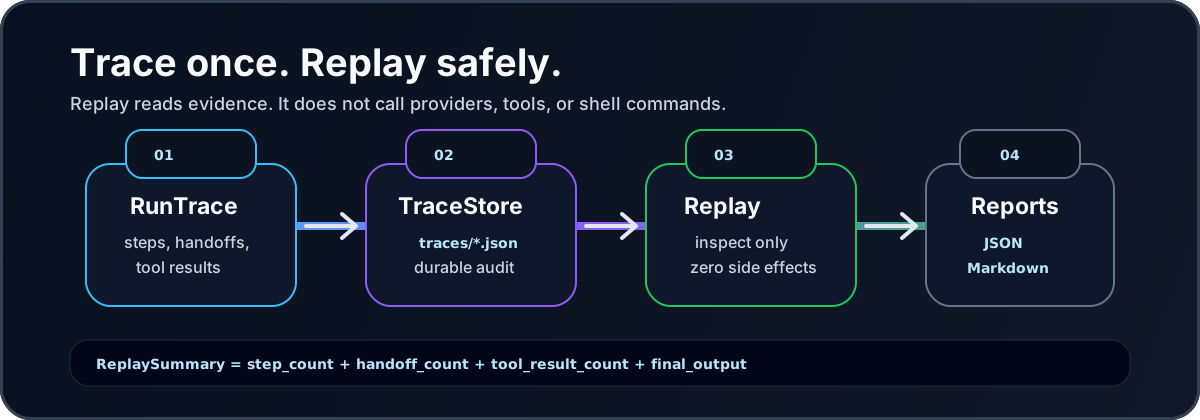
HandoffKit is built around three ideas:
| Layer | API | Why it matters |
|---|---|---|
| State transfer | HandoffState, HandoffProtocol, Team |
Agents receive explicit task, decisions, files, errors, and next steps. |
| Quality control | ValidationReport, HandoffQualityReport |
Handoffs can be validated, scored, serialized, and reviewed. |
| Audit trail | RunTrace, FileTraceStore, ReplayRunner |
Runs can be stored and replay-inspected without providers, tools, or shell. |
What 1.9.0 Adds
HandoffKit 1.9.0 splits the JavaScript/TypeScript layer into browser-safe core and Node-only helpers:
@handoffkit/corefor JS apps that need the same handoff contract shape in browsers, Next.js client components, Vite, Workers, Deno, Bun, or Node,@handoffkit/nodefor local filesystem helpers,- async
Agent.arun()andTeam.arun()helpers, ToolRegistry,ToolCall,ToolResult, andAgent.runWithTools(),ProviderToolAdapterfor HandoffKit, OpenAI, and Anthropic-style tool schemas/calls,FileTraceStore,writeReportFiles(),loadReportJSON(), andProjectIndexerlive in@handoffkit/node.
The JS core package is dependency-free, browser-safe, and tested offline. Provider SDKs and filesystem features are intentionally left to adapter packages or app code.
pnpm js:check
pnpm js:test
JavaScript Core
Use @handoffkit/core when your Next.js/Node app needs structured agent
handoffs without pulling in the Python runtime:
import {
  Agent,
  HandoffProtocol,
  ProviderToolAdapter,
  RunTrace,
  Team,
  defineTool,
} from "@handoffkit/core";

const add = defineTool({
  name: "add",
  description: "Add two numbers.",
  parameters: {
    type: "object",
    properties: { a: { type: "number" }, b: { type: "number" } },
    required: ["a", "b"],
  },
  execute: ({ a, b }) => a + b,
});

const openaiTools = new ProviderToolAdapter().toolsToProviderFormat([add], "openai");

const team = new Team({
  agents: [new Agent({ name: "Architect" }), new Agent({ name: "Coder" })],
  protocol: new HandoffProtocol(),
});

const result = await team.arun("Build a calculator.");
const trace = RunTrace.fromTeamResult(result);
Package source: js/packages/core.
What 1.5.0 Adds
HandoffKit 1.5.0 adds lightweight media workflow contracts and offline demos:
MediaAsset,TranscriptSegment,SpeakerProfile,DubbingSegment, andMediaWorkflowReportfor audiobook, transcription, translation, and dubbing workflows,- subtitle/transcript helpers:
write_srt(),write_transcript_json(), andread_transcript_json(), - optional
ffmpegwrappers for extracting audio and muxing translated audio back into a video, handoffkit demo-mediaandhandoffkit media ...CLI commands.
No media dependency is installed by default. Real transcription, TTS, speaker diarization, source separation, and video processing stay opt-in.
Media Workflows
Use HandoffKit as the contract layer around media agents:
Video -> Audio Extractor -> Transcriber -> Speaker Mapper
      -> Translator -> Voice Generator -> Mixer -> Publisher
The state passed between stages can include:
from handoffkit import TranscriptSegment, SpeakerProfile, build_dubbing_plan, write_srt

segments = [
    TranscriptSegment(1, 0.0, 2.5, "你好", speaker="SPEAKER_01", language="zh"),
]
speakers = [SpeakerProfile("SPEAKER_01", "Narrator", "es-LATAM-calm", "es")]
dubbing = build_dubbing_plan(segments, {1: "Hola."}, speakers)
write_srt(dubbing, "examples/output/media/subtitles_es.srt", translated=True)
Optional ffmpeg helpers are available when an ffmpeg binary is installed:
from handoffkit import extract_audio, mux_audio

extract_audio("input_zh.mp4", "examples/output/media/original.wav")
mux_audio("input_zh.mp4", "dubbed_es.wav", "examples/output/media/output_es.mp4")
Docs: docs/python/MEDIA_WORKFLOWS.md.
What 1.3.0 Adds
HandoffKit 1.3.0 is focused on stronger tool creation and evidence-aware agent workflows:
ToolSpec,ToolFactory,DeclarativeTool, andHttpJsonToolfor building provider-ready tools without hand-writing wrappers,- public medical evidence lookup tools for PubMed, ClinicalTrials.gov, and DailyMed,
- clinical MAI-style MiMo benchmark runner with multi-stage handoffs, adversarial challenge, label normalization, and replayable reports.
Medical tools are for research and benchmark workflows only. They do not diagnose, treat, or replace clinical judgment.
from handoffkit.tools import pubmed_search, clinical_trials_search, dailymed_drug_search

pubmed_search.run(query="scleroderma renal crisis case report", max_results=3)
clinical_trials_search.run(condition="systemic sclerosis", max_results=3)
dailymed_drug_search.run(drug_name="ibuprofen", max_results=3)
Tool Creation and Evidence Tools
HandoffKit 1.3.0 makes tool creation explicit and testable. Use declarative tool specs for local workflows, HTTP JSON wrappers for public APIs, and provider-ready schemas when an agent needs tool calls.
from handoffkit import ToolFactory

factory = ToolFactory()
tool = factory.from_function(
    name="summarize_file",
    description="Summarize a project file for the next agent.",
    func=lambda path: f"summary for {path}",
)

print(tool.to_schema())
Research/evidence helpers are opt-in and public-data only:
python examples/demos/medical_tools_demo.py
python examples/integrations/opencode_go_agent.py --help
python examples/integrations/opencode_zen_agent.py --help
Medical and benchmark tooling is for research workflows only. It is not clinical validation, not patient care, and not a diagnostic system.
What 1.4.5 Adds
HandoffKit 1.4.5 adds native OpenAI-compatible provider entries without adding provider SDK dependencies:
- NVIDIA NIM, including
z-ai/glm-5.2through NVIDIA Build, - OpenRouter unified routing,
- Groq and xAI Grok,
- Together AI, Fireworks AI, DeepInfra, Perplexity, Mistral AI, Cerebras, SambaNova Cloud, and Z.ai / GLM.
All provider CLI commands stay offline unless --real is passed:
handoffkit providers list
handoffkit providers models --provider nvidia
handoffkit providers select --provider openrouter --models openrouter/auto --json
Real probes use provider-specific env vars:
$env:NVIDIA_API_KEY="..."
handoffkit providers probe --provider nvidia --models z-ai/glm-5.2 --real

$env:OPENROUTER_API_KEY="..."
handoffkit providers probe --provider openrouter --models openrouter/auto --real
What 1.4.0 Adds
HandoffKit 1.4.0 adds experimental provider routing:
- provider registry entries for OpenCode Go, OpenCode Zen, OpenAI-compatible endpoints, and Ollama,
ProviderSelectorfor offline model lists and real opt-in probes,ProviderRouterfor ordered fallback between model candidates,- retry/backoff for transient OpenCode
429,5xx, and transport failures, handoffkit providers ...CLI commands that never call real APIs unless--realis passed.
handoffkit providers list
handoffkit providers models --provider opencode-go
handoffkit providers select --provider opencode-go --models mimo-v2.5,deepseek-v4-flash --json
Real probes require an explicit flag and a scoped provider key:
$env:OPENCODE_API_KEY="..."
handoffkit providers probe --provider opencode-go --models mimo-v2.5,deepseek-v4-flash --real
Provider Registry and Model Routing
The provider registry is experimental in 1.4.x. It is intended for diagnostics, model selection, and fallback without adding heavy provider SDKs.
from handoffkit.providers import ModelCandidate, ProviderRouter

router = ProviderRouter(
    [
        ModelCandidate("opencode-go", "mimo-v2.5"),
        ModelCandidate("opencode-go", "deepseek-v4-flash"),
    ]
)

print(router.generate("Create a concise release checklist."))
Docs: docs/python/PROVIDERS.md.
Native providers in 1.4.5:
| Provider | Key env var | Default model |
|---|---|---|
nvidia |
NVIDIA_API_KEY |
z-ai/glm-5.2 |
openrouter |
OPENROUTER_API_KEY |
openrouter/auto |
groq |
GROQ_API_KEY |
llama-3.3-70b-versatile |
grok |
XAI_API_KEY |
grok-4.3 |
together |
TOGETHER_API_KEY |
meta-llama/Llama-3.3-70B-Instruct-Turbo |
fireworks |
FIREWORKS_API_KEY |
accounts/fireworks/models/deepseek-v3p1 |
deepinfra |
DEEPINFRA_API_KEY |
meta-llama/Llama-3.3-70B-Instruct-Turbo |
perplexity |
PERPLEXITY_API_KEY |
sonar-pro |
mistral |
MISTRAL_API_KEY |
mistral-small-latest |
cerebras |
CEREBRAS_API_KEY |
llama3.1-8b |
sambanova |
SAMBANOVA_API_KEY |
Meta-Llama-3.3-70B-Instruct |
zai |
ZAI_API_KEY |
glm-5.2 |
Fusion-style Model Panels
HandoffKit can also model a Fusion-style workflow without external APIs:
- assign specialist roles to a panel,
- collect parallel model answers or deterministic offline stand-ins,
- compare consensus, contradictions, gaps, and blind spots,
- write reusable JSON/Markdown reports.
handoffkit demo-fusion
python examples/demos/fusion_style_demo.py --help
For real provider probes, pass --real and configure provider credentials in
environment variables. The demo never prints tokens and never calls real APIs
unless explicitly requested.
Research-only Benchmarks
HandoffKit includes benchmark tooling to stress-test handoff contracts,
traceability, report generation, and model routing. These workflows are
educational and research-only. gold_replay never counts as diagnostic
accuracy. The 400-case MAI-style summary (233/400) is a legacy research
artifact, not an official 1.20 result. Official 1.20 scored runs require
exactly 897 MedCaseReasoning test cases, three judges, and a complete audit.
This is not a medical device, not clinical validation, not patient care, and not a diagnostic claim. Full model outputs, partials, logs, and OpenCode live artifacts are intentionally kept out of Git and PyPI.
Integrations
HandoffKit is intentionally small: no heavy runtime integrations are required. Use it as the contract and reporting layer beside orchestration frameworks:
LangGraph: graph nodes passHandoffState,OpenAI Agents SDK: agent handoffs become auditable contracts,Pydantic AI: typed outputs become workflow handoff state,OpenCode Go / Zen: provider adapters route OpenCode model families to their matching API endpoint styles.Provider Registry: experimental provider listing, probing, model selection, and fallback routing.
Runnable offline examples:
examples/integrations/langgraph_integration.py,
examples/integrations/openai_agents_sdk_integration.py,
and examples/integrations/pydantic_ai_integration.py.
Release Highlights
Older releases built the stable base that 1.3.0 and 1.4.0 sit on:
| Release | Highlight |
|---|---|
| 1.2.0 | Showcase CLI, report gallery, better onboarding, and integration examples. |
| 1.1.0 | Three real-world demos: coding agents, support escalation, and research workflow. |
| 1.0.x | Stable API, Trusted Publishing docs, security docs, async runtime, templates, and evaluator reports. |
| 0.8-0.9 | Trace/replay, stable API docs, compatibility tests, and stronger provider validation. |
| 0.6-0.7 | Structured outputs, provider tool adapters, contract validators, and quality reports. |
| 0.3-0.5 | Tool execution loop, memory/project context, recipes, and extension APIs. |
For detailed release notes, see CHANGELOG.md.
Why HandoffKit?
Multi-agent systems break when context handoffs are vague. One agent makes a decision, another agent never sees it. One agent finds an error, the next agent gets only a polished summary. Files, constraints, and validation evidence vanish.
HandoffKit gives you:
Agent: a small role-based agent abstraction.HandoffState: a JSON-friendly contract between agents.HandoffProtocol: protocol modes for different transfer styles.Team: sequential multi-agent execution.tool: typed Python tools with schema metadata.EchoProvider: deterministic local provider for tests and demos.OllamaProvider: local Ollama integration.OpenAIProvider: OpenAI and OpenAI-compatible APIs.OpenCodeZenProvider: OpenCode Zen with GPT, Claude, Qwen, DeepSeek, MiniMax, GLM, Kimi, MiMo, Grok, and free model routing.OpenCodeGoProvider: OpenCode Go with curated open coding models.
Core Concept
from handoffkit import Agent, HandoffProtocol

architect = Agent("Architect", "Create implementation plans.")
coder = Agent("Coder", "Implement from structured handoff state.")

protocol = HandoffProtocol(mode="hybrid_state")

state = protocol.transfer(
    from_agent=architect,
    to_agent=coder,
    task="Create a small Python CLI calculator with tests.",
    summary="Build a dependency-free CLI with pytest coverage.",
    decisions=["Use argparse.", "Keep calculator operations pure."],
    important_files=["calculator.py", "test_calculator.py"],
    next_steps=["Implement code.", "Run pytest."],
)

state.validate()
print(state.to_json())
Protocols
| Mode | What it passes | Best for |
|---|---|---|
natural |
Human-readable summary | Simple demos and debugging |
compressed |
Compact summary | Token-sensitive transfers |
hybrid_min |
Task, summary, next steps | Lightweight structured chains |
hybrid_state |
Full state contract | Replayable, testable workflows |
Quickstart
from handoffkit import Agent

agent = Agent(
    name="Planner",
    role="Create concise implementation plans.",
)

print(agent.run("Create a plan for a Python CLI app with tests."))
No API key required. By default, HandoffKit uses EchoProvider, so examples and
tests run locally and deterministically.
Tool Schema Example
from handoffkit import tool


@tool
def add(a: int, b: int) -> int:
    """Add two numbers."""
    return a + b


print(add.to_schema())
print(add.run(a=2, b=3))
Output:
{
    "name": "add",
    "description": "Add two numbers.",
    "parameters": {
        "type": "object",
        "properties": {
            "a": {"type": "integer"},
            "b": {"type": "integer"},
        },
        "required": ["a", "b"],
    },
}
Tool Execution Loop
Register Python tools, let an agent create structured ToolCall objects, execute
them through a ToolRegistry, and receive structured ToolResult objects.
from handoffkit import Agent
from handoffkit.tools.filesystem import list_files, read_file

agent = Agent(
    name="FileAgent",
    role="Use tools to inspect files.",
    tools=[read_file, list_files],
)

result = agent.run_with_tools("read file README.md")
print(result.final_output)
print(result.tool_results)
There are two modes:
- Deterministic/local mode: with
EchoProvider, HandoffKit handles simple tasks such asread file README.md,list files .,write file ..., orrun command .... This is honest local automation, not hidden AI reasoning. - Provider JSON mode: if a provider returns JSON with
tool_calls, HandoffKit executes those tools and feeds results into the next step until the provider returns{"final": "..."}ormax_stepsis reached.
Provider tool-call JSON:
{
  "tool_calls": [
    {
      "tool_name": "read_file",
      "arguments": {
        "path": "README.md"
      }
    }
  ],
  "final": null
}
Safety:
- dangerous shell commands such as
rm -rf,del /s,format,shutdown,reboot,mkfs, anddiskpartare blocked; - when
require_approval=True, write and shell tools returnapproval_requiredinstead of executing.
Structured Outputs + Provider Tool Adapters
Structured outputs matter because multi-agent workflows need machine-checkable contracts, not only polished prose. HandoffKit can ask a provider for JSON, parse common response shapes, validate the result, and perform small safe repairs such as removing Markdown fences or trailing commas.
from handoffkit import Agent, StructuredOutputSchema

schema = StructuredOutputSchema(
    name="TaskSummary",
    fields={
        "title": str,
        "summary": str,
        "success": bool,
    },
    required=["title", "summary", "success"],
)

agent = Agent(name="Reporter", role="Return structured task summaries.")
result = agent.run_structured("Summarize the task.", schema=schema)

print(result.data)
print(result.to_markdown())
Agent.run_structured() sends schema instructions to the provider, parses the
response with JsonOutputParser, validates it with StructuredOutputSchema,
and can use OutputRepairer for simple JSON mistakes. It works with fake or
local providers, so normal tests do not require API keys.
Provider tool adapters keep tool calling provider-agnostic:
from handoffkit import ProviderToolAdapter, ToolRegistry, tool


@tool
def read_file(path: str) -> str:
    """Read a file."""
    return f"read:{path}"


adapter = ProviderToolAdapter()
provider_tools = adapter.tools_to_provider_format([read_file])
tool_calls = adapter.parse_tool_calls(
    {
        "tool_calls": [
            {
                "function": {
                    "name": "read_file",
                    "arguments": '{"path":"README.md"}',
                }
            }
        ]
    }
)

registry = ToolRegistry([read_file])
results = [registry.execute(call) for call in tool_calls]
The internal format stays ToolCall(tool_name="read_file", arguments={...})
whether a provider returns HandoffKit JSON or function-style tool calls. This is
provider-neutral by design; HandoffKit does not require any external SDK for
normal tests.
Handoff Quality Metrics
Quality checks are deterministic and offline. They help compare handoff states without calling a provider or judging prose with another model.
from handoffkit import HandoffQualityEvaluator, HandoffState

state = HandoffState(
    task="Create a Python CLI calculator.",
    from_agent="Architect",
    to_agent="Coder",
    summary="Build an argparse calculator with pure operations and tests.",
    decisions=["Use argparse.", "Keep operations pure."],
    important_files=["calculator.py", "test_calculator.py"],
    next_steps=["Implement calculator.py", "Run pytest -q"],
    context_refs=["README.md#real-task-demo"],
    metadata={"errors_checked": True},
)

report = HandoffQualityEvaluator().evaluate(state)
print(report.score, report.grade)
print(report.to_markdown())
Metrics:
| Metric | Checks |
|---|---|
completeness |
required fields, summary, decisions, files, context, next steps |
clarity |
useful summary length and non-empty decisions |
actionability |
next steps written as concrete actions |
traceability |
important files and context references |
error_awareness |
recorded errors or explicit error-check metadata |
Contract Validators
Validators return ValidationReport objects that can be serialized, rendered as
Markdown, or raised as exceptions. Existing APIs stay compatible:
HandoffState.validate() still returns self or raises HandoffValidationError,
and StructuredOutputSchema.validate() still returns the input dictionary or
raises OutputValidationError.
from handoffkit import (
    HandoffStateValidator,
    StructuredOutputSchema,
    StructuredOutputValidator,
    ToolSchemaValidator,
    tool,
)


@tool
def add(a: int, b: int) -> int:
    """Add two integers."""
    return a + b


schema = StructuredOutputSchema(
    name="Plan",
    fields={"title": str, "ready": bool},
    required=["title", "ready"],
)

print(StructuredOutputValidator().validate(schema, {"title": "Demo", "ready": True}).to_json())
print(ToolSchemaValidator().validate(add).to_markdown())
Provider Tool Formats
ProviderToolAdapter can render tools as HandoffKit, OpenAI function-style, or
Anthropic tool_use schemas. It also parses provider-native tool call payloads
back into HandoffKit ToolCall objects.
from handoffkit import ProviderToolAdapter, tool


@tool
def read_file(path: str) -> str:
    """Read a file."""
    return f"read:{path}"


openai_adapter = ProviderToolAdapter(provider_format="openai")
anthropic_adapter = ProviderToolAdapter(provider_format="anthropic")

print(openai_adapter.tools_to_provider_format([read_file]))
print(anthropic_adapter.tools_to_provider_format([read_file]))

calls = openai_adapter.parse_tool_calls(
    {
        "tool_calls": [
            {
                "id": "call_123",
                "type": "function",
                "function": {"name": "read_file", "arguments": '{"path":"README.md"}'},
            }
        ]
    }
)
print(calls[0].tool_name, calls[0].arguments, calls[0].call_id)
Replayable Workflows
Run traces turn team, recipe, and tool execution reports into durable evidence. Replay does not call providers or tools again; it inspects a saved trace.
from handoffkit import Agent, HandoffProtocol, RunTrace, Team

team = Team(
    agents=[Agent("Planner", "Plan."), Agent("Reviewer", "Review.")],
    protocol=HandoffProtocol(mode="hybrid_state"),
)

result = team.run("Prepare a release checklist.")
trace = RunTrace.from_team_result(result)

print(trace.to_json())
print(trace.to_markdown())
Run Traces
RunTrace can be created from TeamRunResult, RecipeRunResult, and
ToolExecutionReport.
from handoffkit import FileTraceStore, ReplayRunner, RunTrace

trace = RunTrace.from_team_result(result, name="release-checklist")
path = FileTraceStore("traces").save(trace)
loaded = FileTraceStore("traces").load(path)
summary = ReplayRunner(loaded).summary()

print(summary.to_markdown())
Report Files
Any report object with to_json(), to_markdown(), or to_dict() can be
written consistently:
from handoffkit import write_report_files

json_path, markdown_path = write_report_files(trace, "trace_demo")
Evaluation Suite
Use WorkflowEvaluator to check whether workflow artifacts are ready to ship:
from handoffkit import RunTrace, WorkflowEvaluator

trace = RunTrace.from_team_result(team_result)
report = WorkflowEvaluator().evaluate(trace)
print(report.to_markdown())
The evaluator runs offline and checks contracts, handoff quality, replay summaries, trace completeness, and tool result success.
Async Runtime
Synchronous APIs remain the compatibility baseline. Async helpers are additive:
from handoffkit import Agent, Team

team = Team([Agent("Planner", "Plan."), Agent("Reviewer", "Review.")])
result = await team.arun("Prepare a release checklist.")
Providers can implement native agenerate(), or use HandoffKit's default
thread-backed async wrapper.
Project Templates
Start small offline projects with built-in templates:
handoffkit init my-agent --template basic-agent --output .
handoffkit init my-team --template team-workflow --output .
handoffkit init coding-review
handoffkit init support-escalation
handoffkit init research-workflow
Templates never overwrite existing files unless --force is passed.
CLI Doctor
handoffkit doctor
handoffkit api
handoffkit demo-async
handoffkit demo-trace
handoffkit demo-replay
handoffkit demo-coding-review
handoffkit demo-support
handoffkit demo-research
handoffkit demo-doctor
handoffkit report runs/latest
handoffkit validate-report examples/fixtures/reports/trace_demo.json
handoffkit evaluate examples/fixtures/reports/trace_demo.json
doctor runs local package diagnostics only. It does not make network calls and
does not inspect secrets.
Stable API Surface
The following APIs are stable for the 1.x series:
Agent,Team,HandoffState,HandoffProtocol,Tool,ToolCall,ToolResult,ToolRegistry,Recipe,RecipeStep,RecipeRunner,RecipeRunResult,ValidationReport,HandoffQualityReport,WorkflowEvaluator,WorkflowEvaluationReport,ProviderToolAdapter,RunTrace,ReplayRunner,TemplateScaffolder,ProjectTemplate.
See docs/python/API_STABILITY.md and docs/python/ROAD_TO_1_0.md.
Road to 1.0
1.0.0 completes the first stable API commitment. The stable surface is
documented in docs/python/PUBLIC_API.md, migration notes live in
docs/python/MIGRATION_1_0.md, and runtime/test/provider support policy lives in
docs/python/COMPATIBILITY.md.
Memory + Project Context
HandoffKit can store durable project decisions, index local files, retrieve relevant context, and hand explicit references from one agent to the next.
from handoffkit import (
    Agent,
    ContextPack,
    ContextRetriever,
    JsonMemoryStore,
    ProjectIndexer,
)

memory = JsonMemoryStore("examples/output/memory.json")
memory.add(
    "Calculator CLI should use argparse and pure functions.",
    kind="decision",
    tags=["calculator", "cli"],
)

documents = ProjectIndexer(".").index()
retriever = ContextRetriever(documents)
matches = retriever.search("calculator argparse tests", limit=3)

context = ContextPack(
    query="Create a calculator CLI implementation plan.",
    documents=matches,
    memories=memory.search("calculator cli", limit=3),
)

agent = Agent("Architect", "Create concise implementation plans.")
result = agent.run_with_context(
    "Create a concise architecture plan for a Python CLI calculator.",
    context=context,
    memory=memory,
)

print(result.final_output)
print(context.to_markdown())
Run the included demos:
python examples/demos/memory_demo.py
python examples/demos/project_context_demo.py
python examples/demos/context_handoff_demo.py
Recipes + Extension API
Recipes make agent workflows reusable. Instead of wiring the same planner,
executor, reviewer, tools, context, and memory flow by hand in every script, you
can define a Recipe once and run it with RecipeRunner.
from handoffkit import Agent, Recipe, RecipeRunner, RecipeStep

planner = Agent(name="Planner", role="Plan the task.")
executor = Agent(name="Executor", role="Execute the plan.")
reviewer = Agent(name="Reviewer", role="Review the result.")

recipe = Recipe(
    name="plan-execute-review",
    description="A reusable three-step workflow.",
    steps=[
        RecipeStep(name="plan", agent=planner, task="Create a plan."),
        RecipeStep(name="execute", agent=executor, task="Execute the plan."),
        RecipeStep(name="review", agent=reviewer, task="Review the output."),
    ],
)

result = RecipeRunner(recipe).run()
print(result.to_markdown())
Templates create common workflow shapes:
from handoffkit import Agent, WorkflowTemplate

recipe = WorkflowTemplate.sequential(
    name="simple-workflow",
    agents=[
        Agent("Architect", "Plan."),
        Agent("Coder", "Build."),
        Agent("Tester", "Test."),
    ],
    task="Build a small calculator.",
)
Extensions bundle recipes and tools safely:
from handoffkit import Extension, ExtensionRegistry

registry = ExtensionRegistry()
registry.register(
    Extension(
        name="coding",
        description="Local coding workflows.",
        version="0.1.0",
        recipes=[recipe],
        tools=[],
    )
)

print([recipe.name for recipe in registry.recipes()])
HandoffKit does not ship Git/GitHub APIs as core primitives. A repository agent can be built as an extension or recipe using HandoffKit's general tools: structured state, memory, context packs, recipes, and extension registries.
Real Task Demo
HandoffKit includes a reproducible real task demo:
python examples/demos/real_task_calculator.py
It runs this workflow:
Architect -> Coder -> Tester -> Reporter
Task:
Create a tiny Python CLI calculator with add, subtract, multiply and divide
operations, plus tests.
The demo creates a real generated project:
examples/output/calculator_cli/
  calculator.py
  test_calculator.py
  README.md
It also writes reproducibility reports:
examples/fixtures/reports/real_task_calculator.md
examples/fixtures/reports/real_task_calculator.json
The generated project is tested with pytest, and the report captures command,
cwd, return code, stdout, stderr, files created, provider used, model used, and
handoff flow.
Providers
Local deterministic provider
from handoffkit import Agent

agent = Agent("Planner", "Plan work.")
print(agent.run("Prepare a package release."))
Ollama
ollama pull llama3.1
ollama serve
python examples/integrations/ollama_agent.py --model llama3.1
OpenAI-compatible APIs
$env:OPENAI_API_KEY="..."
$env:OPENAI_BASE_URL="https://api.freemodel.dev/v1"
$env:OPENAI_MODEL="gpt-4o-mini"
python examples/integrations/freemodel_openai_compatible.py
Optional real API tests are skipped unless explicitly enabled:
$env:HANDOFFKIT_RUN_API_TESTS="1"
$env:OPENAI_API_KEY="..."
$env:OPENAI_BASE_URL="https://api.freemodel.dev/v1"
$env:OPENAI_MODEL="gpt-4o-mini"
pytest tests_api -q
Use temporary or scoped provider tokens. Do not commit API keys.
OpenCode Go and OpenCode Zen
HandoffKit can call OpenCode Go and OpenCode Zen without adding provider SDK
dependencies. Use one OPENCODE_API_KEY; choose the catalog-specific model with
OPENCODE_GO_MODEL or OPENCODE_ZEN_MODEL. For offline model lists, probes,
selection, and fallback routing, use the provider registry commands above.
$env:OPENCODE_API_KEY="..."
$env:OPENCODE_GO_MODEL="deepseek-v4-flash"
python examples/integrations/opencode_go_agent.py
$env:OPENCODE_API_KEY="..."
$env:OPENCODE_ZEN_MODEL="gpt-5.4"
python examples/integrations/opencode_zen_agent.py
Docs:
docs/python/integrations/OPENCODE.md and
docs/python/PROVIDERS.md.
CLI
handoffkit --version
handoffkit demo
handoffkit demo-async
handoffkit demo-recipe
handoffkit demo-extension
handoffkit demo-structured
handoffkit demo-provider-tools
handoffkit demo-quality
handoffkit demo-validators
handoffkit demo-provider-formats
handoffkit doctor
handoffkit api
handoffkit demo-trace
handoffkit demo-replay
handoffkit validate-report examples/fixtures/reports/trace_demo.json
handoffkit evaluate examples/fixtures/reports/trace_demo.json
handoffkit providers list
handoffkit providers models --provider opencode-go
handoffkit providers select --provider opencode-go --models mimo-v2.5,deepseek-v4-flash --json
handoffkit init my-agent --template basic-agent --output .
Examples
python examples/demos/simple_agent.py
python examples/demos/coding_review.py
python examples/demos/support_escalation.py
python examples/demos/research_workflow.py
python examples/demos/doctor_orchestrator.py
python examples/demos/handoff_demo.py
python examples/demos/coding_team.py
python examples/demos/tool_schema_demo.py
python examples/demos/tool_execution_demo.py
python examples/demos/fake_provider_tool_call_demo.py
python examples/integrations/opencode_go_agent.py
python examples/integrations/opencode_zen_agent.py
python examples/demos/structured_output_demo.py
python examples/demos/provider_tool_adapter_demo.py
python examples/demos/handoff_quality_demo.py
python examples/demos/contract_validation_demo.py
python examples/demos/provider_tool_formats_demo.py
python examples/demos/evaluation_demo.py
python examples/demos/async_demo.py
python examples/demos/template_demo.py
python examples/demos/trace_demo.py
python examples/demos/replay_demo.py
python examples/demos/provider_matrix_demo.py
python examples/demos/structured_recipe_demo.py
python examples/demos/recipe_demo.py
python examples/demos/coding_review_recipe.py
python examples/demos/extension_demo.py
python examples/demos/memory_demo.py
python examples/demos/project_context_demo.py
python examples/demos/context_handoff_demo.py
python examples/demos/real_task_calculator.py
Development
git clone https://github.com/DaosPath/handoffkit.git
cd handoffkit
cd python/packages/handoffkit
pip install -e ".[dev]"
Run checks:
ruff check .
pytest -q
python -m build
python -m twine check dist/*
From the repository root, the same checks are available as:
pnpm python:lint
pnpm python:test
pnpm python:build
pnpm python:twine
Publishing
HandoffKit 1.0.0 was uploaded manually with twine. HandoffKit 1.0.1 and later
are prepared for PyPI Trusted Publishing through GitHub Actions OIDC.
Trusted Publishing keeps package tokens out of the repository and out of GitHub
Secrets. TestPyPI publishing is triggered manually from the Publish workflow;
real PyPI publishing is triggered by publishing a GitHub Release after CI is
green.
Trusted Publisher settings must be configured on TestPyPI and PyPI before using the workflow:
- owner:
DaosPath - repository:
handoffkit - workflow:
publish.yml - TestPyPI environment:
handoffkit - PyPI environment:
pypi
See docs/python/RELEASE_PROCESS.md for the full release checklist.
Local build validation still uses:
python -m build
python -m twine check dist/*
Inspiration
HandoffKit is inspired by the research and reproducibility repository
DaosPath/state-transfer-protocols,
especially its comparison of natural, compressed, hybrid_min, and
hybrid_state handoff protocols for multi-agent workflows.
HandoffKit is a developer library, not a copy of that repository.
Roadmap
- 1.x compatibility maintenance,
- richer memory persistence adapters after 1.0,
- broader provider-specific integration examples,
- benchmark-inspired quality comparisons,
- more workflow templates and extension examples.
License
MIT.
1 maintainer

Metadata
1 maintainer
Release files for handoffkit 1.20.0
For a detailed explanation of source distributions (sdists) and built distributions (wheels), please see the package formats documentation.
Source distribution (sdist)
| File | Size | Uploaded | |
|---|---|---|---|
| handoffkit-1.20.0.tar.gz | 627.3 kB | Details |
Built distribution (wheel)
| File | Interpreter | ABI | Platform | Reset |
|---|---|---|---|---|
| handoffkit-1.20.0-py3-none-any.whl | Python 3 | none | any | Details |
Total release size: 973.3 kB
Release files / handoffkit-1.20.0.tar.gz
| Download URL | handoffkit-1.20.0.tar.gz |
|---|---|
| Size | 627.3 kB |
| Tags | Source |
|
SHA-256 checksum How to use checksums |
741986fcb265721d8830b492996d81b666f9d93c0820eec713432af0166f7fce
|
|
BLAKE2b-256 checksum How to use checksums |
d2cc6af758581ca50076150a7998d4deb9d2e494925ccc085e7ed4e19a33cad4
|
| Upload date | |
|
Uploaded using Trusted Publishing? What is trusted publishing? |
Yes |
| Uploaded via |
twine/7.0.0 CPython/3.13.14
|
Provenance
Provenance describes where a file came from. On PyPI, provenance is shared via attestations, which provide a verifiable record of the build or publishing details. View details, limitations and caveats.


PyPI Publish Attestation
PyPI verified that this artifact, at this checksum, originated from the publisher listed below.
Signed by GitHub Actions, verified by PyPI on Oct 15, 2026.
Transparency logRelease files / handoffkit-1.20.0-py3-none-any.whl
| Download URL | handoffkit-1.20.0-py3-none-any.whl |
|---|---|
| Size | 346.0 kB |
| Tags | Python 3 |
|
SHA-256 checksum How to use checksums |
429539b36fa7780779aada0392e22a37481c960c8915ed3736f702fc050439a8
|
|
BLAKE2b-256 checksum How to use checksums |
bcdace45c777b153cbad86c9555b82ea7af75a8bd9aee5aa6bab0d3a53d7f7e0
|
| Upload date | |
|
Uploaded using Trusted Publishing? What is trusted publishing? |
Yes |
| Uploaded via |
twine/7.0.0 CPython/3.13.14
|
Provenance
Provenance describes where a file came from. On PyPI, provenance is shared via attestations, which provide a verifiable record of the build or publishing details. View details, limitations and caveats.
PyPI Publish Attestation
PyPI verified that this artifact, at this checksum, originated from the publisher listed below.
Signed by GitHub Actions, verified by PyPI on Oct 15, 2026.
Transparency log













