

Helm
The local operations layer for long-running AI agents.
Coding, ops, research, automation — any agent that runs for hours on the same workspace.
Profiles before commands · Checkpoints before risky work · Durable history after the chat is gone.






Landing · Quickstart · What Helm does · Workflows · Docs · 한국어
Quickstart
pip install helm-agent-ops
helm init --path ~/.helm/workspace
export HELM_WORKSPACE=~/.helm/workspace
Run your first inspection under a declared risk profile:
helm profile run inspect_local --task-name "first look" -- git status --short
helm status --brief
helm dashboard
The first command produces a guarded execution record. The second shows what just happened in plain English. The third lays out the workspace state on one page.
No PyPI? Use the bootstrap installer:
curl -fsSL https://raw.githubusercontent.com/JDeun/Helm/main/install.sh | bash
Why Helm
Long-running AI agents drift. They forget prior decisions, execute risky actions before you can stop them, and leave behind a chat log nobody can audit a week later — regardless of whether the agent is editing code, running ops, organizing notes, browsing sites, or chaining tool calls.
Helm is a thin, file-backed operations layer that sits around your existing agent runtime. It does not replace your agent. It makes the agent's work boundable, recoverable, and reviewable.
The model proposes actions; the harness validates, authorizes, executes, records, and returns observations. Safety and completion claims should come from execution evidence, not from prompt advice or a compacted chat transcript.
| Without Helm | With Helm |
|---|---|
| Risky commands run as soon as the agent decides | Commands run under a declared execution profile with a guard check |
| Multi-step or multi-file changes leave you guessing what happened | Checkpoint created before the work; visible rollback point |
| "What did the agent do yesterday?" → scroll the chat | Local task ledger, command log, dashboard, markdown report |
| Context lives in the chat window | File-backed memory + ranked retrieval rehydrates the next session |
| Skill rules live in prompts | SKILL.md + contract.json enforce policy at run time |
If your agent only runs one-off demos, you do not need Helm. If you run it for hours on the same workspace — coding, ops, knowledge capture, or any mix — you do.
What Helm does

A three-minute demo
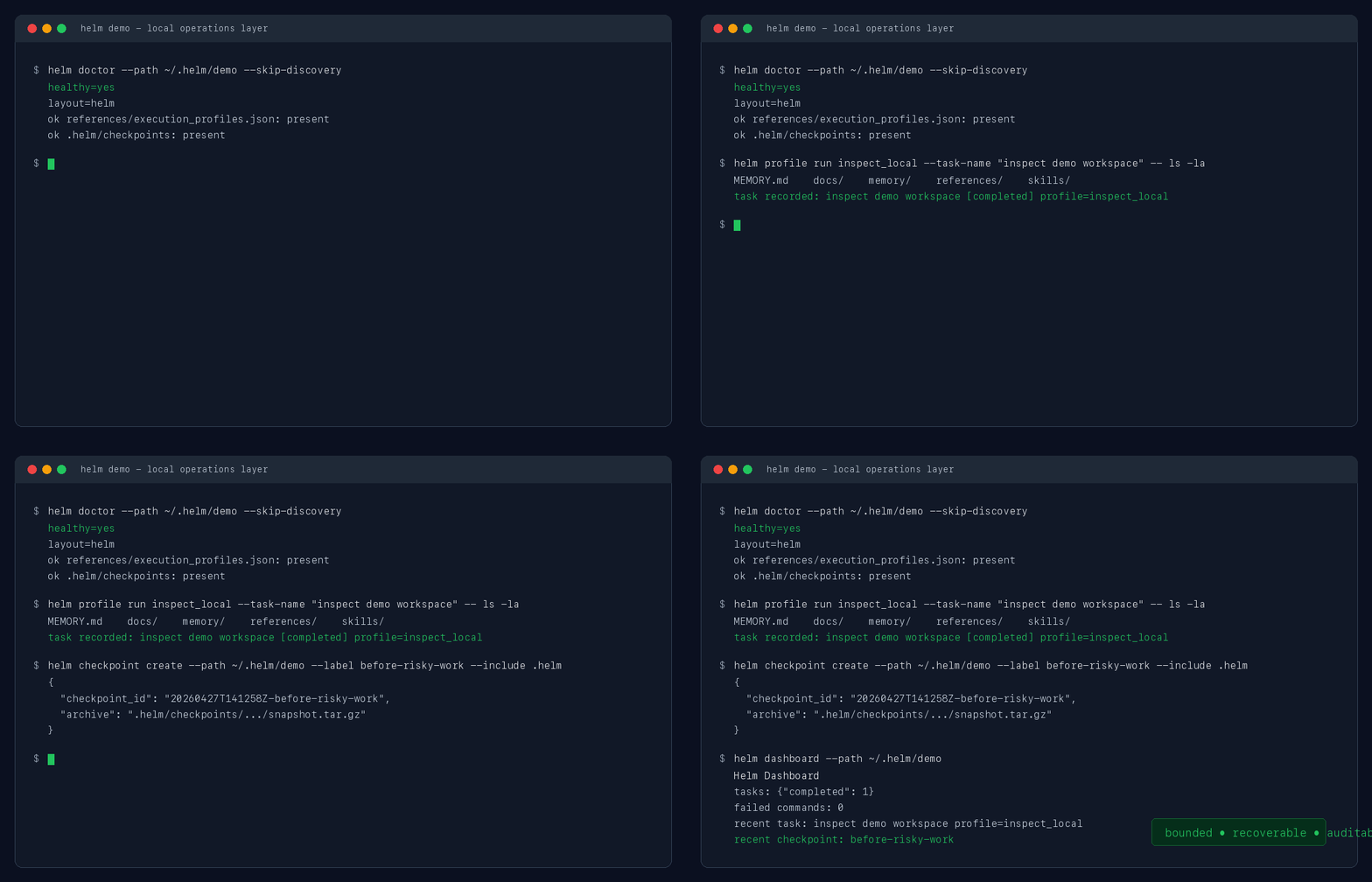
helm profile run inspect_local --task-name "inspect current repository" -- git status --short
helm checkpoint create --label before-risky-work --include $HELM_WORKSPACE
helm report --format markdown
helm dashboard
Each command leaves a structured record on disk: task ledger, command log, checkpoint record, dashboard summary. None of it requires the agent to remember anything.
Workflows
Inspect the workspace
helm doctor
helm status --brief
helm dashboard
helm reconcile              # dry-run: report reference drift vs the desired snapshot
helm verify-contract        # assert behavioral operating invariants still hold
Run a command under a declared profile
helm profile run inspect_local --task-name "inspect repository state" -- git status --short
helm profile run workspace_edit --task-name "tighten typing in api/" -- ruff check api/
Adopt existing systems as context sources
helm survey
helm onboard --use-detected --dry-run
helm onboard --use-detected
Check rollback and recent state
helm checkpoint-recommend
helm checkpoint list
helm task list --status running
helm task doctor
helm report --format markdown
Query durable context with inspectable ranking
helm context --mode decisions --explain-ranking --json
helm context --mode timeline --since 2026-05-01
helm context --mode entity --entity project_helm
helm context --mode reflect-candidates
Run a privacy boundary preflight
helm privacy scan --text "Contact alice@example.com" --json
helm privacy tokenize --scope task-123 --text "Contact alice@example.com"
Review stale skill claims
helm skill-lifecycle negative-claims --persist
helm skill-lifecycle revalidation-due
helm skill-lifecycle revalidate-claim \
  --skill old-skill \
  --claim-id sha256:abc123 \
  --status resolved \
  --note "command now exists"
Review run contracts and improvement candidates
helm run-contract --json
helm capability-diff --json
helm skill-promotion digest --json
helm shadow-report --since 14 --format md --with-recommendations
Probe model health
helm health state --json
helm health select --profile inspect_local --context-tokens 4096 --json
python3 scripts/model_health_probe.py probe --model omfm/balanced --json
Every command also accepts
--path /custom/workspaceif you do not want to use$HELM_WORKSPACE. The demo workspace atexamples/demo-workspaceis safe to point at.
v1.0.0 — helm.-nested namespace, no compat shim
Current release: v1.0.0 — released 2026-09-28.
Breaking change. The four unprefixed top-level packages scripts, commands,
references and memory_tree now live under the helm package: helm.scripts,
helm.commands, helm.references, helm.memory_tree. Installing helm-agent-ops
previously claimed scripts and commands — two of the most common directory names
in Python projects — and could silently shadow a user's own package of that name;
that happened to helm's own only user. There is no compatibility alias —
replace from scripts.X import Y with from helm.scripts.X import Y, and likewise
for commands, references and memory_tree, before upgrading.
- 443 import sites across 158 files were rewritten. The installed distribution now
declares five top-level names (
helm,helm_context,helm_frontmatter,helm_state_model,helm_workspace) instead of nine. helm.pyis now a package (helm/cli.pyplus a lazyhelm/__init__.py). Thehelmconsole script andimport helm; helm.main([...])are unchanged;python -m helmis now also supported.
v0.13.0 — operations-layer hardening
v0.13.0 — released 2026-07-16. This release imports patterns proven in live agent operation.
helm reconcilere-applies workspace reference files against the packaged desired snapshot — drift-tolerant and idempotent, reporting drift instead of clobbering local overrides.helm verify-contractasserts behavioral operating invariants (guard deny/fail-closed, approval TTL/consume-once, atomic ledger), complementing structuraldoctor/validate.- Deterministic skill routing (
scripts/skill_router.py), a generic tool/MCP adapter registry (scripts/tool_adapter.py+references/connectors.json), and grounding-by-guidance-injection with a deterministic template fallback (scripts/grounding.py). - Source-provenance tiering refuses to promote model-generated-only claims; fast-ACK intake dedups retried deliveries; tasks record their interpreter fingerprint and
run_checkpointusessys.executable; non-file checkpoint backends fingerprint dependencies before a runtime bump.
v0.12.0 — evidence-aware workflow governance
v0.12.0 — released 2026-07-13. This release makes workflow boundaries and completion claims explicit and inspectable.
references/workflow_units.yamldefines allowed inputs, live sources, mutation surfaces, verification, reporting, handoff, and stop contracts.python3 scripts/workflow_registry.pyvalidates those contracts before adoption.- Reply gates carry structured claims, evidence references, refuter findings, and arbiter decisions.
- State snapshots preserve active scope, loaded context, planned mutations, pending claims, evidence, and retrieval traces.
- Verified execution runs executor → evidence gatherer → criterion verifier with bounded retries; service readback is trusted only from its dedicated allowlist or actual remote/provider readback.
- Source bundles centralize claims, lineage, derived-artifact readback, fidelity, cross-bundle conflict, and transactional materialization checks.
- Memory quality labels are decayed on capture and retrieval; the optional OMFM router remains behind context, canary, and low-risk runtime gates.
v0.10.2 — loop and skill-intake primitives
Released 2026-06-24. This patch adds read-only loop validation and conservative external skill-intake classification.
helm loops validateandhelm loops inspectvalidate reusable workflow contracts.- Completion-evidence and docs-sweep loop examples define evidence and stop conditions before runner work.
helm skill-intake classifyandhelm skill-intake validateprovide a conservative review path for external skill candidates.
v0.10.1 — ledger attribution patch
Released 2026-06-20. This patch keeps task-ledger attribution inspectable across profiled runs and chat memory captures.
- Completed, blocked, and guard-audit ledger rows now record
experience_attribution. helm memory capture-chatkeepsqueued/runningrows free of final-only memory and attribution payloads.- Chat capture rows preserve
conversationas the selected tool for attribution.
v0.10.0 — harness-engineering layer
Released 2026-05-22. Everything new ships in shadow mode by default — decisions are logged but not enforced until you opt in.
- Failure signature classification — every failure event normalizes to
{component, tool, profile, error_class, target, fingerprint}so the same failure is recognizable across runs. - Profile → tool-group grants — each execution profile exposes only the tools it should; runner records the grant in every ledger row.
- Repeated-failure policy transitions — same-fingerprint, patch-failed, same-skill, and credential-invalid-grant patterns automatically pick a next action (stop / decompose / repair / re-auth).
- Patch-first edit policy + validation gates — file edits prefer patch operations; per-extension validation commands run after writes.
- Task-state control container — Forge's "Control Flow Is Not Memory" principle: required-steps, completed-steps, blockers, approvals, and recovered messages live as structured state, not transcript content.
- Trace recorder → trace replay → skill candidate — every run produces a JSON trace; recurring success patterns surface as skill drafts; recurring failures surface as repair candidates.
- Profile pause / resume — secret-token-gated hard stop per profile, gated by
OPENCLAW_PAUSE_GATE. - Browser work verifier — pre-flight decision (
allow_single_session,block_mutation,require_user_login,require_confirmation,pause_profile,require_cleanup_evidence) with a runner-side enforcement gate. - Model repair + synthetic respond hooks — library entry points for small-model fallback proxies; gated by
HELM_MODEL_REPAIRandHELM_SYNTHETIC_RESPOND. - Shadow-mode reporter —
helm shadow-report --since 14 --with-recommendationsaggregates 14 days of signals and emitsready_to_enforce / needs_more_data / caution / no_signalper feature.
See the full v0.10.0 notes and the 13-document docs/harness-engineering/ directory for the design.
Workspace model
Helm runs in a dedicated workspace, treating existing systems as read-only context sources first.
- Helm state lives under
.helm/inside the workspace. - Profiles, notes, policies, and skill rules stay as explicit files.
- OpenClaw, Hermes, and notes vaults can be adopted instead of overwritten.
- JSONL is the append-only source of truth; SQLite is a query index.
How Helm compares
| Category | Better for | Helm adds |
|---|---|---|
| Agent frameworks (LangChain, AutoGen, etc.) | prompts, planners, tool loops, agent graphs | profiles, guard decisions, checkpoints, task ledgers |
| Observability (Langfuse, Helicone, etc.) | hosted traces, service metrics | pre-execution policy + local recovery state |
| Evaluation (DeepEval, Phoenix, etc.) | scoring model output | operational history around repeated human-agent work |
| Shell wrappers (cmd helpers) | command convenience | workspace state, memory capture, reports, recovery discipline |
See deeper comparisons in docs/comparisons/.
Documentation
| Get started | Core concepts | Advanced |
|---|---|---|
Research background
Helm's design follows the findings in Harness Design Determines Operational Stability in Small Language Models, which experimentally studies how planning, verification, and recovery harnesses affect operational stability. Its adaptive-harness direction is also informed by It's Not the Capability: Harness Sensitivity Is Non-Monotone Across LLM Agent Tiers, which shows that harness strictness should be selected by model type and failure mode rather than applied uniformly.
Cite Helm:
@software{helm_2026,
  title  = {Helm: A stability-first operations layer for long-lived agent workspaces},
  author = {Cho, Yong Eun},
  year   = {2026},
  url    = {https://github.com/JDeun/Helm},
  version = {0.13.0}
}
See CITATION.cff for the machine-readable form.
Contributing
Issues and pull requests welcome.
- Read
CONTRIBUTING.mdbefore opening a PR. - Run the test suite:
python -m pytest -q(currently 1,596 tests). - Run the release checks:
python scripts/release_version_check.py --version <next>. - Security reports: see
SECURITY.md.
Release history
- Latest: v1.0.0 — breaking:
scripts/commands/references/memory_treemoved underhelm.*, no compat shim - Previous: v0.13.0, v0.12.0, v0.10.2, v0.10.1, v0.10.0
- Full changelog:
CHANGELOG.md· older release notes
What Helm does NOT include
Helm ships only the public operations layer. It does not include:
- Private memory contents
- Personal agent overlays
- Credentials or secrets
- Raw task content from any specific workspace
- Live connector tokens
The repository is safe to fork, clone, and inspect.
License
1 maintainer

Metadata
1 maintainer
Release files for helm-agent-ops 1.0.0
For a detailed explanation of source distributions (sdists) and built distributions (wheels), please see the package formats documentation.
Source distribution (sdist)
| File | Size | Uploaded | |
|---|---|---|---|
| helm_agent_ops-1.0.0.tar.gz | 586.1 kB | Details |
Built distribution (wheel)
| File | Interpreter | ABI | Platform | Reset |
|---|---|---|---|---|
| helm_agent_ops-1.0.0-py3-none-any.whl | Python 3 | none | any | Details |
Total release size: 1.0 MB
Release files / helm_agent_ops-1.0.0.tar.gz
| Download URL | helm_agent_ops-1.0.0.tar.gz |
|---|---|
| Size | 586.1 kB |
| Tags | Source |
|
SHA-256 checksum How to use checksums |
f319d5f65c270fd202c717f142d5fc470edbcd307d35b29b2f48416f2b686db2
|
|
BLAKE2b-256 checksum How to use checksums |
ca49802c3006389c48f0c1d4d3b5425f16bccc9b103687e62af555abcac82b35
|
| Upload date | |
|
Uploaded using Trusted Publishing? What is trusted publishing? |
Yes |
| Uploaded via |
twine/7.0.0 CPython/3.13.14
|
Provenance
Provenance describes where a file came from. On PyPI, provenance is shared via attestations, which provide a verifiable record of the build or publishing details. View details, limitations and caveats.


PyPI Publish Attestation
PyPI verified that this artifact, at this checksum, originated from the publisher listed below.
Signed by GitHub Actions, verified by PyPI on Sep 29, 2026.
Transparency logRelease files / helm_agent_ops-1.0.0-py3-none-any.whl
| Download URL | helm_agent_ops-1.0.0-py3-none-any.whl |
|---|---|
| Size | 450.2 kB |
| Tags | Python 3 |
|
SHA-256 checksum How to use checksums |
8d992ed17b20053b7055d6a38326d2819d3cb5d69042e7750ab7b0391f63e867
|
|
BLAKE2b-256 checksum How to use checksums |
c730894fb73ac4c979f8b081c96221cbc01e9bfd7ba963ce86f8b81911e60929
|
| Upload date | |
|
Uploaded using Trusted Publishing? What is trusted publishing? |
Yes |
| Uploaded via |
twine/7.0.0 CPython/3.13.14
|
Provenance
Provenance describes where a file came from. On PyPI, provenance is shared via attestations, which provide a verifiable record of the build or publishing details. View details, limitations and caveats.
PyPI Publish Attestation
PyPI verified that this artifact, at this checksum, originated from the publisher listed below.
Signed by GitHub Actions, verified by PyPI on Sep 29, 2026.
Transparency log













