
Hermes Plugin Guard


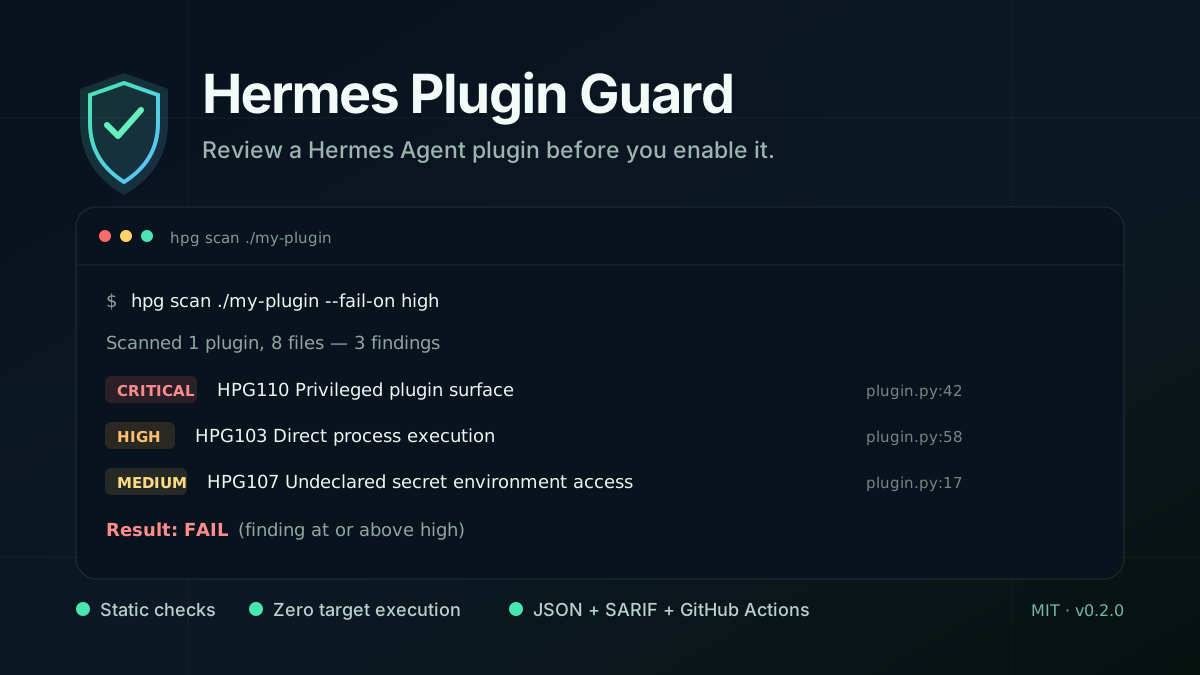
Review a Hermes Agent plugin before you enable it.
Hermes Plugin Guard (hpg) is a local static scanner for
NousResearch Hermes Agent plugins. It
checks plugin manifests, Python source, dependency declarations, likely secret material, and
basic repository hygiene. Target plugin code is read as data: it is never imported or executed.
This is an unofficial community project. It is not affiliated with, endorsed by, or maintained by Nous Research.
Read the engineering note: I turned a Hermes plugin scanner into a Hermes plugin. It still cannot be an admission gate.
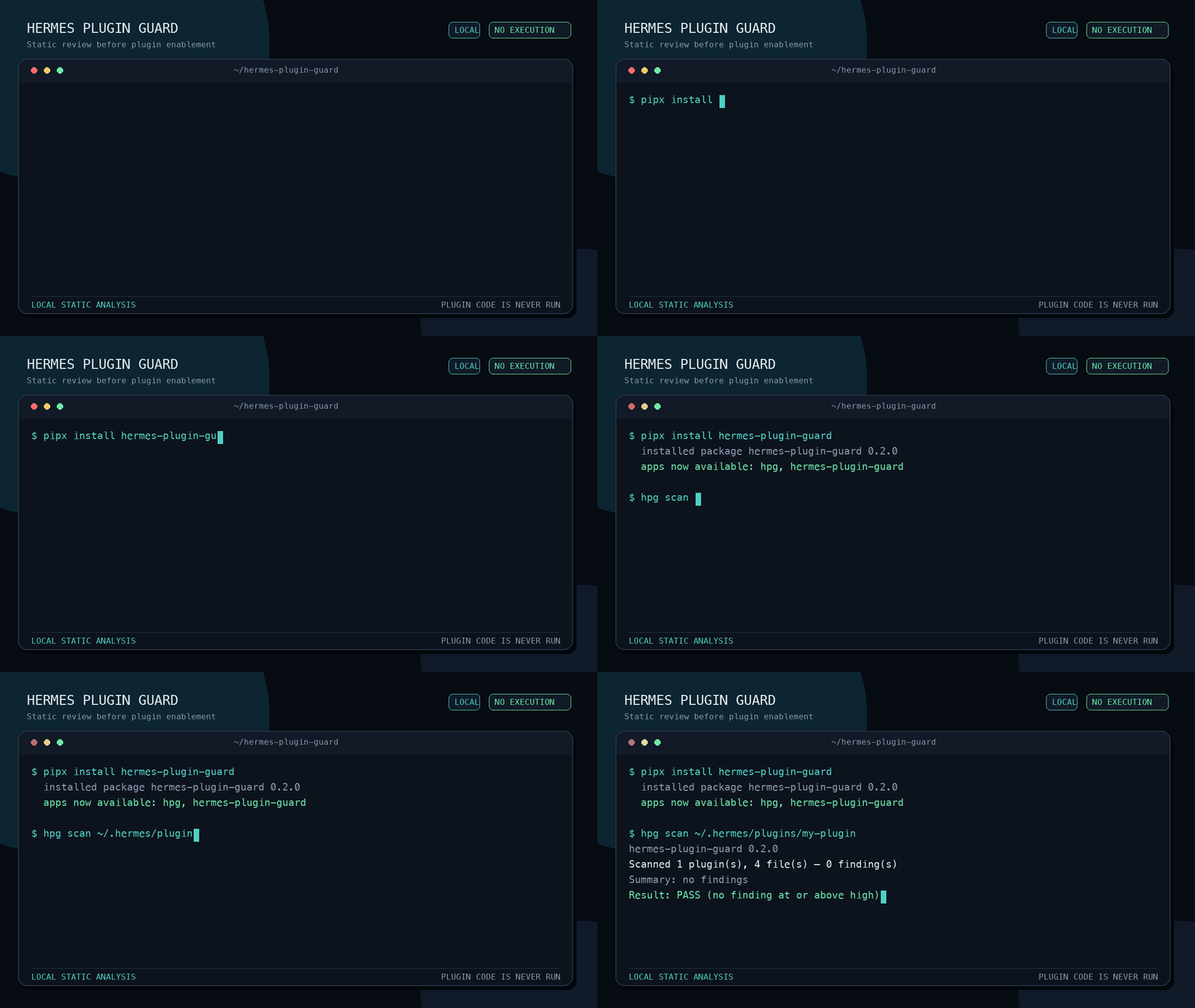
Five-minute beta test
If you maintain or use a Hermes plugin, one local scan is enough to help improve the rules. Python 3.11 or newer and pipx are required.
-
Install the current release from PyPI:
pipx install hermes-plugin-guard
-
Scan your plugin without failing the command on findings:
hpg scan /absolute/path/to/your-plugin --fail-on none
-
Send a short beta-test report with the rule IDs that were useful, noisy, or missing. A public plugin URL is helpful but not required.
The standalone hpg scan stays on your computer. It reads target files as data, does not import
or execute target plugin code, makes no network requests, includes no telemetry, and uploads
neither source code nor results. The optional native Hermes tool has a different, explicitly
documented privacy boundary below. Do not paste private code, credentials, or unsanitized paths
into a public issue.
Already installed? Use pipx upgrade hermes-plugin-guard. For a reproducible installation
directly from the tagged source, install the v0.2.1 GitHub release:
pipx install \
  "git+https://github.com/mauricemohr88-debug/hermes-plugin-guard.git@v0.2.1"
Why this exists
Hermes plugins are Python extensions, not isolated data files. A third-party plugin can register
tools and hooks and can run with the permissions of the Hermes process. Code review remains the
most important control; hpg adds a fast, repeatable first pass before enablement and in CI.
The scanner is designed to make high-risk patterns visible, including:
- direct subprocess calls that bypass Hermes' terminal-tool approval path;
- dynamic execution and unsafe deserialization;
- sensitive-path access, destructive filesystem operations, and disabled TLS verification;
- all-interface listeners, networking capability, concrete outbound calls with redacted destinations, and undeclared secret environment variables;
- privileged registration and middleware surfaces, plus work performed during import or registration;
- likely committed credentials, mutable remote dependencies, and remote scripts piped to shells;
- plugin declaration drift, missing tests, and missing project policies.
Install
Python 3.11 or newer is required.
Install the current release from PyPI with pipx (recommended for command-line tools):
pipx install hermes-plugin-guard
Alternatively, install reproducibly from the tagged GitHub source:
pipx install \
  "git+https://github.com/mauricemohr88-debug/hermes-plugin-guard.git@v0.2.1"
Or install from a local checkout:
git clone https://github.com/mauricemohr88-debug/hermes-plugin-guard.git
cd hermes-plugin-guard
python -m pip install .
Both hpg and hermes-plugin-guard invoke the same command.
Native Hermes v0.20.5+ integration
Hermes Plugin Guard can also be installed as a native, review-only Hermes plugin from Git. The
/src suffix is intentional: current Hermes releases scan that runtime-only subtree before
installation, without including this project's deliberately adversarial test fixtures. Keep the
plugin disabled during installation, then enable the guard itself without granting tool-override
permission:
hermes plugins install mauricemohr88-debug/hermes-plugin-guard/src --no-enable
hermes plugins enable hermes-plugin-guard --no-allow-tool-override
Hermes v0.20.5 and v0.20.6 do not retain .git metadata for a subdirectory installation, so
hermes plugins update hermes-plugin-guard cannot update this layout. Disable an existing
installation before replacing its files; --no-enable by itself does not disable a plugin
that is already enabled. Then reinstall the same reviewed source and enable it again only after
review:
hermes plugins disable hermes-plugin-guard
hermes plugins install mauricemohr88-debug/hermes-plugin-guard/src \
  --force \
  --no-enable
hermes plugins enable hermes-plugin-guard --no-allow-tool-override
The package also advertises the standard hermes_agent.plugins entry point. That path is useful
only when hermes-plugin-guard is installed into the same Python environment as Hermes;
installing the standalone CLI with pipx intentionally uses a separate environment. Use either
the Git subdirectory installation or the same-environment package entry point as the native
plugin source, not both.
In a new Hermes process you can use the operator CLI:
hermes plugin-guard rules
hermes plugin-guard scan /path/to/a/plugin --fail-on high
The safest manual review sequence for another Git plugin is:
hermes plugins install owner/repository --no-enable
hermes plugin-guard installed plugin-name --fail-on high
hermes plugins enable plugin-name --no-allow-tool-override
Hermes also receives one read-only model tool, plugin_guard_review_candidate. It accepts only an
installed plugin key below HERMES_HOME/plugins, refuses currently enabled plugins, applies fixed
high-severity policy, and returns at most 20 findings. The strict native path scans runtime-capable
directories such as tests, build, and generated, rejects unsupported executable binaries,
and runs the analyzer in a single resource-bounded worker. Its response contains only rule IDs,
severity, opaque location IDs, bounded line numbers, and bounded counts; it omits filenames,
source, finding messages, evidence, dependency strings, secrets, internal tree digests, and
absolute paths. That bounded response becomes part of the active Hermes conversation and may
therefore be sent to the configured model provider. Exclusive, model-provider, and
Hermes-detected legacy memory or cron-scheduler plugins use separate activation paths. Those
candidates are rejected by this tool rather than being incorrectly described as disabled.
This integration does not intercept or replace Hermes' native install, update, enable, or load paths. Hermes v0.20 has no third-party plugin-admission hook, so the guard cannot honestly enforce a scan before every activation. Hermes' own install-time scanner is a separate host control. The native surface here is a convenient additional review step; the operator still makes the activation decision. Its private before/after digest detects endpoint changes during a review, but it is not an atomic filesystem snapshot or sandbox. A generic upstream admission-policy proposal is already registered with the Hermes plugin-interface tracker.
Usage
Scan one plugin directory:
hpg scan /path/to/my-plugin
Scan a repository containing multiple plugins and fail when a high or critical finding exists:
hpg scan /path/to/plugins-repository --fail-on high
The scanner recognizes directory plugins using plugin.yaml, dashboard-only plugins using
dashboard/manifest.json, and pip-distributed plugins using
[project.entry-points."hermes_agent.plugins"] in pyproject.toml.
Write machine-readable results:
hpg scan ./my-plugin --format json --output hpg.json
hpg scan ./my-plugin --format sarif --output hpg.sarif
Show GitHub workflow annotations:
hpg scan ./my-plugin --format github
Exclude a reviewed rule for one invocation:
hpg scan ./my-plugin --exclude HPG106 --exclude HPG203
List the complete rule catalog and remediation guidance:
hpg rules
The default failure threshold is high. Use --fail-on critical, high, medium,
low, info, or none to set policy. Exit code 0 means no finding reached the selected
threshold, 1 means the policy threshold was reached, and 2 indicates an invocation or scan
error.
Output
hpg keeps rule IDs stable so findings can be discussed and tracked across runs.
| Format | Intended use |
|---|---|
text |
Human-readable local review (default) |
github |
File and line annotations in GitHub Actions logs |
json |
Automation, baselines, and custom reporting |
sarif |
SARIF-compatible code-scanning consumers |
JSON includes the scan root, plugin and file counts, severity totals, sorted findings, and a stable fingerprint for each finding. SARIF includes rule metadata and source locations. Output is deterministic for unchanged inputs.
GitHub Actions
The repository includes a composite action:
name: Plugin security

on:
  pull_request:

permissions:
  contents: read

jobs:
  guard:
    runs-on: ubuntu-latest
    steps:
      - uses: actions/checkout@3d3c42e5aac5ba805825da76410c181273ba90b1 # v7.0.1
        with:
          persist-credentials: false
      - uses: mauricemohr88-debug/hermes-plugin-guard@v0.2.1
        with:
          path: path/to/plugin
          fail-on: high
          format: github
For stronger supply-chain controls, pin hermes-plugin-guard to a reviewed full commit SHA
instead of a moving tag.
Rules at a glance
| IDs | Area | Examples |
|---|---|---|
HPG001–HPG006 |
Declaration | Missing or invalid declarations, unknown kind, entry point and hook drift |
HPG101–HPG112 |
Python | Execution, deserialization, processes, sensitive paths, network and privileged behavior |
HPG201–HPG204 |
Supply chain | Likely secrets, mutable dependencies, unbounded versions, remote installers |
HPG301–HPG303 |
Project | License, security policy, and automated tests |
Run hpg rules for the current severity, explanation, and suggested remediation for every rule.
Network-egress inventory
HPG106 reports that a plugin imports a network-capable module. HPG112 is more specific: it
reports a concrete outbound request or connection and records the statically visible destination.
The scanner never resolves DNS or makes a request while doing this.
Destination evidence is deliberately limited to the scheme, hostname, and port. User information,
paths, query strings, fragments, headers, and payloads are never copied into a finding. Dynamic or
relative destinations are reported as <dynamic destination>. Loopback calls default to low,
encrypted external calls to medium, and explicitly cleartext HTTP, FTP, WebSocket, or gRPC and
link-local/cloud-metadata targets to high. Raw TCP and SMTP stay medium because the protocol may
upgrade to TLS after connecting.
Threat model
The scanner assumes a plugin directory may be untrusted and inspects it without importing its Python modules. It aims to catch explicit, statically visible patterns that deserve human review. It also helps maintainers enforce a consistent minimum policy in pull requests.
Scanning is a review aid, not a sandbox, signature verifier, malware detector, or proof that a plugin is safe. Enabling a plugin still grants its code the permissions of the Hermes process. Review the source, dependencies, requested environment variables, network destinations, and maintainer history before installation.
Limitations
- Static analysis cannot reliably resolve dynamically constructed names, paths, commands, or network destinations.
- Egress checks cover common Python HTTP, WebSocket, socket, FTP, SMTP, and gRPC APIs. Calls hidden behind dependencies, arbitrary SDK wrappers, native extensions, or dashboard JavaScript can require manual review.
- A finding describes a risky capability or pattern, not necessarily a vulnerability.
- The absence of findings does not establish safety.
- Secret matching is heuristic and may produce false positives or miss encoded or split secrets.
- Dependency checks inspect
requirements*.txt,pyproject.toml, and relevantplugin.yamldeclarations; they do not resolve, download, or audit dependency contents. - Symlinks and oversized files are skipped rather than followed or executed.
- Suppressions are command-line policy choices and should be documented in the consuming project.
If a result looks wrong, please open an issue with the smallest safe reproducer. Never attach live credentials or private plugin code to a public report.
Development and contributing
Contributions are welcome, especially focused detection rules with both positive and negative tests. See CONTRIBUTING.md for setup and design expectations, SECURITY.md for private vulnerability reporting, and CODE_OF_CONDUCT.md for community standards.
License
MIT. See LICENSE.
1 maintainer

Metadata
1 maintainer
Release files for hermes-plugin-guard 0.2.1
For a detailed explanation of source distributions (sdists) and built distributions (wheels), please see the package formats documentation.
Source distribution (sdist)
| File | Size | Uploaded | |
|---|---|---|---|
| hermes_plugin_guard-0.2.1.tar.gz | 79.3 kB | Details |
Built distribution (wheel)
| File | Interpreter | ABI | Platform | Reset |
|---|---|---|---|---|
| hermes_plugin_guard-0.2.1-py3-none-any.whl | Python 3 | none | any | Details |
Total release size: 131.1 kB
Release files / hermes_plugin_guard-0.2.1.tar.gz
| Download URL | hermes_plugin_guard-0.2.1.tar.gz |
|---|---|
| Size | 79.3 kB |
| Tags | Source |
|
SHA-256 checksum How to use checksums |
38346efbfa8d84e7c9fc92fcd63e422824ccde4d344ac9b0c6e34c133da3a7ef
|
|
BLAKE2b-256 checksum How to use checksums |
7881f7963bafb3f3ffbebbf354167c396f261793fe44de721ccab6ea16575168
|
| Upload date | |
|
Uploaded using Trusted Publishing? What is trusted publishing? |
Yes |
| Uploaded via |
twine/6.1.0 CPython/3.13.14
|
Provenance
Provenance describes where a file came from. On PyPI, provenance is shared via attestations, which provide a verifiable record of the build or publishing details. View details, limitations and caveats.


PyPI Publish Attestation
PyPI verified that this artifact, at this checksum, originated from the publisher listed below.
Signed by GitHub Actions, verified by PyPI on Aug 31, 2026.
Transparency logRelease files / hermes_plugin_guard-0.2.1-py3-none-any.whl
| Download URL | hermes_plugin_guard-0.2.1-py3-none-any.whl |
|---|---|
| Size | 51.8 kB |
| Tags | Python 3 |
|
SHA-256 checksum How to use checksums |
a55e89a677ce4a2aa866d7edc36e04fe9acd333e973381966871a463ec4585c4
|
|
BLAKE2b-256 checksum How to use checksums |
4e87f3e7472fb51019132edc5b501685afdc5d7d8d04d6f8acec64155c016a83
|
| Upload date | |
|
Uploaded using Trusted Publishing? What is trusted publishing? |
Yes |
| Uploaded via |
twine/6.1.0 CPython/3.13.14
|
Provenance
Provenance describes where a file came from. On PyPI, provenance is shared via attestations, which provide a verifiable record of the build or publishing details. View details, limitations and caveats.
PyPI Publish Attestation
PyPI verified that this artifact, at this checksum, originated from the publisher listed below.
Signed by GitHub Actions, verified by PyPI on Aug 31, 2026.
Transparency log













