
HGQ2: High Granularity Quantization 2




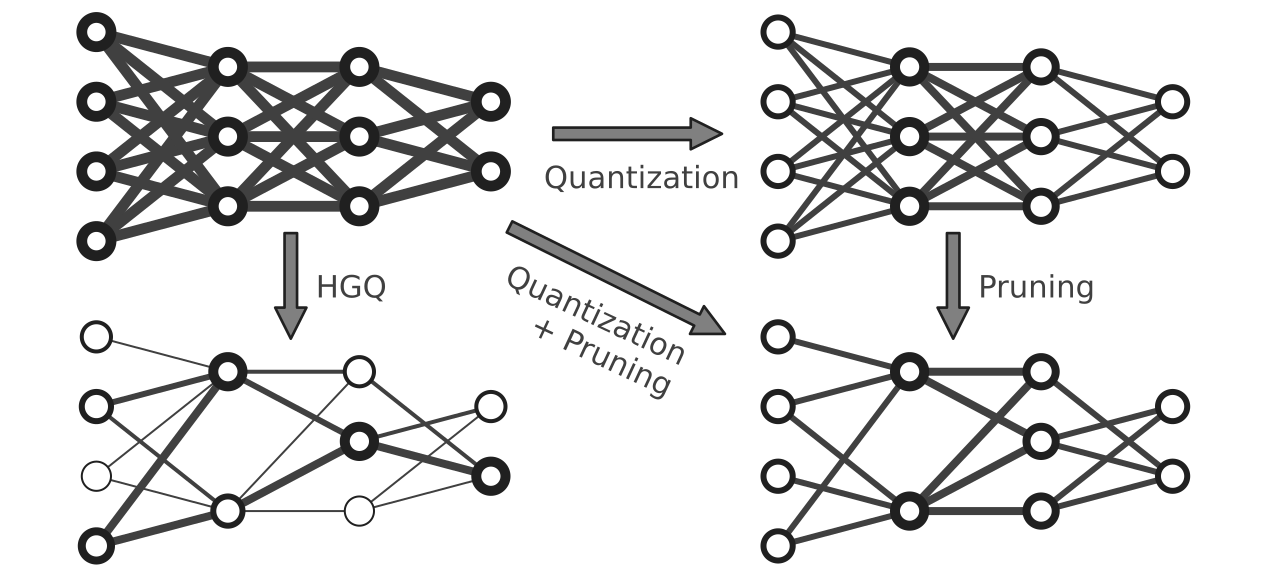
HGQ2 (High Granularity Quantization 2) is a quantization-aware training framework built on Keras v3, targeting real-time deep learning applications on edge devices like FPGAs. It provides a comprehensive set of tools for creating and training quantized neural networks with minimal effort.
HGQ2 implements an gradient-based automatic bitwidth optimization and quantization-aware training algorithm. By laveraging gradients, it allows for bitwidth optimization at arbitrary granularity, up to per-weight and per-activation level.
- High Granularity: HGQ supports per-weight and per-activation bitwidth optimization, or any other lower granularity.
- Automatic Quantization: Bit-widths are optimized via gradients, no need to manually tune them in general.
- What you see is what you get: One get exactly what you get from
Kerasmodels fromRTLmodels.- still subject to machine float precision limitation.
- Accurate Resource Estimation:
EBOPsestimated by HGQ gives a good indication of the actual resource usage on FPGA, either upper limit ofLUT(da4ml) orLUT + 55 * DSP(hls4ml).
In addition, this framework improves upon the old HGQ implementation in the following aspects:
- Scalability: HGQ2 supports
TensorFlow,JAX, andPyTorch. As XLA compilation inJAXandTensorFlowcan significantly speed up the training process. Training speed on HGQ2 can be 1.2-5 times faster than the previous implementation. - Quantizers:
- Fixed-point: While the last implementation only optimizes the number of floating bits with one way of parameterizing the fixed-point numbers, HGQ2 supports multiple ways of parametrizing them, and allows of optimizing any part of them via gradients.
- Minifloat: Training with minifloat quantization is supported, also with surrogate gradients support (alpha quality).
- More Layers: More layers are supported now, including the powerful
EinsumDense(BatchNorm)layer and theMultiHeadAttentionlayer with bit-accurate softmax and scaled dot-product attention.
Installation
pip install HGQ2
If you are using da4ml, please make sure it is at least version 0.6:
pip install da4ml>=0.6
If you are using hls4ml, please make sure it is at least version 1.2:
pip install hls4ml>=1.2.0
Usage
Please refer to the documentation for more details on how to use the library.
A minimal example is shown below:
   import keras
   from hgq.layers import QDense, QConv2D
   from hgq.config import LayerConfigScope, QuantizerConfigScope

   # Setup quantization configuration
   # These values are the defaults, just for demonstration purposes here
   with (
      # Configuration scope for setting the default quantization type and overflow mode
      # The second configuration scope overrides the first one for the 'datalane' place
      QuantizerConfigScope(place='all', default_q_type='kbi', overflow_mode='SAT_SYM'),
      # Configuration scope for enabling EBOPs and setting the beta0 value
      QuantizerConfigScope(place='datalane', default_q_type='kif', overflow_mode='WRAP'),
      LayerConfigScope(enable_ebops=True, beta0=1e-5),
   ):
      model = keras.Sequential([
         QConv2D(32, (3, 3), activation='relu'),
         keras.layers.MaxPooling2D((2, 2)),
         keras.layers.Flatten(),
         QDense(10)
      ])
Citation
If you use HGQ2 in your research, please consider citing the following paper:
@inproceedings{hgq,
  author = {Sun, Chang and Que, Zhiqiang and Aarrestad, Thea and Loncar, Vladimir and Ngadiuba, Jennifer and Luk, Wayne and Spiropulu, Maria},
  title = {HGQ: High Granularity Quantization for Real-time Neural Networks on FPGAs},
  year = {2026},
  isbn = {9798400720796},
  publisher = {Association for Computing Machinery},
  address = {New York, NY, USA},
  url = {https://doi.org/10.1145/3748173.3779200},
  doi = {10.1145/3748173.3779200},
  booktitle = {Proceedings of the 2026 ACM/SIGDA International Symposium on Field Programmable Gate Arrays},
  pages = {79–91},
  numpages = {13},
  keywords = {quantization-aware training, fpga, real-time inference, neural networks, hardware-software codesign, low-latency, quantization},
  location = {USA},
  series = {FPGA '26}
}
If LUT-based layers are used, please also cite the following paper:
@inproceedings{hgq-lut,
  author={Sun, Chang and Que, Zhiqiang and Zadeh, Bakhtiar and Liu, Qibin and Alvarez, Kevin H. and Luk, Wayne and Spiropulu, Maria},
  booktitle={2026 IEEE 34th Annual International Symposium on Field-Programmable Custom Computing Machines (FCCM)},
  title={HGQ-LUT: Fast LUT-Aware Training and Efficient Architectures for DNN Inference},
  year={2026},
  volume={},
  number={},
  pages={19-28},
  keywords={Modeling;Table lookup;Training;Field programmable gate arrays;Timing;Manuals;Hardware;Accuracy;Neural networks;Elementary particles;machine learning;lookup-based inference;quantization;co-design;fpga},
  doi={10.1109/FCCM68464.2026.00017},
  series = {FCCM '26}
}
1 maintainer

Download files
Download the file for your platform. If you're not sure which to choose, learn more about installing packages.
Source Distribution
Built Distribution
Filter files by name, interpreter, ABI, and platform.
If you're not sure about the file name format, learn more about wheel file names.
Copy a direct link to the current filters
File details
Details for the file hgq2-0.2.0.tar.gz.
File metadata
- Download URL: hgq2-0.2.0.tar.gz
- Upload date:
- Size: 214.2 kB
- Tags: Source
- Uploaded using Trusted Publishing? Yes
- Uploaded via:
twine/7.0.0 CPython/3.13.14
File hashes
| Algorithm | Hash digest | |
|---|---|---|
| SHA256 |
9b10d53d13c9c88ff68ff6258ff744294d36ccd66374069e2890255598c9a59e
|
|
| MD5 |
df50b178d70ba81fe3b60065fa26cc20
|
|
| BLAKE2b-256 |
1e12c8da359b843b6e2e8a16058b7b6b35a9e1a09cdf8a0adae6ca2cde0000dd
|
Provenance
The following attestation bundles were made for hgq2-0.2.0.tar.gz:
Publisher:
python-publish.yml on calad0i/HGQ2
-
Statement:
-
Statement type:
https://in-toto.io/Statement/v1 -
Predicate type:
https://docs.pypi.org/attestations/publish/v1 -
Subject name:
hgq2-0.2.0.tar.gz -
Subject digest:
9b10d53d13c9c88ff68ff6258ff744294d36ccd66374069e2890255598c9a59e - Sigstore transparency entry: 2626673239
- Sigstore integration time:
-
Permalink:
calad0i/HGQ2@ecc0435b75affc406e99c840a3839164156384e9 -
Branch / Tag:
refs/tags/v0.2.0 - Owner: https://github.com/calad0i
-
Access:
public
-
Token Issuer:
https://token.actions.githubusercontent.com -
Runner Environment:
github-hosted -
Publication workflow:
python-publish.yml@ecc0435b75affc406e99c840a3839164156384e9 -
Trigger Event:
release
-
Statement type:
File details
Details for the file hgq2-0.2.0-py3-none-any.whl.
File metadata
- Download URL: hgq2-0.2.0-py3-none-any.whl
- Upload date:
- Size: 125.2 kB
- Tags: Python 3
- Uploaded using Trusted Publishing? Yes
- Uploaded via:
twine/7.0.0 CPython/3.13.14
File hashes
| Algorithm | Hash digest | |
|---|---|---|
| SHA256 |
c47086535b2bae33bdd186590733f44cebd7a0160029cab2b1d3eb05cb8c1164
|
|
| MD5 |
8071fba8e1e4a27f17bbeb65f8ef6236
|
|
| BLAKE2b-256 |
9c8c0fe11c8254911e93ab403531884602c628928c07e8429c3084c744f13159
|
Provenance
The following attestation bundles were made for hgq2-0.2.0-py3-none-any.whl:
Publisher:
python-publish.yml on calad0i/HGQ2
-
Statement:
-
Statement type:
https://in-toto.io/Statement/v1 -
Predicate type:
https://docs.pypi.org/attestations/publish/v1 -
Subject name:
hgq2-0.2.0-py3-none-any.whl -
Subject digest:
c47086535b2bae33bdd186590733f44cebd7a0160029cab2b1d3eb05cb8c1164 - Sigstore transparency entry: 2626673245
- Sigstore integration time:
-
Permalink:
calad0i/HGQ2@ecc0435b75affc406e99c840a3839164156384e9 -
Branch / Tag:
refs/tags/v0.2.0 - Owner: https://github.com/calad0i
-
Access:
public
-
Token Issuer:
https://token.actions.githubusercontent.com -
Runner Environment:
github-hosted -
Publication workflow:
python-publish.yml@ecc0435b75affc406e99c840a3839164156384e9 -
Trigger Event:
release
-
Statement type:














