
Ultra-fast 2D and 3D Hilbert space-filling curve encode/decode kernels (NumPy/Numba + PyTorch/Triton).
Verified details
These details have been verified by PyPIProject links
GitHub Statistics
Maintainers

Project description
HilbertSFC





Ultra-fast 2D & 3D Hilbert space-filling curve encode/decode kernels for Python.


2D Hilbert curves (nbits 1..5) and 3D Hilbert curves (nbits 1..4, animated).
✨ New in v0.3.0: PyTorch API + GPU-accelerated kernels with Triton!
New in v0.4.0: Morton/z-order curves
This library is performance-first and implemented entirely in Python. It provides fast Hilbert encode/decode kernels for both CPU and GPU, with convenient high-level APIs for NumPy and PyTorch, low-level kernel accessors and clean integration with torch.compile for fusion with surrounding code. For completeness, it also includes Morton/z-order curve kernels.
The hot kernels are JIT-compiled with Numba (CPU) and Triton (GPU) and tuned for:
- Branchless, fully unrolled inner loops
- Small, L1-cache-friendly lookup tables (LUTs)
- Reduced dependency chains for better ILP and MLP (e.g. state-independent lookups)
- Multi-threading for batch processing
- SIMD via LLVM vector intrinsics (CPU)
- Reduced register pressure (GPU)
Performance
CPU - Numba
HilbertSFC is orders of magnitude faster than existing Python implementations. It also outperforms the Fast Hilbert Rust crate by a factor of ~8x. In fact, HilbertSFC takes only ~6 CPU cycles per point for 2D encode/decode of 32-bit coordinates.
2D Points - Random, nbits=32, size=5,000,000
| Implementation | ns/pt (enc) | ns/pt (dec) | Mpts/s (enc) | Mpts/s (dec) |
|---|---|---|---|---|
| hilbertsfc (multi-threaded) | 0.41 | 0.48 | 2410.39 | 2084.98 |
| hilbertsfc (Python) | 1.38 | 1.59 | 726.68 | 629.52 |
| fast_hilbert (Rust) | 12.24 | 12.03 | 81.67 | 83.11 |
| hilbert_2d (Rust) | 121.23 | 101.34 | 8.25 | 9.87 |
| hilbert-bytes (Python) | 2997.51 | 2642.86 | 0.334 | 0.378 |
| numpy-hilbert-curve (Python) | 7606.88 | 5075.58 | 0.131 | 0.197 |
| hilbertcurve (Python) | 14355.76 | 10411.20 | 0.0697 | 0.0961 |
System info: Intel Core Ultra 7 258v, Ubuntu 24.04.4, Python 3.12.12, Numba 0.63.1
Additional benchmarks and details are available in the benchmark-cpu.md.
For a deep dive into how the HilbertSFC kernels are derived and why the implementation maps well to modern CPUs (FSM/LUT formulation, dependency chains, ILP/MLP, unrolling, constant folding, vectorization, gathers), see the performance deep dive notebook.
GPU (CUDA/ROCm) - Torch/Triton
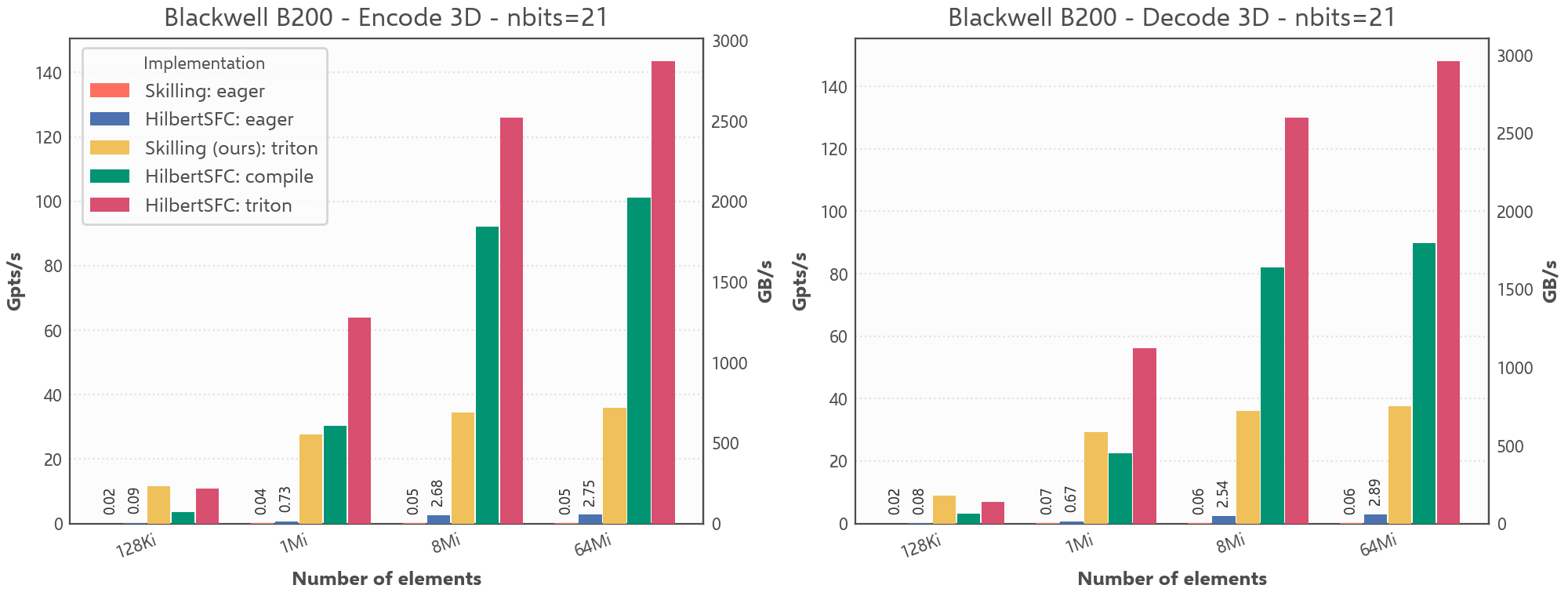
HilbertSFC achieves very high throughput on modern GPUs, reaching up to ~143 billion points per second for 3D encode of 32-bit coordinates (nbits=21) on an NVIDIA Blackwell B200. At size=64Mi, compared to an eager PyTorch implementation of the Skilling algorithm, it is roughly 3100× faster for 3D encode and 2300× faster for 3D decode.
2D and 3D Points - Random, nbits=32 (2D), nbits=21 (3D), size=64Mi (2^26), throughput in Mpts/s
| Implementation | Mode | 2D enc | 2D dec | 3D enc | 3D dec |
|---|---|---|---|---|---|
| HilbertSFC | triton | 225234 | 238367 | 143405 | 147926 |
| HilbertSFC | eager | 5668 | 5324 | 2745 | 2886 |
| Skilling (Pointcept) | eager | 37.9 | 48.4 | 46.4 | 63.1 |
System info: NVIDIA Blackwell B200, Ubuntu 24.04.4, Python 3.12.3, PyTorch 2.11.0, CUDA 13.0, Triton 3.6.0
Throughput comparison for 3D Hilbert encode/decode on B200 (`nbits=21`).
See benchmark-gpu.md for more details and additional GPU benchmarks.
Quickstart
Installation
Install the base package with either pip or uv:
With pip:
pip install hilbertsfc
Or with uv:
uv add hilbertsfc
PyTorch support
To enable the optional PyTorch extension, install with the torch extra:
pip install hilbertsfc[torch]
[!NOTE]
By default, installing
hilbertsfc[torch]pulls in a platform-default PyTorch build:
- Windows: CPU-only
- Linux: CUDA-enabled
If you need a specific PyTorch, CUDA, or ROCm version, follow the official PyTorch installation instructions. Then install
hilbertsfc[torch]as shown above.
Usage
Space-filling curves such as Hilbert and Morton map multi-dimensional integer coordinates onto a single scalar index while preserving spatial locality. hilbertsfc provides simple encode/decode APIs for Python scalars, NumPy arrays, and PyTorch tensors.
Python scalars
Use hilbert_encode_2d and hilbert_decode_2d directly on Python integers:
from hilbertsfc import hilbert_decode_2d, hilbert_encode_2d

index = hilbert_encode_2d(17, 23, nbits=10)
x, y = hilbert_decode_2d(index, nbits=10)
nbits controls the coordinate domain [0, 2**nbits) on each axis. It is optional, but when you know the coordinate range ahead of time, passing a tighter value can improve performance and reduce output dtypes.
The 3D API follows the same pattern via hilbert_encode_3d and hilbert_decode_3d. The Morton/z-order functions mirror these names with morton_encode_2d, morton_decode_2d, morton_encode_3d, and morton_decode_3d.
NumPy arrays
The same functions also accept NumPy integer arrays, preserving shape and supporting batch encode/decode efficiently.
import numpy as np
from hilbertsfc import hilbert_encode_2d

xs = np.array([0, 1, 2, 3], dtype=np.uint32)
ys = np.array([3, 2, 1, 0], dtype=np.uint32)

indices = hilbert_encode_2d(xs, ys, nbits=2)
This is the preferred use for high-throughput workloads on CPU. It can be further accelerated with parallel=True.
PyTorch tensors
The hilbertsfc.torch frontend works with PyTorch tensors on CPU and accelerator devices. On CUDA/ROCm, contiguous tensors take the Triton path when available; otherwise execution falls back to the Torch backend.
import torch
from hilbertsfc.torch import hilbert_decode_2d, hilbert_encode_2d

device = "cuda" if torch.cuda.is_available() else "cpu"
nbits = 10

xs = torch.randint(0, 2**nbits, (4096,), dtype=torch.int32, device=device)
ys = torch.randint(0, 2**nbits, (4096,), dtype=torch.int32, device=device)

indices = hilbert_encode_2d(xs, ys, nbits=nbits)
xs2, ys2 = hilbert_decode_2d(indices, nbits=nbits)
HilbertSFC also supports torch.compile. Before entering a compiled region, call precache_compile_luts(...) so LUT materialization happens outside the compiled graph.
Learn more
For more details and advanced usage, see:
Project details
Verified details
These details have been verified by PyPIProject links
GitHub Statistics
Maintainers


Download files
Download the file for your platform. If you're not sure which to choose, learn more about installing packages.
Source Distribution
Built Distribution
Filter files by name, interpreter, ABI, and platform.
If you're not sure about the file name format, learn more about wheel file names.
Copy a direct link to the current filters
File details
Details for the file hilbertsfc-0.4.0.tar.gz.
File metadata
- Download URL: hilbertsfc-0.4.0.tar.gz
- Upload date:
- Size: 316.5 kB
- Tags: Source
- Uploaded using Trusted Publishing? Yes
- Uploaded via: uv/0.11.7 {"installer":{"name":"uv","version":"0.11.7","subcommand":["publish"]},"python":null,"implementation":{"name":null,"version":null},"distro":{"name":"Ubuntu","version":"24.04","id":"noble","libc":null},"system":{"name":null,"release":null},"cpu":null,"openssl_version":null,"setuptools_version":null,"rustc_version":null,"ci":true}
File hashes
| Algorithm | Hash digest | |
|---|---|---|
| SHA256 |
0b90923a9062e3e75afeeb0572cf8f6468fe5860128c923e1dc9a49857efce39
|
|
| MD5 |
2e118fcd6cb6104ae8e0651970fb350e
|
|
| BLAKE2b-256 |
e735e69cbae0a68e252a6b340aee52bfca6a13b34b3e07e8d3f3a0e1ec1c8272
|
File details
Details for the file hilbertsfc-0.4.0-py3-none-any.whl.
File metadata
- Download URL: hilbertsfc-0.4.0-py3-none-any.whl
- Upload date:
- Size: 357.4 kB
- Tags: Python 3
- Uploaded using Trusted Publishing? Yes
- Uploaded via: uv/0.11.7 {"installer":{"name":"uv","version":"0.11.7","subcommand":["publish"]},"python":null,"implementation":{"name":null,"version":null},"distro":{"name":"Ubuntu","version":"24.04","id":"noble","libc":null},"system":{"name":null,"release":null},"cpu":null,"openssl_version":null,"setuptools_version":null,"rustc_version":null,"ci":true}
File hashes
| Algorithm | Hash digest | |
|---|---|---|
| SHA256 |
0029465b3ef58e2ad1d006c0881f9b02d7d56fe6a8ca4add69c87f90a9db769b
|
|
| MD5 |
389d058b8a71a39a652b0e87c9eb0e1f
|
|
| BLAKE2b-256 |
6e4e81dc8be6becbf149d69b859f69325a502a11d66f0a4c46f76bd94e881c83
|






