
Kivy-androidwidgets
Generate Android home-screen widgets for Kivy / Buildozer apps from a pure-Python DSL — no XML, no Java. Widget definitions are compiled by a CLI pre-build step into res/, src/ and a p4a hook that Buildozer compiles straight into the APK.
Complete sample: working app
Quickstart
1. Install
pip install home-widget
2. Describe your widget in Python
widgets.py (in your project root):
from home_widget import HomeWidget, AWColumn, AWRow, AWText, AWImage, AWButton, AWProgressBar, Color

clock = HomeWidget(
    name="Clock",
    description="Shows the current time",
    layout=AWColumn(
        spacing=6,
        children=[
            AWText("12:00", id="time", size=28, bold=True),
            AWText("Mon 4 Aug", id="date", size=12, color=Color("#888888")),
        ],
    ),
    min_width_dp=110,          # 2 cells
    min_height_dp=110,
    resize_mode="horizontal|vertical",
    update_period_ms=1800000,  # Android minimum: 30 minutes
    tap_to_open=True,          # whole widget opens the app on tap
    background=Color("#FFFFFF"),
    radius=12,
)
3. Generate the Android artifacts
python -m home_widget init     # creates p4a/hook.py (one-time)
python -m home_widget generate --spec buildozer.spec --module widgets.py
This writes (gitignore them):
res/layout/<name>.xml,res/layout/<name>_preview.xmlres/xml/<name>_provider.xml— theappwidget-providermetadatares/drawable/widget_bg_<name>.xml— rounded background shapessrc/<package>/<ClassName>.java— oneAppWidgetProviderper widgetres/values/widgets.xml,p4a/widget_receivers.json
generate reads package.domain + package.name from buildozer.spec. Use --dry-run to preview without writing.
4. Wire it into buildozer.spec
android.add_resources = res
android.add_src = src
p4a.hook = p4a/hook.py
5. Build
buildozer android debug
The generated p4a/hook.py (after_apk_build) injects the <receiver> entries into the dist's AndroidManifest.xml before aapt compiles it, so no manual manifest editing.
DSL Reference
HomeWidget—name,description,layout,min_width_dp,min_height_dp,target_cells,max_cells,resize_mode,widget_category,update_period_ms,preview_image,preview_layout,tap_to_open,background(Color),radius,paddingAWColumn,AWRow—spacing,childrenAWFrame— single child, ideal for cardsAWText—text,size,color,bold,italic,align,max_lines,idAWImage—resource,path,scale_type,content_description,idAWButton—text,idAWProgressBar—style,max,id
Layout children with an id become runtime handles: the generated Java loads images from context.getFilesDir()/app/assets/... for AWImage(path=...) at add-time. tap_to_open=True wires @+id/widget_root to a PendingIntent opening the app (with the API-23 FLAG_IMMUTABLE guard).
Runtime updates
Add widgets to the home screen from Python at runtime (see using-python-to-update-widget.md for the manual version). update_period_ms cannot go below 1 800 000 ms on Android.
Widget & feature recipes: examples.md (clock, battery meter, photo, button, card layouts, multiple widgets per app, and the runtime update API).
Tests
python3 -m unittest discover -s tests -v
Manual fallback
Prefer the DSL above. If you need full control, the original manual method still works: hand-write the layout/provider XML, the Java AppWidgetProvider and the manifest hook (see below).
Step 1: Design the layout
Store in res/layout/simple_widget.xml:
<?xml version="1.0" encoding="utf-8"?>
<LinearLayout xmlns:android="http://schemas.android.com/apk/res/android"
    android:orientation="vertical"
    android:padding="10dp"
    android:background="#FFFFFF"
    android:gravity="center"
    android:layout_width="wrap_content"
    android:layout_height="wrap_content">

    <TextView
        android:id="@+id/widget_text"
        android:text="Loading..."
        android:textSize="18sp"
        android:textColor="#000"
        android:layout_width="wrap_content"
        android:layout_height="wrap_content"/>

</LinearLayout>
Step 2: Create the widget info XML
Path: res/xml/widgetproviderinfo.xml
<appwidget-provider xmlns:android="http://schemas.android.com/apk/res/android"
    android:minWidth="120dp"
    android:minHeight="60dp"
    android:updatePeriodMillis="1800000"
    android:initialLayout="@layout/simple_widget"
    android:previewImage="@drawable/ic_launcher_foreground"
    android:resizeMode="horizontal|vertical"
    android:widgetCategory="home_screen">
</appwidget-provider>
Create the preview image at res/drawable/ic_launcher_foreground.png.
Step 3: Create an AppWidgetProvider
Path: src/SimpleWidget.java
package org.wally.waller; // Change here from buildozer.spec package.domain+package.name

import android.appwidget.AppWidgetManager;
import android.appwidget.AppWidgetProvider;
import android.content.Context;
import android.widget.RemoteViews;

import org.wally.waller.R; // Change here from buildozer.spec package.domain+package.name
import android.app.PendingIntent;
import android.content.Intent;

public class SimpleWidget extends AppWidgetProvider {

    @Override
    public void onUpdate(Context context, AppWidgetManager appWidgetManager, int[] appWidgetIds) {
        for (int appWidgetId : appWidgetIds) {

            RemoteViews views = new RemoteViews(context.getPackageName(), R.layout.simple_widget);

            // Example: Set text
            views.setTextViewText(R.id.widget_text, "Hello Widget!");

            // Update widget
            appWidgetManager.updateAppWidget(appWidgetId, views);
        }
    }
}
Step 4: Inject the receiver with a p4a hook
Path: p4a/hook.py
from pathlib import Path
from pythonforandroid.toolchain import ToolchainCL


def after_apk_build(toolchain: ToolchainCL):
    manifest_file = Path(toolchain._dist.dist_dir) / "src" / "main" / "AndroidManifest.xml"
    text = manifest_file.read_text(encoding="utf-8")

    package = "org.wally.waller"
    receiver_xml = f'''
    <receiver android:name="{package}.SimpleWidget"
              android:enabled="true"
              android:exported="false">
        <intent-filter>
            <action android:name="android.appwidget.action.APPWIDGET_UPDATE" />
        </intent-filter>
        <meta-data android:name="android.appwidget.provider"
               android:resource="@xml/widgetproviderinfo" />
    </receiver>
    '''

    if receiver_xml.strip() not in text:
        if "</application>" in text:
            text = text.replace("</application>", f"{receiver_xml}\n</application>")
            print("Receiver added")
        else:
            print("Could not find </application> to insert receiver")
    else:
        print("Receiver already exists in manifest")

    manifest_file.write_text(text, encoding="utf-8")
    print("Successfully_101: Manifest update completed successfully!")
Step 5: Wire into buildozer.spec
android.add_resources = res
android.add_src = src
p4a.hook = p4a/hook.py
Sample Image:
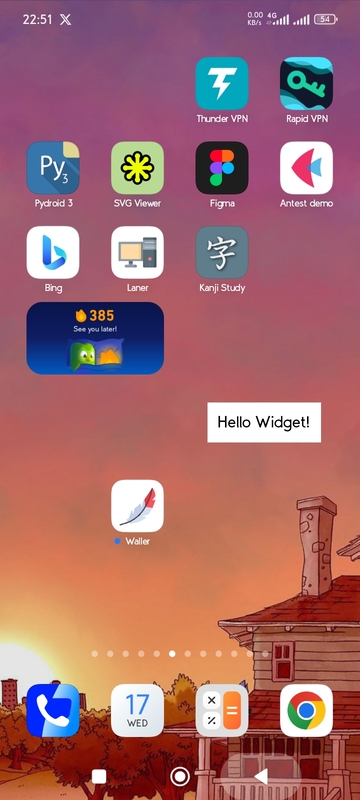
For more widget customisation check: How to Customise.md
1 maintainer

Metadata
1 maintainer
Release files for home-widget 0.0.1
For a detailed explanation of source distributions (sdists) and built distributions (wheels), please see the package formats documentation.
Source distribution (sdist)
| File | Size | Uploaded | Provenance | Actions |
|---|---|---|---|---|
| home_widget-0.0.1.tar.gz | 35.6 kB | Without provenance | Details for home_widget-0.0.1.tar.gz |
Built distribution (wheel)
| File | Interpreter | ABI | Platform | Actions Reset |
|---|---|---|---|---|
| home_widget-0.0.1-py3-none-any.whl | Python 3 | none | any | Details for home_widget-0.0.1-py3-none-any.whl |
Total release size: 77.9 kB
Release files / home_widget-0.0.1.tar.gz
| Download URL | home_widget-0.0.1.tar.gz |
|---|---|
| Size | 35.6 kB |
| Tags | Source |
|
SHA-256 checksum How to use checksums |
e62a19a524dceee2903fbeeb54517468b1224637119ef54e096ead302c42d385
|
|
BLAKE2b-256 checksum How to use checksums |
2a247d451355a54bec236298e06fa550cae140b6e51fc27bce612f571aa4ab2c
|
| Upload date | |
|
Uploaded using Trusted Publishing? What is trusted publishing? |
No |
| Uploaded via |
twine/7.0.0 CPython/3.12.3
|
Release files / home_widget-0.0.1-py3-none-any.whl
| Download URL | home_widget-0.0.1-py3-none-any.whl |
|---|---|
| Size | 42.3 kB |
| Tags | Python 3 |
|
SHA-256 checksum How to use checksums |
bd06ab070362df0900fbd1f0a9206b5b20bd637f51acedc988ac1b8339cd7f5d
|
|
BLAKE2b-256 checksum How to use checksums |
1f53924f1928a2e310e45435fe3dfeea42fae18fb6cd6ca9b46c0c0f948c6a64
|
| Upload date | |
|
Uploaded using Trusted Publishing? What is trusted publishing? |
No |
| Uploaded via |
twine/7.0.0 CPython/3.12.3
|
Security for home-widget 0.0.1
Provenance
Provenance describes where a file came from. On PyPI, provenance is shared via attestations, which provide a verifiable record of the build or publishing details. View details, limitations and caveats.
No provenance found
None of the files in this release were uploaded with provenance metadata.
A note on package security
PyPI is a repository for distributing packages, not a service for auditing them. While third-party security researchers and our staff do their best to detect and remove malicious packages, PyPI cannot guarantee the quality, security or suitability of any given package.
To learn more about protecting yourself from malicious actors, visit our package security documentation.













