






Penguin-inspired self-organizing load balancer with adaptive thermal eviction.
Interactive Simulation & Live Architecture →
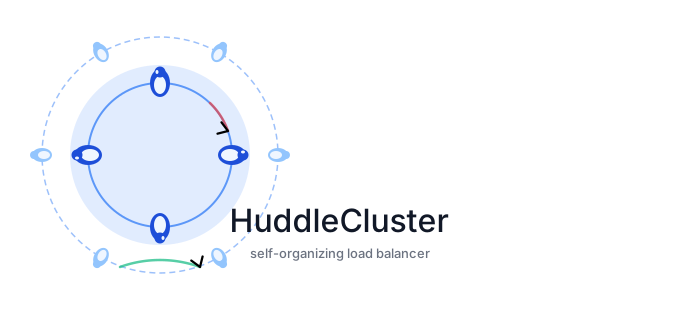
Emperor Penguins survive Antarctic blizzards without any central coordinator — each bird follows one rule: if you're cold, push inward; if you're warm, drift outward. The huddle self-organizes.
HuddleCluster applies this directly to server scheduling. Servers that run hot rotate to an outer ring to cool down. Cooled servers rotate back in. No manual tuning. No fixed thresholds. The cluster finds its own equilibrium.
Install
pip install huddle-cluster
Optional extras: fastapi · redis · grpc · kubernetes
Single-instance
from huddle_cluster import create_cluster
import requests

cluster = create_cluster([
    ("web-1", "10.0.0.1", 8080),
    ("web-2", "10.0.0.2", 8080),
    ("web-3", "10.0.0.3", 8080),
])
cluster.start()

with cluster.get_server_context() as server:
    response = requests.get(f"http://{server.host}:{server.port}/api")
What the cluster reports at any point:
print(cluster.health_report())
{
  "inner_servers": ["web-1", "web-3"],
  "outer_servers": ["web-2"],
  "fairness_score": 0.94,
  "rotation_count": 12,
  "requests_per_sec": 847.3,
  "cluster_health": "healthy"
}
1-Minute Live Anomaly Demo
Test how HuddleCluster handles relative latency anomalies, shields tail latency, and recovers:
python demos/reproducible_anomaly_demo.py
Under severe latency degradation (280ms+ injected spike into one node), HuddleCluster thermally evicts the degraded node within seconds, delivering 80% fewer slow requests and shielding cluster P99 latency compared to traditional Round-Robin.
Multi-node cluster
Coordinate a fleet of hosts — each node runs its own HuddleCluster; the master tracks enrollment, heartbeats, and health.
# Start the coordinator
huddle-cluster master start --port 7070

# Enroll nodes on each host
huddle-cluster agent start --id web-01 --master http://master:7070 --port 8080

# Inspect from anywhere
huddle-cluster nodes list
NODE ID                ADDRESS                STATUS       HB       LAST SEEN
─────────────────────────────────────────────────────────────────────────────
web-01                 10.0.0.1:8080          alive        142      0.8s ago
web-02                 10.0.0.2:8080          alive        139      1.1s ago
web-03                 10.0.0.3:8080          dead         41       34.2s ago
Ask the scheduler which node to send the next workload to:
curl http://master:7070/v1/scheduler/next
{ "ok": true, "node": { "node_id": "web-01", "address": "10.0.0.1", "port": 8080 } }
Live topology and Prometheus metrics are built in:
http://master:7070/dashboard      → real-time cluster topology
http://master:7070/v1/metrics     → Prometheus scrape endpoint
http://master:7070/v1/docs        → interactive API explorer (Swagger UI)
How it works
| Concept | What it means |
|---|---|
| Inner ring | Active servers handling traffic right now |
| Outer ring | Servers cooling down after a hot streak |
| Thermal score | EMA of relative latency anomaly, CPU, memory, error rate |
| Rotation | Overheated servers evict outward; cooled servers return inward |
| Relative anomaly | Compared to the cluster median — adapts to any baseline automatically |
No server is permanently marked bad. Every server gets rest and returns.
Performance
Under server failure, P95 latency stays under 86 ms where NGINX round-robin reaches 5,027 ms — a 58× reduction. Full methodology and results in the research paper below.
Documentation
| Interactive Website & Demo | rahadbhuiya.github.io/HuddleCluster |
| Single-instance guide | USAGE.md |
| Cluster system | docs/CLUSTER.md — MasterNode, Scheduler, RBAC, dashboard, API |
| API explorer | http://your-master:7070/v1/docs (live, once the master is running) |
| Research paper | docs/HuddleCluster.pdf · arXiv preprint |
Roadmap
- Thermal eviction, relative anomaly scoring, adaptive thresholds — v1.x
- Redis backend, gRPC routing, Kubernetes discovery, Prometheus, webhooks — v1.4
- Cluster system: MasterNode, AgentNode, CLI — v2.0
- Auto recovery, RBAC, metrics, dashboard, OpenAPI + Swagger UI — v2.x
- Cluster Scheduler — thermal-fitness workload placement — v3.0
- Cluster Auto Scaler — load-signal scale recommendations — v3.1
- Rolling Updater — zero-downtime batch upgrades with health gate — v3.2
- Service Discovery — health-aware registry, metadata-driven, DNS responder — v3.3
- HA Master — simplified Raft leader election, state replication, write redirect — v3.4
- Multi-Region — cross-datacenter topology, region-aware scheduling — v3.5
- Cluster Circuit Breaker — error-rate-based automatic trip/reset, scheduler exclusion — v4.0
- Rate Limiter — per-node token bucket, burst protection, scheduler exclusion — v4.1
- Canary Deployment — weight-based traffic splitting, start/advance/promote/abort — v4.2
- Observability — structured JSON logging, distributed trace IDs — v4.3, Level 4 complete
- TLS/HTTPS + mTLS, threaded HTTP server — v4.4, Level 5 (Production Hardening) in progress
- State persistence — HA term/voted_for + node registry survive restarts — v4.5
- mTLS node identity — client cert CN recorded on join — v4.6
- HA failover staleness fix + documented Raft limitations — v4.7
- OTLP log export (Jaeger/Tempo/OTel Collector compatible) — v4.8
- Docker + Kubernetes deployment manifests, SIGTERM graceful shutdown fix — v4.9
- WAN-latency simulation benchmark (partial — see docs for scope) — v4.10, Level 5 complete
- Agent TLS trust for self-signed certificates — v4.11
- AutoScaler cooldown reporting and status accuracy — v4.12
- CLI feature wiring (
--features) for production master — v4.13 - Production Helm chart with StatefulSet HA discovery — v4.14
- Fine-grained RBAC with 20 granular permission scopes — v4.15
- Cloud-native probes (
/healthz,/livez,/readyz) and HA readiness gates — v4.16 - Cluster Webhooks with HMAC-SHA256 event dispatch and retry queue — v4.17
- Proactive synthetic canary prober with autonomous outer-ring cooldown promotion — v4.18
- Adaptive request hedging & speculative execution (Tail at Scale) with budget ratio safeguard — v4.19
- AI / LLM token-aware thermal routing & TTFT streaming latency gateway — v4.20
- Linux Kernel eBPF / XDP zero-copy high-performance data plane — v4.21
Commercial Support & Consulting
Need specialized architecture, custom integrations, or production deployment assistance?
We offer direct engineering support and consulting:
- Custom Adapters & Integrations: Tailoring HuddleCluster for your custom stack (AI/LLM inference clusters, high-frequency trading, IoT).
- Production Deployment & Tuning: Multi-region HA setup, Kubernetes migration, and stress testing.
- Priority Enterprise Support & SLAs: Dedicated hotline, rapid issue resolution, and feature requests.
Contact: rahadbhuiya2021@gmail.com
Support this open-source project: GitHub Sponsors | Buy Me a Coffee
Citation
Bhuiya, R. (2025). HuddleCluster: A Penguin-Inspired Self-Organizing Load Balancer
with Adaptive Thermal Eviction. https://github.com/rahadbhuiya/HuddleCluster
Bhuiya, Rahad (2026). HuddleCluster. figshare. Journal contribution.
https://doi.org/10.6084/m9.figshare.32397180
Bhuiya, Rahad (2026). HuddleCluster. Zenodo. https://doi.org/10.5281/zenodo.20348019
Author: Rahad Bhuiya · License: MIT
1 maintainer

Release files for huddle-cluster 4.21.0
For a detailed explanation of source distributions (sdists) and built distributions (wheels), please see the package formats documentation.
Source distribution (sdist)
| File | Size | Uploaded | |
|---|---|---|---|
| huddle_cluster-4.21.0.tar.gz | 226.0 kB | Details |
Built distribution (wheel)
| File | Interpreter | ABI | Platform | Reset |
|---|---|---|---|---|
| huddle_cluster-4.21.0-py3-none-any.whl | Python 3 | none | any | Details |
Total release size: 383.8 kB
Release files / huddle_cluster-4.21.0.tar.gz
| Download URL | huddle_cluster-4.21.0.tar.gz |
|---|---|
| Size | 226.0 kB |
| Tags | Source |
|
SHA-256 checksum How to use checksums |
a0bc76634c4ef5eb842305b4d1483263e642b560f831433460b21d6e3bac7b49
|
|
BLAKE2b-256 checksum How to use checksums |
8321c9f41180a1974b09dfe13a4604dcb3983669e7551c967e1254d33a1be4eb
|
| Upload date | |
|
Uploaded using Trusted Publishing? What is trusted publishing? |
Yes |
| Uploaded via |
twine/7.0.0 CPython/3.13.14
|
Provenance
Provenance describes where a file came from. On PyPI, provenance is shared via attestations, which provide a verifiable record of the build or publishing details. View details, limitations and caveats.


PyPI Publish Attestation
PyPI verified that this artifact, at this checksum, originated from the publisher listed below.
Signed by GitHub Actions, verified by PyPI on Sep 20, 2026.
Transparency logRelease files / huddle_cluster-4.21.0-py3-none-any.whl
| Download URL | huddle_cluster-4.21.0-py3-none-any.whl |
|---|---|
| Size | 157.8 kB |
| Tags | Python 3 |
|
SHA-256 checksum How to use checksums |
121e5d4e55d5ec9778eb3caa7c2938b4f9c60a46d11e0cd31e30fafaffb0d659
|
|
BLAKE2b-256 checksum How to use checksums |
f3d4f7c003c8e85712869dcc2e031178505ac973f43a86499e8ce8e13e77c01b
|
| Upload date | |
|
Uploaded using Trusted Publishing? What is trusted publishing? |
Yes |
| Uploaded via |
twine/7.0.0 CPython/3.13.14
|
Provenance
Provenance describes where a file came from. On PyPI, provenance is shared via attestations, which provide a verifiable record of the build or publishing details. View details, limitations and caveats.
PyPI Publish Attestation
PyPI verified that this artifact, at this checksum, originated from the publisher listed below.
Signed by GitHub Actions, verified by PyPI on Sep 20, 2026.
Transparency log













