
hugpy-media
The media add-on arm for hugpy-core (distribution hugpy-media, import
name hugpy_media). The Python wheel includes its /media/ UI and backend
category tree. Installed into Core's Python environment, it runs as an embedded
addon. The Debian package also provides a standalone service and discovery
descriptor for installations using a separate process.
The package does two jobs:
- It is a self-contained arm: the
/mediamedia-intelligence console (a chat-first SPA) and its toolset API (/api/media/*), embedded in Core or served separately on127.0.0.1:7340. Core proxies the separate deployment. - It provides engine task plugins: runners and request builders for speech
recognition, TTS, embeddings and similarity, keywords, summaries, vision
chat, vision analysis (depth, detection, classification, segmentation), image
generation, ComfyUI, and document/URL extraction. They register with
hugpy_engine.tasks.
The backend contract (category tree → Blueprint → standalone server →
arms.d → Core proxy) is documented in ROUTES-CONVENTION.md. How
the model routes pick and fall back between models is in
docs/execute_prompt.md.
The shared media-intelligence[documents]>=0.1.3,<0.3 dependency owns native
document parsing, persisted source-bound artifacts, page retrieval and search.
OCR requests go through Hugpy workers. It remains a separate distribution;
the hugpy-media add-on provides the hosted upload, authorization and API layer.
Running inside Core
Install the Media wheel and its base dependencies into the Python environment
used by the updated Core service. Core then mounts hugpy_media.routes.media_bp
at /api/media/*, retains /api/session/*, and loads the hugpy.arm_prepare
and hugpy.arm_ui hooks. The packaged UI runs at /media/ on Core's port;
there is no second Media HTTP process. Core continues to own /v1/*, Help,
and /api/prompt (including the /api/prompt/execute spelling).
Core passes its own services in through hugpy_media.host.configure: the
prompt executor the model routes call, its model catalog and its central-drive
catalog. The in-process catalog is keyed model_key and lists the workers
holding a copy; host.catalog_models() returns those rows with the id and
available fields the HTTP model list carries, so capabilities and
summarize find models either way.
Media is optional: Core can run without the package installed. No model stack is loaded by the startup hook. Inference still dispatches through the existing Engine/Wrapper path; installing Media's base wheel does not install GPU extras.
Configuration belongs to the Core service environment. Embedded hosting does
not read /etc/hugpy/media.env, since its global values could alter Core.
Set HUGPY_MEDIA_UPLOADS_HOME to a dedicated directory if desired; otherwise
uploads use the host's hugpy_platform.constants.UPLOADS_HOME. Document artifacts
use its .documents child unless HUGPY_DOCUMENTS_HOME is configured. The Core
service user needs write access to these directories. To retain existing upload
sessions, use their existing directory and grant Core access before switching.
An existing arms.d/media.json does not override an embedded Media UI. Named
API URLs such as /api/arms/media/media/health remain local too. External addons
continue through the descriptor proxy.
The Debian package does this by itself. Installed on a host with hugpy-core,
it asks Core to take the arm (hugpy-core addon attach media): Core installs
the package's bundled wheels into its own environment, replacing nothing it was
installed with, restarts, and hugpy-media.service is switched off. Installed
on a host without Core, or beside a Core that declines (an older Core, a
dependency it cannot hold, HUGPY_CORE_ADDONS=none in Core's core.env), it
runs as hugpy-media.service on 127.0.0.1:7340 and a Core reaches it through
arms.d. A Core installed later takes the arm at that point; removing Core
gives it back. hugpy-core addon list says which of the two is in effect.
With pip, pip install "hugpy-media[core]" is the embedded arrangement.
For a source build, install the wheel from python -m build --wheel package
into Core's environment, with its base dependencies, and restart Core when
applying the change. Avoid leaving the separate hugpy-media.service enabled
once the embedded deployment is active. No UI rebuild is needed when using
the wheel's existing ui_dist.
Layout
The package follows the shared imports/ convention. Cross-cutting primitives
live in one cheap layer that never imports a model stack. The model stacks are
cohesive subpackages imported lazily.
src/hugpy_media/
  imports/            shared primitives; importing this pulls in no model stack
    constants.py      ARM_NAME="media", UI_MOUNT="/media/", ML_TASKS (route -> task),
                      env-var NAMES, standalone host/port/env-file, LLM upstream default
    functions/
      runtime.py      availability, lazy loading, version and environment helpers
      placement.py    placement questions the in-process runners ask; all answer "no directive"
      chunking.py     shared token counting and recursive text chunking
      tool_schema.py callable schemas, result text selection, common field helpers
      text.py         text quality and normalization
      files.py        atomic text-file writing
    classes.py        MediaError (hosts turn it into {"error": ...})
    init_imports.py   lazy registry of stdlib, external and package imports
  toolset.py          the route handlers, get_toolset() and get_manifest()
  categories.py       ALL_CATEGORIES: the route tree a host merges (the hugpy.arms entry point)
  routes.py           media_bp: the same tree registered on a Blueprint
  host.py             services a hosting Core supplies (executor, model catalogs); HTTP to Core otherwise
  serve/__init__.py   standalone server: `hugpy-media serve`
  serve/embed.py      the hugpy.arm_prepare and hugpy.arm_ui hooks a hosting Core runs
  ui.py               dist_dir() -> the wheel's built SPA (ui_dist/)
  ui_dist/            built @hugpy/media-intelligence-ui (see ui_dist/PROVENANCE.md)
  api.py              back-compat shim: media_bp, ML_TASKS, normalize_ml_kwargs
  plugin.py           register(): the hugpy_engine.tasks entry point (LazyRunner proxies)
  plugin_builders.py  pydantic request builders per task
  extract.py          deterministic document/URL text ingest (path-jailed, SSRF-guarded)
  hooks.py            fleet-worker process/telemetry hooks
  model_battery.py    battery recorder
  comfy/ embed/ imagegen/ keywords/ pdfs/ schemas/ seo/ summarizers/
  text/ tts/ vision/ vision_analysis/ whisper_model/        the model stacks
Modules import shared pieces through the layer:
from hugpy_media.imports import constants as C, functions as F, MediaError.
Following hugpy-discovery, standard-library, external and section imports go
through named exports in imports/init_imports.py. Imports remain at their
original eager or function-local sites; the registry itself loads no model
stack. Static section defaults live in imports/constants.py, with aliases at
established module paths. Mutable caches, locks, runtime configuration and
section registries stay with their owning sections.
Shared functions live under imports/functions/ and are imported from
hugpy_media.imports; there are no compatibility paths. imports also delegates
named lookups to shared constants, helpers and the import boundary.
The TTS child runs by file path in an isolated profile interpreter. Its three
stdlib bootstrap imports expose only the hugpy_media package directory,
without adding the parent environment's site-packages to sys.path. Operational
imports then use the same central boundary. The boundary stays stdlib-only so
this child does not need a separate copy of Hugpy's dependency stack.
tests/test_import_boundary.py checks this exception, central import ownership,
lightweight startup and the isolated child protocol. It also resolves every
name in the registry against the installed siblings, so a symbol that
hugpy-engine or hugpy-platform moves or drops fails there instead of at the
first request that reaches the import. Wildcard imports remain forbidden by
tests/test_import_policy.py.
The toolset (media/*, 18 routes)
Every route is GET+POST at /api/media/<route>, with a trailing-slash
variant. Request data (JSON body, else form, else query string) is pruned to
the callable's parameters. The return value comes back as {"result": ...},
and an exception as 500 {"error": "<message>"}. Append ?help to any route
for its parameters. Source: toolset.get_toolset(), verified against the live
GET /api/media/manifest.
| Route | Parameters | What it does | Backend |
|---|---|---|---|
health |
none | {"ok": true, "arm": "media", "version": ...} |
local |
capabilities |
none | per-amenity {task, ready, extra} from a find_spec probe of local extras; also pool |
local |
manifest |
include_optional |
get_manifest(): arm, version, ui, per-route target/description/inputSchema |
local |
upload |
multipart file (+ form fields) |
saves under UPLOADS_HOME (default $DEFAULT_ROOT/uploads) and returns {path, name, size} |
local |
extract |
path | file | image_path |
text from PDF (pdfplumber/PyPDF2), DOCX/XLSX (extract extra) or text files. The path must be under UPLOADS_HOME or DEFAULT_ROOT. |
local |
fetch |
url |
LLM-ready assessment of a public URL. Internal and loopback addresses are refused. Uses abstract_webtools when installed, else requests + bs4. |
local plus outbound HTTP |
analyze |
path/file/url, kind, prompt, model |
one DocumentIntelligence record: extract (fetch for a URL, transcribe for audio/video, vision for images, extract otherwise), then best-effort summarize and keywords. A missing backend records a skipped or error stage instead of failing. |
composite |
transcribe |
path, model |
automatic-speech-recognition |
engine → core /v1/audio/transcriptions |
summarize |
text, model |
text-summarization |
engine → core /v1/summarize |
keywords |
text, model |
keyword-extraction |
engine → core /v1/keywords |
embed |
text, model |
feature-extraction |
engine → core /v1/embeddings |
similarity |
text, model |
sentence-similarity |
engine → core /v1/embeddings |
imagine |
prompt, model |
text-to-image |
engine → core /v1/images/generations |
vision |
image_path | image_b64, prompt, model |
image-text-to-text |
GGUF vision models: engine → core /v1/chat/completions. A transformers row runs in-process (vision + transformers extras). |
depth / detect / classify / segment |
image_path | image_b64, model |
depth, object detection, classification, segmentation | in-process vision_analysis runners (transformers extra) |
The model routes call hugpy_engine.execute_prompt with the task fixed by the
route. Any task the client sends is ignored. model becomes model_key, and
for vision image_b64 becomes images=[...]. The reserved worker pool
HUGPY_ML_POOL is applied unless the task is listed in
HUGPY_ML_GENERAL_ROUTE_TASKS (default image-text-to-text). The result is
model_dump()ed, so it includes ok and the engine's resolution metadata
(task, source, model_key, attempts).
Standalone vs needs core/GPU
- Works with nothing else running:
health,capabilities,manifest,upload,extract,fetch.analyzeworks too for documents and URLs, with its enrich stages recorded as errors when no model answers. - Needs a reachable core (
HUGPY_CORE_URL, defaulthttp://127.0.0.1:7020) and a fleet worker that serves the task:transcribe,summarize,keywords,embed,similarity,imagine, andvisionfor GGUF vision models. The GPU work happens on the worker. The media box needs no torch or whisper for these. - Needs local extras in this venv:
depth,detect,classify,segmentand transformers-frameworkvision. Missing optional dependencies are reported as errors by these local paths. capabilitiesreports local extras only. A route shownready: falsecan still answer through core when the fleet serves its task.
Chat and tool calling (/v1)
The SPA's chat talks to the OpenAI-compatible surface at the origin root:
POST /v1/chat/completions and GET /v1/models.
- Behind core (
http://<core>/media/),/v1/*is core's own surface. - Standalone, the server forwards
/v1/*(streamed) to an upstream. With no reachable upstream it answers503 {"error": {"code": "no_model_backend", ...}}. The upstream isHUGPY_MEDIA_LLM_URL, thenHUGPY_CORE_URL, thenhttp://127.0.0.1:7020. Configure it for the intended Core endpoint.
The chat model calls the toolset itself. Each round the UI offers it the
routes that have something to work on (file routes for the uploaded files,
text routes for a read file or a substantial message, imagine, fetch,
analyze_url) as function signatures; the model either calls one or answers.
The UI runs the call against /api/media/<route>, shows the result panel, and
sends the result back as source evidence for the next round, up to four calls
a turn. Two wire formats, the ones hugpy-terminal's adapter uses:
- prompted (default): signatures in the system prompt, the call written in
the reply as
<tool_call>{"name": ..., "arguments": {...}}</tool_call>. It needs only messages and text from/v1, which is all Core relays; Core dropstoolsfrom a chat request and returns notool_calls. - native: OpenAI
toolson the request andtool_callson the reply, for a/v1that passes them through, such as the wrapper's own. Those rounds are not streamed: the wrapper's streamed reply is one chunk withouttool_calls.
A model whose context cannot hold the signatures gets the earlier one-shot router instead. The UI build chooses the format; see the UI README.
Standalone server and CLI
hugpy-media                     # same as `hugpy-media serve`
hugpy-media serve [--host H] [--port P] [--env-file /etc/hugpy/media.env]
serve loads the env file without overriding the environment. It then builds
abstract_flask.get_Flask_app(name="hugpy-media", routes=hugpy_media.routes, url_prefix="api") and adds:
- the SPA at
/media/with history fallback (/→302 /media/). A build withoutui_distanswers500with the reason. - the
/v1/*forwarder.
It then runs Flask's threaded server. get_Flask_app also adds
/api/endpoints, /endpoints and /prefixes, and writes its audit log
hugpy-media.log to the working directory.
curl -s 127.0.0.1:7340/api/media/health
curl -s -X POST -H 'Content-Type: application/json' -d '{"url":"https://example.com"}' 127.0.0.1:7340/api/media/fetch
curl -s -F file=@notes.pdf 127.0.0.1:7340/api/media/upload      # -> {"result": {"path": ...}}
curl -s '127.0.0.1:7340/api/media/vision?help'
Environment
| Variable | Default | Effect |
|---|---|---|
HUGPY_MEDIA_HOST / HUGPY_MEDIA_PORT |
127.0.0.1 / 7340 |
bind address of serve |
HUGPY_MEDIA_ALLOWED_ORIGINS |
unset (CORS allows all origins) | comma-separated CORS origins |
HUGPY_MEDIA_LLM_URL |
unset → HUGPY_CORE_URL → http://127.0.0.1:7020 (0.3.4); http://127.0.0.1:52017 in 0.3.3 |
upstream for the standalone /v1/* forwarder |
HUGPY_ML_POOL |
unset | reserved worker pool for the model amenities |
HUGPY_ML_GENERAL_ROUTE_TASKS |
image-text-to-text |
tasks that skip the reserved pool |
DEFAULT_ROOT |
from hugpy_platform (the deb sets /var/lib/hugpy-media) |
storage root: uploads, and the extract jail |
HUGPY_CORE_URL |
http://127.0.0.1:7020 |
engine: catalog, bindings and relays (see execute_prompt.md); in 0.3.4, also the /v1 fallback upstream |
The file /etc/hugpy/media.env (KEY=VALUE) is optional. The deb does not
create it, and the unit reads it through EnvironmentFile=-.
Debian package
BUILD_PYTHON=/usr/bin/python3 packaging/debian/build.sh     # -> build/debian/hugpy-media_<ver>_amd64.deb (Python 3.12)
sudo apt install ./build/debian/hugpy-media_<ver>_amd64.deb      # 0.3.3 is the newest deb built so far
build.sh bundles offline wheels for hugpy-media and its private siblings
(hugpy-platform and hugpy-engine, built from the local source tree) and
their public dependencies. Since 0.3.4, hugpy-storage is no longer bundled.
The 0.3.3 deb bundled it as a base dependency. It then asserts that the wheel contains
ui_dist/index.html and that the abstract_flask wheel is in the bundle.
postinst:
- creates the
hugpy-mediasystem user and/var/lib/hugpy-media; - builds
/opt/hugpy-media/venvoffline; - writes
/usr/share/hugpy/arms.d/media.json; - writes and starts
hugpy-media.service, withWorkingDirectory=andDEFAULT_ROOT=set to/var/lib/hugpy-media.
Core then proxies /api/media/* and /media/* to the service. The arm is not
installed into core's venv. postrm removes the unit and the arms.d file. On
purge it also removes the venv, the state, /etc/hugpy/media.env and the user.
For host-level steps see docs/install.md and
docs/operations.md.
Dependencies
Runtime (pyproject.toml): media_intelligence[documents]>=0.1.3,<0.3,
hugpy-platform>=0.3.0, hugpy-engine>=0.3.9, flask>=2,
abstract_flask>=0.0.0.1071, abstract_essentials, pydantic>=2, requests,
beautifulsoup4, PyPDF2, pdfplumber, pillow. A Core install already has
all of these except media_intelligence and its python-docx/openpyxl.
hugpy-storage is not a base dependency since 0.3.4. It moved to the
local extra. The local in-process inference runners (transformers, embed,
keywords, vision, imagegen) resolve weights lazily through
hugpy_storage.download_models.ensure_model, and those runners need the torch
extras anyway. import hugpy_media never imports hugpy_storage, and the arm
deb (fleet mode, where the GPU work happens on workers) does not need it.
Extras (each model stack is imported only inside its runner): audio
(openai-whisper), imagegen, embed, transformers, vision, extract
(python-docx, openpyxl, ...), keywords (keybert), comfy, local
(hugpy-storage), tts (chatterbox-tts; opt-in only, because it conflicts with
the rest), all (every extra except tts, including local), and test.
Entry points
| Group | Name → target |
|---|---|
console_scripts |
hugpy-media → hugpy_media.serve:main |
hugpy.arms |
media → hugpy_media.categories:ALL_CATEGORIES |
hugpy.arm_prepare |
media → hugpy_media.serve.embed:prepare |
hugpy.arm_ui |
media → hugpy_media.serve.embed:wrap_ui |
hugpy.toolsets |
media → hugpy_media.toolset:get_toolset |
hugpy_engine.tasks |
media → hugpy_media.plugin:register |
Engine plugin
hugpy_media.plugin.register() registers these (task, framework) pairs with
hugpy_engine.tasks, using LazyRunner proxies so registration imports no
model stack:
automatic-speech-recognition,text-to-speech,text-summarization,text2text-generation,keyword-extraction,feature-extraction,sentence-similarity,image-text-to-text,text-to-imageandimage-to-imageontransformers;text-to-imageandimage-to-imageoncomfy;document-extractionandurl-extractionon any framework;- the four vision-analysis tasks on
transformers.
Tasks in the engine's TASK_ROUTES table (speech recognition, TTS,
summarization, keywords, embeddings, image generation) are relayed to core,
not run by these plugin runners, in an arm process. The wrapper serves
those tasks with its own runners and decides where a model is placed. A runner
started in this process gets no placement directive: the fleet worker's
hugpy_engine.spill wire is retired, and imports/functions/placement.py
answers each of its questions with "no directive", so the load uses the primary
GPU and the loader's own memory budget. HUGPY_TTS_PYTHON names the separate
interpreter for the chatterbox backend when it cannot share this one.
UI
The SPA source is UI source.
Its build is copied into src/hugpy_media/ui_dist/, and the provenance is in
ui_dist/PROVENANCE.md.
Downloads and feature gallery
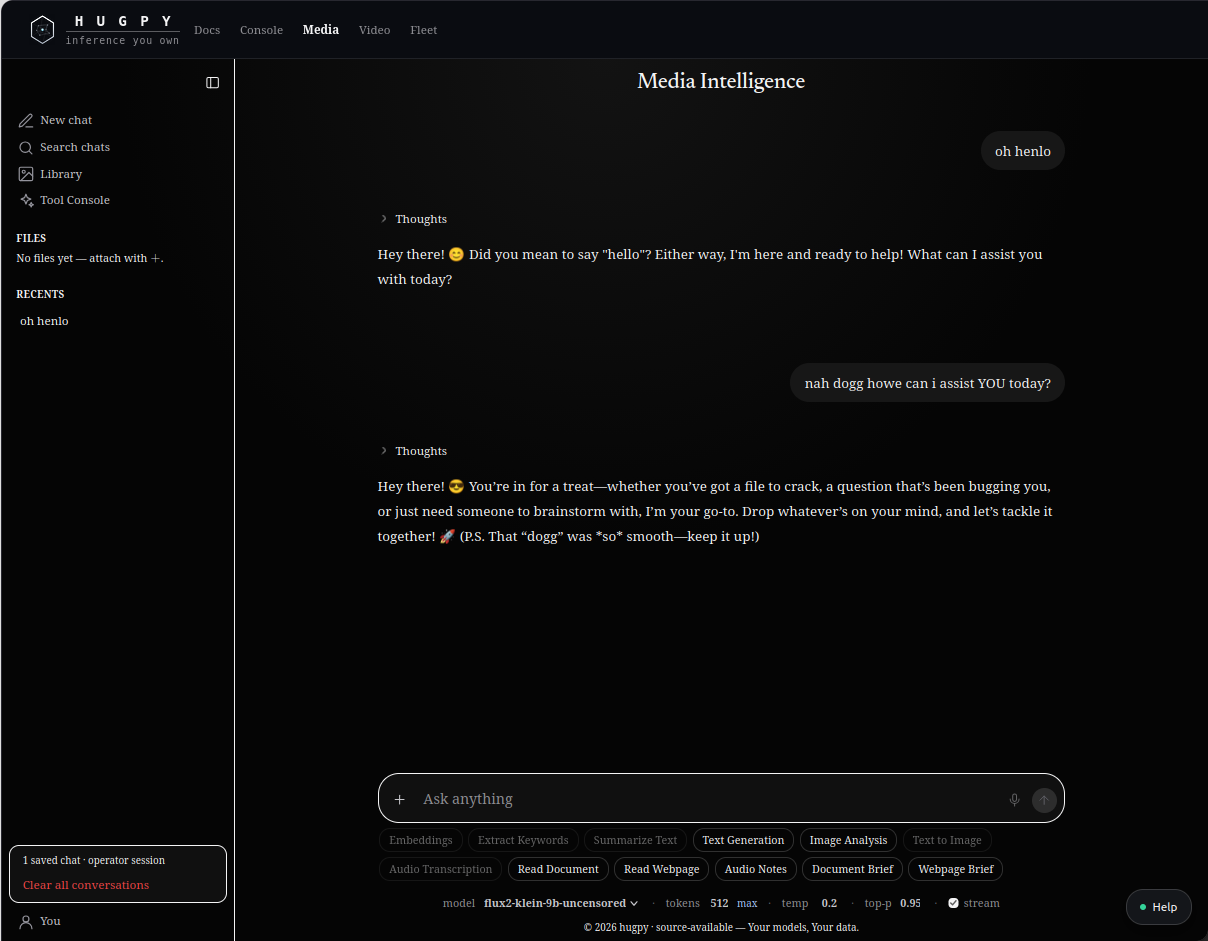
Get the Debian packages, architecture details, SHA-256 checksums and installation commands from Hugpy Downloads. The feature gallery shows the console, Agent, Station, Media and Video interfaces. Screenshots reflect the versions captured; the current interface may differ.
Media workspace
Conversations alongside file, image, audio and document task controls.
1 maintainer

Metadata
1 maintainer
Release files for hugpy-media 0.3.13
For a detailed explanation of source distributions (sdists) and built distributions (wheels), please see the package formats documentation.
Source distribution (sdist)
| File | Size | Uploaded | Provenance | Actions |
|---|---|---|---|---|
| hugpy_media-0.3.13.tar.gz | 360.3 kB | Without provenance | Details for hugpy_media-0.3.13.tar.gz |
Built distribution (wheel)
| File | Interpreter | ABI | Platform | Actions Reset |
|---|---|---|---|---|
| hugpy_media-0.3.13-py3-none-any.whl | Python 3 | none | any | Details for hugpy_media-0.3.13-py3-none-any.whl |
Total release size: 715.5 kB
Release files / hugpy_media-0.3.13.tar.gz
| Download URL | hugpy_media-0.3.13.tar.gz |
|---|---|
| Size | 360.3 kB |
| Tags | Source |
|
SHA-256 checksum How to use checksums |
9ef69cf5a5a179a7dea956e13c974317f2805ee882ff95fb9c32db3eee202f62
|
|
BLAKE2b-256 checksum How to use checksums |
33bacb34897c675aa8ea65b01cbfaf82d2c6dc5939183e18bcbda942d1a9ce9f
|
| Upload date | |
|
Uploaded using Trusted Publishing? What is trusted publishing? |
No |
| Uploaded via |
twine/7.0.0 CPython/3.12.3
|
Release files / hugpy_media-0.3.13-py3-none-any.whl
| Download URL | hugpy_media-0.3.13-py3-none-any.whl |
|---|---|
| Size | 355.2 kB |
| Tags | Python 3 |
|
SHA-256 checksum How to use checksums |
660edc921d272afd1a06261eba815ae5b36cfa73a3a2dc8f2c384b37e37807e1
|
|
BLAKE2b-256 checksum How to use checksums |
d89c650e958642bd3943e4fff770140dcb855ec02f42d9f578c473a5959706f7
|
| Upload date | |
|
Uploaded using Trusted Publishing? What is trusted publishing? |
No |
| Uploaded via |
twine/7.0.0 CPython/3.12.3
|
Security for hugpy-media 0.3.13
Provenance
Provenance describes where a file came from. On PyPI, provenance is shared via attestations, which provide a verifiable record of the build or publishing details. View details, limitations and caveats.
No provenance found
None of the files in this release were uploaded with provenance metadata.
A note on package security
PyPI is a repository for distributing packages, not a service for auditing them. While third-party security researchers and our staff do their best to detect and remove malicious packages, PyPI cannot guarantee the quality, security or suitability of any given package.
To learn more about protecting yourself from malicious actors, visit our package security documentation.














