Run hurl test files in dependency order using frontmatter metadata

Project description

Hurl Orchestrator

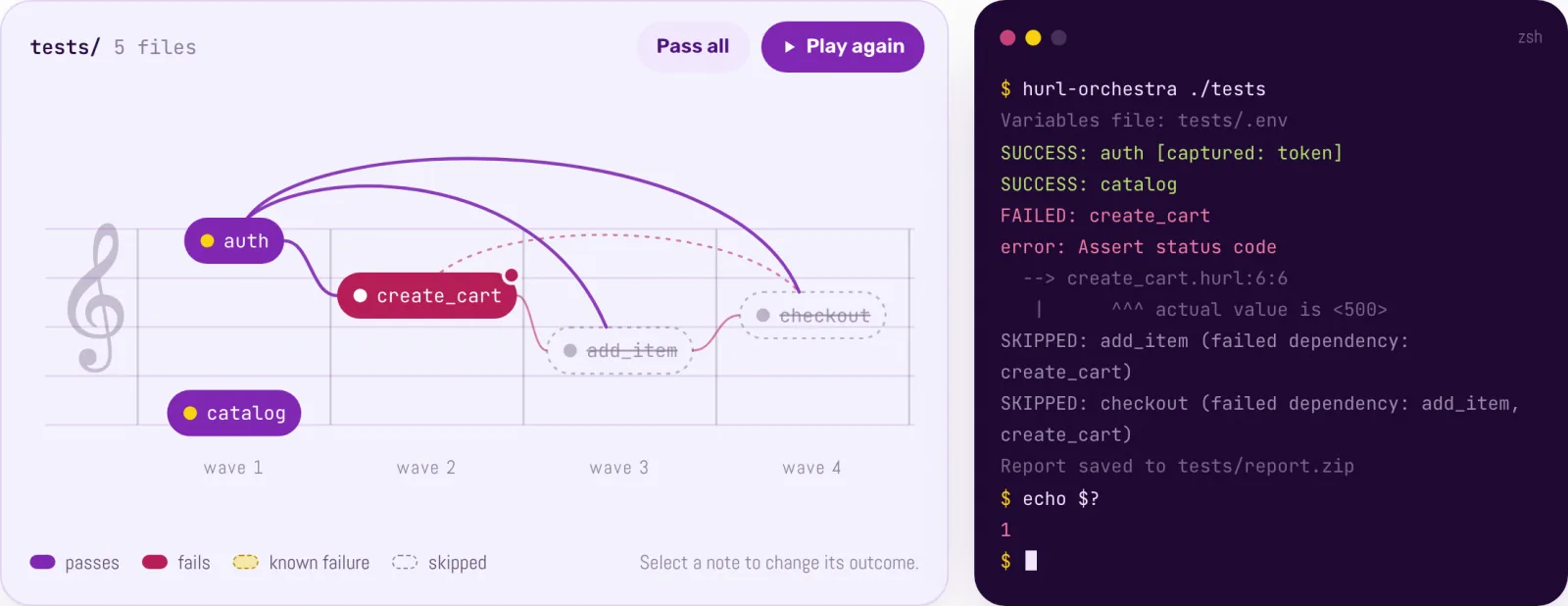
A dependency-aware task runner for Hurl. It allows you to treat API requests as a Directed Acyclic Graph (DAG), managing complex authentication flows and resource creation without redundant executions or manual variable passing.

Getting Started

Install the package and verify that hurl is available on your PATH.

pip install hurl-orchestra
hurl --version

Run the orchestrator from the current directory:

hurl-orchestra

Or point it at a specific test folder:

hurl-orchestra ./tests

For a quick diagram of your DAG instead of execution, use:

hurl-orchestra --diagram ./tests

Core Philosophy

  • Explicit over Implicit: Every dependency must be declared. This ensures that if a test fails, you know exactly which parent requirement was not met.
  • Namespaced Variables: Outputs are tied to the ID of the node that produced them (auth_token), preventing variable collisions in large suites.
  • Reusable Logic: Run the same Hurl file multiple times with different identities (e.g., admin_login vs user_login) using the alias syntax.

1. Setup

Requirements

  • Python 3.11+
  • Hurl installed and available on your PATH

Install

pip install hurl-orchestra

Project Structure

Place your .hurl files in a directory. You can optionally include a .env file for global variables.

tests/
├── .env                # Global variables (base_url, etc.)
├── auth.hurl           # Reusable auth logic
└── create_user.hurl    # Depends on auth

2. Defining Hurl Files

Each .hurl file uses YAML frontmatter to define its place in the graph.

Creating and formatting a .hurl file

A .hurl file consists of:

  • Optional YAML frontmatter wrapped in --- markers
  • The Hurl request and assertions body

Common frontmatter fields:

  • id — unique node name for this test; defaults to the file stem when omitted
  • outputs — list of capture names this test publishes; optional
  • deps — list of upstream node IDs or alias definitions; optional
  • priority — optional integer that influences ordering within a ready wave
  • args — optional list of Hurl CLI flags specific to this file; strings are auto-prefixed (verbose--verbose, v-v), while single-key dicts become a flag/value pair (connect-timeout: 30--connect-timeout 30)

Example file structure:

---
id: my_test
outputs: [token, session_id]
deps: [auth]
priority: 1
---
GET https://api.example.com/resource
Authorization: Bearer {{auth_token}}
HTTP 200

Aliases let you reuse the same template under multiple names and run each alias separately:

---
id: admin_flow
deps:
  - auth: admin_login
  - auth: user_login
---
GET https://api.example.com/admin
Authorization: Bearer {{admin_login_token}}

The Producer (auth.hurl)

Define an id and a list of outputs you want to share with other tests.

---
id: auth
outputs: [token]
---
POST https://api.com/login
[Captures]
token: jsonpath "$.token"
HTTP 200

The Consumer (profile.hurl)

List the id of the producer in deps. Access the variable using the {id}_{variable} syntax.

---
id: get_profile
deps: [auth]
---
GET https://api.com/profile
Authorization: Bearer {{auth_token}}
HTTP 200

3. Running

hurl-orchestra                          # runs against the current directory
hurl-orchestra ./tests                  # runs against a specific directory
hurl-orchestra auth.hurl profile.hurl   # run specific files only

Passing Hurl Flags

Simple boolean flags (no value) can be passed directly:

hurl-orchestra ./tests --verbose

For flags that take a value (--variable, --connect-timeout, --header, etc.), place them after a -- separator so they are forwarded correctly:

hurl-orchestra ./tests -- --variable host=localhost --retry 3
hurl-orchestra auth.hurl profile.hurl -- --variable env=staging
hurl-orchestra --report-zip r.zip ./tests -- --variable k=v --connect-timeout 10

Everything after -- is passed through verbatim to every hurl invocation.

You can also specify per-file Hurl flags in frontmatter using args:

---
id: slow_endpoint
args:
  - verbose
  - connect-timeout: 30
  - variable: env=staging
---
GET https://slow.example.com/data
HTTP 200

Per-file args are appended after any global CLI flags, so last-value-wins behavior applies when the same flag is specified in both places.

Running Specific Files

When you pass .hurl files directly, the orchestrator still respects their deps, outputs, and all other frontmatter — only the file discovery step changes. Files you list are the only ones loaded as templates, so any deps they declare must also be among the files you pass.

If the diagram output file already exists, use --diagram-overwrite to replace it.

# Runs auth.hurl first (because profile.hurl depends on it), then profile.hurl
hurl-orchestra auth.hurl profile.hurl

Reports

After every run, the orchestrator writes a zip archive containing the raw hurl JSON reports for every node that executed. Each node gets its own subdirectory inside the zip, named after its ID.

report.zip
├── auth/
│   ├── report.json
│   └── store/
└── create_user/
    ├── report.json
    └── store/

The zip is written even if the run fails, so partial results are preserved for debugging. The report is placed inside the test directory when one is explicitly passed, or in the current working directory otherwise. Use --report-zip to change the filename:

hurl-orchestra ./tests                        # → ./tests/report.zip
hurl-orchestra                                # → ./report.zip (CWD)
hurl-orchestra ./tests --report-zip ci-run.zip  # → ./tests/ci-run.zip

GitHub CI report (CTRF)

Use --report-ctrf to also generate a CTRF JSON report alongside the zip. CTRF is the format consumed by ctrf-io/github-test-reporter, which displays test results as a GitHub Actions job summary and PR comment.

hurl-orchestra ./tests --report-ctrf results.json

Each hurl entry becomes one test in the report. Nodes that were skipped because an upstream dependency failed appear with status: skipped; nodes that errored at the subprocess level appear with status: failed.

Add the reporter step to your GitHub Actions workflow after running the orchestrator:

- name: Run tests
  run: hurl-orchestra ./tests --report-ctrf results.json

- name: Publish test report
  uses: ctrf-io/github-test-reporter@v1
  with:
    report-path: 'results.json'
  env:
    GITHUB_TOKEN: ${{ secrets.GITHUB_TOKEN }}
  if: always()

Visualising the DAG

Pass --diagram to generate a Markdown file with a Mermaid flowchart instead of running tests:

hurl-orchestra --diagram ./tests                      # writes diagram.md
hurl-orchestra --diagram ./tests --diagram-output pipeline.md
hurl-orchestra --diagram auth.hurl profile.hurl --diagram-output -  # stdout
hurl-orchestra --diagram ./tests --diagram-output diagram.md --diagram-overwrite

The output file contains:

  • Flowchart — all nodes with edges showing dependency direction. Node labels include the output count and, when non-zero, the priority.

4. Advanced Features

Rerunning Dependencies (Aliasing)

If you need to run the same logic twice (e.g., to get two different tokens), use the template: alias syntax in your deps.

---
id: admin_test
deps:
  - auth: admin_login  # Runs auth.hurl as "admin_login"
  - auth: user_login   # Runs auth.hurl as "user_login"
---
GET /admin
Authorization: {{admin_login_token}}

Execution Priority

By default, nodes at the same dependency level run in an unspecified order. Use priority to control that order without adding artificial dependencies.

Value Effect
positive (e.g. 2) runs earlier than nodes with lower or no priority
0 (default) neutral
negative (e.g. -1) runs later than neutral nodes

Example: you have a create, a search, and a delete that are all independent. Without priority they could run in any order — if delete runs first it breaks search.

---
id: create
priority: 1   # runs first
---
---
id: search
# priority defaults to 0
---
---
id: delete
priority: -1  # runs last
---

Priority only affects ordering within the same wave. It never overrides actual deps — a node always waits for its dependencies regardless of its priority value.

Global Environment (.env)

The orchestrator looks for a .env file in the directory passed as argument (or the current working directory when none is given). Variables defined here are available to all Hurl files without being declared in the frontmatter.

# .env
base_url=https://staging.api.com

5. Execution Flow

When you run hurl-orchestra, the tool performs the following steps:

  1. Discovery: Scans for all .hurl files and reads their metadata.
  2. Graph Construction: Builds an execution map. If you used an alias, it "clones" that template into a unique node.
  3. Validation: Ensures there are no circular dependencies (e.g., A depends on B, and B depends on A).
  4. Execution:
    • Processes nodes wave by wave — each wave contains all nodes whose dependencies are satisfied.
    • Within each wave, nodes are sorted by priority (highest first).
    • Captures output variables into a shared pool.
    • Injects required variables into downstream tests via Hurl's --variable flag.
    • Stops immediately if any test fails to prevent cascade failures.

6. Troubleshooting

"ERROR: 'hurl' not found on PATH. Install it from https://hurl.dev"

The tool requires the Hurl binary to be installed and available in your shell PATH. Install Hurl and verify with hurl --version.

Frontmatter validation errors

Messages like:

  • ERROR: node id for foo must be a non-empty string
  • ERROR: output name for node 'foo' must be a non-empty string
  • ERROR: deps for 'foo' must be a list
  • ERROR: deps for 'foo' must contain strings or dicts
  • ERROR: priority for 'foo' must be an integer

mean your YAML frontmatter is malformed or one of the fields has the wrong type. Fix the id, outputs, deps, or priority fields in the .hurl file.

"ERROR: alias template 'X' not found (used as 'Y')"

An alias refers to a template that was not loaded from the provided files. Make sure the aliased .hurl file is included in the same run and that the template name matches the source file's id or stem.

"ERROR: 'foo' depends on 'bar' but no .hurl file or alias defines id: bar"

Your declared dependency does not exist. Either add the missing .hurl file, correct the dependency name, or include the dependency file when calling hurl-orchestra directly.

"Circular dependency detected"

Your deps create an infinite loop. Check your frontmatter to ensure you aren't accidentally requiring a file that eventually requires the current file.

"FAILED: <node_id>\nHurl timed out after 300 seconds"

A single Hurl execution took longer than the built-in 5-minute timeout. Either optimize that test, remove long-running steps, or run it manually in Hurl to diagnose why it hangs.

"FAILED: <node_id>\n"

The Hurl command itself failed. This is usually a failed assertion, invalid request, or runtime error inside the .hurl file. Use the Hurl error output to fix the failing test.

"FAILED: <node_id>\nMissing expected outputs: ..."

Your node declared outputs, but the report did not contain those capture names. Check that the Captures section in the .hurl file defines all expected variables and that the response includes the expected JSON or text path.

"ERROR: <node_id>: report not found; [...] not captured"

Hurl did not produce a report for that node, usually because the command failed or the report directory was not written. Inspect the earlier failure message and confirm Hurl was invoked with --report-json correctly.

"ERROR: <node_id>: invalid report JSON; [...] not captured"

The generated report could not be parsed as JSON. This usually indicates a corrupted or incomplete Hurl report file. Re-run the node to see if the failure is reproducible.

Diagram generation errors

  • Diagram output already exists and overwrite is disabled — use --diagram-overwrite to replace the file.
  • Diagram output is a directory — provide a file path, not a directory.

If you pipe diagram output to another tool using --diagram-output -, a broken pipe may happen when the receiver closes early; this is not a failure in the orchestrator itself.

Project details


Download files

Download the file for your platform. If you're not sure which to choose, learn more about installing packages.

Source Distribution

hurl_orchestra-0.7.0.tar.gz (24.6 kB view details)

Uploaded Source

Built Distribution

If you're not sure about the file name format, learn more about wheel file names.

hurl_orchestra-0.7.0-py3-none-any.whl (17.9 kB view details)

Uploaded Python 3

File details

Details for the file hurl_orchestra-0.7.0.tar.gz.

File metadata

  • Download URL: hurl_orchestra-0.7.0.tar.gz
  • Upload date:
  • Size: 24.6 kB
  • Tags: Source
  • Uploaded using Trusted Publishing? Yes
  • Uploaded via: twine/6.1.0 CPython/3.13.12

File hashes

Hashes for hurl_orchestra-0.7.0.tar.gz
Algorithm Hash digest
SHA256 6b256f066ede5625ba502fc5403bd9937b19eaf24c9d580830f631dc461d8a06
MD5 361d039157bad0370cf3feef83d52b39
BLAKE2b-256 ca5171b5f06cb122662a4fa8186e403197c3971de9092c41148a22d832666e81

See more details on using hashes here.

Provenance

The following attestation bundles were made for hurl_orchestra-0.7.0.tar.gz:

Publisher: publish.yml on klaygomes/hurl-orchestra

Attestations: Values shown here reflect the state when the release was signed and may no longer be current.

File details

Details for the file hurl_orchestra-0.7.0-py3-none-any.whl.

File metadata

  • Download URL: hurl_orchestra-0.7.0-py3-none-any.whl
  • Upload date:
  • Size: 17.9 kB
  • Tags: Python 3
  • Uploaded using Trusted Publishing? Yes
  • Uploaded via: twine/6.1.0 CPython/3.13.12

File hashes

Hashes for hurl_orchestra-0.7.0-py3-none-any.whl
Algorithm Hash digest
SHA256 7f4094445f0b2100eeced468024374ccaef01074c91bbb578594bd101d316886
MD5 8314fb831b077989fee80bc38f91adf2
BLAKE2b-256 89dc44cd8cec4ec8361fa11b01dc80db808d6eeee3b07a5d776998e10bcb185b

See more details on using hashes here.

Provenance

The following attestation bundles were made for hurl_orchestra-0.7.0-py3-none-any.whl:

Publisher: publish.yml on klaygomes/hurl-orchestra

Attestations: Values shown here reflect the state when the release was signed and may no longer be current.

Supported by

AWS Cloud computing and Security Sponsor Datadog Monitoring Depot Continuous Integration Fastly CDN Google Download Analytics Pingdom Monitoring Sentry Error logging StatusPage Status page