
Computer use for Hyprland: semantic desktop state over IPC plus vision and native Wayland input, in one MCP server
Verified details
These details have been verified by PyPIProject links
GitHub Statistics
Maintainers

Project description
hypruse
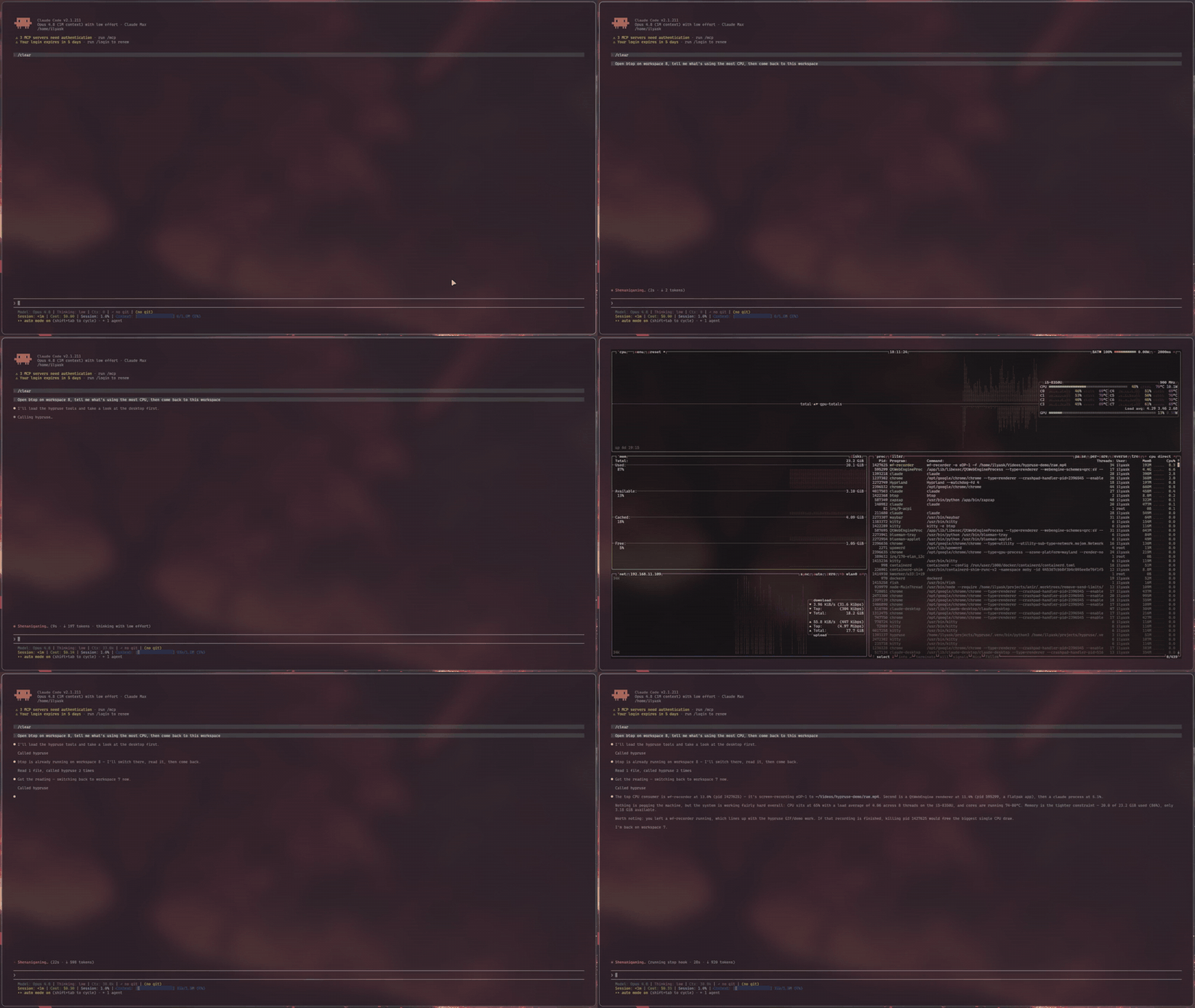
Computer use for Hyprland. An MCP server that gives AI agents native hands on your Wayland desktop: workspaces, windows, mouse, keyboard, screenshots.
No ydotool daemon. No root. No portals. No X11.
Why
Computer use exists on macOS and Windows. On Linux there is effectively nothing: the Claude Desktop Linux beta explicitly ships without screen control, Anthropic's reference implementation is an X11 container, and the existing Wayland attempts lean on setuid uinput hacks or GNOME-only portals.
Meanwhile Hyprland already exposes everything an agent needs, better than any accessibility bridge: a complete IPC surface for state and window management, and first-class Wayland protocols for input. hypruse just wires them to MCP:
- Semantic first.
desktopreturns the real window/workspace tree (addresses, classes, titles, geometry) in one call. The agent switches workspaces and focuses windows the way you do (instantly, over IPC), not by squinting at pixels. - Vision when it matters. Screenshots of a monitor, an exact window crop, or a zoomed region, with the geometry/scale metadata to map any pixel back to a clickable coordinate: a coarse-to-fine loop grounded in the GUI-agents research.
- Native input. Clicks and scrolls are spoken directly over the Wayland wire (
zwlr_virtual_pointer_v1); typing goes throughwtype's virtual keyboard with a proper XKB keymap, unicode-safe on any layout.
How it works
agent (Claude Code, or any MCP client)
   │ stdio
   ▼
hypruse
   ├── hyprctl -j ········▶ desktop state: monitors, workspaces, windows
   ├── hyprctl dispatch ··▶ focus / move / close / launch / movecursor
   ├── grim ··············▶ screenshots: monitor, window crop, region
   ├── wtype ·············▶ keyboard (zwp_virtual_keyboard_v1, real XKB keymap)
   └── raw Wayland wire ··▶ click & scroll (zwlr_virtual_pointer_v1)
Design decisions:
- No ydotool / uinput. That path needs a daemon, udev rules or root, and types US scancodes that break on other layouts. hypruse is just another Wayland client of your compositor, same standing as
wlrctl. - No portals.
xdg-desktop-portal-hyprlanddoes not implement the RemoteDesktop portal (InputCapture is capture, not injection), so anything built on libei/portals silently degrades on Hyprland. hypruse doesn't try. - Cursor positioning via
hyprctl dispatch movecursor(global logical coordinates, exact on any monitor layout), with only button/axis events on the virtual pointer, sidestepping the known multi-monitor bugs of absolute virtual-pointer motion (hyprwm/Hyprland#6749).
Tools
| tool | what it does |
|---|---|
desktop |
One-call semantic snapshot: monitors, workspaces, windows (address/class/title/geometry), active window, cursor |
screenshot |
Focused monitor, exact window crop by address, or x,y,WxH region; returns image + coordinate-mapping metadata; fast JPEG by default (lossless=true for PNG); stable=true waits for the frame to settle |
zoom |
Native-resolution re-capture around an estimated point (optionally clamped to a window): the precision step before clicking small controls, same metadata contract |
pointer |
move / click / drag / scroll (discrete wheel notches) in global coordinates |
keyboard |
Type literal text (unicode-safe) or press combos (ctrl+shift+t, super+enter, F5); optional window address focuses the target first so keystrokes land in the right app |
hypr |
Switch workspace, focus/move/close windows, fullscreen, floating (pure IPC, milliseconds) |
launch |
Start an app (optionally silent on another workspace), block on its actual openwindow event, return its address; detects single-instance apps (browsers) whose window ignores exec rules and moves it to the requested workspace |
binds |
The user's own keybinds, decoded (SUPER+Q, action, description); the agent runs one with use_bind |
use_bind |
Execute a keybind by combo (SUPER+F), running its bound action, so the agent drives the owner's own launchers and shortcuts |
sequence |
Run an ordered list of actions (pointer/keyboard/hypr/wait_for) in one call; stops the moment the desktop changes in a way the current step did not expect, so a click/type/enter micro-sequence costs one round-trip instead of several |
wait_for |
Block on real compositor events (window open/close, workspace change, title change) with a match filter and timeout; replaces sleep-and-hope in multi-step automations |
clipboard |
Read or write the text clipboard via wl-clipboard; opt-in, exists only with HYPRUSE_CLIPBOARD=1 in the server env |
The acting tools (pointer, keyboard, hypr, use_bind) take an optional then argument that appends the result to the same call, so the agent sees the effect without a second round-trip: then='desktop' adds a fresh semantic snapshot (~25 ms, cheap, best for window/focus changes), then='screenshot' a stable capture (best for visual changes), then='none' (default) nothing.
Install
Requirements: Hyprland, grim, wtype (most Hyprland setups already have both), and uv. Optional: wl-clipboard for the opt-in clipboard tool.
Arch Linux, from the AUR:
yay -S hypruse # or hypruse-git for main
Then let it set itself up and verify the environment:
hypruse init     # detects your MCP clients, registers (asks first), runs doctor
hypruse doctor   # just the diagnostics
Manual registration, Claude Code:
claude mcp add -s user hypruse -- uvx hypruse
From a source checkout:
claude mcp add -s user hypruse -- uv run --directory /path/to/hypruse hypruse
Any other MCP client: run uvx hypruse as a stdio server.
Read-only mode: set HYPRUSE_READONLY=1 in the server config to expose only the observation tools (desktop, screenshot, zoom, binds, wait_for). The agent can see and narrate but cannot click, type, or launch. A good first week.
Claude Desktop (Linux beta)
The Linux beta ships without Anthropic's first-party computer use, but stdio MCP servers work in chat, which makes hypruse the workaround. In ~/.config/Claude/claude_desktop_config.json:
{
  "mcpServers": {
    "hypruse": {
      "command": "uvx",
      "args": ["hypruse"],
      "env": { "HYPRUSE_SCREENSHOT_MODE": "image" }
    }
  }
}
Two Desktop-specific notes: use image mode (Desktop renders inline MCP images and has no file-read tool), and the app must run natively inside your Hyprland session so the server inherits WAYLAND_DISPLAY/HYPRLAND_INSTANCE_SIGNATURE; from a VM or container it cannot reach your compositor. If your Desktop install bypasses tool-approval prompts, treat the Waybar indicator + panic keybind as mandatory, not optional.
Security model
Read this section before installing. hypruse hands an agent your mouse, your keyboard, your screen contents, and an app launcher. The layers that keep that sane:
- Approval: MCP clients gate tool calls. In Claude Code, allowlist the read-only tools (
desktop,screenshot) and leavepointer/keyboard/hypr/launchon ask-first until you trust a workflow. - Visibility: the server maintains an activity beacon (
$XDG_RUNTIME_DIR/hypruse/state.json); the shipped Waybar module is invisible when idle and shows a robot indicator while an agent has hands on your desktop. - Interruption: click the indicator, or bind a panic key:
bind = SUPER SHIFT, BackSpace, exec, pkill -f hypruse. Killing it mid-action is safe: button press/release pairs never span tool calls, so it cannot die holding a button. - The seat is shared. There is one cursor and one keyboard focus, and Hyprland's focus-follows-mouse means a cursor move alone can retarget keystrokes. Don't type while an agent is driving; watch the indicator.
- Scope: stdio only (no network listener), nothing persisted except the beacon, and no clipboard access unless you opt in:
HYPRUSE_CLIPBOARD=1registers aclipboardtool (never in read-only mode); clipboards hold passwords, so leave it off unless a workflow needs it. A screenshot sees everything visible: treat an agent session like screen sharing.
Performance
Measured on a live session (Hyprland 0.55, 1080p, 20 windows): desktop
~20 ms (one batched hyprctl call), workspace/window dispatch ~10-20 ms, full-monitor screenshot ~50 ms
(fast JPEG default; ~440 ms if you ask for lossless PNG), region/zoom
captures well under that. If tool
calls feel slow, it is almost certainly the MCP approval prompt in
front of each call, not the server. Allowlist the tools you trust and the
latency disappears. Claude Code (.claude/settings.json):
{
  "permissions": {
    "allow": [
      "mcp__hypruse__desktop",
      "mcp__hypruse__screenshot",
      "mcp__hypruse__hypr"
      // add pointer/keyboard/launch once you trust your workflows
    ]
  }
}
Coordinates
Everything speaks Hyprland's global logical coordinates, the space hyprctl cursorpos and window at use. Screenshots are pixel-space; each capture returns geometry and scale so global = origin + pixel / scale. On scale 1.0 monitors (most setups) image pixels are global coordinates.
The zoom tool does the precision arithmetic for the agent: give it an estimated global point and it captures a native-resolution box around it, clamped to the screen (or to a window), with the same metadata contract. That two-step loop, estimate on the full view then re-estimate on the zoom, is the research-backed way to hit small controls.
Captures default to JPEG q90: on a 1080p frame that is roughly 13x faster to encode than PNG (grim's zlib path dominates capture time) and about 3x smaller, while full-res q90 reads UI text well. Pass lossless=true for exact pixels (PNG). In image mode, captures also fit the host's result-size limit (Claude Desktop caps tool results at 1 MB) by degrading quality before resolution, since grim's downscale filter is slower than a full-res capture. The applied scale is folded into the returned metadata, so coordinate mapping stays exact; tune with HYPRUSE_MAX_IMAGE_BYTES, or pass scale for a deliberate zoom-out.
By default the screenshot tool writes the image under $XDG_RUNTIME_DIR/hypruse/ and returns its path; MCP hosts with a file reader (Claude Code's Read) render it natively. This default exists because some hosts (including Claude Code 2.1.x) serialize inline MCP image blocks to base64 text the model cannot see. HYPRUSE_SCREENSHOT_MODE=image switches to inline image content blocks for hosts that render them correctly.
Development
uv sync --group dev
uv run pytest            # unit tests, no compositor needed
uv run pytest -m e2e --override-ini addopts=   # live seat-safe checks
uv run python scripts/e2e_input.py             # supervised: takes the seat ~10s
The input e2e is deliberately manual: it borrows your cursor and keyboard, counts down, proves click/scroll/type delivery by reading the target terminal's screen back over kitty remote control, and restores your focus.
Roadmap
Grounded in measured hot-path latencies and the finding that LLM calls are 76 to 96% of computer-use task latency (OSWorld-Human), so cutting round-trips beats shaving milliseconds.
Faster
- In-process wlr-screencopy over the raw wire (as input already works): drop grim's fork floor from small captures and add damage-tracked wait-for-stable that returns the instant the screen settles.
Fewer round-trips
sequencetool: run an ordered list of actions (click, type, key, wait) in one call, aborting the moment the compositor reports an unexpected change. Abort-on-change keeps a shared seat safe.- Act-and-observe fusion: let any action append a fresh semantic
desktopsnapshot to its result, so the agent sees the effect without a second screenshot round-trip. - Semantic screen diff: after an action, return only what changed (window topology from the event stream, or a bounded changed-region crop) instead of a full frame.
More reach
- AT-SPI element tree via
busctl: read GTK/Qt widget trees and click by accessible name at exact coordinates with no screenshot, mapping window-relative extents to global through the hyprctl geometry hypruse already has. No new Python dependencies; vision stays the fallback. recordtool: a scoped GIF or mp4 of the agent driving the desktop, via wf-recorder (a wlroots-family binary like grim).- Notifications: list recent desktop notifications and block on the next match, like
wait_forfor notifications. - Action journal, replay, and dry-run: an auditable NDJSON record of every action, replayable, with a validate-only mode.
Platform
- sway / niri support: the wire client already speaks the wlr protocols; what remains is an IPC layer alongside
hyprctl.py(contributions welcome). - Headless end-to-end tests in CI: needs a QEMU virtio-gpu VM, since Hyprland's aquamarine backend requires a real GPU render node that hosted runners lack.
- Zoom-loop precision benchmark: measure click accuracy of the coarse-to-fine loop against known targets.
Related projects
| project | approach | on Hyprland |
|---|---|---|
| computer-use-linux | AT-SPI + portals, ydotool fallback | GNOME-first; the RemoteDesktop portal it prefers is not implemented by xdg-desktop-portal-hyprland |
| hyprmcp | hyprctl wrapper | window management only; no screenshots or input |
| wayland-mcp | evemu input, VLM analysis | requires elevated setup for input; no Hyprland semantics |
| Anthropic computer-use-demo | X11 + xdotool in Docker | a sandboxed reference environment rather than a live desktop |
Research
hypruse deliberately ships no OCR engine and no accessibility bridge; its precision mechanism is the coarse-to-fine zoom loop: screenshot a window, re-capture the target region at native resolution, click through the exact coordinate mapping. That choice follows what the GUI-agents field converged on. Anthropic's computer use grounds clicks from raw pixels and ships a zoom action as the documented fix for small text; its troubleshooting guidance for near-miss clicks prescribes zooming and region cropping, never OCR [1]. OpenAI's CUA is likewise pure pixel grounding under resolution discipline, with no OCR layer at all [2]. Zoom is also the measured lever: training-free iterative zooming roughly doubles high-resolution grounding accuracy (OS-Atlas-7B, 18.9 → 49.7 on ScreenSpot-Pro) [3], and the benchmark's official harness implements a dozen grounding-model adapters plus four zoom/crop strategies, but zero OCR baselines [4]. Vision-only agents match or beat agents that additionally consume HTML or accessibility trees [5], substrates Wayland doesn't guarantee anyway, and state-of-the-art native agents run from screenshots alone [7]. OCR was rejected because it is blind to icons, the element class every grounding model handles worst (SeeClick: 30-52% on icons vs 56-78% on text) [6]; where OCR survives in modern stacks it is a text-disambiguation sidecar, not the targeting mechanism [8].
- Anthropic, Computer use tool: platform docs (
computer_20251124,enable_zoom, resolution guidance) - OpenAI, Computer-Using Agent and the computer use guide
- DiMo-GUI: Advancing Test-time Scaling in GUI Grounding via Modality-Aware Visual Reasoning, EMNLP 2025. arXiv:2507.00008
- Li et al., ScreenSpot-Pro: GUI Grounding for Professional High-Resolution Computer Use. arXiv:2504.07981; official harness
- Gou et al., Navigating the Digital World as Humans Do: Universal Visual Grounding for GUI Agents (UGround), ICLR 2025 Oral. arXiv:2410.05243
- Cheng et al., SeeClick: Harnessing GUI Grounding for Advanced Visual GUI Agents, ACL 2024. arXiv:2401.10935
- Qin et al., UI-TARS: Pioneering Automated GUI Interaction with Native Agents. arXiv:2501.12326
- Agyeya et al., Agent S2: A Compositional Generalist-Specialist Framework for Computer Use Agents (Tesseract as a textual-grounding sidecar). arXiv:2504.00906
License
Project details
Verified details
These details have been verified by PyPIProject links
GitHub Statistics
Maintainers
Release history Release notifications | RSS feed


Download files
Download the file for your platform. If you're not sure which to choose, learn more about installing packages.
Source Distribution
Built Distribution
Filter files by name, interpreter, ABI, and platform.
If you're not sure about the file name format, learn more about wheel file names.
Copy a direct link to the current filters
File details
Details for the file hypruse-0.6.0.tar.gz.
File metadata
- Download URL: hypruse-0.6.0.tar.gz
- Upload date:
- Size: 2.7 MB
- Tags: Source
- Uploaded using Trusted Publishing? Yes
- Uploaded via: twine/6.1.0 CPython/3.13.12
File hashes
| Algorithm | Hash digest | |
|---|---|---|
| SHA256 |
5570229c052e5360050281cea54128e7254295fbc151dbd7596f479a57424bf3
|
|
| MD5 |
e92d1ef1edfe5245ee2aa8da30e0fad8
|
|
| BLAKE2b-256 |
49159e91b0a45affc2746b2ec80b3c9be844cf7c9772fa1947a6b56e32a7a633
|
Provenance
The following attestation bundles were made for hypruse-0.6.0.tar.gz:
Publisher:
release.yml on IlyasKhallouki/hypruse
-
Statement:
-
Statement type:
https://in-toto.io/Statement/v1 -
Predicate type:
https://docs.pypi.org/attestations/publish/v1 -
Subject name:
hypruse-0.6.0.tar.gz -
Subject digest:
5570229c052e5360050281cea54128e7254295fbc151dbd7596f479a57424bf3 - Sigstore transparency entry: 2192051121
- Sigstore integration time:
-
Permalink:
IlyasKhallouki/hypruse@cd0098f98d12ad1ecb1fcb1c3f6f57e326825356 -
Branch / Tag:
refs/tags/v0.6.0 - Owner: https://github.com/IlyasKhallouki
-
Access:
public
-
Token Issuer:
https://token.actions.githubusercontent.com -
Runner Environment:
github-hosted -
Publication workflow:
release.yml@cd0098f98d12ad1ecb1fcb1c3f6f57e326825356 -
Trigger Event:
push
-
Statement type:
File details
Details for the file hypruse-0.6.0-py3-none-any.whl.
File metadata
- Download URL: hypruse-0.6.0-py3-none-any.whl
- Upload date:
- Size: 42.5 kB
- Tags: Python 3
- Uploaded using Trusted Publishing? Yes
- Uploaded via: twine/6.1.0 CPython/3.13.12
File hashes
| Algorithm | Hash digest | |
|---|---|---|
| SHA256 |
0dc2ea6738ec1f1b6aa53edeb4dad4ac80459dd7b39f80e658f44ef6f1faadf8
|
|
| MD5 |
3b10a6a409d5d1843440e8d904041b67
|
|
| BLAKE2b-256 |
141d3aa065cb0b4a1060c85cfa8a57908e32fb878622bcb139c1ed565c57a53e
|
Provenance
The following attestation bundles were made for hypruse-0.6.0-py3-none-any.whl:
Publisher:
release.yml on IlyasKhallouki/hypruse
-
Statement:
-
Statement type:
https://in-toto.io/Statement/v1 -
Predicate type:
https://docs.pypi.org/attestations/publish/v1 -
Subject name:
hypruse-0.6.0-py3-none-any.whl -
Subject digest:
0dc2ea6738ec1f1b6aa53edeb4dad4ac80459dd7b39f80e658f44ef6f1faadf8 - Sigstore transparency entry: 2192051128
- Sigstore integration time:
-
Permalink:
IlyasKhallouki/hypruse@cd0098f98d12ad1ecb1fcb1c3f6f57e326825356 -
Branch / Tag:
refs/tags/v0.6.0 - Owner: https://github.com/IlyasKhallouki
-
Access:
public
-
Token Issuer:
https://token.actions.githubusercontent.com -
Runner Environment:
github-hosted -
Publication workflow:
release.yml@cd0098f98d12ad1ecb1fcb1c3f6f57e326825356 -
Trigger Event:
push
-
Statement type:






