
Ultra-high-performance data profiling natively for Ibis
Verified details
These details have been verified by PyPIProject links
GitHub Statistics
Maintainers

Project description

Ibis Profiling
An ultra-high-performance data profiling system built natively for Ibis.
Core Principle: Profiling as Query Compilation
Unlike traditional profiling tools (e.g., ydata-profiling) that iterate over columns or load data into local memory (Pandas), Ibis Profiling treats profiling as a query planning problem.
It compiles dozens of statistical metrics into a minimal set of optimized SQL queries that execute directly in your remote backend (DuckDB, BigQuery, Snowflake, ClickHouse, etc.). This ensures that computation happens where the data lives, enabling the profiling of multi-billion row datasets in seconds rather than hours.
🖼️ Preview
Overview Dashboard
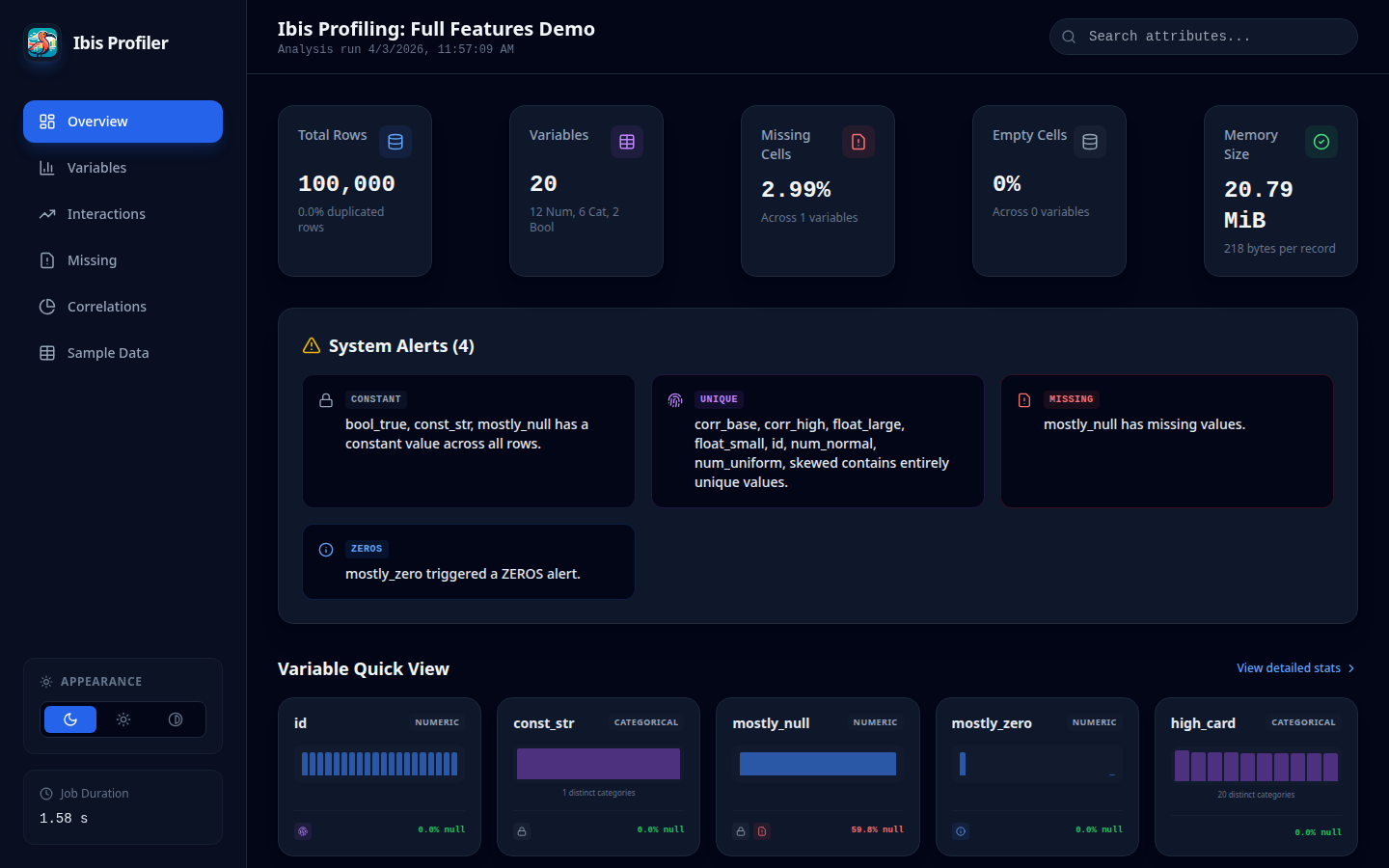
Variable Detail View
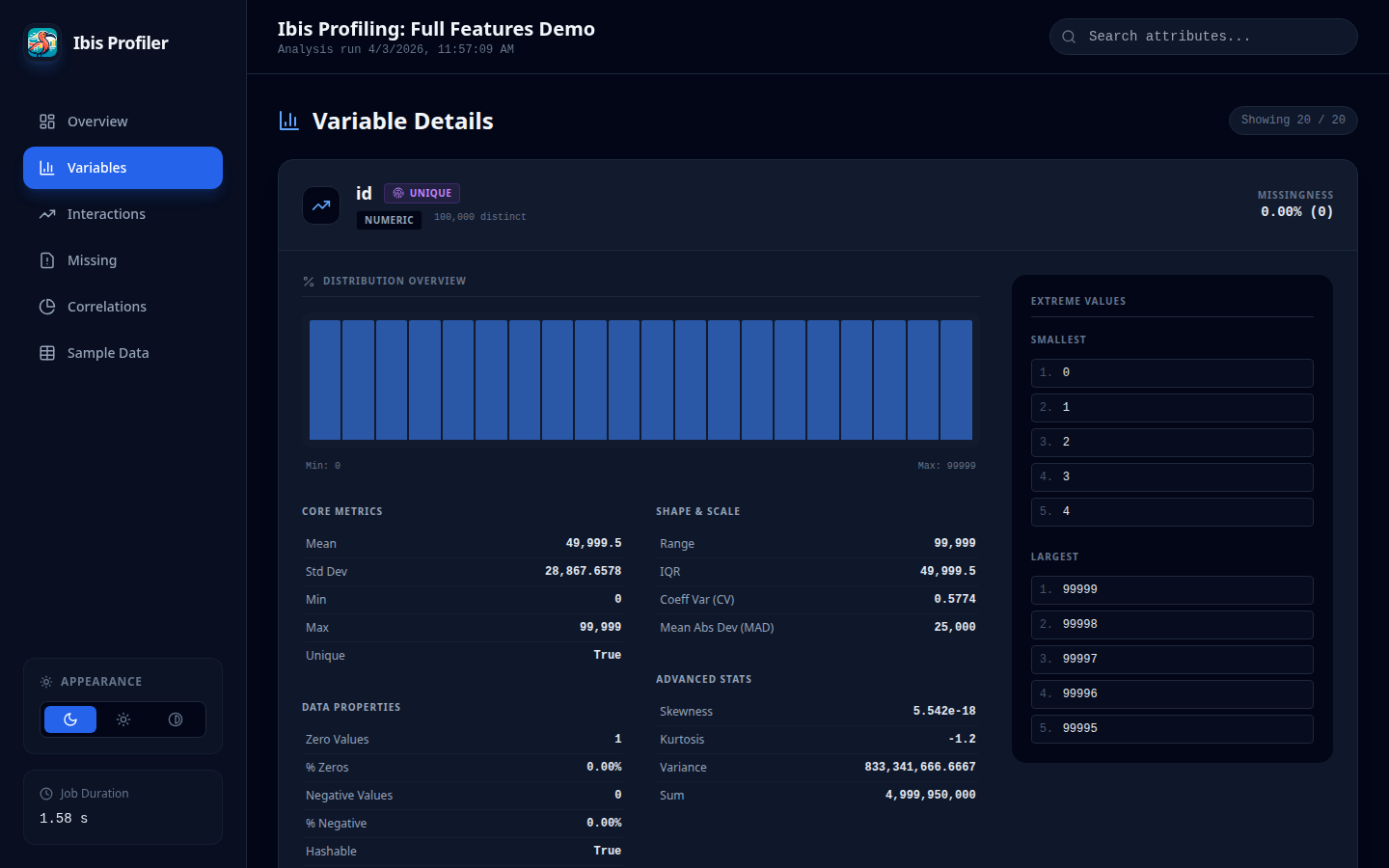
Missing Values Analysis
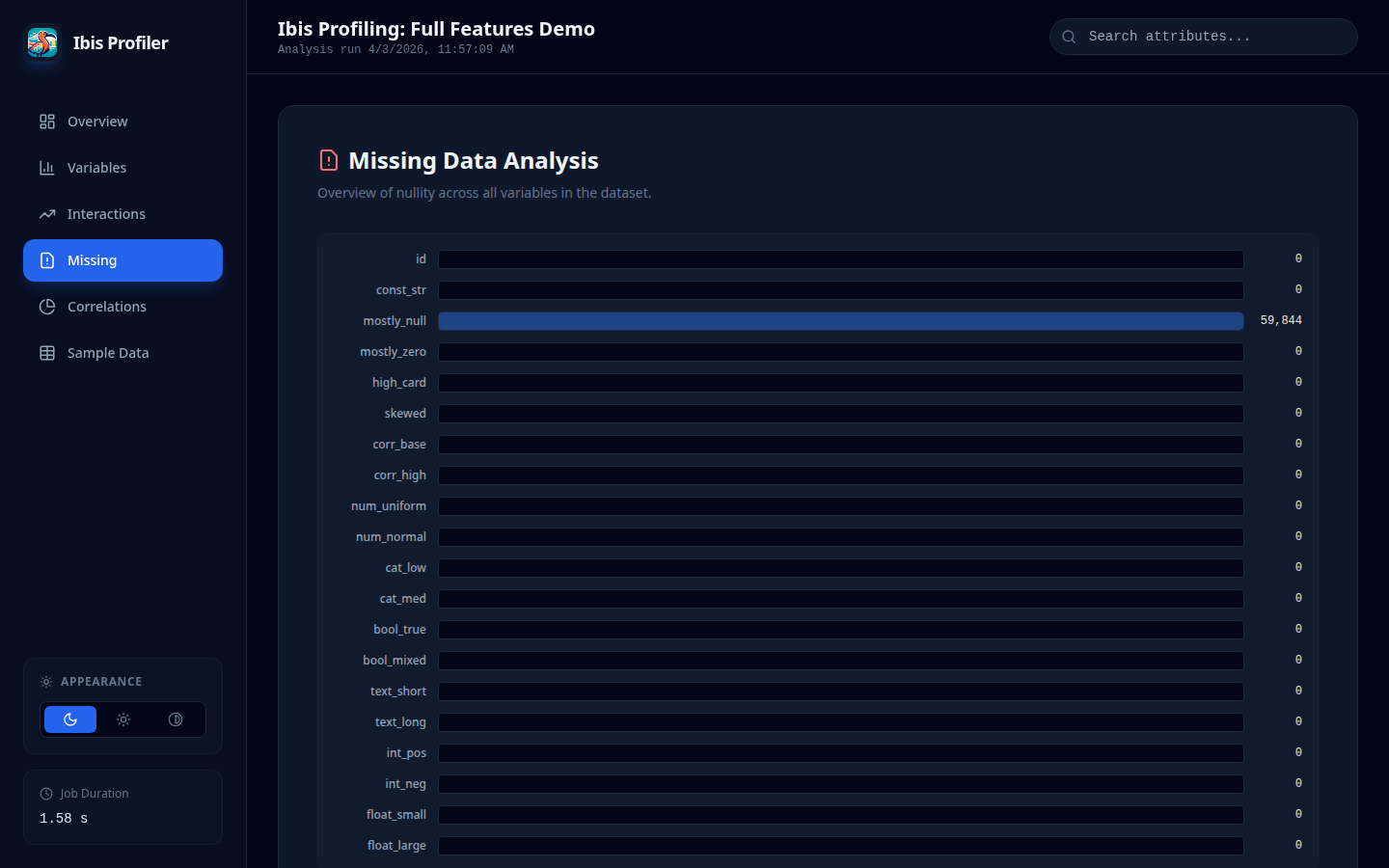
🚀 Key Features
- Backend Pushdown: 100% of the heavy lifting is done by the database engine.
- Multi-Pass Execution: Intelligently splits computation into optimized passes to handle complex moments (Skewness, MAD) without backend "nested aggregation" errors.
- JSON Schema Parity: Achieves full structural and statistical parity with
ydata-profiling, allowing drop-in replacement for downstream automated pipelines. - Modern SPA Report: Generates a lightweight Single Page Application (SPA) with a modern React-based UI.
- Adjustable Themes: Includes built-in support for Dark, Light, and High Contrast modes with persistent user settings.
- Auto-Categorical Detection: Intelligent heuristics automatically reclassify low-cardinality integers (e.g., status codes, term months) as categorical for better visualization.
- DateTime Distribution: Full support for temporal histograms and distribution analysis.
- Excel Support: Directly profile Excel files (.xlsx, .xls, .xlsb) using high-performance Rust-based parsing.
- Scalability: Profile 5 million rows in < 12 seconds (Minimal mode) and < 22 seconds (Full mode).
- Python Compatibility: Fully tested on Python 3.11 through 3.14.3 (Core functionality).
🛡️ Backend Stability & NaN Handling
A critical challenge in database-native profiling is the handling of NaN (Not-a-Number) values in floating-point columns. Traditional database aggregations (like STDDEV_SAMP in DuckDB) often throw OutOfRange errors when encountering NaNs.
Ibis Profiling implements a Safe-Aggregation layer that automatically treats NaN values as NULL during statistical computation. This ensures:
- Zero Crash Policy: Profiles complete successfully even on messy synthetic or sensor data.
- Mathematical Consistency: Statistics (mean, std, variance) are computed on the subset of valid numeric values, matching the behavior of high-level tools like Pandas while staying within the database.
📈 Performance Benchmarks
Benchmarks were conducted using a synthetic dataset with 20 columns (mix of numeric, categorical, text, and boolean) on a standard Linux environment using the DuckDB backend.
| Dataset Size | Ibis (Min) | Ibis (Full) | ydata (Min) | ydata (Full) | Mem Ibis (Min) | Mem ydata (Min) | Mem Ibis (Full) | Mem ydata (Full) |
|---|---|---|---|---|---|---|---|---|
| 10k Rows | 0.89s | 1.40s | 9.94s | 28.38s | ~2.4 MB | ~74 MB | ~4.5 MB | ~107 MB |
| 25k Rows | 1.03s | 1.57s | 12.20s | 30.47s | ~2.1 MB | ~154 MB | ~4.4 MB | ~188 MB |
| 50k Rows | 1.22s | 1.82s | 16.63s | 35.10s | ~2.0 MB | ~284 MB | ~4.4 MB | ~324 MB |
| 500k Rows | 2.29s | 3.56s | 91.93s | ~3m (est) | ~2.0 MB | ~2.5 GB | ~4.4 MB | ~2.8 GB (est) |
| 1M Rows | 3.14s | 5.44s | 166.31s | ~6m (est) | ~2.1 MB | ~4.9 GB | ~4.4 MB | ~5.3 GB (est) |
| 5M Rows | 10.69s | 17.88s | ~14m (est) | ~45m (est) | ~2.0 MB | >20 GB (est) | ~4.4 MB | >25 GB (est) |
| 10M Rows | 20.64s | 21.29s* | ~28m (est) | ~1.5h (est) | ~2.4 MB | >40 GB (est) | ~2.6 MB* | >50 GB (est) |
| 20M Rows | 43.98s | 8.77s** | >1h (est) | >3h (est) | ~2.4 MB | >80 GB (est) | ~1.0 MB** | >100 GB (est) |
*Notes:
- 10M Full (21.29s) used 10 columns.
- 20M Full (8.77s) used 5 columns.
- All other benchmarks use 20 columns.
- Ibis memory usage is nearly constant and extremely low compared to ydata-profiling due to database-native pushdown.*
🔍 Estimation Methodology
Projections for ydata-profiling on larger datasets are derived from observed scaling trends:
- Time (Minimal): Scaled linearly based on the jump from 500k (92s) to 1M (166s) rows.
- Time (Full): Scaled with a factor of ~2.5x - 3x over Minimal mode, consistent with small-sample ratios.
- Memory: Scaled linearly based on observed peak usage (~2.5 GB at 500k, ~4.9 GB at 1M), reflecting the overhead of loading the full dataset into Pandas DataFrames.
🛠 Installation
Since Ibis Profiling is in active development and not yet on PyPI, you can install it directly from GitHub:
Using uv (Recommended)
uv add git+https://github.com/beallio/ibis-profiling.git
Using pip
pip install git+https://github.com/beallio/ibis-profiling.git
💻 Usage
Quick Start (ydata-style API)
import ibis
from ibis_profiling import ProfileReport

# 1. Connect to any Ibis-supported backend
con = ibis.duckdb.connect()
table = con.read_parquet("large_dataset.parquet")

# 2. Generate the report with custom title
report = ProfileReport(table, title="Loan Analysis Report")

# 3. Export results
report.to_file("report.html")
Excel Ingestion
from ibis_profiling import ProfileReport

# Directly profile Excel files with high-performance parsing
report = ProfileReport.from_excel("data.xlsx")
report.to_file("excel_report.html")
Advanced Usage
from ibis_profiling import profile

# Get the raw description dictionary
report = profile(table)
stats = report.to_dict()

print(f"Dataset Skewness: {stats['variables']['income']['skewness']}")
Minimal vs. Full Profiling
The ProfileReport supports a minimal flag (default False) to toggle between fast exploratory profiling and deep statistical analysis.
| Feature | Minimal Mode (minimal=True) |
Full Mode (minimal=False) |
|---|---|---|
| Core Stats | Count, Mean, Std, Min/Max, Zeros, Nullity. | All Minimal stats. |
| Table Metadata | Estimated Memory/Record Size. | Same as Minimal. |
| Advanced Moments | Skipped. | Skewness, Kurtosis, MAD. |
| Correlations | Skipped. | Pearson and Spearman matrices. |
| Advanced Analysis | Skipped. | Extreme Values, Monotonicity, Text Lengths. |
| Visualizations | Histograms (Numeric/DateTime), Summary only. | Nullity Matrix (SVG), Heatmap, Scatter Plots. |
| Duplicates | Skipped. | Dataset-wide duplicate row count. |
| Performance | Ultra-Fast. Recommended for datasets > 50M rows. | Detailed. Recommended for deep data quality audits. |
📦 Report Export & Minification
By default, ibis-profiling minifies the generated HTML report to reduce file size (typically by 15-20%) without compromising functionality. Minification includes:
- Stripping HTML, CSS, and JS comments.
- Removing redundant whitespace and empty lines from the template.
- Compact JSON embedding (removing internal whitespace in the data payload).
To generate a human-readable (non-minified) report, set minify=False in to_file or to_html:
# Save as formatted HTML
report.to_file("report.html", minify=False)

# Get the formatted HTML string
html = report.to_html(minify=False)
Feature Gaps & Roadmap
ibis-profiling is designed for scale, prioritizing metrics that can be pushed down to SQL engines. As a result, some "linguistic" or high-complexity features from ydata-profiling are currently missing or implemented as approximations:
- Linguistic Analysis: Unicode script detection and character-level distributions are missing (require complex UDFs).
- Advanced Correlations:
phi_k,kendall, andcramers_vare currently placeholders (higher computational complexity). - Memory Footprint: While Ibis uses backend-specific commands (like DuckDB's
PRAGMA storage_info) where possible, it falls back to schema-based estimation for others.
🏗 Architecture
The system is decoupled into five core modules:
- Dataset Inspector: Zero-execution schema analysis.
- Metric Registry: Declarative metric definitions as Ibis expressions.
- Query Planner: The "compiler" that batches compatible expressions into minimal execution plans.
- Execution Engine: Multi-pass dispatcher that handles simple vs. complex aggregations.
- Report Builder: Aggregates and formats raw backend results into high-fidelity JSON/HTML following the canonical YData schema.
📊 Missing Values Analysis
Move beyond simple counts with advanced pattern detection:
- Matrix: A vertical sparkline grid (SVG) visualizing the location of missing values across rows.
- Heatmap: Pearson correlation of "nullity" between variables, revealing structural dependencies.
📏 Metrics & Calculation Reference
This section provides a detailed breakdown of how metrics are calculated and how the alert engine identifies potential data quality issues.
1. Variable Calculations
The profiler uses a multi-pass execution engine to compute statistics efficiently across massive datasets while remaining compatible with SQL-based backends (like DuckDB).
Core Statistics (Pass 1)
These are computed in a single global aggregation pass using Ibis primitives.
| Metric | Calculation | Type |
|---|---|---|
n |
Total number of observations (rows) in the table. | All |
n_missing |
Count of NULL or NaN values. |
All |
p_missing |
n_missing / n |
All |
n_distinct |
Count of unique values (excluding NULL). Used for auto-categorical detection. |
All |
p_distinct |
n_distinct / n |
All |
count |
n - n_missing (Total non-missing values) |
All |
mean |
sum(x) / count (NaNs treated as NULL) |
Numeric |
std |
Sample standard deviation (Bessel's correction). | Numeric |
variance |
std^2 |
Numeric |
min / max |
Minimum and maximum values. | Numeric, DateTime |
n_zeros |
Count of values exactly equal to 0. |
Numeric |
n_negative |
Count of values < 0. |
Numeric |
n_infinite |
Count of +/- inf values (Float only). |
Numeric |
histogram |
Binned distribution (Numeric/DateTime) or Top Values (Categorical). | All |
Advanced Statistics (Pass 2)
To avoid "Nested Aggregation" errors in SQL backends, these are computed using values from Pass 1 as constants.
| Metric | Calculation | Logic |
|---|---|---|
skewness |
mean( ((x - μ) / σ)^3 ) |
Standardized 3rd moment. |
mad |
mean( abs(x - μ) ) |
Mean Absolute Deviation. |
n_duplicates |
n - count(distinct_rows) |
Dataset-wide duplicate row count. |
Quantiles
Calculated via col.quantile(p).
5%,25%(Q1),50%(Median),75%(Q3),95%.
2. Alert Engine Logic
The built-in alert engine scans the calculated metrics and triggers warnings based on industry-standard thresholds (aligned with ydata-profiling).
| Alert Type | Logic / Threshold | Severity |
|---|---|---|
| CONSTANT | n_distinct == 1 |
warning |
| UNIQUE | n_distinct == n |
warning |
| HIGH_CARDINALITY | p_distinct > 0.5 (and not UNIQUE, Categorical only) |
warning |
| MISSING | p_missing > 0.05 |
info |
| ZEROS | p_zeros > 0.10 |
info |
| SKEWED | abs(skewness) > 10 |
info |
| Suppression Rules: |
- If a column is CONSTANT, all other alerts for that column are suppressed.
- If a column is UNIQUE, the HIGH_CARDINALITY alert is suppressed.
Project details
Verified details
These details have been verified by PyPIProject links
GitHub Statistics
Maintainers
Release history Release notifications | RSS feed


Download files
Download the file for your platform. If you're not sure which to choose, learn more about installing packages.
Source Distribution
Built Distribution
Filter files by name, interpreter, ABI, and platform.
If you're not sure about the file name format, learn more about wheel file names.
Copy a direct link to the current filters
File details
Details for the file ibis_profiling-0.1.0.tar.gz.
File metadata
- Download URL: ibis_profiling-0.1.0.tar.gz
- Upload date:
- Size: 786.0 kB
- Tags: Source
- Uploaded using Trusted Publishing? Yes
- Uploaded via: twine/6.1.0 CPython/3.13.7
File hashes
| Algorithm | Hash digest | |
|---|---|---|
| SHA256 |
106eac4a45e097d4a6d0e6b67669dac1c8a858351adc3f93900c1cb531b3f782
|
|
| MD5 |
a755d1a97d2df9a8c4c9a20e15c0a2d9
|
|
| BLAKE2b-256 |
e815aa7e290f155473a6a703f5dd19e622a5c63e1af2e98e55990c448cac59dd
|
Provenance
The following attestation bundles were made for ibis_profiling-0.1.0.tar.gz:
Publisher:
publish.yml on beallio/ibis-profiling
-
Statement:
-
Statement type:
https://in-toto.io/Statement/v1 -
Predicate type:
https://docs.pypi.org/attestations/publish/v1 -
Subject name:
ibis_profiling-0.1.0.tar.gz -
Subject digest:
106eac4a45e097d4a6d0e6b67669dac1c8a858351adc3f93900c1cb531b3f782 - Sigstore transparency entry: 1097851688
- Sigstore integration time:
-
Permalink:
beallio/ibis-profiling@d64be7ac6c6be4ab6974be1c49809ff8d5eb7ddb -
Branch / Tag:
refs/tags/v0.1.0 - Owner: https://github.com/beallio
-
Access:
public
-
Token Issuer:
https://token.actions.githubusercontent.com -
Runner Environment:
github-hosted -
Publication workflow:
publish.yml@d64be7ac6c6be4ab6974be1c49809ff8d5eb7ddb -
Trigger Event:
release
-
Statement type:
File details
Details for the file ibis_profiling-0.1.0-py3-none-any.whl.
File metadata
- Download URL: ibis_profiling-0.1.0-py3-none-any.whl
- Upload date:
- Size: 790.3 kB
- Tags: Python 3
- Uploaded using Trusted Publishing? Yes
- Uploaded via: twine/6.1.0 CPython/3.13.7
File hashes
| Algorithm | Hash digest | |
|---|---|---|
| SHA256 |
9790ab9229356f54ada61993c0ebb54ce56684ac1d31b44e854196cbc0894fbe
|
|
| MD5 |
04084e3307fb16d865a863c3ea1bb66d
|
|
| BLAKE2b-256 |
a6a2da665d93a11c54a726850dfba0e0023636b1e3abfc767ca8d054713d7c97
|
Provenance
The following attestation bundles were made for ibis_profiling-0.1.0-py3-none-any.whl:
Publisher:
publish.yml on beallio/ibis-profiling
-
Statement:
-
Statement type:
https://in-toto.io/Statement/v1 -
Predicate type:
https://docs.pypi.org/attestations/publish/v1 -
Subject name:
ibis_profiling-0.1.0-py3-none-any.whl -
Subject digest:
9790ab9229356f54ada61993c0ebb54ce56684ac1d31b44e854196cbc0894fbe - Sigstore transparency entry: 1097851694
- Sigstore integration time:
-
Permalink:
beallio/ibis-profiling@d64be7ac6c6be4ab6974be1c49809ff8d5eb7ddb -
Branch / Tag:
refs/tags/v0.1.0 - Owner: https://github.com/beallio
-
Access:
public
-
Token Issuer:
https://token.actions.githubusercontent.com -
Runner Environment:
github-hosted -
Publication workflow:
publish.yml@d64be7ac6c6be4ab6974be1c49809ff8d5eb7ddb -
Trigger Event:
release
-
Statement type:






