

insightsmith
Forging insight from raw data.
An agentic data consultant that runs on your own machine.
The foundation, not yet the whole thing
Shipped so far: format detection, loading and profiling (
ismith look), hardware probing with model-fit recommendation (ismith doctor), the provider layer routing roles to local or cloud models (ismith models), the dataset card plus ideation (ismith look --ideas), sandboxed code execution answering real questions (ismith ask), and charts with a validated palette (ismith ask --chart).Still to come across 0.7.0–0.8.0: the statistical critic and reports. Nothing sends your data anywhere unless you configure a remote provider yourself.
What it does today
pip install insightsmith
ismith look data/sales.csv
╭──────────────── source ─────────────────╮
│ format    csv                           │
│ encoding  cp1252                        │
│ dialect   delimiter=';' decimal=','     │
│ confidence 95%                          │
│ assumed   read as cp1252; charset-      │
│           normalizer suggested cp775    │
╰─────────────────────────────────────────╯
umsatz.csv: 5 rows x 3 columns
        columns
┏━━━━━━━━┳━━━━━━━━━┳━━━━━━━━━━━━━┳━━━━━━━┳━━━━━━━━┳━━━━━━━━━━━━━━━━━━━━━━━┓
┃ column ┃ dtype   ┃ semantic    ┃ nulls ┃ unique ┃ detail                ┃
┡━━━━━━━━╇━━━━━━━━━╇━━━━━━━━━━━━━╇━━━━━━━╇━━━━━━━━╇━━━━━━━━━━━━━━━━━━━━━━━┩
│ region │ String  │ categorical │     - │      4 │ Nord (2) · Süd (1)    │
│ menge  │ Int64   │ numeric     │     - │      5 │ min 4 · med 12 · max… │
│ umsatz │ Float64 │ numeric     │     - │      5 │ min 40.75 · med 120.5 │
└────────┴─────────┴─────────────┴───────┴────────┴───────────────────────┘
candidate keys: menge
Add --json for the same profile as machine-readable output.
Which local model fits your machine
ismith doctor
Probes CPU, RAM, disk and GPU, then sizes each catalogued model against what it finds — per role, because routing and planning are different jobs and your machine may afford one but not the other.
The arithmetic is the point. Weights come from the quantisation's bytes-per-param;
the KV cache from 2 × layers × n_kv_heads × head_dim × context × 2 bytes. Using
n_kv_heads rather than the attention-head count is what makes it right: on a
4 GB laptop GPU at 8k context, qwen3:8b (8 KV heads) needs 1.21 GB of cache
against 4.92 GB of weights, while deepseek-coder:6.7b — same size, but 32 KV
heads and no grouped-query attention — needs 4.29 GB of cache against 4.20 GB
of weights. A rule of thumb based on parameter count alone cannot tell you that.
Models that don't fit outright get a partial-offload layer count rather than a shrug, and anything larger than your RAM is excluded with a reason.
Getting an actual answer
ismith ask data/sales.csv "total sales by product type?"
The model writes a Polars snippet, it runs, and you get the number — plus the code that produced it, so the result is checkable rather than taken on trust. When the snippet fails, the traceback goes back to the model and it tries again, up to three times, then reports the failure honestly instead of inventing an answer.
The code runs in a separate process behind six layers of defence (design doc
§7): an allowlist AST gate that refuses eval, exec, open, getattr,
dunder attributes and every import outside the analysis stack; an isolated
interpreter with a scrubbed environment; CPU, memory and file-size limits;
a Parquet copy of the data in a scratch directory rather than a path into your
tree; and --approve to see each snippet before it runs.
Add --chart and the answer is drawn as well as printed:
ismith ask data/sales.csv "total sales by product type?" --chart
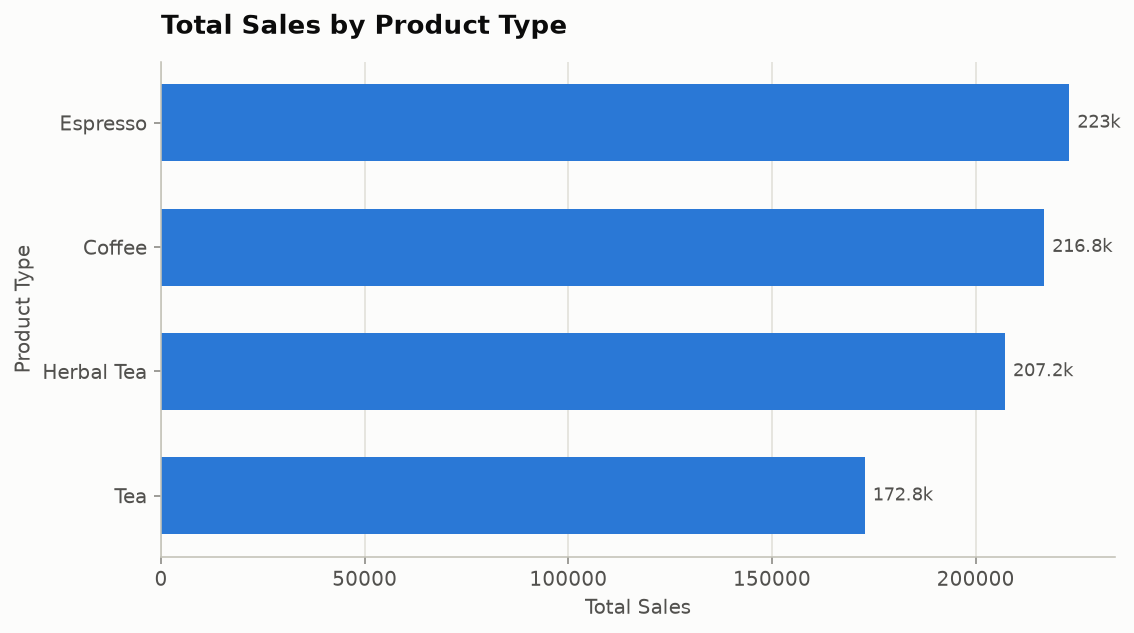
The model picks the chart, it does not draw it. It returns a form and which column fills which role; the renderer draws that spec. So charts are consistent, reproducible for a given spec, and no plotting code written by a model ever runs. A spec naming a column the result doesn't have is discarded, exactly as an idea would be.
The palette was validated with a colour-blindness and contrast checker rather than chosen by eye, and two of its measurements are enforced in code: slots are assigned in a fixed order and a ninth series raises instead of inventing a hue, and scatter caps at three series because all-pairs forms fail the separation floor at four. Bars are ranked, long tails fold into "other", and one series gets one hue — colouring every bar differently implies a distinction the data does not contain.
Each run saves a PNG and a self-contained interactive HTML next to a manifest recording the question, the code and the card hash, so a figure found later can be traced back to the data behind it.
Read SECURITY.md before pointing this at anything sensitive. It is defence in depth against a model erring by accident — the realistic failure — and explicitly not a security boundary against a deliberately malicious prompt. The resource limits are POSIX-only; on Windows the gate and the timeout are all there is.
Asking a model what's worth analysing
ismith look data/sales.csv --ideas    # ranked analyses
ismith look data/sales.csv --card     # exactly what the model will be shown
The dataframe is never pasted into a prompt. Everything an agent sees arrives through a dataset card: a compact JSON summary of schema, per-column statistics, quality flags, a correlation shortlist, and a few stratified example rows with obvious PII masked. Three things follow, and they are the reason for the design:
- Token cost is flat regardless of file size. A 589 KB, 4248-row, 20-column file produces a 4.8 KB card — and so would a 40 GB one. That is what makes an 8B local model workable.
- No raw records leave the machine. Sensitive columns are redacted by name, recognisable values by pattern.
- The card hashes, so the same data yields the same plan and results cache.
Ideas come back ranked, each naming the columns it needs — and any idea referencing a column the card doesn't contain is discarded before you see it. That one check removes most hallucination for the price of a set-membership test.
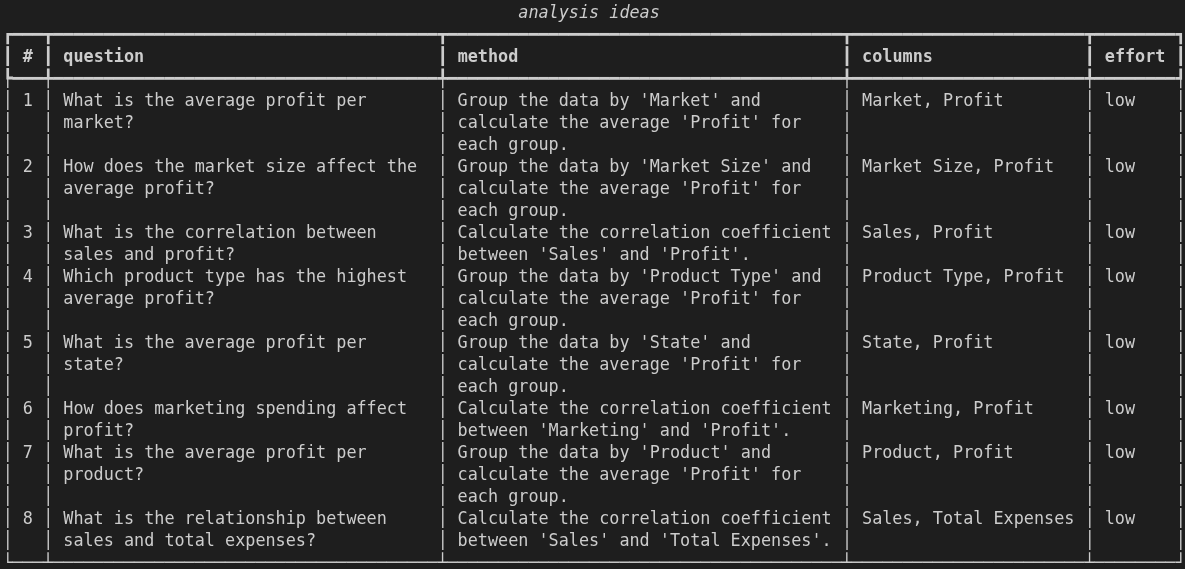
Every column named above — Market, Product Type, State, Marketing,
Total Expenses — exists in the file. Anything else was dropped before it
reached the table.
The quality notes travel on the card too, so a model hedges where the data warrants it: given a date column flagged as ambiguous, it proposes parsing it "with caution" rather than trusting it.
Wiring up a model
ismith models
Shows what each role resolves to, whether it stays on your machine, and how it
will be asked for structured output. Configure it in ~/.insightsmith/config.toml:
[roles]
planner = "ollama/qwen3:8b"
coder   = "ollama/qwen2.5-coder:7b"
cheap   = "ollama/qwen3:4b"

[budget]
max_usd_per_session = 0.50
local_only = true
One class covers every backend that speaks the OpenAI wire format — OpenAI,
OpenRouter, DeepInfra, Together, Groq, Fireworks, Mistral, Gemini's compat
endpoint, and local vLLM / llama.cpp / LM Studio — because they differ only by
base URL and key. Ollama is written natively instead, since /api/show,
/api/ps and keep_alive are the whole reason to run locally.
Capabilities are read, not assumed. Ollama reports whether a model supports tool-calling, so the router picks its approach up front rather than failing mid-run: tool-calling where available, JSON mode next, and otherwise prompted JSON with a bounded retry that feeds the parse failure back. Small models wrap JSON in prose and code fences no matter how firmly told not to, so that path is the common case, not an edge case.
local_only = true is a hard failure, not a warning. Point a role at a
remote provider with it set and loading the config raises, naming the offending
role. A privacy switch that only warned would not be a privacy switch.
Format detection doesn't trust the extension. A three-stage cascade — extension
hint, then magic bytes, then a text-dialect probe — where each stage can veto the
one before it. A Parquet file named .csv is loaded as Parquet, and you're told
the extension lied. Every result carries a confidence score and the list of
assumptions behind it; below 80% those assumptions are printed rather than hidden.
It is built for the files that actually turn up: semicolon-delimited cp1252 CSVs with decimal commas and thousands separators, BOMs, comment preambles, quoted fields containing the delimiter, gzip and single-member zip wrappers.
Profiling reports per-column dtype and semantic type, null rates, cardinality, numeric summaries with outlier counts by two different methods, temporal ranges, text lengths, category frequencies, candidate keys, and quality notes: duplicate and near-duplicate rows, constant and near-constant columns, runaway cardinality, class imbalance.
As a library
from insightsmith import load, profile, sniff

spec = sniff("data/sales.csv")
print(spec.format, spec.encoding, spec.confidence, spec.warnings)

frame = load(spec)  # a Polars LazyFrame — nothing read yet
result = profile(spec)
print(result.summary())
for issue in result.issues:
    print(issue.severity.value, issue.column, issue.message)
Polars LazyFrame is the internal representation throughout, so Parquet, Arrow,
NDJSON and UTF-8 CSV are scanned rather than loaded.
Formats loadable today: csv, tsv, xlsx/xlsm (with [excel]), xls, parquet,
feather/arrow, json, jsonl/ndjson. Detected-but-not-yet-loadable formats — sqlite,
duckdb, xml, html, ods, orc, hdf5, spss, stata, sas — say so, and name the release
that will handle them.
Install
pip install insightsmith            # csv, tsv, parquet, arrow, json, jsonl
pip install insightsmith[excel]     # + xlsx / xls
pip install insightsmith[viz]       # + charts (matplotlib, plotly)
pip install insightsmith[pandas]    # + a .to_pandas() escape hatch
The base install is six dependencies — polars, typer, rich, charset-normalizer, psutil and httpx (plus a TOML backport on Python 3.10 only). No torch, no pandas, no agent framework. Extras stay optional on purpose.
What it won't do
Worth stating plainly, in advance:
-
Large files are profiled on a sample. Above a size threshold the profile is built from a strided sample of the rows, and every affected statistic is marked
estimated. Row counts remain exact; distributions are approximate. -
Encoding detection is a guess on small files. Single-byte codepages are genuinely ambiguous in a few hundred bytes. Sparse non-ASCII text is read as cp1252 and the substitution is reported, but it can still be wrong.
-
Statistics have edges. The IQR fence is degenerate when the middle 50% of a column is a single value, so outliers are counted by a MAD-based modified z-score as well, and both numbers are shown. They disagree usefully.
-
"Near-duplicate" means one specific thing — identical once string columns are trimmed and case-folded. It is not fuzzy matching.
-
PII masking is best-effort, not a guarantee. It catches values that look like contact details or identifiers and blanks columns whose names say they hold personal data. It cannot recognise a person's name in free text, an address split across columns, or an identifier in a format it hasn't seen. If data must not leave the machine, set
local_only— masking is defence in depth, not a substitute for keeping it local.--cardshows exactly what would be sent, andinclude_examples=Falseomits sample values entirely. -
Dates are inferred, and
04/01/10is genuinely ambiguous. Date columns load as strings and the format is inferred afterwards, so a file polars cannot parse still loads. Where day-first and month-first fit equally well, the chosen format is reported as a quality note rather than picked silently — check it before trusting anything grouped by that column. -
Thousands separators are detected but not stripped. polars has no option for them, so such columns may load as strings.
-
No XML row-unit discovery, and zstd payloads aren't inspected (no stdlib decompressor before Python 3.14).
-
Throughput figures are estimates, not benchmarks.
ismith doctorderives tok/s from published peak memory bandwidth, which no real decode loop reaches. Devices missing from that table reportunknownrather than a plausible substitute, and the catalog only contains models whose layer and KV-head counts were read from a running Ollama — never guessed. -
LLMs write wrong code confidently.
ismith askprints the code for exactly that reason — check it. The retry loop fixes code that crashes; it cannot tell that a snippet ran cleanly and answered the wrong question. The statistical critic that catches some of that arrives in 0.7.0. -
The sandbox is defence in depth, not a security boundary. See SECURITY.md. Resource limits are POSIX-only.
License
Apache-2.0. See LICENSE.
1 maintainer

Metadata
1 maintainer
Release files for insightsmith 0.6.0
For a detailed explanation of source distributions (sdists) and built distributions (wheels), please see the package formats documentation.
Source distribution (sdist)
| File | Size | Uploaded | Provenance | Actions |
|---|---|---|---|---|
| insightsmith-0.6.0.tar.gz | 115.2 kB | With provenance | Details for insightsmith-0.6.0.tar.gz |
Built distribution (wheel)
| File | Interpreter | ABI | Platform | Actions Reset |
|---|---|---|---|---|
| insightsmith-0.6.0-py3-none-any.whl | Python 3 | none | any | Details for insightsmith-0.6.0-py3-none-any.whl |
Total release size: 210.7 kB
Release files / insightsmith-0.6.0.tar.gz
| Download URL | insightsmith-0.6.0.tar.gz |
|---|---|
| Size | 115.2 kB |
| Tags | Source |
|
SHA-256 checksum How to use checksums |
6f8a950e81ebc3436d1b095495fe47edb9ec7519b9d09795599f5fb84aa12ae8
|
|
BLAKE2b-256 checksum How to use checksums |
c6da764577334ce233d628798ed68783a61c029f224d59fd1fd7f8c925f0f7b7
|
| Upload date | |
|
Uploaded using Trusted Publishing? What is trusted publishing? |
Yes |
| Uploaded via |
twine/7.0.0 CPython/3.13.14
|
Provenance
Provenance describes where a file came from. On PyPI, provenance is shared via attestations, which provide a verifiable record of the build or publishing details. View details, limitations and caveats.


PyPI Publish Attestation
PyPI verified that this artifact, at this checksum, originated from the publisher listed below.
Signed by GitHub Actions, verified by PyPI on Aug 27, 2026.
Transparency logRelease files / insightsmith-0.6.0-py3-none-any.whl
| Download URL | insightsmith-0.6.0-py3-none-any.whl |
|---|---|
| Size | 95.5 kB |
| Tags | Python 3 |
|
SHA-256 checksum How to use checksums |
25f3c48ea5edd48cb95aa0189c6be49284c22fe31e066d7b37ba7e9594ca1d60
|
|
BLAKE2b-256 checksum How to use checksums |
94f190a95e07c229ee13b5ec9c546313dbb14be9282f10754ebfd00e89402407
|
| Upload date | |
|
Uploaded using Trusted Publishing? What is trusted publishing? |
Yes |
| Uploaded via |
twine/7.0.0 CPython/3.13.14
|
Provenance
Provenance describes where a file came from. On PyPI, provenance is shared via attestations, which provide a verifiable record of the build or publishing details. View details, limitations and caveats.
PyPI Publish Attestation
PyPI verified that this artifact, at this checksum, originated from the publisher listed below.
Signed by GitHub Actions, verified by PyPI on Aug 27, 2026.
Transparency logSecurity for insightsmith 0.6.0
Provenance
Provenance describes where a file came from. On PyPI, provenance is shared via attestations, which provide a verifiable record of the build or publishing details. View details, limitations and caveats.
Full provenance
Both files in this release have been uploaded with provenance metadata.
Attestation for insightsmith-0.6.0.tar.gz
PyPI Publish Attestation
PyPI verified that this artifact, at this checksum, originated from the publisher listed below.
Signed by GitHub Actions, verified by PyPI on Aug 27, 2026.
Transparency logA note on package security
PyPI is a repository for distributing packages, not a service for auditing them. While third-party security researchers and our staff do their best to detect and remove malicious packages, PyPI cannot guarantee the quality, security or suitability of any given package.
To learn more about protecting yourself from malicious actors, visit our package security documentation.














