
interp-engine





interp-engine is an interpretability engine that is fast, standardized (34 'points'/addresses across architectures), and easy to use and debug. It powers all of Neuronpedia's inference and is checked for accuracy against HF Transformers and other engines.
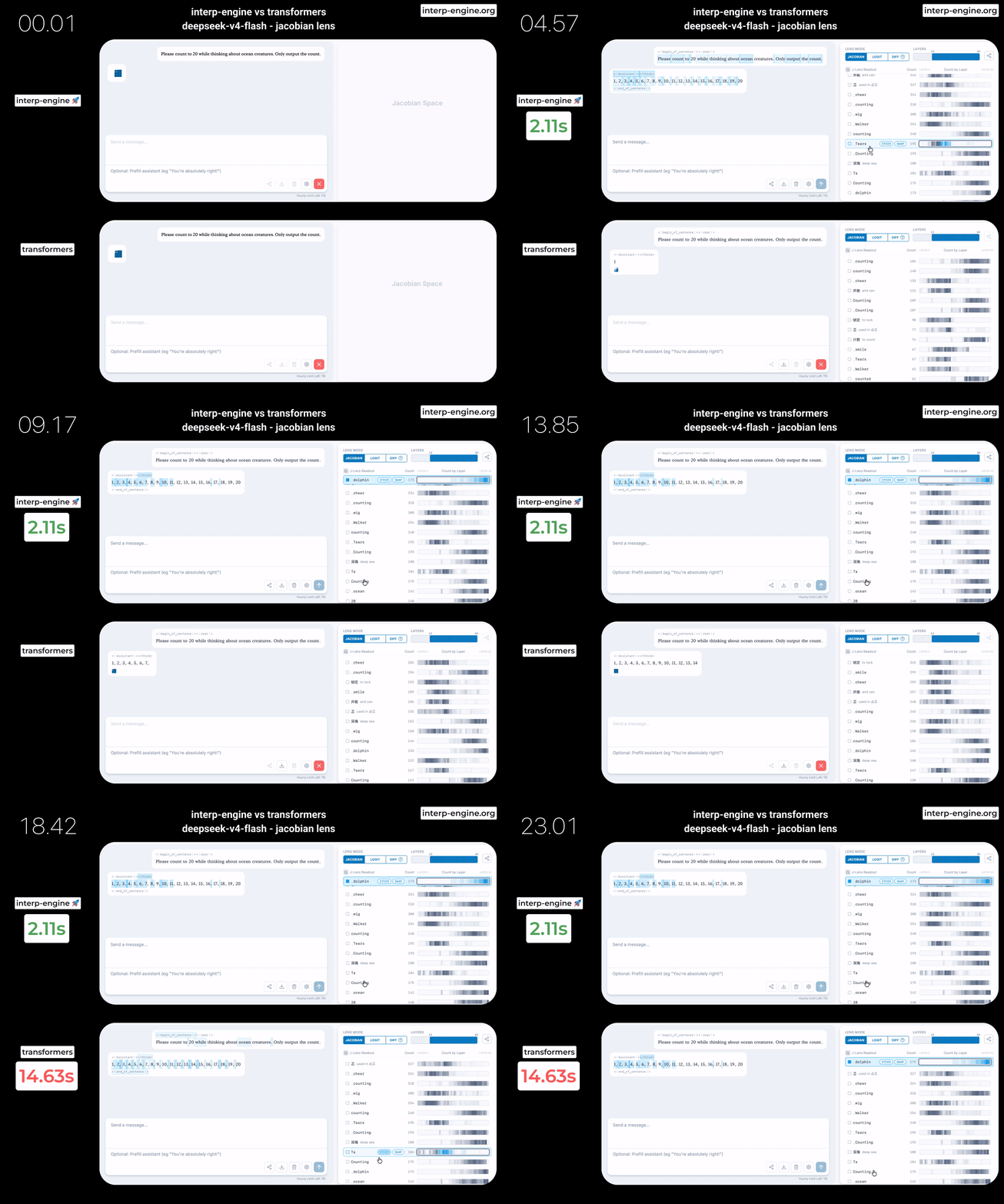
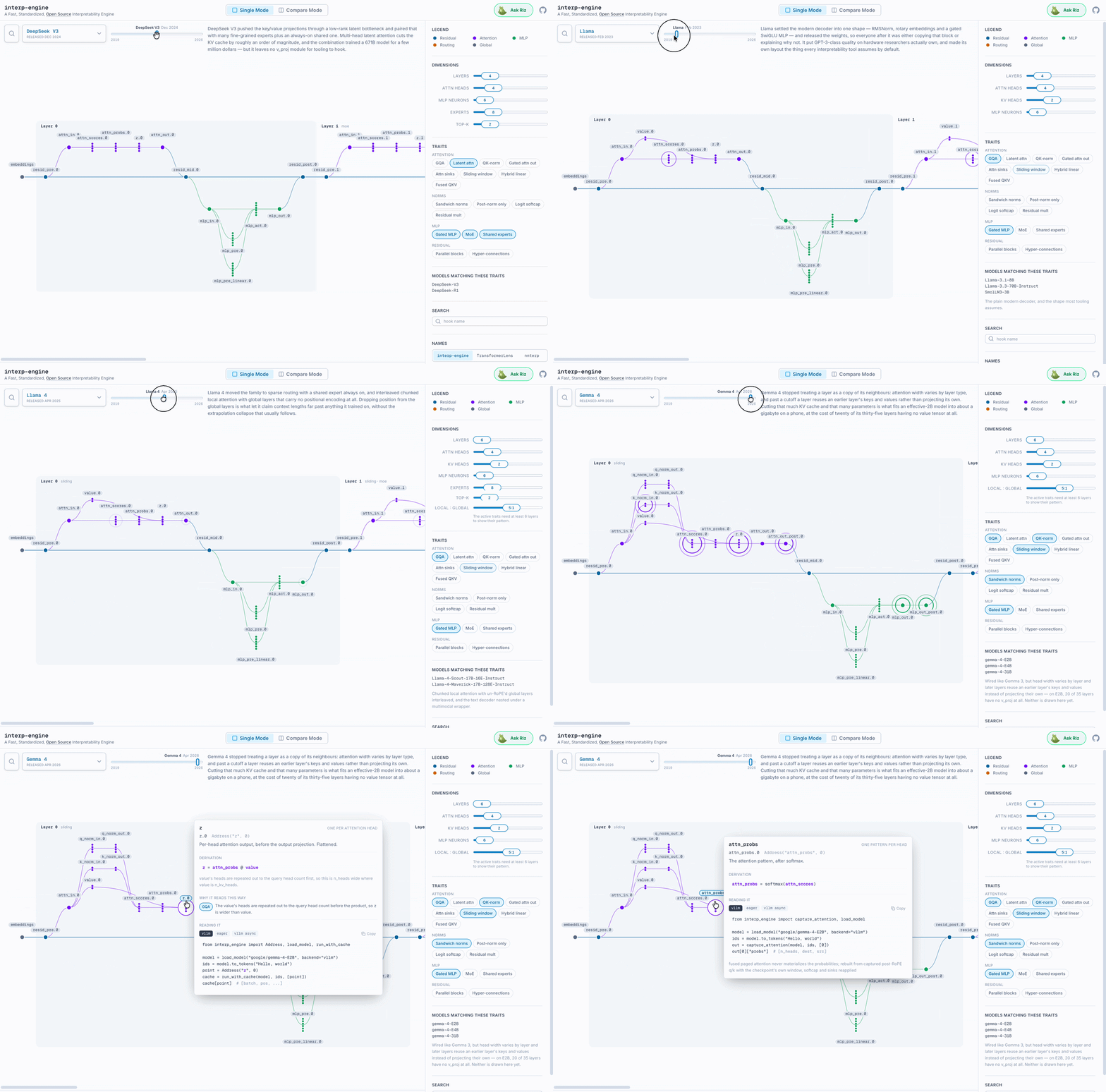
This repo contains:
validator/, which compares/validates it against TransformerLens, and nnsight/nnterp on real architectures.visualizer-web/, a "cheat sheet" hosted at interp-engine.org of each 'point' (egresid_post.16), standardized across architectures.gpu-sizer/, which finds the GPU/config you need to fit an interp-engine model (and what performance you'll get), to avoid OOMing while working. docs | API
Installation
pip install 'interp-engine[vllm]'  # preferred install: includes vLLM support (CUDA required)
pip install interp-engine          # eager backend only
Simple Usage
from interp_engine import Address, load_model, run_with_cache

# VLLM (default): low VRAM, medium speed, every point, chosen per request
model = load_model("Qwen/Qwen3-8B")

# VLLM-STATIC: high VRAM, high speed, only the points you declare (default resid_post)
# model = load_model("Qwen/Qwen3-8B", backend="vllm-static")

# VLLM-GENERATE: fastest, generation only -- no capture, no steering
# model = load_model("Qwen/Qwen3-8B", backend="vllm-generate")

# EAGER: low VRAM, low speed
# model = load_model("Qwen/Qwen3-8B", backend="eager")

point = Address("resid_post", 10)      # or string: "resid_post.10"
cache = run_with_cache(model, model.to_tokens("Hello, world"), [point])
cache[point]  # [batch, pos, ...]
AI Agents
Add "use interp-engine" to your prompt and let your agent figure it out - everything is fully documented in this repo and open source.
Supported Points ("Addresses")
interp-engine supports 34 standardized points ("Addresses") across architectures: every one of them on the eager backend, 28 of them on vLLM. Check interp-engine.org for the "cheat sheet", or SUPPORTED_POINTS.md for a markdown version with the per-backend detail.
Performance / Speed
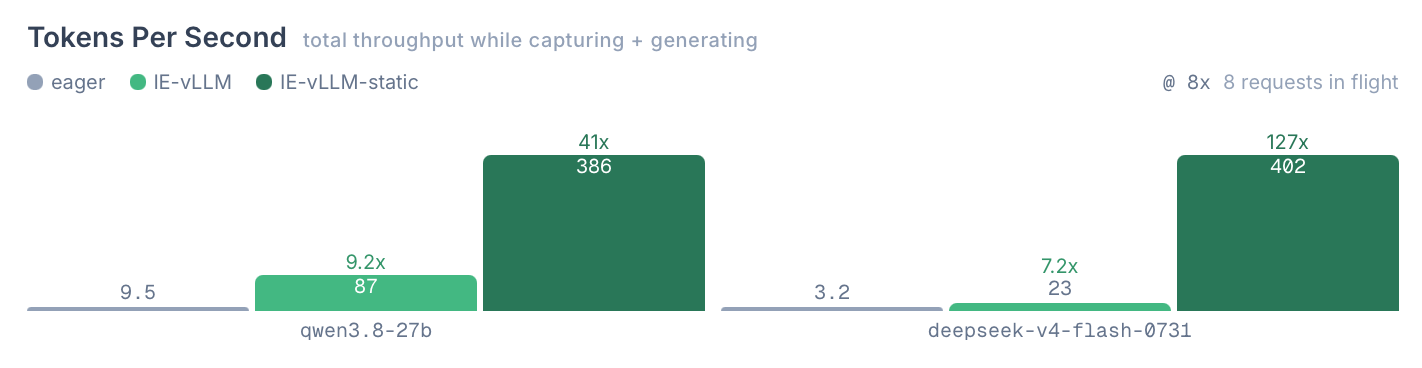
vLLM gives interp-engine high throughput via concurrency, and backend="vllm-static" gives even higher throughput at the cost of higher VRAM usage. Every column below is capture-capable.
Measured on NVIDIA B200, bf16, 512-token prompt, 128 new tokens.
One stream (tok/s):
| model | eager | vLLM | vLLM + static taps |
|---|---|---|---|
gemma-2-2b |
75 | 88 (1.2x) | 220 (2.9x) |
qwen3-4b |
60 | 136 (2.3x) | 313 (5.2x) |
llama-3.1-8b |
84 | 163 (1.9x) | 258 (3.1x) |
qwen3.8-27b |
25 | 35 (1.4x) | 63 (2.5x) |
deepseek-v4-flash-0731 |
5.3 | 15 (2.9x) | 132 (25x) |
8 concurrent requests (aggregate tok/s):
| model | eager | vLLM | vLLM + static taps |
|---|---|---|---|
gemma-2-2b |
75 | 675 (9.0x) | 1,436 (19.2x) |
qwen3-4b |
61 | 973 (15.9x) | 2,219 (36x) |
llama-3.1-8b |
81 | 1,187 (14.6x) | 1,755 (22x) |
qwen3.8-27b |
24 | 246 (10.3x) | 408 (17.0x) |
deepseek-v4-flash-0731 |
5.4 | 117 (22x) | 631 (116x) |
backend="vllm-static" is opt-in, and serves only the tap set it declared — static_points="auto" by default, or a list you name. PERFORMANCE.md has how it works and what it trades; benchmarks/results-latest.md has every figure at full precision, including capture, steering and lens latencies; benchmarks/README.md has how the tables above are rounded.
Correctness
We verify correctness in two main ways:
- A test suite that checks results across several models - what each check is designed to catch is in INTERNALS.md.
- A full
validatorcomparison engine that checks most hook points across 50+ models, at early, middle and late layers - fully reproducible, with detailed results saved in the git repo atvalidator/.
GPU-Sizer
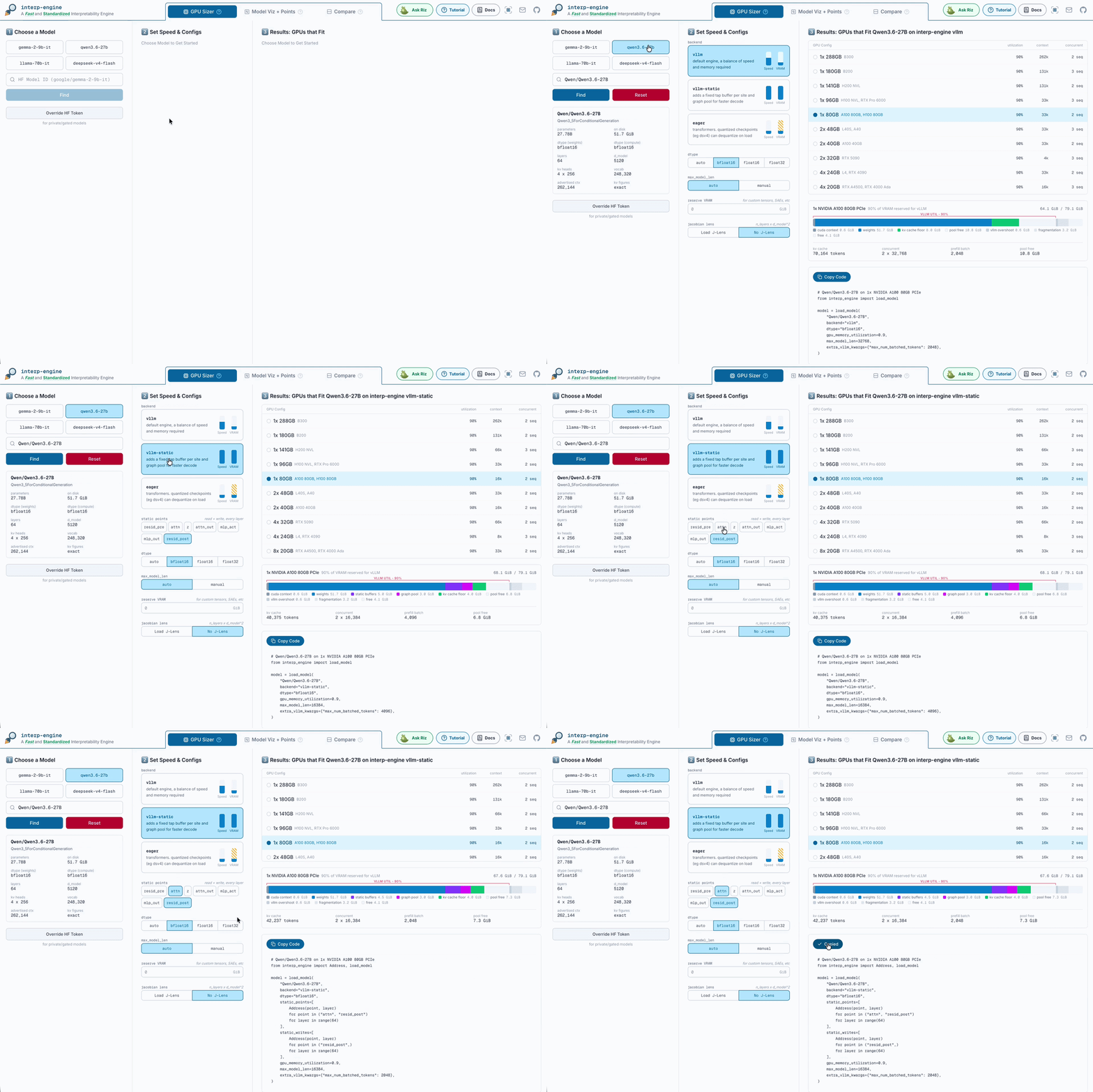
Never OOM again - interp-engine includes gpu-sizer, an intuitive UI which tells you what GPU(s) and configs you need to get the best performance out of your selected model. For example, interp-engine.org/sizer/Qwen/Qwen3.6-27B shows that you can run Qwen3.6-27B with interp-engine's vllm-static backend for max speed while keeping it in a single 80GB A100, and have ~160k tokens for the KV Cache.
Why use an Interpretability Engine instead of building from scratch?
- Speed: Get performance without sacrificing correctness.
- Standardization + Verification: Eliminate ambiguity when referring to points, plus a full test suite included.
- Faster Dev / Fewer Tokens Used: You could spend ten million tokens and have your AI write, test, and make production-ready an interpretability engine. Or you could just
pip install interp-engine[vllm].
Caveats
- Gemma 4 requires transformers 5.14.1 because 5.15 moved
head_dimintoper_layer_configand vLLM's config read dies before a weight loads (vllm#51744). - DeepSeek-V2 on transformers older than 5.15.0 captures a wrong attention temperature — the engine warns at load, and upgrading is the fix (COMPATIBILITY.md).
- DeepSeek-V4 on the eager backend needs two flags outside Hopper. Its FP8 paths reach for
kernels-community/deep-gemm, which declares a9.0abuild, and withkernels>= 0.16.1 the arch refusal escapes transformers' Triton fallback and kills the first forward. Load withTRANSFORMERS_DISABLE_DEEPGEMM_LINEAR=1andexperts_implementation="grouped_mm", which transformers already recommends on B200 for an unrelated DeepGEMM accuracy problem. The engine raisesHubKernelUnsupportednaming both; vLLM is unaffected. - MXFP4 checkpoints (gpt-oss) need
interp-engine[quant], which the[vllm]extra does not include; without it transformers dequantizes them to bf16 at roughly 3x the weights, which can turn a model that fits into one that does not. gemma-4-26B-A4B-iton the static vLLM backend needsVLLM_BATCH_INVARIANT=1on B200/B300. On compute capability 10.x, vLLM's own greedy output moves by up to 6.8 nats under the CUDA-graph replay a static set requires, so the taps would report a forward pass vLLM itself gets wrong (vllm#55238). The engine refuses this combination at load and names the flag; capability 9.x and 12.x are bit-identical and unaffected.
Per-architecture structural quirks — which points a family serves and why — are not caveats but facts about the architecture, and live in ARCHITECTURE_QUIRKS.md.
Development / Contributing
Activate the shared git hooks once per clone — they format staged Python, rebuild the generated files, and run CI's static checks before a push. Details in CONTRIBUTING.md.
make hooks # or: git config core.hooksPath .githooks
Contact
Bugs and feature requests belong in issues. For anything else: johnny@neuronpedia.org.
License
Apache 2.0
1 maintainer

Metadata
1 maintainer
Release files for interp-engine 1.11.3
For a detailed explanation of source distributions (sdists) and built distributions (wheels), please see the package formats documentation.
Source distribution (sdist)
| File | Size | Uploaded | |
|---|---|---|---|
| interp_engine-1.11.3.tar.gz | 936.6 kB | Details |
Built distribution (wheel)
| File | Interpreter | ABI | Platform | Reset |
|---|---|---|---|---|
| interp_engine-1.11.3-py3-none-any.whl | Python 3 | none | any | Details |
Total release size: 1.4 MB
Release files / interp_engine-1.11.3.tar.gz
| Download URL | interp_engine-1.11.3.tar.gz |
|---|---|
| Size | 936.6 kB |
| Tags | Source |
|
SHA-256 checksum How to use checksums |
af06c4fdaf3fd517ffb056d6e10f64ad2602b539b23695c770d2e34a093606f8
|
|
BLAKE2b-256 checksum How to use checksums |
6b0ce298d705151f70d3560005213ca4239e5ab9ee4937f87773f747781bc023
|
| Upload date | |
|
Uploaded using Trusted Publishing? What is trusted publishing? |
Yes |
| Uploaded via |
twine/7.0.0 CPython/3.13.14
|
Provenance
Provenance describes where a file came from. On PyPI, provenance is shared via attestations, which provide a verifiable record of the build or publishing details. View details, limitations and caveats.


PyPI Publish Attestation
PyPI verified that this artifact, at this checksum, originated from the publisher listed below.
Signed by GitHub Actions, verified by PyPI on Sep 28, 2026.
Transparency logRelease files / interp_engine-1.11.3-py3-none-any.whl
| Download URL | interp_engine-1.11.3-py3-none-any.whl |
|---|---|
| Size | 468.9 kB |
| Tags | Python 3 |
|
SHA-256 checksum How to use checksums |
1a66e64b4bbb8c500babcf229d7e6db33d4a8fff20295c8bba25bc004f23979c
|
|
BLAKE2b-256 checksum How to use checksums |
aa80df3831098a353595b0726de0aa20e6f25bb4e5cc6e52fab3c37a68aa5e97
|
| Upload date | |
|
Uploaded using Trusted Publishing? What is trusted publishing? |
Yes |
| Uploaded via |
twine/7.0.0 CPython/3.13.14
|
Provenance
Provenance describes where a file came from. On PyPI, provenance is shared via attestations, which provide a verifiable record of the build or publishing details. View details, limitations and caveats.
PyPI Publish Attestation
PyPI verified that this artifact, at this checksum, originated from the publisher listed below.
Signed by GitHub Actions, verified by PyPI on Sep 28, 2026.
Transparency log













