

Run or import paired release-regression evidence. Verify it independently. Hand off a recipient-controlled decision.





Using independently supplied trust inputs, an artifact recipient can check whether one exact model derivative satisfies an agreed release-regression policy.
InvarLock is an open-source assurance engine for one paired baseline-versus-subject decision. It can execute both sides on the same deterministic schedule or import complete authenticated per-record material from another controlled evaluation. A closed request binds the artifacts, evaluation source or schedule, runtime and evaluator identities, scoring contract, and policy. InvarLock recomputes the permitted comparison and publishes a signed evidence bundle; a separate verifier replays that bundle against independently supplied trust anchors.
Evidence paths
Native execution and independently replayable import converge on the same signed evidence, independent verification, and reporting transaction:
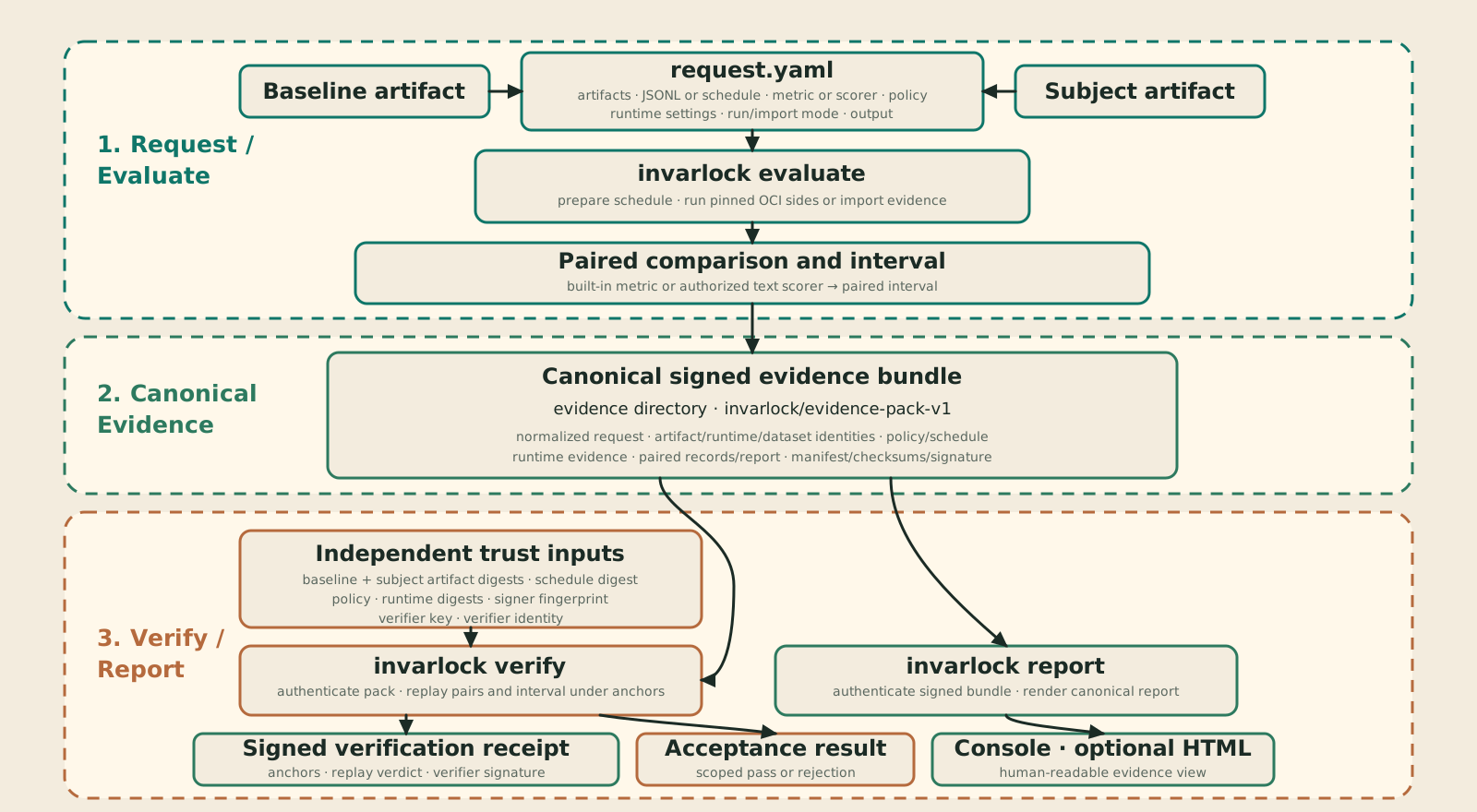
For artifact delivery, the workflow continues from technical verification to a recipient-controlled decision:
authenticated evaluation → portable signed evidence → independent technical verification → recipient-controlled acceptance
An evaluation operator publishes the evidence; the artifact recipient controls the acceptance policy and decision.
invarlock evaluate request.yaml
invarlock verify evidence/
invarlock report evidence/
Native execution receives pinned artifacts, evaluation source, runtime, deterministic scoring, and policy; InvarLock runs both sides and derives the paired result. External evaluator adapters remain in the example and integration layer and normalize source exports through evaluator-neutral contracts; the core exposes evaluator-neutral contracts only. Their status is recorded on three independent axes:
| Axis | Values | Meaning |
|---|---|---|
| Adapter support | Maintained or external | Whether an adapter and pinned upstream entry point are maintained; this grants no decision authority |
| Replay authority | Independently replayable or observation-only | Whether complete ordered facts can be deterministically recomputed, or can only be preserved as authenticated context |
| Signed-journey maturity | Retained or not yet demonstrated | Whether a model-running signed evaluate → verify → report OCI transaction has been retained |
The stable qualification result expresses replay authority as
verdict_authority or observation_only. Adapter support and signed-journey
maturity are catalog metadata, not fields that an imported result can claim
for itself.
Decision boundary
InvarLock answers one precise question: whether a subject artifact satisfies an agreed release-regression policy relative to a baseline, using authenticated evidence and independently supplied trust anchors. It makes that decision reproducible, portable, and suitable for recipient-controlled approval.
The decision remains bounded by the supplied evidence and identities. Broader deployment, safety, compliance, and organizational decisions remain with their corresponding controls and reviewers. See the threat model and assurance case for the complete claim boundary and assumptions.
Try the signed handoff locally
The five-minute wheel workflow verifies retained signed evidence against independent anchors, issues a fresh verifier-signed receipt, and renders an HTML report. It needs only Python 3.12 or newer and a regular CPU.
python -m venv .venv
. .venv/bin/activate
python -m pip install "invarlock==0.15.0"

curl -fsSLO \
  https://github.com/invarlock/invarlock/archive/refs/tags/v0.15.0.tar.gz
tar -xzf v0.15.0.tar.gz --strip-components=3 \
  invarlock-0.15.0/examples/quickstart \
  invarlock-0.15.0/examples/acceptance-handoff/golden

python run.py --fixture golden
The command prints Decision: pass and the paths to the signed receipt,
machine-readable verification result, and human report. The versioned example
files stay outside the package; the command imports only the installed wheel.
The fuller offline handoff example
also builds fixture evidence and exercises ten fail-closed recipient scenarios.
Inspect published evidence
The repository carries strictly verified signed evidence packs across the built-in text runtime and first-party GGUF/llama.cpp, vision-text, and TensorRT-LLM runtimes. Each uses a pinned public qualification suite and includes an independently signed verification receipt.
make public-evidence-audit
invarlock report \
  public_evidence/evidence/mistral-7b-weight-scale-hf/evidence
python -m json.tool \
  public_evidence/evidence/mistral-7b-weight-scale-hf/verification.receipt.json
Start with the public evidence index for the maintained inventory and interpretation limits. Reporting authenticates and explains the signed bundle. Acceptance remains a separate, recipient-controlled decision under current policy. Technical verification obtains the expected artifact, schedule, evaluated policy, runtime, evidence signer, and verifier anchors through channels independent of the submitted pack.
Run, verify, and report
Install the built-in Hugging Face provider for a native text comparison:
python -m pip install "invarlock[hf]"
For the native command below, start from the
complete run request
and replace every illustrative digest with one derived from the exact input.
Import mode instead starts from the repository's
schema-valid import request
and omits --runtime-image and --runtime-image-digest; the request binds the
complete imported provider sidecars.
invarlock evaluate request.yaml \
  --signing-key evidence-signer.pem \
  --runtime-image registry.example/invarlock-runtime@sha256:aaaaaaaaaaaaaaaaaaaaaaaaaaaaaaaaaaaaaaaaaaaaaaaaaaaaaaaaaaaaaaaa \
  --runtime-image-digest sha256:aaaaaaaaaaaaaaaaaaaaaaaaaaaaaaaaaaaaaaaaaaaaaaaaaaaaaaaaaaaaaaaa

invarlock verify artifacts/evidence-001/ \
  --trust-profile trust/trust-inputs.json \
  --receipt verification.receipt.json

invarlock report artifacts/evidence-001/ --html evidence.html --explain
evaluate --preflight --json returns the machine-readable result of complete
execution-free validation. Native run mode delegates to a caller-authorized,
digest-addressed Docker or Podman image. Import mode authenticates and replays
complete provider sidecars and ordered per-record evidence locally.
The getting-started guide
and runtime-provider guide
cover request construction, image preparation, device selection, host-only
signing keys, and independently derived verifier inputs.
The release-regression decision
Both sides score the same authenticated records in the same order. InvarLock derives one of two built-in paired comparisons:
| Metric | Point comparison | Policy verdict |
|---|---|---|
exact_match |
Subject accuracy minus baseline accuracy, with paired regression and improvement counts | Lower bound of the paired Newcombe 95% interval is at least delta_min_pp |
normalized_nll_per_utf8_byte |
Ratio of arithmetic means of per-record byte-normalized expected-continuation NLL | Upper bound of the paired schedule-resampling interval is at most ratio_max |
The conservative interval bound controls the policy; the point value remains descriptive. A policy may also require a minimum paired-record count and maximum interval width. Exact match includes an exact two-sided McNemar test; normalized NLL uses 2,048 deterministic paired schedule-resampling replicates. Normalized NLL specifically measures expected-continuation likelihood regression; broader model-quality claims require other evidence.
For task-specific deterministic scoring, a request may bind one authorized scorer extension. The extension derives one replayable value per record while the core retains ownership of pairing, aggregation, intervals, and policy. See schedule and policy for the full statistical contract and threshold guidance.
Import and qualify evaluator results
The core exposes one evaluator-neutral qualification contract as versioned
JSON, the invarlock-qualify-evaluator companion CLI, and
invarlock.engine.qualify_evaluator_export for Python callers. Open-source or
proprietary evaluators reached through an SDK, CLI, or API normalize into that
same boundary outside the core.
Independent replay requires complete ordered per-record evidence that passes identity, provenance, schedule, and deterministic recomputation requirements. Aggregate-only outputs and unsupported judge results remain observation-only. A signed observation proves what was supplied; a replayable source additionally requires the identity, schedule, and recomputation guarantees above.
The maintained evaluator qualification matrix groups recognizable upstream evaluators by role and records adapter support, source version, replay authority, and retained signed-journey maturity. Each independently replayable import starts with retained output from a pinned real model evaluation, passes through a source-shaped adapter, and completes the closed import replay. LM Evaluation Harness and Inspect AI additionally include retained 400-record native signed OCI transactions for Qwen3.5 9B over a shared balanced MMLU-Pro schedule. LM Evaluation Harness also retains a Gemma 4 12B instruction-to-QAT transaction to demonstrate a second model family. Their adapters and profiles are example-owned; new profiles extend the same evaluator-neutral engine contract. The retained proof map links each upstream output, qualified import, signed transaction, and verifier receipt.
The
examples/integrations/
directory contains maintained artifact-producing journeys for Hugging Face,
PEFT, TorchAO, GGUF/llama.cpp, TensorRT-LLM, Hugging Face vision-text, and LM
Evaluation Harness, plus the compact Inspect AI bridge. OpenAI Evals has a
maintained native adapter without retained signed-journey evidence. The
model-change workflow guide
maps common model and runtime changes to native execution, optional-runtime, or
import boundaries.
Hand off acceptance
The detailed signed verification receipt remains the replayable technical result. An optional in-toto/DSSE acceptance attestation transports that result and its exact subject binding. The artifact recipient still applies separate envelope and receipt trust, independent envelope and evidence freshness, contract-version, signer-status, and verdict policy.
Recipients can consume the acceptance envelope with a standalone reference verifier and maintained OPA/Rego or CUE policy configuration. The example authenticates the envelope and embedded receipt, then applies current recipient policy. Its conformance fixtures cover an accepted delivery, policy rejection, subject tampering, an untrusted signer, stale evidence, and an unsupported contract.
Acceptance-policy interoperability applies current recipient policy to the
authenticated projection. invarlock verify performs complete evidence-pack
replay. See the
policy-engine interoperability reference.
Compatibility note: v0.13 evidence and receipts remain permanently verifiable and permanently ingestible as first-class dossier inputs. Every acceptance outcome remains controlled by the recipient's current policy.
Providers and diagnostics
Hugging Face Transformers is the built-in reference provider and supports both built-in metrics. First-party optional GGUF/llama.cpp, TensorRT-LLM, and Hugging Face vision-text packages are independently installable runtime integrations with their own dependency sets. The vision-text add-in supports exact-match comparisons over authenticated prompt and image parts. See runtime providers.
Spectral, random-matrix, and variance summaries live in the optional
invarlock-diagnostics package. They are observation-only diagnostics. Their
canonical JSON can be attached to the signed bundle and appears in a separate
report section. The selected paired comparison and policy remain the sole
technical-verdict inputs. See
diagnostics.
Documentation
- Run and review: getting started, evaluation requests, schedule and policy, and evidence and verification.
- Understand the claim: assurance case, decision semantics, and trust model.
- Integrate: CLI, contracts, acceptance attestations, compatibility covenant, evaluator qualification, policy-engine interoperability, runtime providers, and Python API.
InvarLock is pre-1.0. Canonical artifact formats carry explicit format versions; the Python embedding facade may evolve between minor releases.
Questions and design discussions belong in GitHub Discussions. Report bugs through GitHub Issues and security concerns through SECURITY.md.
If you ship or receive derived model artifacts and want to co-publish a real evidence-and-receipt handoff using the open engine, start a design-partner discussion.
Apache-2.0 — see the license.
1 maintainer

Metadata
1 maintainer
Release files for invarlock 0.15.0
For a detailed explanation of source distributions (sdists) and built distributions (wheels), please see the package formats documentation.
Source distribution (sdist)
| File | Size | Uploaded | |
|---|---|---|---|
| invarlock-0.15.0.tar.gz | 240.4 kB | Details |
Built distribution (wheel)
| File | Interpreter | ABI | Platform | Reset |
|---|---|---|---|---|
| invarlock-0.15.0-py3-none-any.whl | Python 3 | none | any | Details |
Total release size: 514.7 kB
Release files / invarlock-0.15.0.tar.gz
| Download URL | invarlock-0.15.0.tar.gz |
|---|---|
| Size | 240.4 kB |
| Tags | Source |
|
SHA-256 checksum How to use checksums |
85c1b5f7b060bc174a1a2abae0eba5fbc42b20ea2b9be99cefbb183c25664f51
|
|
BLAKE2b-256 checksum How to use checksums |
e9775592649e32b5263d9d68bf9aa867c611d3855f76a7348f7c0e4eecac52cd
|
| Upload date | |
|
Uploaded using Trusted Publishing? What is trusted publishing? |
Yes |
| Uploaded via |
twine/7.0.0 CPython/3.13.14
|
Provenance
Provenance describes where a file came from. On PyPI, provenance is shared via attestations, which provide a verifiable record of the build or publishing details. View details, limitations and caveats.


PyPI Publish Attestation
PyPI verified that this artifact, at this checksum, originated from the publisher listed below.
Signed by GitHub Actions, verified by PyPI on Aug 16, 2026.
Transparency logRelease files / invarlock-0.15.0-py3-none-any.whl
| Download URL | invarlock-0.15.0-py3-none-any.whl |
|---|---|
| Size | 274.4 kB |
| Tags | Python 3 |
|
SHA-256 checksum How to use checksums |
7b4d371e2bb3bbc07ed6be7bbec545bf4b8d675826704ca3a67ecb44ed6c06ec
|
|
BLAKE2b-256 checksum How to use checksums |
78e3da629c4b0e7d369592c4fe07225f5b3f5f1245b6dfce38a4753987a78a42
|
| Upload date | |
|
Uploaded using Trusted Publishing? What is trusted publishing? |
Yes |
| Uploaded via |
twine/7.0.0 CPython/3.13.14
|
Provenance
Provenance describes where a file came from. On PyPI, provenance is shared via attestations, which provide a verifiable record of the build or publishing details. View details, limitations and caveats.
PyPI Publish Attestation
PyPI verified that this artifact, at this checksum, originated from the publisher listed below.
Signed by GitHub Actions, verified by PyPI on Aug 16, 2026.
Transparency log













