




ipysensitivityprofiler
Jupyter Widgets for visualizing local sensitivities of vectorized functions with
signature y = f(x) where x, y are arrays.
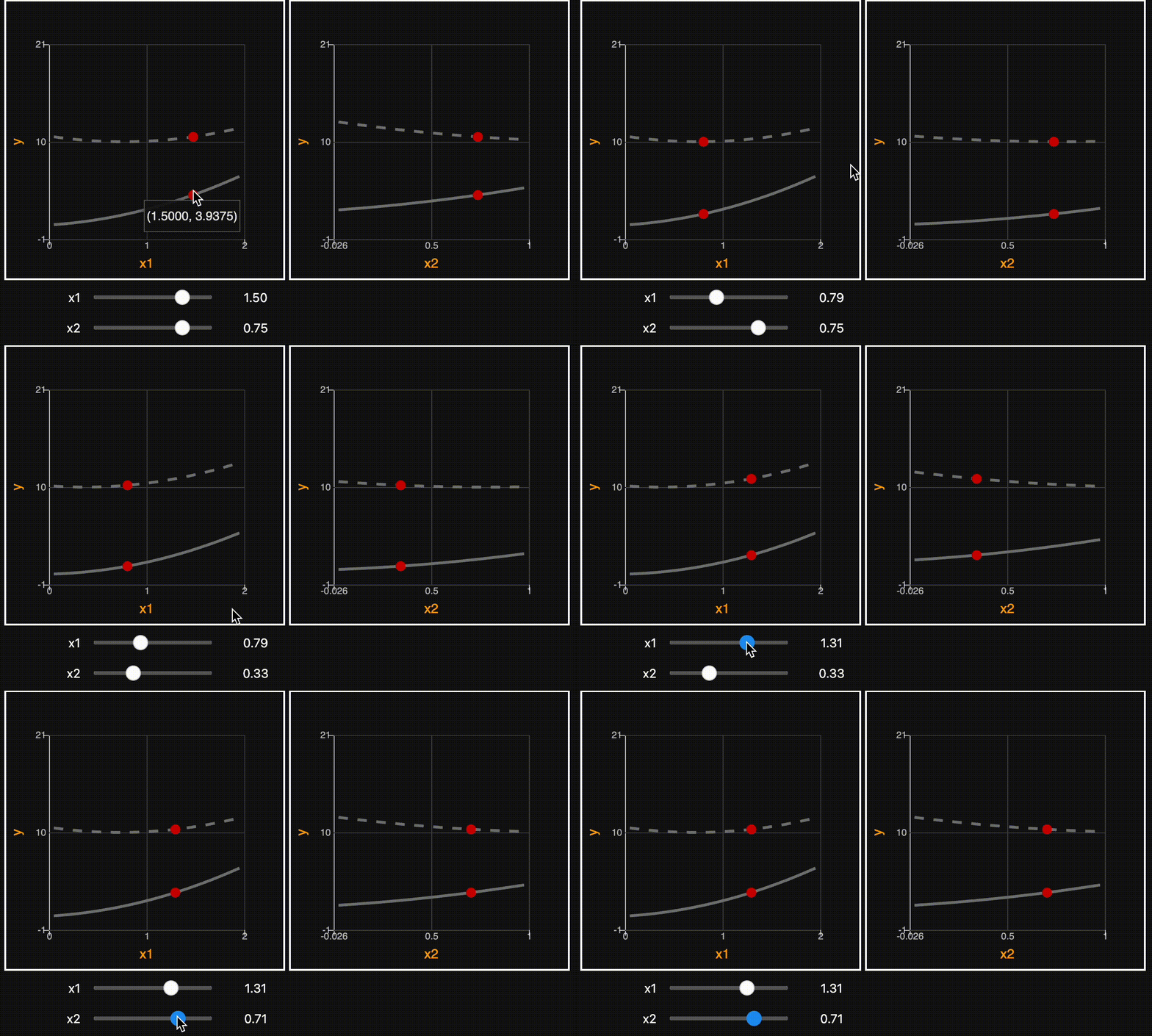
Main Features
- Visualize multiple outputs against multiple inputs interactively
- Overlay more than one model at once
- Download pictures of individual plots (by clicking on the red dot)
Installation
pip install ipysensitivityprofiler
Example Usage
See the example notebooks, or run them without installing anything on binder.
Import the library and define one or more vectorized models:
import numpy as np
import ipysensitivityprofiler as isp

def quadratic1(x):
    """y = x1**2 + x2**2 + x1*x2"""
    return np.prod(x, axis=1) + np.power(x, 2).sum(axis=1)

def quadratic2(x):
    """y = 10 + x1**2 + x2**2 - 2 * x1*x2"""
    return 10 - 2 * np.prod(x, axis=1) + np.power(x, 2).sum(axis=1)
Then profile them:
isp.profiler(
    models=[quadratic1, quadratic2],
    xmin=[0, 0],
    xmax=[2, 1],
    ymin=[0],
    ymax=[20],
    x0=[1.5, 0.75],
    resolution=10_000,
    xlabels=["x1", "x2"],
    ylabels=["y"],
)
Use Case
A local sensitivity profile is the trace of a function obtained by holding all dimensions fixed but one. Profiling a model interactively is useful for debugging models (spotting obviously wrong trends early), for robust design (seeing how performance changes when the design is perturbed away from nominal), and for model comparison (overlaying a high-fidelity model, a low-fidelity one, and ground truth on the same plot to see where they disagree).
Limitations
Models must be fast for interactivity: they must be able to evaluate thousands of datapoints on the order of milliseconds. This is a non-issue for empirical regressions (e.g. neural nets) or first-order physics-based models.
The other limitation is screen real estate. Beyond a certain number of inputs and outputs, humans become overwhelmed and the screen runs out of room, so this library is best suited for targeted studies on a subspace of a larger problem.
Documentation
Documentation is available here
(generated using sphinx).
Contributing
Contributions are welcome — see CONTRIBUTING.md for how to set up
the development environment (pixi) and run the QA pipeline.
A Note on AI-Assisted Development
This library began in 2024 as hand-written code, and its foundation — the profiling idea itself, the widget architecture, and the vectorized numerics behind it — reflects deliberate design rather than generated output. We recognize how capable AI has since become, and we leverage it judiciously and under human oversight — applying it where it genuinely improves the project, such as performance audits and test coverage, not as a substitute for understanding it. Every change, whatever its source, is held to the same standard of review.
License
Distributed under the terms of the MIT License.
1 maintainer

Download files
Download the file for your platform. If you're not sure which to choose, learn more about installing packages.
Source Distribution
Built Distribution
Filter files by name, interpreter, ABI, and platform.
If you're not sure about the file name format, learn more about wheel file names.
Copy a direct link to the current filters
File details
Details for the file ipysensitivityprofiler-0.0.3.tar.gz.
File metadata
- Download URL: ipysensitivityprofiler-0.0.3.tar.gz
- Upload date:
- Size: 22.2 kB
- Tags: Source
- Uploaded using Trusted Publishing? Yes
- Uploaded via:
twine/7.0.0 CPython/3.13.14
File hashes
| Algorithm | Hash digest | |
|---|---|---|
| SHA256 |
0c8868786a8528a42da53c14ca561aeb4bf2fe857df6eccf32ce57a7b54ab667
|
|
| MD5 |
359fcd1f604db3b754484cdfc276c40a
|
|
| BLAKE2b-256 |
bb14818f71a437791948786b20d0110932967a55e2866da8ecefa639418366de
|
Provenance
The following attestation bundles were made for ipysensitivityprofiler-0.0.3.tar.gz:
Publisher:
release.yml on shb84/ipysensitivityprofiler
-
Statement:
-
Statement type:
https://in-toto.io/Statement/v1 -
Predicate type:
https://docs.pypi.org/attestations/publish/v1 -
Subject name:
ipysensitivityprofiler-0.0.3.tar.gz -
Subject digest:
0c8868786a8528a42da53c14ca561aeb4bf2fe857df6eccf32ce57a7b54ab667 - Sigstore transparency entry: 2654698735
- Sigstore integration time:
-
Permalink:
shb84/ipysensitivityprofiler@d25ceb5ccb82fa68de67af13f4189790507d79cf -
Branch / Tag:
refs/tags/v0.0.3 - Owner: https://github.com/shb84
-
Access:
public
-
Token Issuer:
https://token.actions.githubusercontent.com -
Runner Environment:
github-hosted -
Publication workflow:
release.yml@d25ceb5ccb82fa68de67af13f4189790507d79cf -
Trigger Event:
push
-
Statement type:
File details
Details for the file ipysensitivityprofiler-0.0.3-py3-none-any.whl.
File metadata
- Download URL: ipysensitivityprofiler-0.0.3-py3-none-any.whl
- Upload date:
- Size: 18.0 kB
- Tags: Python 3
- Uploaded using Trusted Publishing? Yes
- Uploaded via:
twine/7.0.0 CPython/3.13.14
File hashes
| Algorithm | Hash digest | |
|---|---|---|
| SHA256 |
4b6343e3d32859e6ffe3d168e43fdf3ed9453d20cbc8b2b97aa8dfbfe1f1969c
|
|
| MD5 |
92c426269af1d862d06b6466a5a593dd
|
|
| BLAKE2b-256 |
f0f307862cffe6e9fb37e87f5ada5696715f9e6edc1ac3935353c936049dfd20
|
Provenance
The following attestation bundles were made for ipysensitivityprofiler-0.0.3-py3-none-any.whl:
Publisher:
release.yml on shb84/ipysensitivityprofiler
-
Statement:
-
Statement type:
https://in-toto.io/Statement/v1 -
Predicate type:
https://docs.pypi.org/attestations/publish/v1 -
Subject name:
ipysensitivityprofiler-0.0.3-py3-none-any.whl -
Subject digest:
4b6343e3d32859e6ffe3d168e43fdf3ed9453d20cbc8b2b97aa8dfbfe1f1969c - Sigstore transparency entry: 2654698743
- Sigstore integration time:
-
Permalink:
shb84/ipysensitivityprofiler@d25ceb5ccb82fa68de67af13f4189790507d79cf -
Branch / Tag:
refs/tags/v0.0.3 - Owner: https://github.com/shb84
-
Access:
public
-
Token Issuer:
https://token.actions.githubusercontent.com -
Runner Environment:
github-hosted -
Publication workflow:
release.yml@d25ceb5ccb82fa68de67af13f4189790507d79cf -
Trigger Event:
push
-
Statement type:














